Background
On 28 February 2026, the United States and Israel started a series of surprise attacks on a variety of military and industrial targets across Iran, thus starting the war with Iran. [19] [20] On 24 March, Trump claimed that Iran was unable to "do a thing" about US aircraft operating in its airspace. [21] [22]
On 3 April, an American F-15E Strike Eagle was shot down by Iran with a shoulder-fired missile, [23] [24] which BBC described as a "significant blow" to Trump's administration. [21] The two crew members ejected and landed in Iranian territory. [25] [26]
Rescue operation
An F-15E Strike Eagle normally carries a pilot and a weapon systems officer (WSO). The U.S. military launched an immediate rescue operation to extract the two crew men from Iranian territory, using special operations forces and air support assets. [27] The pilot was successfully rescued by U.S. forces hours after the crash, [28] [29] but the WSO, who held the rank of colonel, was still missing. [2] According to BBC, Trump's national security team spent much of the day in the West Wing briefing the President on the mission. Publicly, Trump played down the incident, but privately, it was likely considered "a serious concern", as the capture of the airman would have been a "political embarrassment" for the US government. [21]
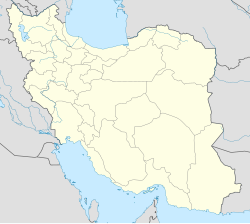
Iranian and US forces engaged in a race to find the second crew member. [30] US surveillance drones failed to find the airman, and he was "status unknown". [31] The airman hiked a 7,000 feet (2,100 m) ridgeline [31] on the Zagros Mountains and hid in a mountain crevice and restricted the use of his emergency beacon signal so that it would not be picked up by Iran. [32] While tracking the airman, the Central Intelligence Agency (CIA) launched a disinformation campaign in Iran claiming that the airman was already rescued. [33] The CIA shared the beacon signal's location with the Pentagon, which had to confirm that the beacon was not an Iranian trap. [32] The airman sent a short radio message, saying “God is good”. [34] The CIA then reportedly used a special technology to locate the airman. [34] The CIA also used the so-called "unconventional assisted recovery" process by contacting civillians willing to assist U.S. military forces. [34] US Navy SEAL Team 6 special forces were airdropped from several aircraft to the airman's area, while airstrikes were used to keep Iranian forces away from that area. [32] The U.S. used an abandoned agricultural airstrip (200 ft by 3900 ft) 14 mi (23 km) north of Shahreza city in southern Isfahan as a temporary forward operating base, [4] while Iran offered a reward of approximately US$ 60,000 for information leading to the airman. [35] [36] [25] [37]
The elite U.S. forces raced not only against IRGC forces, but also local Bakhtiari nomadic tribesmen who are traditionally armed with hunting rifles and familiar to the Zagros Mountains terrain. [38] [39] The Iranian state media released a video showing a surface-to-air missile shooting down an A-10 Warthog between the Qeshm and Hengam islands. [40] The pilot ejected over Kuwait and was recovered. [40] During the operation U.S. aircraft and drones provided fire support. [33] Two helicopters were hit by small-arms fire originating from the tribesmen, but remained operational. [41] [42] [43] Some of the helicopter crew were wounded.
Iran claimed it disrupted the rescue operation and shot down many U.S. aircraft. [33] The U.S. later announced the operation as a success, stating two stuck MC-130 special operations transport planes were deliberately destroyed at the abandoned airstrip, after replacement aircraft arrived. [15] Iran then revised its previous statement, claiming it destroyed one aircraft. [44] [6]
During daylight while closing in on the WSO, U.S. commandos fired weapons to keep Iranian forces away from the rescue site, but did not engage in a firefight. U.S. attack aircraft also dropped bombs on approaching Iranian convoys to keep them away from the area, [14] [44] and engaged in electronic jamming. [2] Iran reported shooting down a drone over Isfahan. [32] [41]
On 5 April, the WSO was successfully rescued alive, [45] but with a sprained ankle. [2] The U.S. and multiple reports stated that no American servicemen were killed during the operation. [46]
According to Israeli officials, Israeli intelligence and tactical support played a role in searching for the missing pilots, while the Israel Defense Forces (IDF) targeted Iranian assets to sabotage and disrupt Iranian attempts to find the WSO. [47]
Reactions
Iran
Iranian officials celebrated the shooting down of the F-15E and later the A-10 during the rescue mission, claiming it as a success. [48] [49] Khatam al-Anbiya spokesman Ebrahim Zolfaghari stated that "the so-called US military rescue operation, planned as a deception and escape mission at an abandoned airport in southern Isfahan under the pretext of recovering the pilot of a downed aircraft, was completely foiled." The Iranian military compared the rescue operation to Operation Eagle Claw—a rescue operation in 1980 in Iran that resulted in the destruction of US aircraft. [50]
On 6 April, Iran's foreign ministry spokesperson Esmail Baghaei stated "The possibility that this was a deception operation to steal enriched uranium should not be ignored at all", referring to the nuclear program of Iran, and arguing the claimed location of the pilot in Kohgiluyeh and Boyer-Ahmad was "a long way" from the locations of attempted US landings. [51] [52] [53] On 1 April US outlets had reported on a developing US plan to use special forces to seize almost 1,000 pounds of enriched uranium from the Isfahan nuclear complex. [54] [55]
Israel
Prime Minister Benjamin Netanyahu hailed the rescue of the missing U.S. airmen, stating that "This rescue operation reinforces the sacred principle: no one is left behind." He further noted that "This is a shared value demonstrated time and time again in the history of both our countries [...] As a nation that repeatedly carried out daring rescue operations, and as someone who was wounded in such a mission and lost a brother in the Entebbe rescue, Israelis and I, we know what a bold decision you took." [56]
United States
President Donald Trump used the operation to claim a great victory, "turning what had been a potential propaganda problem into a cause for celebration". [57] He posted "WE GOT HIM!" on Truth Social after the second crew member was rescued. [58] He then described the operation as the "most daring operation in US history". [59] The White House and Pentagon both praised the bravery and skills of all military personnel involved in the operation. [60]
This page is based on this
Wikipedia article Text is available under the
CC BY-SA 4.0 license; additional terms may apply.
Images, videos and audio are available under their respective licenses.