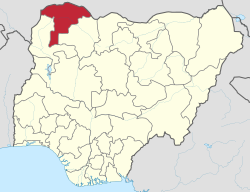
On 25 December 2025, the United States in coordination with the Nigerian government conducted strikes against Islamic State militants in northwest Nigeria.[5][6][7]
The Nigerian government has been combating jihadist groups for several years, including Boko Haram and its Islamic State-linked splinter groups.[4] Jihadist groups in Nigeria's northeast, the center of the insurgency, killed tens of thousands of Nigerians from 2016 to 2025.[8]
According to Nigeria's military, the Islamic State-aligned Lakurawa rebel group became more active on the Nigerian side of the border with Niger following the 2023 Niger coup, which impacted the countries' joint border operations.[1] In 2017, the Lakurawa were formed as an anti-bandit force and were initially welcomed into villages; however, they became increasingly oppressive. They control territories in Sokoto and Kebbi states.[1]
In November 2025, the United States Africa Command drafted plans to strike at militant compounds in northern Nigeria.[9] Later in November, 25 schoolgirls were abducted from a Catholic school in Kebbi state and 303 schoolchildren and 12 teachers were kidnapped at another Catholic school in Niger state.[10][11] US president Donald Trump said that Christians in Nigeria were facing an "existential threat"; locals and experts emphasized that Nigerians of all faiths are targets of violence.[12]
Strikes
Sokoto state in northwest Nigeria was targeted by US airstrikes
Early on 26 December 2025, the US conducted airstrikes which it said were against Islamic State (IS) militants in northwest Nigeria. According to the US, the strikes were approved by and in coordination with the Nigerian government, and killed "multiple" Islamic State militants.[13][14]AFRICOM said that the strikes focused on targets in Sokoto State.[15]
Malagi added that debris from munitions mistakenly hit Jabo and Offa, but caused no civilian casualties.[14] According to Isa Salihu Bashir, the chairman of Tangaza, strikes hit Lakurawa camps, killing many fighters and forcing others to flee.[4] At least four missile warheads failed to explode and fell short of their targets, landing in Offa, Zugurma, and Jabo.[19] In Jabo, Tambuwal, farmland was destroyed.[20][3][21] In Offa, former state official Tajudeen Alabi told the BBC that "about five structures" were destroyed, with some injuries but no deaths.[22]
The New Humanitarian reported that two missiles hit a Lakurawa camp in Tangaza. The first strike killed around 30 fighters, and the second strike killed survivors who had gathered to assess the damage. An estimated 155 Lakurawa were killed in total, including 19 who succumbed to their wounds. Another 200 were missing, and almost half the group's cattle were killed. Lakurawa commander Dando Sibu was reported to have survived the strikes, leaving the area five minutes before the second missile impacted.[5]
US Defense Secretary Pete Hegseth stated that the strikes were related to stopping the killings of Christians in Nigeria.[23] Conversely, the Nigerian government stated that the strikes were not intended to protect any specific religions.[24]
The Nigerian Ministry of Foreign Affairs issued a statement that said "precision hits" had been made and that the country's authorities remained "engaged in structured security cooperation with international partners, including the United States of America, in addressing the persistent threat of terrorism and violent extremism".[25][26] The Nigerian Armed Forces said the strikes were jointly conducted with approval from the government, and came after "credible intelligence and careful operational planning" to minimize collateral damage.[27]
The casualties have been reported as being in a range of 155-200+ fighters killed.[28]
Targets
According to the FDD, the missile strikes targeted camps of the Islamic State's Sahel Province (ISSP) in northwestern Nigeria, the main IS affiliate responsible for operations across the Sahel region and Sokoto State.[29] The FDD added that the attack target was indicative of the inroads that ISSP had made in Nigeria.[30]
A spokesperson for Nigerian president Bola Tinubu told Agence France-Presse that the strikes targeted "ISIS, Lakurawa and bandits", saying that IS supplied and trained Lakurawa and bandits through the Sahel. He noted that the strikes hit an area with a historic Lakurawa and bandit presence, and that US intelligence had detected an influx of IS fighters there from the Sahel.[2]
Analysis
When the strikes were originally proposed in November 2025, Judd Devermont, former US president Joe Biden's national security advisor for African affairs, criticized the Trump administration stating that instability in Nigeria "will not be reversed overnight by an influx of U.S. resources".[31]
Nigeria's Minister of Defence Christopher Musa said that military intervention would only solve 30% of the conflict, with 70% depending on good governance, notably addressing poor state capacity in the north. The Associated Press reported that experts saw the strikes as providing "crucial help" for Nigeria's security forces which are "overstretched" and "outgunned".[1]
Aftermath
On February 3, 2026 an advance team of US soldiers were sent to train and advise the Nigerian military as they continue to fight Islamic terrorist groups operating in their nation. It has been reported that these forces will not take a direct military role, and will be under the Command of the Nigeria military. Later, on 16 February 2026, the United States sent an additional 100 troops, and it is expected that the force will reach it's maximum deployment strength with a further 100 forces by the end of the month. This will bring the total deployment to 200 military units.[32][33][34]
This page is based on this Wikipedia article Text is available under the CC BY-SA 4.0 license; additional terms may apply. Images, videos and audio are available under their respective licenses.

 United States
  United States Navy
  United States Air Force
  Nigerian Armed Forces [3]