| Friedrichshafen N.I | |
|---|---|
 | |
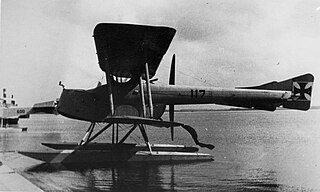
| A profile view of the N.I | |
| Role | Bomber |
| Manufacturer | Friedrichshafen |
| First flight | 1917 |
| Number built | 1 |
The Friedrichshafen N.I was a German prototype night bomber built by Friedrichshafen during World War I.
| Friedrichshafen N.I | |
|---|---|
| | |
| A profile view of the N.I | |
| Role | Bomber |
| Manufacturer | Friedrichshafen |
| First flight | 1917 |
| Number built | 1 |
The Friedrichshafen N.I was a German prototype night bomber built by Friedrichshafen during World War I.
The Friedrichshafen N.I was a two-seat biplane equipped with a 260 hp (190 kW) Mercedes D.IVa engine, double-mainwheel tri-cycle landing gear and large relatively highly swept biplane wings. It flew in 1917, but flight testing revealed a number of deficiencies, the main one of which was the large length of the nose, which made it difficult for the pilot to get a look at landing, especially at night. [1]
Related lists

The AEG N.I was a German biplane night-bomber which saw limited action during World War I. A total of 37 were built. Several were used postwar as airliners.

Friedrichshafen FF.33 was a German single-engined reconnaissance three-bay wing structure biplane, using twin floats, designed by Flugzeugbau Friedrichshafen in 1914 for the Marine-Fliegerabteilung aviation forces of the Kaiserliche Marine.

The Albatros J.II was a German single-engine, single-seat, biplane ground-attack aircraft of World War I.

The Albatros G.II,, was a twin-engined German biplane bomber of World War I.

The Albatros W.5 was a floatplane torpedo bomber used by Germany during World War I. It was a biplane with twin pusher engines.

The Hansa-Brandenburg W.12 was a German biplane fighter floatplane of World War I. Ernst Heinkel's KDW was redesigned, with a rear cockpit, reshaped tailfin, and rudder.

The Friedrichshafen G.I was a prototype heavy bomber aircraft that was built in Germany by Flugzeugbau Friedrichshafen in 1915. It was Karl Gehlen's first design for the company, and although it was not produced in quantity, it provided the foundation for the later, highly successful bombers culminating in the G.III.
The Friedrichshafen FF.34 was a German biplane floatplane of the 1910s produced by Flugzeugbau Friedrichshafen.

The Friedrichshafen FF.64 was a German two-seat biplane floatplane of the 1910s produced by Flugzeugbau Friedrichshafen.
The Friedrichshafen FF.43 was a German single-seat floatplane fighter of the 1910s produced by Flugzeugbau Friedrichshafen.

The Friedrichshafen FF.48 was a German two-seat floatplane fighter of the 1910s produced by Flugzeugbau Friedrichshafen.

The Friedrichshafen FF.53 was a German torpedo-carrying biplane floatplane of the 1910s produced by Flugzeugbau Friedrichshafen.

The Friedrichshafen FF.35 was a German three-seat floatplane torpedo bomber built during World War I by Friedrichshafen Flugzeugbau built for the Imperial German Navy's Naval Air Service. Only one prototype was constructed in 1916 and it saw limited operational use during the war in Courland.

The Friedrichshafen FF.71 was a German biplane floatplane produced by Flugzeugbau Friedrichshafen.

The Albatros W.8 was a German biplane fighter floatplane that saw service during First World War. It patrolled the seas around 1918. The fuselage of the aircraft was made of wood, similar to most aircraft designs of that period. The W.8 had a water-cooled Benz Bz.IIIb eight-cylinder engine fitted with a fixed two-bladed wooden propeller.

The LVG G.I,, was a prototype German bomber aircraft built by LVG during World War I.

The BFW N.I was a prototype night bomber aircraft developed in Germany during the First World War.
The Hansa-Brandenburg W.17 was a German flying boat fighter of the World War I era, designed and built by Hansa-Brandenburg.

The Friedrichshafen FF.63 was a German experimental floatplane produced by Flugzeugbau Friedrichshafen.
The Friedrichshafen FF.67 was a German experimental floatplane produced by Flugzeugbau Friedrichshafen.
