
The Albatros D.V is a fighter aircraft of the German aircraft manufacturer Albatros Flugzeugwerke. It was the final development of the Albatros D.I family and the last Albatros fighter to see operational service with the Luftstreitkräfte during the First World War.

The Pfalz D.III was a fighter aircraft used by the Luftstreitkräfte during the First World War. The D.III was the first major original design from Pfalz Flugzeugwerke. Though generally considered inferior to contemporary Albatros and Fokker fighters, the D.III was widely used by the Jagdstaffeln from late 1917 to mid-1918. It continued to serve as a training aircraft until the end of the war.

The Friedrichshafen G.I was a prototype heavy bomber aircraft that was built in Germany by Flugzeugbau Friedrichshafen in 1915. It was Karl Gehlen's first design for the company, and although it was not produced in quantity, it provided the foundation for the later, highly successful bombers culminating in the G.III.

The Friedrichshafen G.IV and G.V respectively were heavy bombers that were designed and manufactured in Germany during World War I by Flugzeugbau Friedrichshafen. The G.IV saw limited use by the Luftstreitkräfte for tactical and limited strategic bombing operations, while the G.V and a follow-on design, the FF.62 did not fly until after the Armistice.

The Friedrichshafen FF.31 was a two-seat prototype German maritime reconnaissance floatplane built by Flugzeugbau Friedrichshafen during the First World War. Although primarily intended for reconnaissance duties, the aircraft was provided with a machine gun to engage other aircraft. Although it was satisfactory for its intended mission, it lacked the performance necessary for use as a fighter. A pair of aircraft were built in 1915 and it was not accepted for production by the Imperial German Navy's Naval Air Service.

The Friedrichshafen FF.43 was a German single-seat floatplane fighter of the 1910s produced by Flugzeugbau Friedrichshafen.

The Friedrichshafen FF.48 was a German two-seat floatplane fighter of the 1910s produced by Flugzeugbau Friedrichshafen.

The Daimler D.I was a German fighter aircraft of World War I. It was a conventional biplane design with a very small interplane gap - the top wing nearly touched the top of the fuselage. Power was provided by a Daimler D.IIIb water-cooled V-8 engine.

The Friedrichshafen FF.35 was a German three-seat floatplane torpedo bomber built during World War I by Friedrichshafen Flugzeugbau built for the Imperial German Navy's Naval Air Service. Only one prototype was constructed in 1916 and it saw limited operational use during the war in Courland.
The Schütte-Lanz D.III was a German fighter prototype during World War I. It participated in the first Idflieg D competition at Adlershof, Germany in January and February 1918. It was a conventional single-bay staggered biplane with N-type interplane struts. Constructed of wood with fabric skinning, the D.III gave an unspectacular performance: production was never continued.
The Schütte-Lanz D.IV was a German fighter prototype during World War I. It was developed in parallel with the Schütte-Lanz D.III, however the two fighters had nothing in common. The D.IV was made of wood and was a single-bay staggered biplane with N-type interplane struts and ailerons on both upper and lower mainplanes. It first flew in late 1917 and was found to be inferior to the Schütte-Lanz D.III, and as a result production was not started.

The LFG Roland D.I was a fighter aircraft produced in Germany during World War I. It was a single-seat aircraft based originally on the Roland C.II two-seat reconnaissance type. It shared its predecessor's unusual design feature of having a deep fuselage that completely filled the interplane gap, but in comparison, the fuselage was much sleeker. While the C.II's appearance had earned the Walfisch ("Whale"), the D.I became known as the Haifisch ("Shark"). The I-struts that had been used to brace the C.II's wing were replaced by more conventional struts. Other changes to the wing included the removal of stagger from the design and the introduction of slight sweepback.
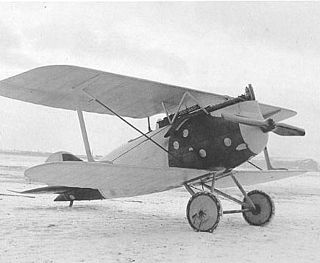
The Rumpler D.I was a fighter-reconnaissance aircraft produced in Germany at the end of World War I. It was a conventional single-bay biplane with wings of unequal span braced by I-struts. It featured an open cockpit and a fixed, tailskid undercarriage. The upper wing was fitted with aerodynamically balanced ailerons and fuselage had an oval cross-section.

The Aviatik D.II was a prototype German single-seat biplane fighter aircraft built by Aviatik during World War I. Only a single aircraft was built, but no production order followed. It later had its conventional wings replaced by bird-shaped wings and has been referred to as the Geest Fighter in this guise. Further development was discontinued.

The Aviatik D.III was a German prototype single-seater fighter plane from the First World War, designed by Aviatik. It became the basis for the Aviatik D.IV and Aviatik D.V. In November 1917, the plane was first flown, using a 195 hp Benz Bz IIIbo gearless engine. It was of similar design to the Aviatik D.II, and was armed with two LMG 08/15 machine guns. After several tests at Adlershof from February 9–12, 1918, the plane underwent modifications, as requested by the Idflieg. In April, a second prototype, powered by a Benz Bz IIIbm, although several D.III powered by the original IIIbo engine were already under production; however, none of them were ever completed.

The Kondor D 7 was a prototype German single seat biplane fighter built over the winter of 1917-18. It was not a success and its development was soon abandoned.
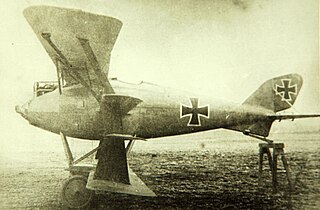
The Friedrichshafen FF.54 was a German experimental quadruplane that was developed by Flugzeugbau Friedrichshafen during the First World War.
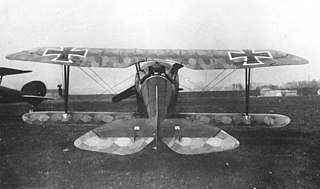
The Kondor D 1, given the unofficial name Kondorlaus, was a German single seat, biplane fighter aircraft designed and built close to the end of WWI.

The Kondor D 2 was a German single seat, biplane fighter aircraft designed and built close to the end of World War I.
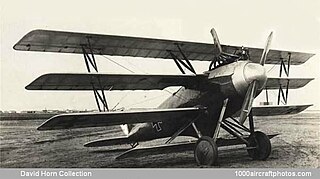
The Naglo D.I was a German single seat quadruplane fighter, flown late in World War I. It took part in one of the fighter competitions but did not reach production.

