英文互译镜像站

Friedrichshafen FF.41

Last updated
FF.41a
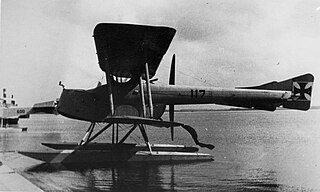
Friedrichshafen FF.41 aircraft.jpg
General information
TypeReconnaissance
Manufacturer Flugzeugbau Friedrichshafen GmbH
Primary users Kaiserliche Marine
Number built9 (1 x FF.41a + 8 x FF.41at)
History
Introduction date1917
First flight1917

The Friedrichshafen FF.41a was a large, German-built, three-seat, twin-engine floatplane reconnaissance aircraft designed by Flugzeugbau Friedrichshafen in 1917.

Contents

The aircraft was mainly used as a reconnaissance aircraft, but also as a bomber and as a mine-laying aircraft. A torpedo-carrying version, the FF.41at, was also developed. It had a modified fuselage and a single vertical fin (in comparison to the basic model's three). Only five FF.41at aircraft were manufactured. According to another information, eight FF.41 were built, and six of them were stationed in the Baltic territories. Aircraft numbered 996, 1000 and 1209 were stationed In Vindava (Ventspils), and aircraft numbered 997, 998 and 999 in Angersee.

Use in Finland

A side view of a FF.41AT torpedo bomber Friedrichshafen FF.41AT Q66895.jpg
A side view of a FF.41AT torpedo bomber

The Finnish Air Force purchased one FF.41at aircraft from the Germans in Estonia on 26 November 1918, at the end of World War I. It was flown to Sortavala where it was repaired. In 1922, the torpedo-carrying fuselage was changed, and the capability to carry torpedoes was removed. This aircraft was in use between 1918–23.

Use in Estonia

The Estonians found an unairworthy Friedrichshafen FF.41a in the Tallinn hangars. The remains of the wrecked German aeroplane were used to produce the first aeroplane of the independent Estonian Air Force. On 13 March 1919, the Naval Squad was established, and the barrack finished in 1921. [1] According to the other information the Estonians were left three aircraft. One of them was purchased by the Finns, and the other two in bad conditions were re-built as a new functioning one, which stayed in Estonian service.[ citation needed ]

Variants

FF.41a
A twin engined floatplane torpedo bomber, developed from the FF.35; one built.
FF.41at
Further developed torpedo bomber floatplane; eight built.

Operators

Flag of Estonia.svg  Estonia
Estonian Air Force
Flag of Finland.svg  Finland
Finnish Air Force
Flag of the German Empire.svg  German Empire
German Imperial Navy

Specifications (FF.41at)

Data from Flugzeugbau Friedrichshafen GmbH, [2] Thulinista Hornetiin – 75 vuotta Suomen ilmavoimien lentokoneita [3]

General characteristics

Performance

560 m (1,840 ft) in 9 minutes
800 m (2,600 ft) in 16 to 18 minutes
1,000 m (3,300 ft) in 20-25 minutes

Armament

See also

Related lists

Related Research Articles

<span class="mw-page-title-main">Fokker D.X</span>

Fokker D.X was a Dutch fighter aircraft designed after World War I.

<span class="mw-page-title-main">Friedrichshafen FF.33</span>

Friedrichshafen FF.33 was a German single-engined reconnaissance three-bay wing structure biplane, using twin floats, designed by Flugzeugbau Friedrichshafen in 1914 for the Marine-Fliegerabteilung aviation forces of the Kaiserliche Marine.

<span class="mw-page-title-main">Friedrichshafen FF.49</span>

Friedrichshafen FF.49 was a German, two-seat, single-engine float-plane designed by Flugzeugbau Friedrichshafen in 1917.

Grigorovich M-16 was a successful Russian World War I-era biplane flying boat of the Farman type, developed from the M-9 by Grigorovich. Somewhat larger than the M-9, the M-16 was a version especially intended for winter operations, with better aerodynamic qualities.

<span class="mw-page-title-main">Friedrichshafen FF.31</span> German maritime reconnaissance floatplane

The Friedrichshafen FF.31 was a two-seat prototype German maritime reconnaissance floatplane built by Flugzeugbau Friedrichshafen during the First World War. Although primarily intended for reconnaissance duties, the aircraft was provided with a machine gun to engage other aircraft. Although it was satisfactory for its intended mission, it lacked the performance necessary for use as a fighter. A pair of aircraft were built in 1915 and it was not accepted for production by the Imperial German Navy's Naval Air Service.
<span class="mw-page-title-main">Friedrichshafen FF.34</span>

The Friedrichshafen FF.34 was a German biplane floatplane of the 1910s produced by Flugzeugbau Friedrichshafen.

<span class="mw-page-title-main">Friedrichshafen FF.40</span>

The Friedrichshafen FF.40 was a German three-seat floatplane of the 1910s produced by Flugzeugbau Friedrichshafen.

<span class="mw-page-title-main">Friedrichshafen FF.64</span>

The Friedrichshafen FF.64 was a German two-seat biplane floatplane of the 1910s produced by Flugzeugbau Friedrichshafen.

The Friedrichshafen FF.43 was a German single-seat floatplane fighter of the 1910s produced by Flugzeugbau Friedrichshafen.

<span class="mw-page-title-main">Friedrichshafen FF.48</span>

The Friedrichshafen FF.48 was a German two-seat floatplane fighter of the 1910s produced by Flugzeugbau Friedrichshafen.

<span class="mw-page-title-main">Friedrichshafen FF.53</span>

The Friedrichshafen FF.53 was a German torpedo-carrying biplane floatplane of the 1910s produced by Flugzeugbau Friedrichshafen.

<span class="mw-page-title-main">Friedrichshafen FF.60</span>

The Friedrichshafen FF.60 was a German experimental floatplane produced by Flugzeugbau Friedrichshafen.

<span class="mw-page-title-main">Friedrichshafen FF.35</span> Type of aircraft

The Friedrichshafen FF.35 was a German three-seat floatplane torpedo bomber built during World War I by Friedrichshafen Flugzeugbau built for the Imperial German Navy's Naval Air Service. Only one prototype was constructed in 1916 and it saw limited operational use during the war in Courland.

The Friedrichshafen FF.27 was a reconnaissance floatplane built in Germany during World War I.

<span class="mw-page-title-main">Friedrichshafen FF.71</span> German civilian biplane

The Friedrichshafen FF.71 was a German biplane floatplane produced by Flugzeugbau Friedrichshafen.

<span class="mw-page-title-main">Friedrichshafen FF.1</span> Seaplane of the 1910s built in Germany

The Friedrichshafen FF.1 was a German experimental floatplane built in 1912. It was the first aircraft designed and built by the newly established Flugzeugbau Friedrichshafen. Only one prototype was constructed and it set a German national record for endurance in 1913 before crashing in early 1914.

The Friedrichshafen FF.2 was a floatplane built in Germany in 1913. It was derived from a design by the Swiss pilot and designer René Grandjean. Only one aircraft was built before the design was reworked into the Friedrichshafen FF.4 the following year.

<span class="mw-page-title-main">Friedrichshafen FF.17</span> Type of aircraft

The Friedrichshafen FF.17 was an experimental floatplane built in Germany in 1914. Originally designed and flown with a single main float and two outriggers as the FF.17, it was later modified as the FF.17b with two floats.

<span class="mw-page-title-main">Friedrichshafen FF.63</span> Type of aircraft

The Friedrichshafen FF.63 was a German experimental floatplane produced by Flugzeugbau Friedrichshafen.

The Friedrichshafen FF.67 was a German experimental floatplane produced by Flugzeugbau Friedrichshafen.

References

  1. "Meremuuseum". www.meremuuseum.ee.
  2. Kober, Theodor von; Borzutzki, Siegfried (1993). Flugzeugbau Friedrichshafen GmbH (in German) (1. Aufl ed.). Burbach. pp.  132-135. ISBN   978-3927513600.
  3. Timo Heinonen (1992). Thulinista Hornetiin – 75 vuotta Suomen ilmavoimien lentokoneita (in Finnish). Tikkakoski: Keski-Suomen ilmailumuseo. ISBN   951-95688-2-4.

Bibliography

自动镜像站群 时间因子转换镜像 网站复制工具 站点核心词加权 递归网站下载