However, secularism is also one of the four fundamental principles of the Constitution of Bangladesh since 2011,[10] and the country is mostly governed by secular laws dating from the British colonization.[11]The Constitution guarantees freedom of religion and declares that "the State shall ensure equal status and equal right in the practice of the Hindu, Buddhist, Christian and other faiths and religions".[12] In 2022, Freedom House rated Bangladesh's religious freedom as 2 out of 4.[13]
East Bengal (present-day-Bangladesh) had a population of 39.12 million by the year (1941), of which 27.5 million people were followers of Islamic religion representing about (70.3%) of the region's population, while 10.95 million belongs to the Hindu faith constituting (28%) of the region.[15] Smaller number of 6.65 lakhs people follows Buddhism, Animism and Christianity together presenting around (1.7%) of the region.
Demographic landscape of Bangladesh after Independence from Pakistan (1971)
Religions in Bangladesh (1971 after independence)[14]
After 1971, East Pakistan became sovereign nation of People republic of Bangladesh. During that time the population of Bangladesh was found to be 68.7 million, of which majority of 58.7 million people professed to Islamic Faith comprising 85.4% of the country's population, Hindus are second largest community with a population of 9.28 million comprising 13.5% of the country's population, while 1.1% practices other religions like Buddhism and Christianity.[16]
Before the Partition of Bengal, it was found that the Muslim population of West Bengal stood at 26% and the Hindu population of East Bengal stood at 28% respectively. Soon after partition, Muslim population in West Bengal have reduced from 26% in 1941 to 19% in 1951, while Hindu population in East Bengal have reduced from 28% in 1941 to 22% in 1951.[17]
During 1971 Bangladesh liberation war
It is estimated that during the time of Bangladesh liberation war, an estimated population of around 10 million people most being 80% Hindus fled from East Pakistan to neighbouring India as refugees following the torture of Pakistani army, and after independence nearly an estimated population of 1.5 - 2 million Hindus stayed back in India and never went back.[18]
The Muslim population in Bangladesh was over 150.36 million according to the 2022 census which makes Muslims, 91.04% of the population in the country.[2] Estimation shows that over 1 million Rohingya Muslim refugees live in Bangladesh who have come here during the period of (2016–17) massacre in Myanmar.[21] On 28 September 2018, at the 73rd United Nations General Assembly, Bangladeshi Prime Minister Sheikh Hasina said there are 1.1-1.3 million Rohingya refugees in Bangladesh.[22][23]
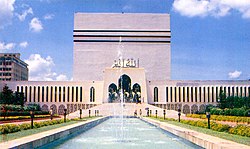
The Constitution of Bangladesh declares Islam as the state religion. Bangladesh is the fourth-largest Muslim-populated country. Muslims are the predominant community of the country and they form the majority of the population in all eight divisions of Bangladesh. The overwhelming majority of Bangladeshi Muslims are Bengali Muslims at 98 percent, but a small segment about 2 percent of them are Bihari Muslims and Rohingyas.[citation needed] Almost all Muslims in Bangladesh are Sunnis, but there is a small Shia community. There are 2 million Shias in Bangladesh.[24] Although these Shias are few in number, in Dhaka on Ashura they bring out mourning processions commemorating the death of the Islamic prophet Muhammad's grandson Husain ibn Ali.[25][26] Muslims celebrate Eid ul-Fitr, Eid ul-Adha, Muharram, Mawlid, Shab-e-Barat and Chand Raat all across the country with much fanfare and grandeur. The annual Bishwa Ijtema is the largest and most notable congregation of Muslims in Bangladesh. Bangladesh also has a minority of Ahmadiyya Muslims. As of 2004, there are approximately 100,000 Ahmadis in the country.[27][28]
The Muslim community in the Bengal region i.e., Bangladesh and West Bengal (India), developed independently of the dominant Islamic rules in India. Features of Bangladeshi Hinduism, which similar to other parts of South Asia (Indian subcontinent), influenced both the practices and the social structure of the Bangladeshi Muslim community. In spite of the general personal commitment to Islam by the Muslims of Bangladesh, observance of Islamic rituals and tenets varies according to social position, locale, and personal considerations. In rural regions, some beliefs and practices tend to incorporate elements that differ from and often conflict with orthodox Islam.
Map of percentage of Bangladeshi Hindus by Upazila or Sub-district (2011)Dhakeshwari Temple, the national temple and one of the largest temples of Bangladesh.Durga Puja celebrations in Dhakeshwari Temple, DhakaShiva Temple in Puthia, RajshahiRatha Yatra, one of the Hindu festivals in Bangladesh.
Hinduism is the second largest religious affiliation in Bangladesh, with around 13.1 million people identifying themselves as Hindus out of 165.16 million people and making up about 7.95 per cent of the total population as second largest minority according to the recent 2022 census.[29][30] In terms of population, Bangladesh is the third largest Hindu populated country of the world, just after India and Nepal.[31]
Bangladeshi Hindus are predominantly Bengali Hindus, but a distinct Hindu population also exists among the indigenous tribes like Garo, Khasi, Jaintia, Santhal, Bishnupriya Manipuri, Tripuri, Munda, Oraon, Dhanuk etc. Hindus are evenly distributed throughout all regions of Bangladesh, with significant concentrations in northern, southwestern and northeastern parts of the country. In nature, Bangladeshi Hinduism closely resembles the rituals and customs of Hinduism practised in the neighbouring Indian state of West Bengal with which Bangladesh (at one time known as East Bengal) was united until the partition of India in 1947. Hindu festivals of Durga Puja, Rath Yatra, Dol Yatra (Holi), Janmashtami, Deepabali, Sankranti, Kali Puja, Lakshmi Puja, Saraswati Puja etc. witness jubilant celebrations across various cities, towns and villages of Bangladesh.
Map of percentage of Bangladeshi Buddhists by District.Buddha Dhatu Jadi, one of the largest Theravada Buddhist temples in Bandarban, has the second-largest Buddha statue in Bangladesh.Somapura Mahavihara is a World Heritage Site at Naogaon.A Buddhist temple in Moheshkhali, Cox's Bazar
About 1 million people in Bangladesh adhere to the Theravada school of Buddhism. Buddhists form about 0.61 per cent of the population of Bangladesh as per 2022 census. Buddhism is the third largest religion in Bangladesh.[29]
In antiquity, the region of present-day Bangladesh was a center of Buddhism in Asia. Buddhist civilisation, including philosophies and architecture, traveled to Tibet, Southeast Asia and Indonesia from Bengal. The Buddhist architecture of Cambodia, Indonesia and Thailand, including the Angkor Wat Temple and the Borobudur vihara, are believed to have been inspired by the ancient monasteries of Bangladesh such as the Somapura Mahavihara.
Most of the followers of Buddhism in Bangladesh live in the Chittagong division. Here, Buddhism is practised by the Bengali-speaking Baruas, who are almost exclusively Buddhist and are concentrated heavily in the Chittagong area as well as few of the Barua Buddhists live in other parts of Bangladesh, such as Comilla, Mymensingh, Rangpur, Sylhet districts. Most of the followers of Buddhism in Bangladesh live in southeastern region, especially in the Chittagong Hill Tracts, Chittagong and Comilla district. Most of the Buddhists of Chittagong Hill Tracts belong to the Chakma, Marma, Mru, Khumi, Chak, Murang, Tanchangya and Khiang tribes, who since time immemorial have practised Buddhism. Other tribal communities who practise animism, have come under some Buddhist influence. The beliefs and rituals of the Buddhist communities in this region are amalgamations of Buddhism and ancient animistic faiths. Buddha Purnima is the most widely observed festival among both Bengali Buddhists and Buddhist tribes.
Map of Christians, per Upazila in BangladeshHoly Cross Church, Dhaka, BangladeshHoly Rosary's Church (Est.1677) in DhakaA Seventh-day Adventist Church in Dhobaura, Mymensingh, Bangladesh
Christianity is the fourth largest religion in Bangladesh. Christianity arrived in what is now Bangladesh during the late sixteenth to early seventeenth centuries AD, through the Portuguese traders and missionaries. Christians numbering around half a million account for approximately 0.3 per cent of the total population[29] and they are mostly an urban community. Roman Catholicism is predominant among the Bengali Christians, while the remaining are mostly Baptist and others. Few followers of Christianity are also present among certain indigenous tribal communities such as Garo, Santal, Oraon, Khasi, Lushei, Bawm, etc.
Bangladesh has a small community of the Baháʼí Faith. Baháʼís have spiritual centres in Dhaka, Chittagong, Khulna, Rajshahi, Sylhet, Barisal, Rangpur, Mymensingh, Jessore, Rangamati and other places. There is a National Bahá'í Centre in Dhaka.
The origins of the Baháʼí Faith in Bangladesh begin previous to its independence, when it was part of the British Raj. The roots of the Baháʼí Faith in the region go back to the first days of the Bábí religion in 1844.[32]
According to The Business Standard the population is about 300,000.[33]
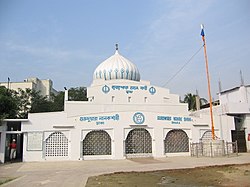
Gurdwara Nanak Shahi at Dhaka, one of the oldest and largest Gurudwara of Bangladesh
The presence of this religion goes back to the visitation of Guru Nanak in 1506–07 with some of his followers to spread Sikhism in the region of the present-day Bangladesh. When some Bengali people accepted this faith, a Sikh community was born.[34] This community became bigger when almost 10,000 Sikhs came from India during the Bangladesh Liberation War. This community has made great progress in the country. Today there are almost 10 gurdwaras in Bangladesh. Among them only 7 are well-known, especially the Gurdwara Nanak Shahi beside the University of Dhaka in Dhaka, which was built in 1830, the oldest gurdwara in Bangladesh. There are currently 23,000 Sikhs in Bangladesh.[35][36]
140-year-old Jewish property in Chittagong, Bangladesh
Since the 18th century there have been Jews in what today is Bangladesh, but their number was always very small, often only some few individuals. The Jewish population in East Bengal was only about 135 Jews at the time of the Partition of British India in 1947.[37]
By the late 1960s, much of the Jewish community had left for Calcutta.[38] According to historian Ziauddin Tariq Ali, a trustee of the Liberation War Museum, "There were two Jewish families in Bangladesh [after independence], but both migrated to India — one in 1973 and the other in 1975."[39] In 2018 there were 4 Jews in Dhaka.[40] Some sources also claim that there are 175 Jews in Bangladesh, and 3,500 with Bangladeshi ancestry.[41] Bangladesh also has a small community of the Jewish Bnei Menashe Kuki-Chin-Mizo community, they mostly live in Bandarban district.[42]
Clay pots with snake-like designs have been found in Bangladesh, which bear evidence of the worship of the Panchanag or Saptanag of Jainism
Jainism likely reached the Bengal region, including what is now Bangladesh, by the 5th century BCE. The religion thrived alongside Buddhism and Hinduism in ancient Bengal, during the Pala dynasties, during 8th to 12th centuries and Sena dynasty from 11th to 12th centuries, Jains enjoyed patronage, leading to the establishment of temples and communities.[43][44]
In the 19th and early 20th centuries, Jains migrated to urban areas during British colonial rule. After the Partition of India in 1947, many Jains migrated to India due to communal tensions and demographic changes, significantly reducing their population in Bangladesh. There are approximately 1,000 Jains living in Bangladesh now.[citation needed]
Other religions
Animism and folk religions
A place of worship of traditional Meitei deities called Umang Lai of Sanamahism in Moulvibazar, Bangladesh.Sarnaist place of worship used by the Santal people in Dinajpur, Bangladesh.
Parsi Marriage and Divorce Act from 1936 (Bangladesh)
Bangladesh has a small community of Zoroastrians (Parsis).[65][66] The existence of a legally recognized Zoroastrian community in Bangladesh is evidenced by the Parsi Marriage and Divorce Act, 1936, which provided a legal framework for the marriage and divorce of members of the Parsi community in the region.[67]
Confucianism exists mainly as a cultural and philosophical influence. It is promoted through educational and community programmes within Chinese diaspora circles, focusing on moral and social teachings rather than formal religious practice.[73]
Shintoism
Shintoism is limited to Japanese expatriates and embassy cultural activities. Rites and seasonal observances occur privately or in official events, with no significant local following.[74]
A survey, commissioned by WIN-Gallup International, conducted from 5 November 2014, to 25 November 2014, found that fewer than one per cent of Bangladeshi's said they were "convinced Atheists".[77][78]
In Bangladesh several people especially bloggers, secularists, liberals, non-religious, Non-Muslims have been brutally killed by Islamic militants[79][80][81][82][83] for mocking and questioning Islam.[84] Jihadist Islamic militants in the nation are seen as a key challenge by the Bangladeshi authorities. The Islamist ideologies was imported into Bangladesh in the early 1990s by the jihadist returnees of the Soviet–Afghan War, who wanted to turn Bangladesh into a full-fledged Islamic state ruled by the Sharia (Islamic) law.[85][86][87][88]
Secularism in Bangladesh is known as "neutrality of religion" (Bengali: ধর্মনিরপেক্ষতা) under Bangladeshi law.[89] In the Constitution of Bangladesh, secularism is mentioned in the preamble as one of the fundamental principles of Bangladeshi law. Article 8 enshrines secularism as one of the fundamental principles of state policy. Article 12 elaborates further on secularism and freedom of religion.[90]
In 1977, after the assassination of Sheikh Mujibur Rahman (in 1975), secularism was removed from the constitution by a Martial Law directive during the military dictatorship of Ziaur Rahman.[91] In 1988, the Parliament of Bangladesh declared Islam as the state religion during the presidency of Hussain Muhammad Ershad.[92] After the restoration of parliamentary democracy in 1990, the Bangladesh Nationalist Party (BNP) and Awami League governments retained Islam as the state religion. In 2010, the Bangladesh Supreme Court ruled that the removal of secularism in 1977 was illegal because it was done by an unconstitutional martial law regime. The court reinstated secularism in the constitution. The principle of secularity now co-exists with the state religion.[93][94]
Secularism is a recurring topic in Bangladeshi politics. For example, in 2019, a demand by the Hefazat-e-Islam Bangladesh to curtail women's education was dismissed by the Deputy Minister of Education Mohibul Hasan Chowdhury as contrary to the fundamental principles of state policy.[95] The separation of religion and state prevails across large parts of Bangladeshi law. However, family law is based on religious law. A civil marriage is allowed under the Special Marriages Act 1872 only if one renounces faith in either Islam, Hinduism, Buddhism, or Christianity.[96]
Although Bangladesh initially opted for a secular nationalist ideology as embodied in its Constitution, the principle of secularism was subsequently replaced by a commitment to the Islamic way of life through a series of constitutional amendments and government proclamations between 1977 and 1988. During the eighties, the state was designated exclusively Islamic. In 2010, secularism was restored, but Islam remains the nominal state religion per Article 2 (A).[97][12][98]
Family laws concerning marriage, divorce, and adoption differ depending on the religion of the person involved. There are no legal restrictions on marriage between members of different faiths.[citation needed] Bangladesh is one of the few Muslim-majority countries where proselytizing is legal, under article 41 of the Constitution, subject to law, public order and morality.[99]
↑Baxter, Craig; Malik, Yogendra K.; Kennedy, Charles H.; Oberst, Robert C. (1987). Government and Politics in South Asia (5thed.). Boulder, CO: Westview Press. p.255. ISBN0-8133-0184-X.
↑Rabbani, Golam (1997). Dhaka, from Mughal Outpost to Metropolis. Dhaka: University Press Ltd. p.168. ISBN984-05-1374-5.
↑"The Baháʼí Faith -Brief History". Official Website of the National Spiritual Assembly of India. National Spiritual Assembly of the Baháʼís of India. 2003. Archived from the original on 14 April 2009. Retrieved 4 April 2009.
↑[But despite this history, today, the Jewish population of Bangladesh is virtually non-existent. According to local sources, there are only 4 Jews living in Dhaka and they keep their identity private.What happened to the Jews of Bangladesh? - Foreign Policy ...foreignpolicyblogs.com/2018/04/30/what-happened-to-th]
↑Schulte-Droesch, Lea (2018). Making place through ritual: land, environment and region among the Santal of Central India. De Gruyter. p.187. ISBN978-3-11-053973-8. OCLC1054397811.
↑"The Parsi Marriage and Divorce Act, 1936". Laws of Bangladesh. Ministry of Law, Justice and Parliamentary Affairs, Government of the People's Republic of Bangladesh. Retrieved 29 January 2026.
↑Sohel, Sahiduzzaman (20 November 2010). "Terrorism in Bangladesh". Academia. Archived from the original on 21 December 2014. Retrieved 19 February 2015.
Rosser, Yvette Claire. (2004) Indoctrinating Minds: Politics of Education in Bangladesh, New Delhi: Rupa & Co. ISBN8129104318.
Mukherji, S. (2000). Subjects, citizens, and refugees: Tragedy in the Chittagong Hill Tracts, 1947-1998. New Delhi: Indian Centre for the Study of Forced Migration.
Sarkar, Bidyut (1993). Bangladesh 1992: This is our home: Sample Document of the Plight of our Hindu, Buddhist, Christian and Tribal Minorities in our Islamized Homeland: Pogroms 1987–1992. Bangladesh Minority Hindu, Buddhist, Christian, (and Tribal) Unity Council of North America.
This page is based on this Wikipedia article Text is available under the CC BY-SA 4.0 license; additional terms may apply. Images, videos and audio are available under their respective licenses.