Mussolini took Italy to war when it was unprepared for a major conflict, so the country's armed forces were sent into battle with insufficient resources, many untrained personnel and poor quality equipment. Italy consequently suffered early setbacks, such as in North Africa and Greece, that coloured its relationship with Nazi Germany, and buoyed the confidence of the Allies. Due to Mussolini's ambitious war agenda, Italy's over-stretched resources were spread over several fronts, dissipating its military strength.
In early 1941, it required German intervention to help Italy reverse setbacks and resume the offensive in the Balkans and North Africa. Between autumn 1942 and spring 1943, the Axis powers suffered a series of heavy battlefield defeats in North Africa and the Soviet Union (where Italy had committed a force to the German-dominated invasion). The Allied invasion of Sicily in July 1943 brought the fighting onto Italian soil, leading to Mussolini being deposed. In September 1943, Italy agreed the armistice of Cassibile with the Allies, effectively quitting the Axis, just as British and American armies invaded the Italian mainland.
The Allied Italian campaign progressed slowly, in part because Allied strategic planning gave the invasion of France greater priority for resources. The mountainous terrain in Italy aided the defenders. Allied victory in Italy came with the 1945 spring offensive prompting the Axis surrender at Caserta on 29 April 1945, which came into effect on 2 May.
In 1922, Italy's liberal democracy gave way to the authoritarian dictatorship of Benito Mussolini. Although Italy was one of the victor nations in World War I, during the inter-war period Mussolini's National Fascist Party felt a sense of grievance towards Britain and France on the issue of territorial gains from the conflict.[1] Also, the Fascists were irredentists and laid claim to parts of France, Switzerland and Yugoslavia, as well as British-held Malta.[2] This led Rome to gravitate towards those countries who felt aggrieved with the Treaty of Versailles and sought a new world order, such as Germany and Japan.[3]
Italian soldiers advancing during the invasion of Ethiopia in 1935.
The Fascist regime hoped to achieve political "hegemony in the Mediterranean–Danubian–Balkan region". More grandiosely, Mussolini envisioned the conquest "of an empire stretching from the Strait of Gibraltar to the Strait of Hormuz", with the Roman Empire cited as a model.[4]
Mussolini wanted to expand in Africa, and in 1935, Italy invaded Ethiopia, a soft target, given its army was mostly irregular troops and had few modern weapons. Time was taken to build up overwhelming invasion forces, with the necessary logistical support - in contrast to Italy's unprepared entry into World War Two in June 1940.[5] The trump card of large quantities of modern arms won the day for Italy.[6]
During the Spanish Civil War (1936-1939) Mussolini sent considerable aid, including air (the Aviazione Legionaria) and ground forces (the Corpo Truppe Volontarie or CTV) to support Franco's Nationalists, viewing the conflict as an opportunity to install a dictatorship that might become an Italian client state.[7] Over the course of the war, the CTV evolved into an effective addition to Franco's forces, and contributed to the development of 'War of Rapid Decision', an Italian doctrine similar to Germany's Blitzkrieg. However, battlefield successes against Spanish Republican forces, who were of mixed quality, caused Rome to overestimate the strength and abilities of the Italian military and its weapons, which delayed modernisation.[8] While the war had highlighted the shortcomings of Italian tanks and showed better co-ordination was needed between infantry and armour, these issues had not been adequately addressed by the time Italy entered World War II.[9]
Italy and Germany agreed a treaty of mutual interest in October 1936. The agreement was the result of growing Italian dependence upon German coal and a sense of common ground in foreign policy and outlook.[10][11] On Mussolini’s drift towards Hitler, Goeshel wrote: “The Duce believed that he had found the most appropriate ally in Nazi Germany, with whom Italy had a common destiny, namely war with France and Britain that would bring Italy spazio vitale (living space)“.[12]
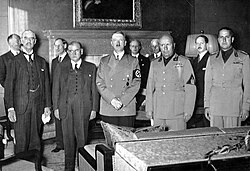
During the negotiation of the Munich Agreement in September 1938, Mussolini backed Hitler, showing Fascist Italy was siding with the Third Reich in diplomacy. Munich marked a diplomatic victory for the authoritarian powers that wanted to tear up the Treaty of Versailles, and this emboldened the Duce to demand in October concessions from France in the Mediterranean and Africa, which Paris rejected.[13]
Italian forces in Albania.
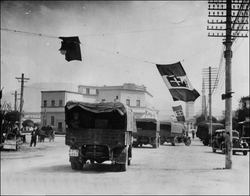
On 7 April 1939, weeks after Hitler broke the Munich Agreement and occupied Bohemia and Moravia, Italian forces invaded Albania. According to Goeschel, Albania "was above all a clear demonstration of the aggression of Fascism and its core belief that war was necessary to strengthen the Italian nation".[14]
On 22 May 1939, Italy and Germany signed the Pact of Steel joining both countries in a military alliance designed for a "joint war against France and Britain", although the Italians were under the impression such a war would not take place for several years.[15][16]
Military
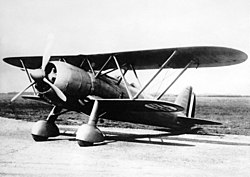
Fiat CR.42 Falco early war Italian fighter.
Mussolini's military was depleted and weak at the beginning of the war compared to other great powers. The Regia Aeronautica (Italian Air Force) at the outbreak of the war had 3,269 aircraft, but 55% were considered to be combat ineffective. Of the 542 fully operational fighters in June 1940, 70% were obsolescent bi-planes.[17] The Fiat CR.42 Falco, a bi-plane fighter, according to Holmes, was Italy’s "staple fighter in both North and East Africa, Greece and over Malta in 1940-41". While a match for the British biplane, the Gloster Gladiator, it was outclassed when fighting modern monoplanes, like the Hawker Hurricane.[18] The Italian Royal Navy (Regia Marina) had several modern battleships and heavy cruisers, but no aircraft carriers.[19]
The Italian Royal Army (Regio Esercito) suffered shortages of much of the equipment that had become commonplace in other armies. Some infantry divisions were unmotorised, others were classed as 'auto transportable', which meant their supply and artillery support were motorised, but infantry had to request lorries from their Corps HQ, and if none were available they had to march on foot.[20] Radios were few in number. While some Italian weapons were high-quality, the bulk of the army's equipment was obsolescent and poor.[21] Most of the artillery's guns dated from World War I. Because it had been assumed Italy would mostly fight in mountainous regions, like the Alps, many tanks were small in order to traverse narrow mountain bridges.[22] The army had been an enthusiastic user of tankettes in the interwar era. By 1940, tankettes were obsolete, but the Italians had 1,320 still in service; and 638 were in use at the time of the September 1943 armistice.[23]
Across the services, training was neglected and many personnel had to learn their skills while in the frontline.[24]
The leadership structure was also a problem. Comando Supremo (the High Command) had a small staff, which limited it to briefing the three service commands of Mussolini's intentions, who then separately developed and executed plans. Consequently, the three military services tended to work independently, with little inter-service cooperation.[25][26]
In December 1939, the Under-Secretary for War Production, Carlo Favagrossa, submitted estimates to Mussolini that suggested the armed forces might not be fully equipped and ready for a major war until 1945.[27] Compared to the other great powers, Italy had a less industrialised and more agrarian economy, plus relatively high levels of illiteracy and poverty.[28] Italy and Great Britain had similar sized populations in 1940 - 43.8 million for Italy, 47.5 million for Britain. However, in that year British industry manufactured 15,000 aircraft, 1,400 armoured fighting vehicles (AFVs) and 13 million tonnes of steel; compared to 2,100 aircraft, 250 AFVs and 2.1 million tonnes of steel for Italy. Many essential commodities had to be imported, due to little or no domestic supply, especially coal and oil, leaving Italy heavily reliant on Germany for the former and Romania for the latter. Around 27% Italy's merchant ships were in Allied ports at the outbreak of hostilities, and were immediately impounded.[29]
In September 1939, Britain declared as contraband coal from Germany which was shipped out of Rotterdam to Italy. The Germans promised to keep up shipments by train, over the Alps, and Britain offered to supply all of Italy's needs in exchange for Italian armaments. The Italians could not agree to the latter terms without shattering their alliance with Germany.[30] On 1 March, the British announced that they would block all coal exports from Rotterdam to Italy.[30][31] Germany supplied Italy with about one million tons of coal a month beginning in the spring of 1940,[32] which increased Italy's dependence upon the Third Reich, and in turn strengthened Hitler's control over Mussolini.[33]
Outbreak of the Second World War
A flight of SM.79 Sparviero medium bombers, which were widely used by Italy in World War II.
Nazi Germany's invasion of Poland on 1 September 1939, marked the beginning of World War II. However, Italy initially declared itself a non-belligerent, as its military was not ready for war - in an April 1939 meeting with General Keitel, the Italian Chief of Staff, General Pariani, had suggested war with Britain and France should happen in 1941-42. Time was needed for further re-arming. For instance, in January 1940, the Italian small arms industry was estimated by the military to have only 13% of the capacity needed to meet wartime demand.[34]
However, Mussolini, while accepting Italy needed more time to re-arm, was dissatisfied with the country's non-belligerent status and wanted a way into the war - on 2 September 1939, Count Ciano, the Italian foreign minister and Mussolini's son-in-law, wrote in his diary: "The Duce is convinced of the need to remain neutral, but he is not at all happy. Whenever he can he reverts to the possibility of our action."[35]
Italy enters the war: June 1940
Mussolini delivering his declaration of war speech, from the balcony of the Palazzo Venezia in Rome
The exact timing of Italy's entry into the war was greatly influenced by political opportunism, coming at a time when Britain and France were in full retreat during the Battle of France. Mussolini wanted a seat at the peace conference table to make territorial gains, and told the heads of the armed forces on 29 May 1940, he feared if Italy entered the war after Anglo-French resistance had collapsed, the Germans would take the view that Italy had only joined in "when the job was done", and thus would be reluctant to share the spoils with the Italians. The rapidly deteriorating situation for the Allies in late May / early June persuaded Mussolini it was time to join the conflict, even though the military were not ready.[36]
On 10 June 1940, as the French government fled Paris for Bordeaux, Mussolini declared war on Britain and France. The Duce famously told the Army's Chief-of-Staff, Marshal Badoglio, "I only need a few thousand dead so that I can sit at the peace conference as a man who has fought", thus admitting he was acting opportunistically.[37]
Invasion of France, Italian Occupation and BETASOM
Despite the 10 June 1940 declaration of war, the main Italian offensive into southern France only began on 21 June, and quickly stalled at the fortified Alpine Line, having encountered stronger-than-expected resistance. On 24 June, France and Italy agreed an armistice. Italian casualties totalled just over 6,000 (a third of whom were troops hospitalised with frostbite), compared to less than 500 casualties for the French. According to the historian, John Keegan, "Italy played an ignominious and Johnny-come-lately part" in the Battle of France.[38]
The Italian Navy established a submarine base at Bordeaux, BETASOM, and a total of 32 submarines operated from there between October 1940 and September 1943 - compared to the 863 German U-boats that fought in the Battle of the Atlantic. Initially, BETASOM got off to a disappointing start, but their combat record steadily improved, and the fleet went on to sink an estimated 571,815 Gross Register Tonnage of Allied shipping. Soboski estimates that the ratio of Allied ships sunk per Italian submarine in the Atlantic was over 3.6, compared to just under 3.5 for German U-boats. By early 1943, the Italian submarines at Bordeaux were obsolete, and it was decided to convert them into transport submarines that would bring back strategically important commodities from the Far East. At the time of the September 1943 Armistice, around 80% of Betasom personnel agreed to continue fighting for the Axis, and subsequently were deployed in other roles, such as manning coastal defences.[39]
In November 1942, the Italian Royal Army occupied south-eastern Vichy France and Corsica as part of Case Anton. From December 1942, Italian military government of French departments east of the Rhône River was established, and continued until September 1943, when Italy quit the war.[40]
The Italian invasion and British counter-offensive
Within a week of Italy's declaration of war on 10 June 1940, the British 11th Hussars had seized Fort Capuzzo in Libya. On 28 June Marshal Italo Balbo, the Governor-General of Libya, was killed by friendly fire while his aircraft was landing in Tobruk. Mussolini ordered Balbo's replacement, General Rodolfo Graziani, to launch an attack into Egypt immediately. Graziani reported to Mussolini that his forces were not properly equipped, but Mussolini still ordered him to proceed. On 13 September, elements of the 10th Army retook Fort Capuzzo and crossed the border into Egypt. Lightly opposed, they advanced 50 miles (80km) to Sidi Barrani, then halted and built a series of fortified camps.[41]
Italian infantry in action in North Africa.
The Italians had 200,000 soldiers in Libya, while the British had 63,000 in Egypt.[42] However, neither side could commit their full strength to the front at Sidi Barrani. Libya had only been pacified in 1932, so garrisons were needed around the country to prevent uprisings, plus guard the border with Vichy French Tunisia. The British had to consider the other Italian threat in East Africa, plus internal security in Egypt and Palestine. Graziani committed four infantry divisions (two Italian, two Libyan) and a mobile group (which included tanks) to the Egyptian invasion. Two Italian infantry divisions were in reserve near Tobruk, but were later brought to Sidi Barrani. They was opposed by Western Desert Force, consisting of two British Commonwealth divisions - British 7th Armoured Division and 4th Indian Infantry Division, later replaced by the 6th Australian Division - totalling 36,000 men. This force was fully mechanised and contained heavily armoured Matilda II tanks[43]
At Sidi Barrani, Graziani, unaware how greatly he outnumbered the British, had halted to stockpile supplies, establish a water pipeline, and extend the Via Balbia highway to that location, creating a single road to Alexandria. Mussolini was disappointed with Graziani's slow progress. However, the Commander-in-Chief of British Middle East Command General Wavell was hoping to see the Italians overextend themselves before his intended counter attack, and this was now happening.[44]
Operation Compass
Italian soldiers taken prisoner during Operation Compass.
On 8 December 1940, the British launched Operation Compass. Planned as an extended raid, it quickly turned into a major offensive when Western Desert Force overran the forts at Sidi Barrani and sent Italian 10th Army into a full retreat. The Italian anti-tank guns were ineffective against the Matilda II tanks, which inflicted heavy losses. Pressing the British advantage home, General Richard O'Connor succeeded in reaching Beda Fomm, cutting off 10th Army, resulting in its surrender on 7 February 1941. The British took 130,000 prisoners, including 22 generals, an admiral and 380 light and medium tanks.[45]
While Compass was an overwhelming defeat for Mussolini's army, there were examples of Italian and Libyan troops fighting doggedly in the opening phases, before the situation became hopeless. For instance, Ceva quotes a British soldier who said of the Attack on Nibeiwa: "The Italian and Libyan dead were everywhere. The guns were piled around with empty cases where men had fired to the very last. The Italians were a pushover afterwards, but they fought like hell at Nibeiwa".[46] Latimer also mentions artillerymen "often fought until shot down around their guns".[47]
Western Desert Force pushed on to El Agheila, deep inside Libya (an advance of 800 kilometres or 500 miles). O'Connor wanted to continue and take the rest of Libya, but with his troops exhausted, supply lines stretched and British attention now shifting towards Greece, Wavell ordered a halt.[48]
Operation Sonnenblume, Tobruk and Operation Crusader
The very day that Wavell ordered British Commonwealth forces in Libya switch to the defensive at El Agheila, the German General Erwin Rommel arrived in Tripoli.[48] The Axis had begun rebuilding its forces in North Africa by sending the German Afrika Korps or DAK, plus six Italian divisions. The new arrivals included the motorised Trieste and armoured Ariete divisions, which improved the mobility and offensive power of the Italians. The de jure situation was that Rommel was commander of the DAK divisions and reported to the Italian Governor of Libya - initially General Italo Gariboldi, then from July 1941, General (later Marshal) Ettore Bastico - who was also the Commander in Chief of Axis Forces in North Africa. The de facto situation was that Rommel would steadily dominate field command and strategy for both German and Italian forces, and by the end of 1941 the Italian divisions at the front reported to him.[49][50]
Italian troops and arms on their way to Tobruk 1941.
Most of the troops in the Axis army in Libya in spring 1941 were Italian, although the DAK panzer divisions were a potent addition to this force, thanks to their modern tanks, well-developed tactics and powerful 88mm anti-tank/anti-aircraft guns. From early March 1941, two British Commonwealth infantry divisions and an armoured brigade were sent from North Africa to Greece, which meant troops and tanks that very soon would be urgently needed in Libya were heading to the Balkans. On 24 March, Rommel launched a counter-offensive, Operation Sonnenblume, with German and Italian forces (including the Ariete division) fighting in mixed formations. The bulk of the British Commonwealth army was quickly pushed back into Egypt, with 3,000 troops taken prisoner, 1,200 of them encircled by an Italo-German force at Mechili. The British garrison at the key port of Tobruk was cut off from the rest of the Allied army and besieged.[51]
M13/40 tanks in North Africa.
The failure to take the Allied enclave at Tobruk left the Axis army's supply lines over-extended and vulnerable, forcing a halt to the advance. Italian and German forces then repelled two British Commonwealth offensives to breakthrough to Tobruk - Operation Brevity and Operation Battleaxe.[52] This was followed by a lull in the fighting that allowed the Italian units to receive new equipment and carry out training, which would pay dividends in the coming battle.[53]
British Eighth Army launched Operation Crusader in November 1941, which was a fiercely fought and close-run battle, in part because the Italian divisions performed much better than they had the previous year.[54] In particular, the Ariete armoured division fought well, notably with its defeat of an attack by the British 22nd Armoured Brigade on Bir el Gubi on 19 November 1941; which was one of a number of setbacks for the British during the opening phase of the battle.[55] Also, Murphy wrote that during a night attack by New Zealanders on 26/27 November:
The Bersaglieri Regt fought with much greater determination than is usually found among Italian troops and the numbers of their dead and the positions in which they lay showed that they had kept their guns in action to the last. Indeed it was reported from several of our men that the first to break under our onslaught were the German troops and that the Bersaglieri had been the last to yield.[56]
Despite heavy losses and several reverses, the British stayed resolute and continued to press home their attack, wearing down the Axis forces. The Battalion Group Giovani Fascisti, re-enforced by German tanks, repelled another British attack on Bir el Gubi on 4-6 December, but this spirited defence made no difference to the outcome of the wider battle, with Rommel ordering a general retreat on 6 December.[57] Operation Crusader ended with a major Allied victory, with Tobruk relieved and the Axis frontline pushed back once more to El Agheila by the end of the year - effectively reversing all Rommel's gains in 1941. However, this left the British now in the precarious position of having over-extended lines of communication.[58]
Italian Semovente da 75/18 assault gun in North Africa.
In the aftermath of Operation Crusader, the Italians reinforced their army in Libya, with the arrival of the Littorio armoured division. Based on lessons learnt in 1941, the armoured divisions were re-organised and re-equipped, adding more artillery and anti-tank guns. They also received two weapons, albeit in small numbers, that would increase their effectiveness against Allied armour. These were the Cannone da 90/53, a powerful anti-tank/anti-aircraft gun, and the Semovente da 75/18assault gun with its 75mm gun.[59]
Battle of Gazala: Opening phase advances by the Axis forces, 26–27 May 1942.
In January 1942 the Axis struck back again, advancing to Gazala where the front lines stabilised while both sides raced to build up their strength. The British had established a number of fortified positions, known as 'boxes', with some placed too far apart to properly support each other. On 26 May 1942, the German-Italian Panzer Army, launched the Battle of Gazala. Italian infantry divisions assaulted the British boxes to the north as a diversion, while the German DAK divisions and the armoured Ariete and motorised Trieste divisions performed a wide flanking movement to the south; during which Ariete destroyed the 3rd Indian Motor Brigade. Having flanked the British boxes, DAK plus Ariete established a defensive position deep behind the Allied lines, known as 'The Cauldron', where Ariete helped repel British attacks, until a link up with the Italian infantry occurred. Trieste participated in the fighting at Bir Hakeim, against a box held by Free French troops. Rommel then launched an attack from the Cauldron towards the coast, which forced the British to evacuate their boxes to avoid encirclement. Ariete and Trieste fought alongside DAK during the capture of Tobruk, which fell to the Axis on 21 June. The British Eighth Army had been soundly defeated at Gazala, and the Italians had played an important part in what is considered to be Rommel's great victory of the North Africa campaign.[60]
However, at the First Battle of El Alamein, in Egypt, the Allies halted the Axis advance towards Alexandria. During the battle the Italians suffered heavy losses, and some units were demonstrating signs of fatigue.[61] The problem of extended supply lines was taking its toll, and according to Gooch: "The army needed 75,000 tons of materials a month, but in the first half of August it received only 15,000 tons. It was now getting half the food and munitions it required - some guns had less than 150 rounds left - and only just over a quarter of the fuel."[62]
The Axis forces made a final attempt to break through during the Battle of Alam el Halfa, but the Eighth Army held firm. The battle saw the Axis field 447 medium tanks (244 were Italian) against 700 British tanks - Axis intelligence had wrongly estimated the two sides were at parity in tank numbers. Also, the British had seen a change of command, with Sir Harold Alexander now C-in-C Middle East and Bernard Montgomery as Eighth Army commander. Most of the losses in the battle for the Italians were taken by XX Corps, which contained all of the armoured units and was the best mechanized of the Italian Corps. Part of the reason the Axis offensive was halted was the sinking of two tankers in the Mediterranean meant there was not enough fuel to continue.[63]
Italian M13/40 tanks at El Alamein.
Lacking the fuel, troops and equipment to launch another attack, Rommel began fortifying his line ready for the expected Allied offensive. Meanwhile, Montgomery built up overwhelming superiority in numbers, with Eighth Army troops receiving training and new (and better) weapons, including over 250 M4 Sherman tanks. The Second Battle of El Alamein began on 23 October 1942 with a heavy Allied bombardment, initiating a battle of attrition which would see Axis forces gradually eroded by fire power and weight of numbers.[64]
On 4 November, with his frontline collapsing, Rommel ordered a retreat, just as most of the Ariete and Littorio armoured divisions, and the Trieste Motorised infantry division, after heavy fighting, were encircled and destroyed. The Bologna and Trento infantry divisions were overrun on 4 November as they tried to disengage from the attackers - with Trento fighting until it ran out of ammunition. On 6 November, the Folgore division of Italian paratroopers, having fought with tenacity at El Alamein, was destroyed during the retreat. The remnants of Rommel's forces conducted a fighting retreat for 2,600km (1,600mi) to the Libyan border with Tunisia.[65]
Italian troops in a cactus field in Tunisia, 1943
After the Operation Torch landings in the Vichy French territories of Morocco and Algeria in November 1942, the German-Italian forces in Tunisia faced Allied troops to the west, raising the prospect of being pincered when Montgomery’s army arrived at the Mareth Line. By February 1943, the Axis army in Tunisia were joined by Rommel's forces, which were re-designated the Italian First Army (under Giovanni Messe) when Rommel left to command the Axis forces to the north at the Battle of the Kasserine Pass. During that battle, the Centauro armoured division, according to Walker, “was instrumental in breaking through the US positions and in opening up the road to Thala and Tebessa”. [66]
In late March 1943, Messe’s army, at the end of the Battle of the Mareth Line, had to retreat having been flanked. In Rome, doubt grew on the wisdom of committing further resources to Tunisia which soon would be needed to confront an Allied invasion of Italy itself.[67] Messe and First Army surrendered on Mussolini’s orders on 13 May bringing to an end the North African campaign.[68]
Fascist poster calling for revenge against the British takeover of Italian East Africa.
In July 1940, offensive operations from Italian East Africa were launched into surrounding British territories.[69] Mussolini’s forces (nearly 68,000 Italian soldiers, around 180,000 native colonial troops, plus a further 32,000 irregulars) outnumbered the British in the region. However, with the outbreak of war, Italy’s colony was immediately cut off, precluding any reinforcement. Many of the locally recruited units were poorly organised, short of officers and NCOs and were widely dispersed.[70]
The Viceroy of Italian East Africa, and the military commander there, Prince Amedeo, Duke of Aosta, has been described as, "amateurish and unimaginative".[71] Limited infrastructure hampered the movement of forces.[72] Nor were the British Commonwealth the only threat, as the Italians faced a native insurgency in Ethiopia.[73]
Initial Italian attacks in July 1940 pushed north into Sudan and south into Kenya. Some border villages were captured, after which the Italians adopted a defensive posture in preparation for British counterattacks. In August, the Italians advanced into British Somaliland. The heavily outnumbered British garrison was evacuated by sea to Aden, following limited fighting, leaving Italy in full possession of the colony.[74]
The Regia Marina maintained a small squadron in the Italian East Africa area. The "Red Sea Flotilla", consisting of seven destroyers and eight submarines, was based at the port of Massawa in Eritrea. Despite a severe shortage of fuel, the flotilla posed a threat to British convoys traversing the Red Sea. However, Italian attempts to attack British convoys resulted in the loss of four submarines and one destroyer.[75]
Italian M11/39 tanks captured at the Battle of Agordat, Eritrea, 1941.
On 19 January 1941, the British counterattack arrived in the shape of the Indian 4th and Indian 5th Infantry Divisions, which made a thrust from Sudan. A supporting attack was made from Kenya by the South African 1st Division, the 11th African Division, and the 12th African Division. On 16 March, an invasion force of British Indian infantry, sent by sea from Aden, re-took the capital of British Somaliland, Berbera, facing only token resistance. Its port was soon re-opened, creating a new supply line for British forces in East Africa.[76]
Fought from February to March, the outcome of the Battle of Keren determined the fate of Italian East Africa. In early April, after Keren fell, Asmara and Massawa followed. The Ethiopian capital of Addis Ababa also fell on 5 April 1941. The Italian Viceroy, Amedeo, Duke of Aosta, surrendered at the stronghold of Amba Alagi in May. By this point, the campaign was almost over and the British began redeploying some of their forces to other fronts, while the remaining units mopped up the scattered pockets of resistance. The surrender of the Italian force at Gondar on 27 November is generally considered to be the end of the campaign.[77]
When the port of Massawa fell to the British, the remaining destroyers all put to sea where they were either abandoned, scuttled or sunk.[78]
Italian army machine gun crew in action in the Greco-Italian War, 1940.
On 28 October 1940, Italy started the Greco-Italian War by launching an invasion of the Kingdom of Greece from Albania. Mussolini had long hoped to turn the Balkans into an Italian sphere of influence. However, Italy's entry into World War II presented the opportunity to pursue a more aggressive agenda, and over the summer and early autumn of 1940 various war plans were drafted to invade Greece and Yugoslavia, as well as Egypt and Vichy France, with Mussolini causing confusion by flitting between the various schemes.[79]
The decision to attack Greece was driven in part by opportunism, as Rome viewed Greece as a soft target, as they greatly underestimated the strength and professionalism of the Greek military.[80] According to Battistellli, "with one-fifth of the population of Italy and little heavy industry, Greece presented quite a weak opponent".[81] Also, Mussolini was spurred into action after being told by Ribbentrop in September that Germany planned to send troops to Romania, a country that Rome had viewed as part of Italy's sphere of influence. The first German soldiers were deployed in Romania on 8 October 1940. As well as seeing the move as an afront, Mussolini is believed to have concluded that Italy needed to make territorial gains in the Balkans via military occupation before the Germans grabbed everything. Mussolini also wanted a show of Italian strength and independence, as Hitler was working to draw Vichy France closer to the Axis; something the Duce feared would prevent him pursuing territorial claims against the French and their colonies.[82]
However, Italy was going into this invasion with several fundamental disadvantages. During an army re-organisation in 1939, Italian divisions had seen the number of infantry regiments they contained cut from three to two. The loss was to be made up by the attachment to each division (excluding Alpini) of a Blackshirt Legion - roughly the equivalent in size of a regiment - although it would be 1941 before most army divisions in Albania contained a Legion, and Blackshirt units were poorly trained and short of weapons. This meant that the typical Greek division outnumbered its Italian equivalent (if the Blackshirt component was set aside) by approximately 3,000 troops. Also, from 1936 onwards, the Greeks had begun investing more in their armed forces and ammunition factories.[83]
Greek soldier sitting on a captured Italian L3/35 tankette in 1940.
The initial Italian offensive from Albania into Greece advanced at a sluggish pace through the mountainous countryside of Epirus, hampered by the destruction of bridges, flooding, and an effective defence from the Greek army. The Italian armour struggled with the terrain and anti-tank obstacles, so armour was not providing the attacker with any significant advantage. In an unexpected turn of events, the offensive was halted on 7 November, and the Italians switched to the defensive, having achieved limited gains.[84]
Taking advantage of Bulgaria's decision to remain neutral to redeploy troops to the front, the Greek Commander-in-Chief, Lt Gen Alexandros Papagos, was able to establish numerical superiority, and on 14 November he launched a counter-offensive that drove the Italians back over the border, and quickly turned into a Greek invasion of Albania.[85] Heading into late November, the weather was getting colder but winter uniforms had not been issued; while the army's communications were "hopelessly inadequate", according to Gooch.[86] Mussolini’s forces were in full retreat, and reinforcements had to be rushed from Italy to Albania in order to stabilise the situation, with 89,000 fresh troops arriving in December 1940, followed by another 90,000 in January 1941.[87]
Italian soldiers at the front in Greece, 1941.
A new offensive in March 1941, which tried to salvage the situation prior to German intervention, made little progress, in part because the Greeks knew it was coming, having found a set of orders on a captured Italian officer. Also, Greek artillery and mortars inflicted heavy losses on the attackers.[88]
Australian soldiers in Alexandria, Egypt, embarking for Greece, March 1941.
From November 1940, British bombers (and some fighters) commenced operations from Greek bases, which raised the possibility of future air raids against Romanian oil fields (which were critical to the Nazi war effort), and a small force of British infantry landed on the island of Crete. This resulted in German plans being drafted for an invasion of Greece. In March 1941, a force of British Commonwealth ground troops - consisting of two infantry divisions and an armoured brigade - began arriving on the Greek mainland, with the first elements reaching Greece on 7 March 1941, six days after Bulgaria joined the Axis. The British deployment prompted Hitler to order a German offensive against Greece and Yugoslavia (where a coup had deposed the German-friendly government).[89]
The Germans attacked Greece on 6 April 1941, smashing through the depleted garrisons opposing them, while the Italians continued a slow advance in Albania and Epirus, with the Greek mainland falling to the Axis by the end of the month. The Germans completed the conquest of Greece by capturing the last bastion of resistance, the island of Crete, in May 1941.[90]
The Greco-Italian War damaged the reputations of Mussolini and his generals. Attacking Greece had been intended to raise the prestige of Italy within the Axis, but it had the opposite effect and, along with the defeat in North Africa in winter 1940/41, had left Italy the subordinate in its alliance with Germany. During the Axis occupation, Italy was given the most territory to garrison. However, occupying Greece turned into a drain on Italy's overstretched military resources, as a major resistance uprising soon began that in some districts saw Italian forces eventually driven out.[91]
Invasion of Yugoslavia
Italian Bersaglieri during the invasion of Yugoslavia.
On 6 April 1941, Germany began its simultaneous invasions of both Yugoslavia and Greece. Although Mussolini had contemplated invading Yugoslavia in 1940, in the 1941 invasion Germany did most of the work of breaking the Yugoslav military, with Italy and Hungary in secondary roles.[92]
The Yugoslavs launched small incursions into Albania on 7–8 April 1941, but on 11 April, Italian forces counter-attacked and crossed into Yugoslavia. Further north, the Italian Second Army in northern Italy crossed the border on 11 April and captured Ljubljana in Slovenia. On 3 May, it was renamed 'Lubiana' and annexed, becoming an Italian province, a move which was followed by mass deportations of many ethnic Slovenes to concentration camps. Dubrovnik was captured on 17 April, where the Italian forces invading from the north linked up with those advancing from Albania. This completed the conquest of Yugoslavia's Adriatic Coast, including Dalmatia (a longstanding Fascist ambition).[93]
Occupation and partition of Yugoslavia 1941
Yugoslavia's armed forces formally surrendered on 18 April 1941 - although in reality, this marked a shift from a conventional war to a complicated, multi-factional guerrilla war that was costly for the Axis. Italy annexed Dalmatia, occupied Montenegro and added Yugoslav territory to Albania. Other regions were occupied by Bulgaria, Germany and Hungary. A German / Italian puppet state was created, the Independent State of Croatia, under the nominal sovereignty of Prince Aimone, Duke of Aosta. It was actually governed by the Croatian leader Ante Pavelić, who according to Goeschel presided over a "regime of terror... persecuting and murdering tens of thousands of Jews and several hundred thousand Serbs".[94]
Across the former-Yugoslavia, nationalist, ideological and religious tensions were turning violent, and according to Gooch, "in every one of Italy's new Balkan fiefdoms the Italian army found itself standing on highly unstable ground".[95] The Italian occupation forces soon found themselves in difficulty, starting with a major uprising in Montenegro in July 1941. Further resistance then followed elsewhere. Like Greece, Yugoslavia was to be a drain on Italy's military as it fought against partisan forces. In Yugoslavia, the Italian military pursued a brutal counterinsurgency campaign, including summary executions, hostage taking, reprisals, burning down villages and deportations to concentration camps; earning General Roatta the nickname, the 'Black Beast of Yugoslavia'.[96]
In 1940, the Italian Royal Navy had a large and modern fleet of capital ships, and the Italian peninsula occupied a central position in the Mediterranean Sea. The opposing British Royal Navy had a strong fleet, the advantage of aircraft carriers and naval bases in strategic locations. After some early inconclusive engagements, such as the Battle of Calabria, the Italian Navy mostly declined to engage in a confrontation of capital ships. So, for both navies, escorting convoys became the major (and often critical) duty in the Mediterranean. However, the theatre did see important innovations in naval warfare. On 11 November, Britain used carrier-launched Fairey Swordfish torpedo bombers to attack Taranto. The raid left three Italian battleships crippled - one of the ships would play no further part in the war.[97][98]
The heavy cruiser, Bolzano, under air attack at the Battle of Cape Matapan.
One of the largest surface fleet battles fought by the Regia Marina in the war was the Battle of Cape Matapan, where it suffered a major defeat against the British Royal Navy. The British went into the battle with significant advantages, particularly Ultra signal intercepts, an aircraft carrier in the theatre, and a surface-search radar set aboard HMS Valiant - a recent innovation which could detect surface ships up to a range of 16 miles. The Italians suffered the loss of three heavy cruisers and two destroyers sunk, plus a battleship and one destroyer damaged. British losses were comparatively light, with one aircraft destroyed and four light cruisers damaged.[99]
The Italian navy found other ways to attack the British. An innovative and successful campaign involved the use of frogmen and manned torpedoes to attack ships in harbour. The 10th Light Flotilla, also known as Decima Flottiglia MAS or Xª MAS, which carried out these attacks, sank or damaged 28 ships from September 1940 to the end of 1942. These included the battleships HMSQueen Elizabeth and HMS Valiant (damaged in the harbour of Alexandria on 18 December 1941), and 111,527 long tons (113,317t) of merchant shipping. The Xª MAS used a particular kind of torpedo, the SLC (Siluro a Lenta Corsa), whose crew was composed of two frogmen, and motorboats packed with explosives, called MTM (Motoscafo da Turismo Modificato). The Allies developed countermeasures, such as guard frogmen and harbour patrol boats.[100]
In 1942, following the attacks on the two British battleships, the Italians went on the offensive, achieving some success at the Second Battle of Sirte in March, and Operation Vigorous and Operation Harpoon in June. However, Mussolini's brief period of relative success did not last. The oil supplies brought to Malta in August 1942, at great cost, by Operation Pedestal, kept the strategic naval and air bases there operational. By May 1943, Axis forces were conclusively defeated in North Africa, in part thanks to Allied interdiction of their supply convoys.[101]
After the Armistice in September 1943, control of the Italian Islands of the Aegean was contested in the Dodecanese campaign. Italy had occupied the islands since 1912. The Germans already had soldiers on Rhodes, and on news of Italy's defection to the Allies quickly secured the island. Italian forces on Kos and Leros (and other islands) declared for the Allies on the arrival of British troops. The Germans gained air superiority, then invaded Kos and Leros, defeating the British and Italians. Most of the Dodecanese were by late November under German occupation, with just Kastellorizo remaining in Allied hands. After surrendering, 103 Italian officers on Kos were executed by the Germans. Many Italian POWs died while being evacuated when their overcrowded transport ships were sunk or foundered in bad weather.[102]
From August 1942 to February 1943, the 8th Army took part in the decisive Battle of Stalingrad, where the Red Army isolated German forces by attacking the over-stretched Hungarian, Romanian, and Italian forces protecting the Germans' flanks. The Italians suffered heavy losses (some 84,830 dead or missing) during the battle and subsequent retreat. Around 70,000 Italian soldiers were taken prisoner, and due to harsh conditions in Soviet prison camps just 10,032 lived to return to Italy again in 1946.[104] In January 1943, during a Soviet offensive against the Alpini Corps, the 2nd Tridentina Division at the Battle of Nikolayevka successfully broke out of a Red Army encirclement, fighting its way back to Axis lines.[105] By the summer of 1943, Rome had withdrawn the remnants of the 8th Army to Italy, with the Italians and Germans exchanging accusations on who was to blame for the defeat the Axis had suffered during the Southern Russia campaign.[106]
The Alliance with Germany
Undoubtedly, there were several occasions where the timely arrival of German military assistance helped avert disaster for the Italians, such as the dispatch of the Afrika Korps to Libya in 1941, and the German invasion of Greece, also in 1941. Italy sent a force to fight alongside the Germans on the Eastern Front between July 1941 and March 1943.[107]
Mussolini inspecting Italian soldiers in Russia.
However, the alliance between Italy and Nazi Germany never saw the same level of co-operation, trust and mutual respect that occurred between the USA and Britain in World War Two. James Holland wrote of the "naked contempt with which Nazi Germany regarded its allies".[108] While the alliance between Germany and Italy had started well, with good personal relations between Hitler and Mussolini, by 1939 it was already beginning to sour with the signing of the Molotov–Ribbentrop Pact without consulting Italy and Germany starting a major European war when Italy was far from militarily ready to fight.[109] Illustrating the level of underlying mistrust, in early 1940 Rome assigned more money to strengthening the Alpine fortifications facing the Third Reich than to those on the border with France, and work on these forts continued until October 1942.[110]
After the Italian invasion of Greece stalled in late 1940, and in the aftermath of the British air attack on the navy base at Taranto, the Italian military attaché in Berlin, General Luigi Efisio Marras, was no longer given the special treatment afforded to the representative of an ally.[111] During a joint visit to troops on the Eastern Front in 1941 by Hitler and Mussolini, a German official was overheard referring to Mussolini as the Gauleiter of Italy.[112]
From late 1942, a view was gaining traction in Rome that the Axis should either make peace with the Soviet Union or switch to the defensive on the Eastern Front, in order to concentrate on the Mediterranean theatre. However, the idea of peace with the USSR was firmly rejected by Hitler. Indeed, by spring 1943 the Germans began planning for a major summer offensive in Russia at Kursk, just as an Axis collapse in Tunisia was drawing close; an event that would have grave consequences for Italy.[113] A meeting with the Germans in April 1943 left the Italian Chief of Staff, General Vittorio Ambrosio, of the opinion that Berlin viewed the Mediterranean as "a war theatre of secondary importance".[114]
Discontent on the Home Front
Allied air raid on Rome, 1943
The outbreak of war saw big demands being made of the Italian population, many of whom were poor to start with, and this placed a strain on the economy, society and adversely impacted the popularity of the war. When Allied air raids on Italy began, there were few air raid shelters and according to Behan in the big industrial cities, "people would frequently walk out and sleep in the surrounding countryside".[115] Prior 1943, anti-aircraft gun batteries in Italy did not have radios or radar. Air raid sirens sometimes only sounded after the bombing had started and false alarms were common.[116]
Food was in short supply resulting in rapid price inflation, but wages did not keep pace which spread discontent, as shown by a rise in the number of industrial strikes in early 1943.[115] Many agricultural workers in Sicily struggled to obtain shoes, as the price had risen from around 150 lire a pair before the war to 1,000 lire in 1943.[117] According to Behan, "by early 1943 the anti-fascists had grown in confidence, as they could see more and more people agreeing with them."[118]
The popularity of the war was also hindered by a lack of historic enmity between the Italian people and the main western Allied nations - Britain and the United States. Indeed, Keegan notes that many Italian aristocrats were Anglophiles, while working class Italians held the United States in "high regard".[119]
The High Command were aware of the need to modernize weapons, to close the technology gap with the Allies. Almost 40% of the 1939 government budget was allocated for military spending.[120]
However, when new Italian weapons were delivered they were often quickly surpassed by new or upgraded Allied weapons. For instance, in late 1941, the Italian army began receiving an improved 'M' tank, the M14/41 tank, while the new Semovente da 75/18 self-propelled gun arrived in Libya in January 1942. However, that very month British Eighth Army began receiving M3 Grant tanks from the USA, referred to as "the tank that surprised Rommel", then in November 1942 the first M4 Shermans saw action at El Alamein, with both tanks outclassing Italian armour.[121][122][123]
The Carro Armato P40 was developed to close the gap with Allied medium tanks, but only one had been made by the time of the 1943 Armistice.
Also, there were numerous examples of advanced weapons that were delivered too late in the war and in too small numbers to make a difference. Three modern fighter aircraft, the Fiat G.55 Centauro, the Macchi C.205 and the Reggiane Re.2005, were developed and produced, but by the time they entered service the war had moved against Italy - the Centauro entered frontline service just weeks before the September 1943 armistice. A medium tank with a 75mm gun, the Carro Armato P40, had not reached mass production at the time Italy defected to the Allies. The Semovente da 105/25 was a self-propelled gun with a powerful 105mm gun. Only 30 had been delivered by the armistice, 26 of which were subsequently used by the Germans, who ordered another 91.[124][125]
Brigadier-General Mario Boschi, the commander of the Regia Aeronautica in Tunisia, when describing inspecting a crashed B-24 Liberator, said, "It's marvellous... there was not a single instrument, even the smallest and most insignificant, which wasn't ten times better than anything we've got. Everything electric... all different from ours, ten years ahead of us".[126]
In March 1943, the Germans agreed to a licence for Italy to manufacture the Panzer IV medium tank, but growing Nazi suspicions about their ally meant the scheme had made no progress by the time of the September Armistice.[121]
The War in the Air
The Regia Aeronautica in June 1940 had a large proportion of aircraft that were combat ineffective, highlighting the lack of war preparedness. The experience of the Spanish Civil War had given the air force a false impression of how effective its many biplane fighters were in combat. However, in the summer of 1940, the British RAF were operating numerous squadrons in the Mediterranean and East Africa flying Gloster Gladiator biplanes, which meant at first many Italian fighters were facing technologically similar opponents in combat. In the East African campaign, where both sides were mainly using older aircraft, seven Italian pilots became aces.[127]
Italian SM.79 Sparviero bomber being refuelled in Sicily.
As the war progressed, the RAF replaced its Gladiators with monoplanes, like the Hawker Hurricane, so Italy's biplanes became obsolete, giving the British the upper hand. The situation began to improve as more Italian squadrons switched to monoplanes. From late 1941, the new Macchi C.202 Folgore began arriving in North Africa, which proved to be a modern and effective fighter. However, British groundcrews in the desert war managed to keep a higher percentage of aircraft serviceable (73%-77% for the British versus 60% for the Italians) and by the time of the El Alamein battles 600-700 Axis aircraft (including transport planes) were facing 1,000 Allied fighters and bombers.[128]
Macchi C.202 fighter prepares for take off, 1943.
The Regia Aeronautica played a considerable part in the Italo-German siege of Malta, and the island's successful resistance was a blow for the Axis campaign in the Mediterranean.[129]
A major drawback for the Italian military in World War II was the failure to build genuine combined arms co-operation between the Regia Aeronautica and the other two services. This reflected inter-service rivalries and inadequate training.[130][131]
After the September 1943 armistice, Regia Aeronautica forces in northern and central Italy were disarmed by the Germans, and later became the pro-Axis Aeronautica Nazionale Repubblicana. It suffered heavy losses in the face of Allied air superiority, while attempts to absorb it into the Luftwaffe hampered operations. The pro-Allied Aeronautica Co-Belligerante was cut off from the bulk of the Italian aircraft industry in northern Italy, so faced shortages of parts until eventually re-equipped with Allied aeroplanes. It was largely used in missions over the Balkans to supply and support Yugoslav and Albanian partisans.[132]
British troops scramble over rubble in a devastated street in Catania, Sicily, 5 August 1943.
On 10 July 1943, the Allies invaded Sicily. The Axis lost the island after weeks of bitter fighting, but succeeded in ferrying large numbers of troops to the Italian mainland. On 19 July, an Allied air raid on Rome hit railways yards, a steel works and an airport, and damaged to homes near the targets. Subsequently, popular support in Italy for the war collapsed.[133]
On 25 July, the Grand Council of Fascismvoted to limit the power of Italian dictator Benito Mussolini and handed control of the Italian armed forces over to King Victor Emmanuel III. The next day, Mussolini met with the King, was dismissed as prime minister, and then imprisoned. A new Italian government, led by General Pietro Badoglio and Victor Emmanuel III, took over in Italy.[134]
Although they publicly declared that they would keep fighting alongside the Germans, the new Italian government began secret negotiations with the Allies to come over to the Allied side.[135]
Armistice with the Allies and German invasion
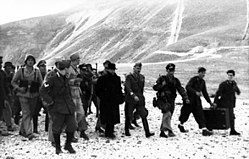
Throughout August 1943, fearful the Germans may try to rescue Mussolini, Badoglio had the deposed dictator transferred from one secret location to the next. On 3 September, a secret armistice was signed with the Allies at Fairfield Camp in Sicily, but not made public straight away as Rome wanted Allied troops to land on the mainland first. That very day, British troops crossed the short distance from Sicily to the 'toe' of Italy in Operation Baytown, but the Badoglio government wanted a landing nearer Rome before publicly defecting as this would certainly spark a German attack. Indeed, according to Goeschel, Hitler had for weeks been infiltrating German soldiers into Italy and preparing a coup to reinstall Mussolini. However, a landing very close to Rome was considered risky by the Allies, but further invasions at Salerno (South of Naples) and Taranto (on Italy's 'heel') were scheduled for 9 September. On 8 September, the German Ambassador in Rome, Rudolf Rahn, was informed by the Italian government of the armistice with the Allies. He replied it was, "a betrayal of the given word".[136][137]
Chronology of the Italian military situation in September–December 1943
The German military responded immediately with Operation Achse, in which Italian forces were disarmed, by force when met with resistance, and northern and central Italy were occupied. This included Italian-occupied zones in south eastern France and the Balkans.[138]
Italian soldiers preparing to clash with the Germans at Porta San Paolo in Rome, 10 September 1943
Skirmishing on the outskirts of Rome between elite German Parachute and Panzer Grenadier divisions and the Italian army began on 8 September 1943. King Victor Emmanuel III and his family, with Marshal Badoglio, General Mario Roatta (the Army Chief of Staff), and others, fled Rome on 9 September, and headed to Allied-controlled Brindisi, which for the next few months became the Kingdom of Italy's seat of government. However, the sudden departure of the senior figures in the government and high command left a power vacuum, which created confusion among Italian military commanders and demoralised personnel. Italian troops in Rome made a last stand at Porta San Paolo on 10 September, then the city was surrendered.[139][140]
As part of the terms of the armistice, the Italian fleet was to sail to Malta for internment; as it did so, it came under air attack by German bombers, and on 9 September two German Fritz X guided bombs sank the Italian battleship Roma off the coast of Sardinia.[141]
Italian soldiers taken prisoner by the Germans in Corfu, September 1943.
On the Greek island of Cephallonia, General Antonio Gandin, commander of the 12,000-strong Italian Acqui Division, decided to resist the German attempt to forcibly disarm his force. The battle raged from 13 to 22 September, when the Italians capitulated having suffered some 1,300 casualties. Following the surrender, the Germans proceeded to massacre thousands of the Italian prisoners.[142]
Italian troops captured by the Germans were given a choice to keep fighting with the Germans, and the 615,000 who refused were designated Italian military internees and were transported as forced labour to Germany, of whom 30,000 died in captivity.[143] Some Italian troops who evaded German capture in the Balkans joined the partisans - approximately 40,000 in Yugoslavia and 20,000 in Greece.[144]
After the German invasion, deportations of Italian Jews to Nazi death camps began. Fascist Italy had been an antisemitic country since 1938, with the introduction of the Italian Racial Laws, although prior to the occupation the persecution had been less severe than in Germany. In October 1943, Nazis raided the Jewish ghetto in Rome. In November 1943, Jews of Genoa and Florence were deported to Auschwitz; the same month saw Italy's Fascists at a congress in Verona declare Italian Jews as foreign enemies. According to Goeschel: "While the order for the deportations came from Germany, they would not have been possible without the assistance of RSI officials, including the police, and the opportunism of some ordinary Italians who became complicit in the persecution of Jews through denunciations, casting into doubt the powerful post-war stereotype of Italians as incapable of inhumanity and anti-Semitism."[146]
Insurgents celebrating the liberation of Naples after the Four days of Naples (27–30 September 1943)
The Allied armies continued to advance through Italy despite increasing opposition from the Germans. The Allies soon controlled most of southern Italy, and Naples rose against and ejected the occupying German forces. From a domestic Italian perspective, the conflict now began to resemble a civil war between the Fascists who collaborated with the Germans versus pro-Allied Italian forces, including those loyal to the King of Italy, plus resistance fighters in the Nazi-occupied areas.[147]
On 13 October 1943, the Kingdom of Italy formally became a co-belligerent of the Allies by declaring war on Nazi Germany. With Allied assistance some Italian troops in the south were re-organized into what were known as "Co-belligerent" or "Royalist" forces, although at first some among the British and Americans were reluctant to trust and arm former-enemies.[148] Autumn 1943 saw the Co-belligerent Army raise its first combat unit, I Motorized Grouping, which was made up of troops who had served in two former-Italian Army divisions, the Legnano and the Messina, and avoided capture by the Germans following the Armistice.[149]
I Motorized Grouping first saw action against Axis forces in December 1943, fighting alongside the US II Corps at the Battle of San Pietro Infine, where it suffered heavy casualties but impressed the Americans enough for the commander of the US Fifth Army, General Clark, to send a message of congratulations to the commanding officer, General Dapino. The Allies consequently provided the equipment and resources to expand this force, which become the Corpo Italiano di Liberazione (CIL). Further expansion saw the CIL replaced by six 'Combat Groups', each consisting of two infantry regiments and one artillery regiment. They were re-equipped with British uniforms, helmets and weapons.[150] US General Mark W. Clark said of the Co-belligerent Army, “The Italian regular units took some heavy losses and fought well in the last year of the war”.[151]
Soldiers of the National Republican Army during the Battle of Anzio, 1944.
The army of the RSI was the National Republican Army (Esercito Nazionale Repubblicano, or ENR), which saw action mostly against partisans, and sometimes fought the Allies. Established with those troops who had agreed to continue fighting for the Axis, it was then expanded by recruiting in the camps holding Italian military internees in Germany. This created issues of loyalty, as some internees joined the ENR simply to escape the appalling conditions in the camps. Attached to the ENR were a number of autonomous combat units. The RSI had a large gendarmerie called the National Republican Guard (Guardia Nazionale Repubblicano, or GNR), which was responsible for internal security, particularly fighting the resistance. There were also local militias, known as the Black Brigades, who fought in anti-partisan operations. The Waffen-SS were assisted by Black Brigade militiamen during the Sant'Anna di Stazzema massacre, where 530 Italian civilians were murdered.[152]
The other major combat force in the civil war was the large Italian resistance movement located in central and northern Italy, which fought a guerrilla war against the German and RSI forces. The first Partisans were mostly Italian military personnel who avoided capture in the September 1943 German invasion, and began fighting a guerrilla war. They were joined by civilians, escaped Allied POWs and agents from the Office of Strategic Services (OSS) and Special Operations Executive (SOE). While the resistance spanned anti-fascists from a wide political spectrum, as well as the apolitical, there was a preponderance of communists and socialists, reflecting the more industrialised economy of northern Italy. In May 1944, General Alexander, commander of Allied 15th Army Group, estimated six Axis divisions in northern Italy were tied up fighting partisan groups.[153]
In the summer and autumn of 1944, there were a number of partisan republics established, which briefly operated free of the RSI and the German occupation forces, but all were over-run by Axis forces within weeks or months of establishment.[154] It has been estimated that by spring 1945, around 300,000 people were fighting with the partisan forces.[155]
Allied advance and Liberation of Italy
Allied progress on the Italian mainland was slow and difficult, hindered by mountainous terrain, fast-flowing rivers and the narrowness of the peninsula, which meant the battle favoured the defender. Axis forces were able to retreat from one fortified line to the next, the strongest being the Winter Line and the Gothic Line, resulting in a difficult campaign for the Allies.[156]
As the Allied advance drew nearer to Rome, resistance activity in the city intensified. One of the most famous partisan attacks in the capital happened on Via Rasella on 23 March 1944. A company of SS Police Regiment Bozen, around 156 fully-armed military policemen, were marching down Via Rasella (at the same time they did every day) when ten kilos of dynamite hidden in a street cleaner's cart exploded. Then a dozen partisans of the Gruppo d'Azione Patriottica ("Patriotic Action Group"), or GAP, attacked with small arms and hand grenades, leaving 33 of the SS gendarmes dead and 100 wounded. The Germans responded with the Ardeatine massacre, where 335 Italian prisoners (75 of whom were Jewish) were murdered.[157]
Following protracted and heavy fighting at the Battle of Monte Cassino (where Co-belligerent Army Alpini captured the strategic summit of Monte Marrone) and the Battle of Anzio, the Allies broke through and took Rome on 4 June 1944, two days before the Normandy landings in France. At the Battle of Ancona (16 June–18 July 1944), the Co-belligerent IX Assault Unit achieved an important breakthrough at Osimo, although Ancona was for the most part a Polish victory.[158][159]
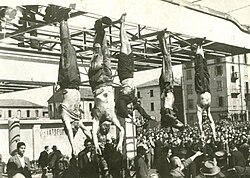
Mussolini (second from left) deceased, next to Clara Petacci, on display at Piazzale Loreto, Milan, 1945
Despite the sluggish advance for the Allies - in part due to veteran Allied divisions and commanders being withdrawn from Italy to participate in the invasion of France (both for the landings in Normandy and the Côte d'Azur), plus other resources being diverted - the Italian Campaign played an important role in the defeat of Nazi Germany. By the time the Allies reached the Gothic Line, 26 Axis divisions were tied-up fighting in Italy that otherwise could have been committed to other fronts.[160]
As the pendulum of likelihood swung steadily towards an Allied victory in the war, many Italian industrialists who had supplied the Fascist and Nazi war effort, in the words of Behan, "began to face both ways"; continuing to deliver on orders to the Axis while simultaneously passing money and other help to the resistance. Once an Axis defeat began to look inevitable, this became a case of wanting to "extricate themselves from recent alliances and bet on partisan horses".[161]
The final and total Allied victory over the Axis in Italy was secured by the spring offensive of 1945. Between 9-21 April, the Co-belligerent army’s Combat Group Friuli and the Partisans were part of a multinational Allied force that fought the Battle of Bologna, liberating the city alongside American, British, Gurkha, Polish and South African troops - with the Polish first into the city, greeted by Partisans.[162] On 25 April, the umbrella organisation for the partisan groups in the north, the National Liberation Committee for Northern Italy, declared a general insurrection, and as a result several important cities in the north were liberated by resistance fighters before Allied troops arrived, including Genoa, Milan and Turin.[163] This greatly assisted the Allied advance, and 25 April is now a national holiday in Italy. Mussolini was captured and killed on 28 April 1945 by partisans while attempting to flee. The surrender of German and RSI forces in Italy occurred on 2 May, shortly before Germany finally surrendered ending World War II in Europe on 8 May.[164]
Italy and Japan after the armistice
The Italian destroyer Carabiniere fought with the Allies against the Japanese in 1945.
In response to Rome’s armistice with the Allies in September 1943, the Japanese Army moved against Italy's tiny concessions in China. Japanese artillery bombarded the Italian concession of Tientsin prompting its surrender, then the small garrison of around 600 was disarmed. At the Italian concession in Beijing, 100 soldiers and sailors resisted for over 24 hours then surrendered. Some Italian ships in Japanese controlled ports were scuttled by their crews.[165][166]
In May 1945, the destroyer Carabiniere was refitted with a new radar and camouflage scheme to operate in the Indian and Pacific Ocean against the Japanese Empire, in collaboration with the Allies. By August 1945, the Carabiniere, under Captain Fabio Tani, had undertaken 38 missions of escorting British warships and search and rescue operations.[167]
Casualties
Estimates[168] based on government data suggest the following military losses (killed and missing) for Italy in World War II (1940–45):
Total military dead and missing from 1940 to 1945: 291,376.[169]
The worst year for killed and missing was 1943: 106,994.[171]
However, The National WWII Museum in New Orleans put the figures for Italy at 301,400 military deaths and 155,600 civilian deaths.[172]
Jewish Holocaust victims totalled 8,562 in Italy and Libya.[173] Around 1,000 died in the genocide of the Roma people in Italy.[174]
Aftermath
The 1947 Treaty of Peace with Italy spelled the end of the Italian colonial empire, saw the Dodecanese Islands handed over to Greece and border territories ceded to France and Yugoslavia. Italy also paid war reparations to Albania, Ethiopia, Greece, the USSR and Yugoslavia. The National Fascist Party and the Republican Fascist Party are banned in Italy. In the 1946 Italian constitutional referendum, the monarchy was abolished, in part due to public anger at the King and establishment figures for fleeing Rome in September 1943 as German troops converged on the city.[175]
The Kingdom of Italy's Co-belligerent status meant that senior Fascists and military leaders did not face an Allied war crimes tribunal (where the judges came from Allied nations), as occurred in Germany and Japan, and instead were tried before Italian courts.[176] In June 1946, the Italian government announced the Togliatti amnesty, which pardoned or reduced sentences for many war criminals below senior level.[177]
Evolution of the historiography
"The German soldier has impressed the world, the Italian Bersagliere has impressed the German soldier." Quote attributed to Rommel at the Italian War Memorial at El Alamein
The destruction of the Italian 10th Army by a significantly smaller British force during Operation Compass left a lasting impression that shaped public attitudes in Britain and its Commonwealth long after the war ended, promoting a popular culture stereotype of an Italian soldier who quickly surrendered.[178] Many histories of the North African campaign written in the immediate decades after the Second World War over-emphasised the role of Erwin Rommel, and downplayed the Italian contribution; with some historians relying too heavily on Allied and German primary sources.[179][180]
While there is no disputing Italy suffered several heavy defeats in World War II, in recent decades it has become more common for historians to present the Italian soldier as someone who was plunged into bad (even hopeless) situations, with obsolete equipment and inadequate logistics; and certainly not as lacking personal courage.[47] During the Tunisian campaign, where Italian units were involved in most major battles, including Kasserine Pass and the Mareth Line, it was observed by General Alexander, "...the Italians fought particularly well, outdoing the Germans in line with them".[181]Gerhard Weinberg said in a lecture on myths of World War II that "there is far too much denigration of the performance of Italy's forces during the conflict".[182]
Much of the responsibility for Fascist Italy's defeat in World War II rests with Mussolini. The Duce entered the war for opportunistic reasons, despite having been repeatedly warned the armed forces were not ready - Mussolini told General Carlo Rossi in May 1940: "If I had to wait for the army to be ready, I would have to wait years to enter the war, but I have to enter it now. We shall do what we can."[183] Mussolini dramatically overestimated at times what was realistically achievable in the war, which led to Italian forces being sent poorly equipped into situations where failure was likely, such as the 1940 invasion of Egypt. General Giuseppe Castellano, who signed the armistice with the Allies in 1943, wrote of Mussolini: "the errors were essentially of a political nature and many times the military were thrust into more dangerous adventures through the incompetence and intemperance of the man who ran the government."[184] Gooch concluded: "Mussolini had little if any comprehension of military strategy and none at all of grand strategy."[185]
However, the Italian military establishment were also at fault, due to a 'top-down' culture, inflexibility and foot-dragging on modernisation. Historians such as Battistelli have noted that the military's rigid lines of authority hindered initiative taking by middle ranking and junior officers.[186] The three armed services, according to Gooch, "lived in institutional 'silos' and stayed inside them". Many troops were poorly trained and not enough effort was invested in improving the quality of junior officers.[187]
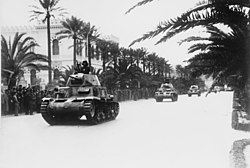
Italian M13/40 tanks on the streets of Tripoli, March 1941.
Historians also attribute the military's defeats to poor equipment and shortages. The Italian military had a lot of obsolescent equipment, especially the army. Many tanks and aircraft were "a whole generation outdated" by those used by the Allies, and when better weapons were eventually produced they often arrived too late in the war and too few in number to turn the tide.[188] Crucially, Italian forces lacked suitable quantities of equipment of all kinds,[189] and Italy's smaller industrial sector hampered ramping up production, with weapons (according to Keegan) "produced by artisan methods which could not match the output of British - and eventually American - factories working to volume demands".[188]
Italian partisans celebrate the liberation of Venice in Piazza San Marco.
Mussolini's regime failed to manage the economy so it supported the war effort. There was never a plan for distributing manpower between the military and major industries, resulting in a surplus of agricultural labour in the south while there was a shortage in the north. Factories struggled to find skilled workers. During the war, there was only a marginal rise in the proportion of women working in industry. Over two years into the war, the planning process for arms production was little changed on how it was done in peacetime.[190]
While Fascist Italy was defeated in World War II, the Co-belligerent forces and the Resistance were among the victors at the end of the conflict. The Resistance typically draws respect from historians for its contribution to the defeat of the Axis. Tom Behan wrote: "The historical record shows that the Italian Resistance was an inspiring story, in which a largely inexperienced movement took on vastly superior military and economic forces, often making their ability to rule over large swathes of the country impossible."[191]
↑Rocca, Gianni (1998). I Disperati: La tragedia dell'Aeronautica Italiana nella seconda guerra mondiale (in Italian). Milan: Mondadori. ISBN88-04-44940-3.
Badoglio, Pietro (1946). L'Italia nella seconda guerra mondiale[Italy in the Second World War] (in Italian). Milan: Mondadori.
Battistelli, Pier Paolo (2021). The Balkans 1940-41 (1): Mussolini's fatal blander in the Greco-Italian War. Oxford: Osprey Publishing. ISBN9781472842572.
Battistelli, Pier Paolo (2021). The Balkans 1940-41 (2): Hitler's Blitzkrieg against Yugoslavia and Greece. Oxford: Osprey Publishing. ISBN9781472842619.
Battistelli, Pier Paolo (2024). East Africa Campaign 1940-41: The Battle for the Horn of Africa. Oxford: Osprey Publishing. ISBN9781472860712.
Battistelli, Pier Paolo; Crociani, Peiro (2013). Italian Navy & Air Force Elite Units and Special Forces 1940-45. Oxford: Osprey Publishing. ISBN9781849088572.
Battistelli, Pier Paolo; Crociani, Peiro (2015). World War II Italian Partisan Warfare in Italy. Oxford: Osprey Publishing. ISBN9781472808936.
Bauer, Eddy (2000) [1979]. Young, Peter (ed.). The History of World War II (rev.ed.). London: Orbis. ISBN1-85605-552-3.
Beevor, Antony (2009). The Battle for Spain: The Spanish Civil War 1936–1939. London: Pluto Press. ISBN978-1-7837-1551-0.
Behan, Tom (2006). The Italian Resistance: Fascists, Guerrillas and the Allies. London: Phoenix. ISBN0-7538-2165-6.
Holland, James (2008). Italy's Sorrow: A Year of War 1944-1945. London: Harper Press. ISBN978-0-00-717645-8.
Holland, James (2020). Sicily '43: The first assault on fortress Europe. London: Penguin Random House. ISBN978-1-473-57429-8.
Holmes, Tony (2021). World War II Fighter Planes Spotter's Guide. Oxford: Osprey Publishing. ISBN9781472848505.
Jensen, W. G. (1968). "The Importance of Energy in the First and Second World Wars". The Historical Journal. 11 (3): 538–54. doi:10.1017/s0018246x00001680. S2CID159620220.
Jowett, Philip (2001). The Italian Army, 1940-45 (3): Italy 1943-45. Oxford: Osprey Publishing. ISBN978-1-85532-866-2.
Keegan, John (1989). The Second World War. London: Pimlico. ISBN9780712673488.
Knox, Macgregor. Common Destiny: Dictatorship, Foreign Policy, and War in Fascist Italy and Nazi Germany (Cambridge UP, 2000).
Knox, MacGregor (2000). Hitler's Italian Allies: Royal Armed Forces, Fascist Regime and the War of 1940–43. Port Chester, NY: Cambridge University Press.
Knox, Macgregor. Mussolini Unleashed 1939-1941: Politics and Strategy in Fascist Italy's Last War (Cambridge UP, 1982).
Mallett, Robert (1997). "The Anglo-Italian War Trade Negotiations, Contraband Control and the Failure to Appease Mussolini, 1939–40". Diplomacy and Statecraft. 8 (1): 137–67. doi:10.1080/09592299708406033.
Massimello, Giovanni; Apostolo, Giorgio (2000). Italian Aces of World War 2. Oxford: Osprey Publishing. ISBN9781841760780.
McNab, Chris (2024). World War II Tank Spotter's Guide. Oxford: Osprey Publishing. ISBN9781472866783.
Murphy, W. E. (1961). Official History of New Zealand in the Second World War 1939–45: The Relief of Tobruk. Wellington: Historical Publications Branch.
O'Hara, Vincent P.; Cernuschi, Enrico (2009). Dark Navy: The Regina Marina and the Armistice of 8 September 1943. Ann Arbor: Nimble Books. ISBN978-1-934840-91-7.
O'Reilly, Charles T (2001). Forgotten Battles: Italy's War of Liberation. Lanham: Lexington Books. ISBN0-7391-0195-1.
Pitt, Barrie (1980). Crucible of War (Vol.1): Wavell's Command. London: Jonathan Cape. ISBN9781082248351.
Quartermaine, Luisa (2000). Mussolini's Last Republic: Propaganda and Politics in the Italian Social Republic (R.S.I.) 1943–45. Elm Bank modern language studies. Intellect Books. ISBN1-902454-08-1.
Rogers, Anthony (2019). Kos and Leros 1943: The German Conquest of the Dodecanese. Oxford: Osprey Publishing. ISBN9781472835109.
Sadkovich, James. J. (1991). "Of Myths and Men: Rommel and the Italians in North Africa". The International History Review. XIII (2): 284–313. doi:10.1080/07075332.1991.9640582. JSTOR40106368.
Soboski, Marek (2022). BETASOM: Italian Submarines in the Battle of the Atlantic, 1940-1945. Zielona Góra: Ikona. ISBN9798367072143.
Soboski, Marek (2021). Mussolini's Eastern Crusade: The Italian Expeditionary Corps in Operation Barbarossa. Zielona Góra: Ikona. ISBN979-8480926569.
Steinberg, Jonathan (1990). All Or Nothing: The Axis and the Holocaust, 1941–1943. Routledge. ISBN0-415-07142-9.
Walker, Ian W. (2003). Iron Hulls, Iron Hearts: Mussolini's Elite Armoured Divisions in North Africa. Ramsbury: The Crowood Press. ISBN1-86126-646-4.
Weinberg, Gerhard L. (2011). "Some myths about World War II". The Journal of Military History. 75 (3): 701–7118.
This page is based on this Wikipedia article Text is available under the CC BY-SA 4.0 license; additional terms may apply. Images, videos and audio are available under their respective licenses.


 Italyportal