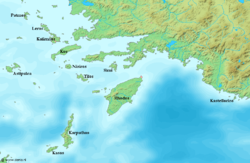
The Dodecanese campaign was the capture and occupation of the Dodecanese islands by German forces during World War II. Following the signing of the Armistice of Cassibile on 3 September 1943, Italy switched sides and joined the Allies. As a result, the Germans made plans to seize control of the Dodecanese, which were under Italian control. The Allies planned to use the islands as bases to strike against German targets in the Balkans, which the Germans aimed to forestall.
Beginning in early September 1943, invading German troops defeated both the Italian garrison in the Dodecanese and British forces sent to support them, aided by the fact that Allied units were operating without sufficient air cover. Most of the Dodecanese islands fell to German forces within two months, resulting in one of Germany's last major victories during the conflict.[1] The Germans continued to occupy the Dodecanese islands they had captured until the end of the war in 1945, when they surrendered to British forces.
The Aegean Sea is part of the Mediterranean from Greece to the western coast of Turkey. The Sporades are in the north, the Cyclades in the south and the twelve islands of the Dodecanese are in the south-eastern Aegean, most close to the Turkish shore and usually grouped with Rhodes and Kastellorizo.[2][a] The islands had been under Italian control since the Italo-Turkish War in 1911. During Italian rule, the islands became a focus of Italian colonial ambitions in the Eastern Mediterranean. Rhodes, the largest of the islands, was a military and air base. The island of Leros, with its excellent deep-water port of Portolago (now Lakki) was developed into a fortified air base, "the Corregidor of the Mediterranean" (Benito Mussolini) but these developments were mostly a bluff to deter the Greeks from attacking the archipelago and served as a latent threat to Greece and Turkey. As Italian colonial ambitions developed in the 1930s, the naval and air bases on the islands became a military threat to the Egyptian coast. The Italians made little use of the islands during the war and their supply became a liability. A British attempt to contest Italian control of the Dodecanese, Operation Abstention (25–28 February 1941) was thwarted, when Italian forces recaptured Kastellorizo from the Royal Marines and No. 50 Commando.[4]
The three zones of the Axis occupation of Greece, 1941−1944.
By May 1943, Adolf Hitler had begun to contemplate the possibility of Italian defection from the Axis. The high command of the German armed forces, Oberkommando der Wehrmacht (OKW) prepared an assessment of the situation if Italy made a separate peace and planned the reinforcement of German troops in Italy (Unternehmen Alaric) and the Balkans (Unternehmen Constantine) that were combined into Unternehmen Achse (Operation Axis) after the overthrow of Mussolini and the Allied invasion of Sicily, the orders being promulgated from 28 to 30 July. On the announcement of the Armistice of Cassibile (3 September 1943) announced on 8 September, the operation began with a weeks' notice. Italian troops were to be disarmed and made to choose between disbandment and fighting on with the Germans.[6]
Transport infrastructure such as the passes in the Apennines, railways, ports and the ships of the Regia Marina, merchant ships, aircraft and airfields of the Regia Aeronautica, military bases and equipment were to be taken under German military control.[6] The German army in the Mediterranean was reinforced to 38 divisions and a new Army Group F (Field Marshal Maximilian von Weichs) created in the Balkans, with the former commander in chief, GeneraloberstAlexander Löhr, taking over the subordinate Army Group E in Greece and the Aegean. The 22nd Air Landing Division was occupying most of Crete and Sturm Division Rhodos (Assault Division Rhodes, Generalleutnant (Lieutenant-General) Ulrich Kleemann) had been built up on the island of Rhodes since January 1943.[7]
Allied strategy
The British Prime Minister Winston Churchill had desired to draw Turkey into the war since 1940, because Turkish adherence to the Allies would turn the Axis flank in Greece and the Balkans that would be another drain on German military resources, cut the German Black Sea route into the Eastern Mediterranean, threaten German Balkan allies and open another supply route to the USSR. Airfields on Turkey would be able to contribute to the strategic bombing campaign, particularly the Romanian oil industry. The Russians thought that if Turkey entered the war, the Germans would divert a minimum of ten divisions. Despite British blandishments, the Turkish government was unmoved, defeat would lead to German occupation and victory would only benefit the USSR. The Americans were not enthused at the prospect of being saddled with the responsibility of equipping the 46 divisions of the Turkish army, along with all the other armies being supplied by Lend-Lease. There was no optimism at the Casablanca Conference (14−24 January 1943) and First Quebec Conference (17–24 August 1943) for a forward policy in the Aegean. Despite the American lack of enthusiasm, Churchill thought that the defection of Italy on 8 September and the collapse of the Axis position in the Mediterranean made an Aegean strategy feasible, "This is the time to play high".[8]
In the spring of 1943, plans began to be laid for offensive action in the Aegean. The British had wanted to gain control of the Aegean since Italy joined in the war but until autumn 1943 the means for such a policy had been lacking. General Dwight D. Eisenhower had been given first call on resources at the Third Washington Conference (12−25 May 1943) except for seven divisions due to be sent to Britain and two British divisions ready to support Turkey against an Axis attack. Naval forces were distributed around the world and the Mediterranean Air Command had been reinforced for the Allied invasion of Sicily (9 July – 17 August 1943) only. General Henry Maitland Wilson, the Commander in Chief Middle East Land Forces had no power to divert troops from Sicily or Italy and permanent uncertainty over the forces at his disposal for an Aegean enterprise. A directive issued to Wilson on 12 February 1943 required him to prepare for operations in the eastern Mediterranean and No. 2 Planning Staff (later Force 292) Lieutenant-General Sir Desmond Anderson, Air Vice-Marshal Richard Saul and Rear-Admiral Geoffrey Miles began to draft plans.[9][b]
Rhodes was the principal object of the Planning Staff, along with Scarpanto (now Karpathos) and then islands further north, to open the route to Smyrna (now Izmir).[9][c] By late July three plans for Accolade were ready, a promenade to Rhodes if the Italians collapsed and the Germans withdrew, a quick exploitation if the Italians gave in but the Germans remained and a methodical invasion should the Italians and Germans be prepared to defend the Island. A planning assumption was that Eisenhower would not use all the forces at his disposal and would lend naval and air forces, possibly troops but this created permanent uncertainty for the planners, whose plans were difficult to devise due to the distance of the Dodecanese from Egypt and the airfields available to the Luftwaffe at Scarpanto [45mi (72km) from Rhodes], Crete [160mi (260km)] and southern Greece [270mi (430km)]. The distance from Alexandria to Kos via the strait between Rhodes and Karpathos is 370nmi (690km; 430mi) and between Rhodes and the Turkish mainland is 400nmi (740km; 460mi). Kos to Leros is 30mi (48km) and Leros to Samos is 40mi (64km).[10]
The nearest RAF bases to Rhodes were in Cyprus, about 270mi (430km) away and Gambut, about 350mi (560km) distant as the war had receded from Egypt after the Second Battle of El Alamein in 1942. The Allied air forces had been concentrated in the central Mediterranean for the Sicilian and Italian campaigns. Allied single-engined fighters had nothing like the range to operate over such distances and it would be necessary to operate them from the Turkish mainland or to develop airfields on Kos sufficient for four fighter squadrons. Twin engined fighters like the Beaufighter operating from Cyprus or Gambut were no substitute against Messerschmitt Bf 109s and the small number of Lightnings in the Mediterranean offered no prospect of success, despite its superior performance. During planning, it was assumed that only single-engined fighters could protect assault landings and that this ruled out Accolade. In August, Allied operations in Italy allowed the hope that German resources had been withdrawn from the Aegean, that Eisenhower could spare heavy bombers to attack Luftwaffe airfields in Greece and Crete and lend four Lightning squadrons.[11]
On 25 July, Mussolini fell and two days later, Churchill prodded the Chiefs of Staff Committee to keep Accolade in mind and on! August, Wilson signalled that the minimum of shipping needed for Accolade was an HQ ship, eight Landing ship, infantry (large) [LSI (l)] or Landing Ship Personnel and eighteen MT ships. There were eight LSI (l) in Egypt but five were due to sail to India and the committee signalled on 2 August that most of the air and sea forces would have to come from the central Mediterranean. Wilson was told to take an opportunistic policy in the Aegean. The ship voyages to India were cancelled and some supplies for Turkey were stopped and the staff was told to beg and borrow from Eisenhower eight ships and landing craft, four Lightning squadrons, a parachute battalion and its aircraft and smaller units of specialists by 14–15 August. The British would have a brigade ready by 18 August and another by 22 August. Eisenhower agreed but later than hoped and less the Lightnings or transport aircraft but on 12 August had second thoughts lest Accolade divert resources from Operation Avalanche, the landings at Salerno, due on 9 September and urge the postponement of Accolade.[12]
Sturm-Division Rhodos a well-armed, mobile force of 6,000–7,000 men, had evolved into the principal German force in the Dodecanese with another 1,500 German troops on the island of Scarpanto (now Karpathos) to the west of Rhodes. The island was the administrative centre of the Dodecanese Islands that had three military airfields.[15] Because of its size and geographical position, Rhodes was the principal military objective for both sides. On 8 September 1943, the Italian garrison on the island of Kastelorizo surrendered to a British detachment, that was reinforced during the following days by ships of the Allied navies.[16]
On 9 September, a British delegation, led by George Jellicoe, parachuted onto Rhodes, to persuade the Italian commander, AmmiraglioInigo Campioni, to join the Allies. Kleemann attacked the 40,000-strong Italian garrison on 9 September and forced it to surrender by 11 September. The loss of Rhodes was a serious blow to Allied hopes.[17] By 19 September, Karpathos, Kasos and the Italian-occupied islands of the Sporades and the Cyclades were in German hands. On 23 September, the 22nd Infantry Division (GeneralleutnantFriedrich-Wilhelm Müller), that garrisoned Fortress Crete, was ordered to take Kos and Leros.[18]
Having identified the vital role of Kos that had the only Allied landing grounds, Fliegerkorps X bombed it and Allied positions, from 18 September. Reinforcements gave the Germans 362 operational aircraft in the Aegean by 1 October.[19] The British forces on Kos numbered about 1,500 men, 680 of whom were from the 1st Durham Light Infantry, the rest being mainly RAF personnel and c.3,500 Italians of the 10th Regiment, 50th Infantry Division Regina. On 3 October, the Germans made amphibious and airborne landings with the code-name Unternehmen Eisbär (Operation Polar Bear) and reached the outskirts of Kos town later that day. The British withdrew under cover of night and surrendered the next day. The fall of Kos was disastrous to the Allies, since it deprived them of air cover. The Germans captured 1,388 British and 3,145 Italian prisoners. On 4 October, German troops committed the Massacre of Kos, killing the captured Italian commander of the island, Colonnello Felice Leggio, and nearly 100 of his officers.[20]
After the fall of Kos, the Italian garrison of Kalymnos surrendered, providing the Germans with a valuable base for operations against Leros. Unternehmen Leopard (Operation Leopard) was originally scheduled for 9 October but on 7 October, the Royal Navy intercepted and destroyed the German convoy headed for Kos. Several hundred men and most of the few German heavy landing craft were lost; replacements were transported by rail and it was not until 5 November that the Germans had assembled a fleet of 24 light infantry landing craft. To avoid interception by the Allied navies, they were dispersed among several Aegean islands and camouflaged. Despite Allied efforts to locate and sink the invasion fleet, as well as repeated shelling of the ports of German-held islands, the Germans suffered few losses and were able to assemble their invasion force, under Generalleutnant Müller, for Unternehmen Taifun (Operation Typhoon) on 12 November.[21]
Leros had been subjected to air attack by the Luftwaffe beginning on 26 September which caused significant casualties and damage to the defenders of the island and supporting naval forces. In the early hours of 12 November, the invasion force in two groups approached the island from east and west. Despite failures in some areas, the Germans established a bridgehead, while airborne forces landed on Mt. Rachi, in the middle of the island. After repulsing Allied counter-attacks and being reinforced the following night, the Germans quickly cut the island in two and the Allies surrendered on 16 November. The Germans suffered 520 casualties and captured 3,200 British and 5,350 Italian soldiers.[24]
Naval operations
Since the operational theater was dominated by a multitude of islands and the Allies and Germans had to rely on naval vessels for reinforcements and supplies, the naval component of the campaign was especially pronounced. Initially, naval presence on both sides was low, most of the Allied shipping and warships having been transferred to the central Mediterranean in support of the operations in Italy, while the Germans did not have a large naval force in the Aegean. The Germans had air superiority, which caused the Allies many losses in ships. Vice-Admiral Werner Lange, the German Naval Commander-in-Chief of the Aegean, tried to reinforce German garrisons and carry out operations against Allied garrisons, while transporting Italian prisoners of war to the mainland. Allied intercepted many of the German ships. On 23 September, HMSEclipse damaged the torpedo boat TA10 and sank the steamer Gaetano Donizetti, which had 1,576 Italian captives on board of whom about 1,200 were killed.[25] Another disaster occurred a month later, when United States Army Air Forces (USAAF) B-25 Mitchells and RAF Beaufighters sank the cargo ship Sinfra, which had 2,389 Italian POWs, 71 Greek POWs and 204 German guards on board, of whom only 539 were saved.[26][d]
On 14 September, the Greek submarine RHN Katsonis, was rammed and sunk by U-boat hunter UJ 2101. The Luftwaffe also intervened on 26 September, when 25 Junkers Ju 88s sank RHN Vasilissa Olga and HMSIntrepid at Lakki Bay, Leros. On 1 October, the Italian destroyer Euro was sunk and on 9 October HMSPanther was sunk and the cruiser HMSCarlisle seriously damaged. The short range of Hunt-class destroyersHMSAldenham, RHN Pindos and RHN Themistoklis prevented them from intercepting the German invasion convoy headed for Kos. After the loss of Kos and its air cover, the Allied navies concentrated on supplying Leros and Samos, mostly under the cover of night. From 22 to 24 October, HMSHurworth and Eclipse sank in a German minefield east of Kalymnos and RHN Adrias lost its prow. Adrias escaped to the Turkish coast and after makeshift repairs, sailed to Alexandria.[27]
On the night of 10/11 November, the destroyers HMSPetard, Rockwood and ORPKrakowiak bombarded Kalymnos and HMSFaulknor bombarded Kos, where German forces were assembling to attack on Leros. The German convoy reached Leros on 12 November, escorted by over 25 ships, mostly submarine chasers, torpedo boats and minesweepers. During the subsequent nights, Allied destroyers failed to find and destroy the German vessels, limiting themselves to bombarding the German positions on Leros. With the fall of Leros on 16 November, the Allied ships were withdrawn, evacuating the remaining British garrisons. By that time, the Germans had also used Dornier Do 217s of Kampfgeschwader 100 (KG 100), with their new Henschel Hs 293 radio-controlled missiles, scoring two hits. One caused severe damage to Rockwood on 11 November and another sank HMSDulverton two days later. The Allies lost six destroyers sunk and two cruisers and two destroyers damaged between 7 September and 28 November 1943.[28]
Aftermath
After the fall of Leros, Samos and the other smaller islands were evacuated. German Ju 87 (Stukas) of I Gruppe, Stukageschwader 3 bombed Samos on 17 November, prompting the 2,500-strong Italian garrison to surrender on 22 November. Along with the occupation of the smaller islands of Patmos, Fournoi and Ikaria on 18 November, the Germans completed their conquest of the Dodecanese, which they held until the end of the war. Only the island of Kastellorizo off the Turkish coast was retained by the British and was never threatened. The Dodecanese campaign was one of the last British defeats in World War II and one of the last German victories, while others have labelled it a fiasco which was badly conceived, planned and executed as a "shoestring strategy".[29] The German victory was predominantly due to their possession of air superiority, which caused great loss to the Allies, especially in ships and enabled the Germans to supply their forces. The revival of German fortunes in the eastern Mediterranean helped restore Spanish confidence in the German war effort, shaken by the Allied landings in Operation Torch the landings in North Africa and Operation Husky, the invasion of Sicily and ensured several more months of Spanish tungsten exports for German war industry.[30]
Genocide
The German occupation of the Dodecanese islands sealed the fate of Jews living there. Although Italy had passed the anti-Jewish law of the Manifesto of Race in 1938, Jews living on the Dodecanese islands (and Italian-occupied Greece) experienced much less antisemitism than in the German and Bulgarian occupied zones of Greece, which culminated in March 1943 with deportations to the death camps in occupied Poland. The Italian surrender, the German takeover and the failure of the Allied offensive meant that the haven disappeared. Most of the Dodecanese Jews were murdered by the Germans; 1,700 members of the ancient Jewish community of Rhodes (of a population of about 2,000 people) were rounded up by the Gestapo in July 1944 and only some 160 of them survived deportation.[31]
Casualties
About 4,800 British troops were killed or captured; 26 naval vessels and the RAF lost 115 aircraft and20 were damaged. Luftwaffe losses are harder to quantify but contemporary reports have 135 aircraft shot down and 126 damaged but in 2008 Smith and Walker suggested that the loss was unlikely to be more than 120. The German communiqué after the capture of Leros claimed 3,200 British and 5,700 Italian troops for a loss of 1,109 troops, 41 per cent of the total. Müller wrote that the cost of capturing Kos and Leros was 260 men killed, 746 wounded and 162 missing; the British took 177 German prisoners off the island.[32] In 2010 Ian Gooderson wrote that the German success was costly, 1,109 casualties being suffered by the 4,500 German troops involved. Fifteen of the 45 vessels used by the Germans had been sunk or damaged. From the end of September to mid-November the Germans lost 35,000GRT of merchant shipping and 21 small naval vessels; the Luftwaffe lost 156 aircraft.[33] The Germans transferred Italian prisoners in overcrowded and unseaworthy vessels, that led to several accidents. On the night of 12/13 February 1944, the 2,127 GRT ship SSOria, was lost off Cape Sounion, trying to evade a submarine attack and more than 4,000 Italians were killed in the disaster.[34]
↑The name for the Rhodes scheme was Operation Handcuff but Accolade became the usual term.[9]
↑Smith and Walker 2008 wrote that 40 of 500 German troops were killed and of 2,000 pro-Badoglio Italians and 200 Greek partisans, about 1,461 Italians and 187 Greek prisoners were killed.[25]
Brown, David (1995) [1990]. Warship Losses of World War II (2nd pbk.ed.). London: Arms and Armour. ISBN978-1-85-409278-6.
Cunningham, A. (1951). A Sailor's Odyssey: the Autobiography of Admiral of the Fleet Viscount Cunningham of Hyndhope. London: Hutchinson. OCLC882476825.
Hilberg, Raul (2003). The Destruction of the European Jews (3rd rev.ed.). New Haven and London: Yale University Press. ISBN0-300-09557-0.
Jordan, Roger W. (2006) [1999]. The World's Merchant Fleets 1939: The Particulars and Wartime Fates of 6,000 Ships (2nded.). London: Chatham/Lionel Leventhal. ISBN978-1-86176-293-1.
O'Hara, Vincent P. (2009). Struggle for the Middle Sea: The Great Navies at War in the Mediterranean Theater, 1940–1945. London: Conway. ISBN978-1-84486-102-6.
Rogers, Anthony (2003). Churchill's Folly: Leros and the Aegean — The Last Great British Defeat of World War II. London: Cassell. ISBN978-0-30-436151-9.
Rogers, Anthony (2007). Churchill's Folly: Leros and the Aegean: The Last Great British Defeat of World War II. Athens: Iolkos. ISBN978-960-426-434-6.
Roskill, Stephen (1960). Butler, J. R. M. (ed.). The War at Sea 1939–1945: The Offensive Part I 1st June 1943 – 31st May 1944. History of the Second World War United Kingdom Military Series. Vol.III. London: HMSO. OCLC987392618.
Smith, Peter; Walker, Edwin (2008) [1974]. War in the Aegean: The Campaign for the Eastern Mediterranean in WWII. Stackpole Military History. Mechanicsburg, PA: Stackpole Books. ISBN978-0-8117-3519-3.
Insolvibile, Isabella (2010). Kos 1943–1948: La strage, la storia[Kos 1943–1948: The History and the Massacre] (in Italian). Napoli: Edizioni Scientifiche Italiane. ISBN978-8-84952-082-8.
Levi, Aldo (1957). Avvenimenti in Egeo dopo l'armistizio (Rodi, Lero e isole minori)[Events in the Aegean Sea after the Armistice (Rhodes, Leros and Smaller Islands)]. Attività dopo l'armistizio; Marina italiana nella Seconda Guerra Mondiale (tome 2) (in Italian). Vol.XVI. Roma: Ufficio storico della Marina Militare. OCLC256470111.
Schenk, Peter (2000). Kampf um die Ägäis. Die Kriegsmarine in den griechischen Gewässern 1941–1945[Battle for the Aegean Sea: The Navy in Greek Waters in 1941–1945] (in German). Germany: Mittler & Sohn. ISBN978-3-81320-699-9.
Shores, Christopher; Massimello, Giovanni; Guest, Russell; Olynyk, Frank; Bock, Winfried; Thomas, Andy (2021). A History of the Mediterranean Air War 1940–1945: From the Fall of Rome to the End of the War 1944–1945. Vol.V. London: Grub Street. ISBN978-1-911621-97-3.
Journals
Mortimer, Gavin (2012). "Pirates of the Aegean". World War II. XXVII (3). Arlington, VA: Hostorynet LLC: 68−73. ISSN0898-4204.
Rogers, Anthony (2023). "Folly in the Aegean". Military History. XL (2). Arlington, VA: Hostorynet LLC: 56−63. ISSN0889-7328.
This page is based on this Wikipedia article Text is available under the CC BY-SA 4.0 license; additional terms may apply. Images, videos and audio are available under their respective licenses.

 Germany