Related Research Articles

The Fokker D.VII was a German World War I fighter aircraft designed by Reinhold Platz of the Fokker-Flugzeugwerke. Germany produced around 3,300 D.VII aircraft in the second half of 1918. In service with the Luftstreitkräfte, the D.VII quickly proved itself to be a formidable aircraft. The Armistice ending the war specifically required, as the fourth clause of the "Clauses Relating to the Western Front", that Germany was required to surrender all D.VIIs to the Allies. Surviving aircraft saw much service with many countries in the years after World War I.

The Albatros C.III was a twin-seat general-purpose biplane designed and produced by the German aircraft manufacturer Albatros Flugzeugwerke. It was produced in greater numbers than any other C-type aircraft by Albatros as well as being the company's most-produced twin-seat aircraft.

The Albatros C.I,, was a twin-seat general-purpose biplanes designed and produced by the German aircraft manufacturer Albatros Flugzeugwerke. It was the first of the successful C-series aircraft operated by the Luftstreitkräfte.

The Albatros B.II, was an unarmed two-seat reconnaissance biplane designed and produced by the German aircraft manufacturer Albatros Flugzeugwerke. It was the aircraft that brought Albatros Flugzeugwerke to the world's attention.
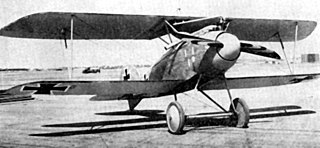
The Albatros D.III was a biplane fighter aircraft used by the Imperial German Army Air Service during World War I. A modified licensed version was built by Oeffag for the Austro-Hungarian Air Service (Luftfahrtruppen). The D.III was flown by many top German aces, including Wilhelm Frankl, Erich Löwenhardt, Manfred von Richthofen, Karl Emil Schäfer, Ernst Udet, and Kurt Wolff, and Austro-Hungarians like Godwin von Brumowski. It was the preeminent fighter during the period of German aerial dominance known as "Bloody April" 1917.

The Albatros B.I, was a German military reconnaissance aircraft designed in 1913 and which saw service during World War I.

The Albatros C.VII was a military reconnaissance aircraft designed and produced by the German aircraft manufacturer Albatros Flugzeugwerke. It was a revised and re-engined development of the Albatros C.V, which had proved disappointing in service.

The Albatros J.II was a German single-engine, single-seat, biplane ground-attack aircraft of World War I.

The Albatros G.II,, was a twin-engined German biplane bomber of World War I.
Automobil und Aviatik AG was a German aircraft manufacturer during World War I. The company was established at Mülhausen in 1909 and soon became one of the country's leading producers of aircraft. It relocated to Freiburg in 1914 and to Leipzig in 1916 and established a subsidiary in Vienna as Österreichisch-Ungarische Flugzeugfabrik Aviatik. During the war, the company became best known for its reconnaissance aircraft, the B.I and B.II, although the Austro-Hungarian subsidiary also produced a number of its own designs, including fighters such as the D.I.
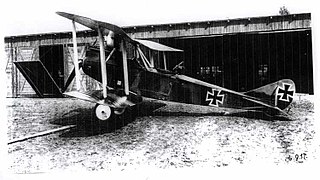
The Rumpler C.IV was a German single-engine, two-seat reconnaissance biplane. It was a development of C.III with different tail surfaces and using a Mercedes D.IVa engine in place of the C.III's Benz Bz.IV. The Rumpler 6B 2 was a single-seat floatplane fighter variant with a 120 kW (160 hp) Mercedes D.III engine built for the Kaiserliche Marine.

Entering service in 1915, the Rumpler C.I,, two-seater single-engine reconnaissance biplane, was one of the first German C-type aircraft, and also one of the longest serving in its class during World War I, being retired from the last front line units only in early 1918.
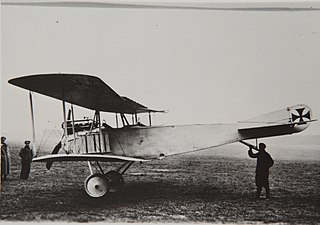
The Albatros B.III,, was a German World War I reconnaissance biplane, built by Albatros Flugzeugwerke as the Albatros LDD.

The Albatros C.II was a 1916 German military pusher biplane designed and built by Albatros Flugzeugwerke. Only one prototype was built and the type did not enter production.
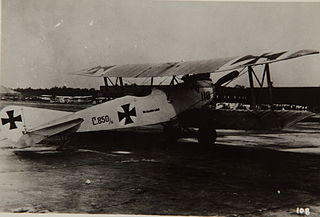
The Albatros C.IV,. was a German military reconnaissance aircraft built in the autumn of 1915 by Albatros Flugzeugwerke. It was a single-engined biplane, and was based on the Albatros C.III, with which it shared many parts. It was eventually abandoned, in favour of the C.V.

The Albatros G.I,, was a four-engined German biplane bomber of World War I.

The Otto C.I, also known as the Otto KD.15, was a German two-seat biplane reconnaissance and bomber aircraft of the First World War designed and produced by Otto Flugmaschinenfabrik. The C.I was a rare example of an aircraft flown by the Central Powers which had a pusher configuration.

The Albatros W.8 was a German biplane fighter floatplane that saw service during First World War. It patrolled the seas around 1918. The fuselage of the aircraft was made of wood, similar to most aircraft designs of that period. The W.8 had a water-cooled Benz Bz.IIIb eight-cylinder engine fitted with a fixed two-bladed wooden propeller.
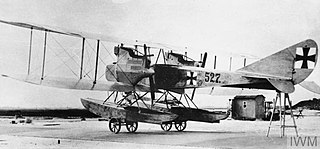
The Albatros W.3, company designation VT, was a biplane torpedo bomber floatplane prototype, built for the Imperial German Navy during the First World War. Only one was built.
The OAW C.II was a World War I-era German prototype reconnaissance aircraft. It was built by Ostdeutsche Albatroswerke (OAW), a subsidiary of Albatros Flugzeugwerke, for the Imperial German Army Air Service. Although the exact number is unknown, only a few were built.
References
- ↑ Gray, Peter; Thetford, Owen (1970). German Aircraft of the First World War (2nd ed.). London: Putnam. p. 253. ISBN 978-0-370-00103-6.