
Montenegro is a country in Southeastern Europe, on the Balkan Peninsula. Its 25 municipalities have a total population of 633,158 people in an area of 13,812 km2. It is bordered by Bosnia and Herzegovina to the northwest, Serbia to the northeast, Kosovo to the east, Albania to the southeast, Croatia to the west, and has a coastline along the Adriatic Sea to the southwest. The capital and largest city is Podgorica, while Cetinje is the Old Royal Capital and cultural centre.

The League of Prizren, officially the League for the Defense of the Rights of the Albanian Nation, was an Albanian political organization that was officially founded on June 10, 1878 in the old town of Prizren in the Kosovo Vilayet of the Ottoman Empire. It was suppressed in April 1881.
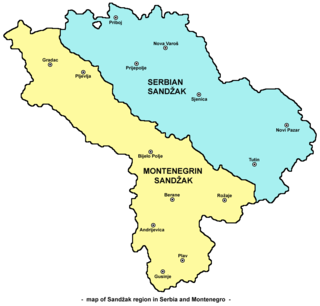
Sandžak is a historical and geo-political region in the Balkans, located in the southwestern part of Serbia and the eastern part of Montenegro. The Serbo-Croatian term Sandžak derives from the Sanjak of Novi Pazar, a former Ottoman administrative district founded in 1865.
The demographic history of Montenegro can be shown through census results and official documents which mention demographic composition.

Ulcinj is a town in the Coastal region of Montenegro and the capital of Ulcinj Municipality. It has an urban population of 11,488.

Southeast Europe or Southeastern Europe (SEE) is a geographical sub-region of Europe, consisting primarily of the region of the Balkans, as well as adjacent regions and archipelagos. There are overlapping and conflicting definitions of the region, due to political, economic, historical, cultural, and geographical considerations.

The Democratic Union of Albanians is a conservative political party of the Albanian minority in Montenegro.

The Kingdom of Montenegro was a monarchy in southeastern Europe, present-day Montenegro, during the tumultuous period of time on the Balkan Peninsula leading up to and during World War I. Officially it was a constitutional monarchy, but absolutist in practice. On 28 November 1918, following the end of World War I, with the Montenegrin government still in exile, the Podgorica Assembly proclaimed unification with the Kingdom of Serbia, which itself was merged into the Kingdom of Serbs, Croats and Slovenes three days later, on 1 December 1918. This unification with Serbia lasted, through various successor states, for almost 88 years, ending in 2006.

Demographic features of the population of Montenegro include population density, ethnicity, education level, health of the populace, economic status, religious affiliations and other aspects.

Kolašin is a town in northern Montenegro. It has a population of 2,989. Kolašin is the centre of Kolašin Municipality and an unofficial centre of Morača region, named after Morača River.
Albanians in Montenegro are ethnic Albanians who constitute 4.97% of Montenegro's total population. They belong to the ethnic Albanian sub-group of Ghegs, and they are the largest non-Slavic ethnic group in Montenegro.

Islam in Montenegro refers to adherents, communities and religious institutions of Islam in Montenegro. It is the second largest religion in the country, after Christianity. According to the 2011 census, Montenegro's 118,477 Muslims make up 20% of the total population. Montenegro's Muslims belong mostly to the Sunni branch. According to the estimate by the Pew Research Center, Muslims have a population of 130,000 (20.3%) as of 2020.
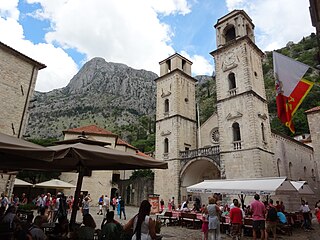
The Catholic Church in Montenegro is part of the worldwide Catholic Church, under the spiritual leadership of the Pope in Rome. Montenegro is not a traditionally Catholic country, as after the Great Schism of 1054 the Montenegrin Christians remained within the sphere of influence of the Church of Constantinople.
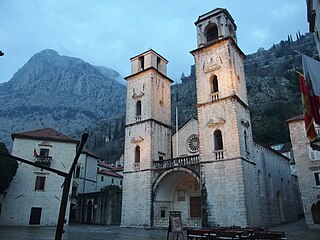
Eastern Orthodox Christianity is the largest religion in Montenegro at 71% of the population, and is the religion of choice for the vast majority of ethnic Montenegrins and Serbs. In addition to Eastern Orthodox Christianity, there is also a sizeable number of adherents to Sunni Islam at 20% of the population, mainly from ethnic Bosniaks and Albanians.
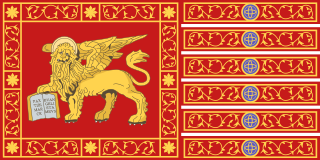
Venetian Albania was the official term for several possessions of the Republic of Venice in the southeastern Adriatic, encompassing coastal territories primarily in present-day southern Montenegro and partially in northern Albania.

The siege of Scutari, also referred to as the siege of Shkodër, known in Turkish as İşkodra Müdafaası(in Turkish) or İşkodra Savunması, took place from 28 October 1912 to 23 April 1913 when the army of the Kingdom of Montenegro defeated the forces of the Ottoman Empire and invaded Shkodër.

The Albania women's national football team represents the country of Albania in international football and is controlled by the Albanian Football Association which is headquartered in the city of Tirana. The team is affiliated with UEFA and competes in the two major professional tournaments, the FIFA World Cup and the UEFA European Championship.

The Malissori uprising or the Albanian revolt of 1911 was one of many Albanian revolts in the Ottoman Empire and lasted from 24 March 1911 until 4 August 1911 in the region of Malësia.

Adrian Lulgjuraj[a] is a Montenegrin-born Albanian singer. Together with Bledar Sejko, he represented Albania in the Eurovision Song Contest 2013 in Malmö with the song "Identitet". The song failed to qualify for the final.

Battle of Ulcinj took place between the Ottoman forces of Dervish Pasha and Albanian irregulars in the year of 1880 at the region of Kodra e Kuqe, close to Kllezna. The area of Plav and Gusinje had been ceded to Montenegro according to the Treaty of Berlin (1878), but the Albanians fought against the annexation. The Great Powers then persuaded the Ottomans to cede the area of Ulcinj, but the Albanians yet again refused. Eventually, the Great Powers commanded the Ottomans to take actions against the League of Prizren, ending the resistance and successfully handing over the town of Ulcinj to Montenegro.
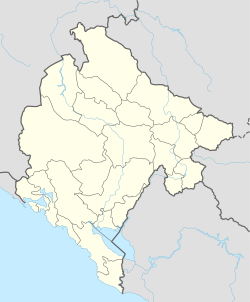

 Montenegro
  Tuzi
Tuzi 