
Montenegro is a country in Southeast Europe, located in the Balkans. It is bordered by Bosnia and Herzegovina to the north, Serbia to the northeast, Kosovo to the east, Albania to the southeast, and Croatia and the Adriatic Sea to the northwest with a coastline of 293.5 km. Podgorica is the country's capital and its largest city; it covers 10.4% of Montenegro's territory of 13,812 square kilometres (5,333 sq mi), and is home to roughly 31% of its total population of 621,000. Cetinje is the former royal capital and cultural centre of Montenegro and is the location of several national institutions, including the official residence of the President of Montenegro.

The League of Prizren, officially the League for the Defense of the Rights of the Albanian Nation, was an Albanian political organization that was officially founded on June 10, 1878 in the old town of Prizren in the Kosovo Vilayet of the Ottoman Empire. It was suppressed in April 1881.
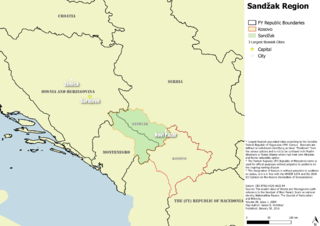
Sandžak is a historical geo-political region located in the southwestern part of Serbia and the eastern part of Montenegro. The name Sandžak derives from the Sanjak of Novi Pazar, a former Ottoman administrative district founded in 1865.
The demographic history of Montenegro can be shown through census results and official documents which mention demographic composition.

Ulcinj is a town on the southern coast of Montenegro and the capital of Ulcinj Municipality. It has an urban population of 10,707 (2011), the majority being Albanians.

Southeast Europe or Southeastern Europe (SEE) is a geographical subregion of Europe, consisting primarily of the cultural region of the Balkans, as well as adjacent regions and archipelagos. There are overlapping and conflicting definitions of the region, due to political, economic, historical, cultural, and geographical considerations.

The Democratic Union of Albanians is a conservative political party of the Albanian minority in Montenegro.

Demographic features of the population of Montenegro include population density, ethnicity, education level, health of the populace, economic status, religious affiliations and other aspects.
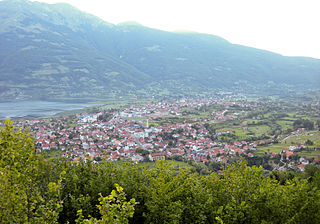
Plav is a town in Polimlje region in north-eastern Montenegro. It has a population of 3,717. Plav is the centre of Plav Municipality.

Rožaje is a town in northeastern Montenegro.

Podgorica Capital City is one of the territorial subdivisions of Montenegro. The seat of municipality is the city of Podgorica. Podgorica municipality covers 10.4% of Montenegro's territory and is home to 29.9% of the country's population. It is the nation's administrative centre and its economic and educational focus.
Albanians in Montenegro are an ethnic group in Montenegro of Albanian descent, which constitute 4.91% of Montenegro's total population. They are the largest non-Slavic ethnic group in Montenegro.

The municipalities are the first level administrative subdivisions of Montenegro. The country is divided into 25 municipalities including the Old Royal Capital Cetinje and the Podgorica Capital City. Podgorica is divided into one subdivision called city municipality, forming the most basic level of local government.
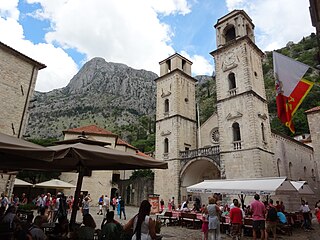
The Catholic Church in Montenegro is part of the worldwide Catholic Church, under the spiritual leadership of the Pope in Rome. Montenegro is not a traditionally Catholic country, as after the Great Schism of 1054 the Montenegrin Christians remained within the sphere of influence of the Church of Constantinople.
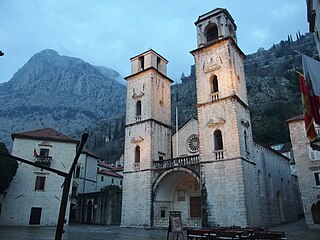
Eastern Orthodox Christianity is largest religion in Montenegro, but there are also sizeable numbers of adherents of both Catholic Christianity and Islam.

Hoti is a historical Albanian tribe (fis) and sub-region of Malësia, a divided area located in northern Albania and southern Montenegro. Its geography is mostly mountainous, but some of its villages are on flat terrain near the banks of Lake of Shkodër.

The siege of Scutari, also referred to as the siege of Shkodër, known in Turkish as İşkodra Müdafaası(in Turkish) or İşkodra Savunması, took place from 28 October 1912 to 23 April 1913 when the army of the Kingdom of Montenegro defeated the forces of the Ottoman Empire and invaded Shkodër.

The Albania women's national football team represents the country of Albania in international football and is controlled by the Albanian Football Association which is headquartered in the city of Tirana. The team is affiliated with UEFA and competes in the two major professional tournaments, the FIFA World Cup and the UEFA European Championship.

The Albanian revolt of 1911 or the Malësori uprising of 1911 was one of many Albanian revolts in the Ottoman Empire and lasted from 24 March 1911 until 4 August 1911 in the region of Malësia.

Adrian Lulgjuraj is a Montenegrin-born Albanian singer. Together with Bledar Sejko, he represented Albania in the Eurovision Song Contest 2013 in Malmö with the song "Identitet". The song failed to qualify for the final.
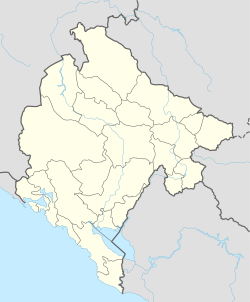

 Montenegro
  Tuzi
Tuzi 