英文互译镜像站

37 Geminorum

Last updated
37 Geminorum
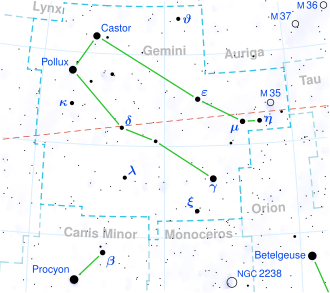
Gemini constellation map.svg
Red circle.svg
Location of 37 Geminorum (circled in red)
Observation data
Epoch J2000       Equinox J2000
Constellation Gemini
Right ascension 06h 55m 18.66636s [1]
Declination +25° 22 32.5036 [1]
Apparent magnitude  (V)5.74 [2]
Characteristics
Evolutionary stage main sequence [1]
Spectral type G0 V [3]
U−B color index +0.01 [4]
B−V color index 0.573±0.010
Astrometry
Radial velocity (Rv)−14.94±0.15 [5] km/s
Proper motion (μ)RA: −37.595 [1] mas/yr
Dec.: +24.234 [1] mas/yr
Parallax (π)57.4559±0.0907  mas [1]
Distance 56.77 ± 0.09  ly
(17.40 ± 0.03  pc)
Absolute magnitude  (MV)4.56 [2]
Details
Mass 1.08 [6]   M
Radius 1.08 [6]   R
Luminosity 1.29 [6]   L
Surface gravity (log g)4.40 [6]   cgs
Temperature 5,913 [6]   K
Metallicity [Fe/H]−0.25 [7]   dex
Rotation 25.0 d [8]
Rotational velocity (v sin i)1.89 [9]  km/s
Age 5.49 [10]   Gyr
Other designations
BD+25°1496, GJ 252, HD 50692, HIP 33277, HR 2569, SAO 78866 [11]
Database references
SIMBAD data

37 Geminorum is a solitary [12] Sun-like star located at the northwest part of the northern constellation of Gemini, about three degrees to the east of the bright star Epsilon Geminorum. [13] The apparent visual magnitude of 37 Geminorum is 5.74, [2] which is just bright enough to be visible to the naked eye on a dark night. It is located at a distance of 57  light years from the Sun based on parallax. [1] This star is drifting closer with a radial velocity of −15 km/s, and is predicted to come as near as 13.8 light-years in approximately a million years. [5] It is positioned close enough to the ecliptic to be subject to lunar occultations, such as happened on April 8, 1984. [14]

Contents

Properties

The stellar classification of 37 Geminorum is G0 V, [3] which indicates it is an ordinary G-type main sequence star that is generating energy through core hydrogen fusion. In 2007, J. C. Hall and associates categorized it as a solar-type with a high mean activity level. [15] The star is around 5.5 [10]  billion years old and is spinning with a rotation period of 25 days. [8] It is slightly larger and more massive than the Sun, [6] with a lower abundance of heavier elements based on its abundance of iron. [7] 37 Geminorum is radiating 1.1 times the luminosity of the Sun from its photosphere at an effective temperature of 5,913  K . [6]

As of 2012, no extrasolar planets or debris disks have yet been discovered around it. [16] The center of the star's habitable zone lies at a distance of 1.32  AU . [17]

Teen Age Message

There was a METI message sent to 37 Geminorum. It was transmitted from Eurasia's largest radar, 70-meter Yevpatoria Planetary Radar. The message was named the Teen Age Message, it was sent on September 3, 2001, and it will arrive at 37 Geminorum in December 2057. [18]

Catalog of Nearby Habitable Systems

The Catalog of Nearby Habitable Systems (HabCat) is a list of approximately 17,000 relatively close stars similar to the sun and considered able to support a planet habitable by humans. 37 Geminorum is on the HabCat list. [19]

See also

References

  1. 1 2 3 4 5 6 7 Vallenari, A.; et al. (Gaia collaboration) (2023). "Gaia Data Release 3. Summary of the content and survey properties". Astronomy and Astrophysics. 674: A1. arXiv: 2208.00211 . Bibcode:2023A&A...674A...1G. doi: 10.1051/0004-6361/202243940 . S2CID   244398875. Gaia DR3 record for this source at VizieR.
  2. 1 2 3 Anderson, E.; Francis, Ch. (2012). "XHIP: An extended hipparcos compilation". Astronomy Letters. 38 (5): 331. arXiv: 1108.4971 . Bibcode:2012AstL...38..331A. doi:10.1134/S1063773712050015. S2CID   119257644.
  3. 1 2 Gray, R.O.; et al. (July 2006). "Contributions to the Nearby Stars (NStars) Project: spectroscopy of stars earlier than M0 within 40 pc-The Southern Sample". The Astronomical Journal . 132 (1): 161–170. arXiv: astro-ph/0603770 . Bibcode:2006AJ....132..161G. doi:10.1086/504637. S2CID   119476992.
  4. Mermilliod, J.-C. (1986). "Compilation of Eggen's UBV data, transformed to UBV (unpublished)". Catalogue of Eggen's UBV Data. SIMBAD. Bibcode:1986EgUBV........0M.
  5. 1 2 Bailer-Jones, C.A.L.; et al. (2018). "New stellar encounters discovered in the second Gaia data release". Astronomy & Astrophysics. 616: A37. arXiv: 1805.07581 . Bibcode:2018A&A...616A..37B. doi:10.1051/0004-6361/201833456. S2CID   56269929.
  6. 1 2 3 4 5 6 7 Stassun, Keivan G.; et al. (9 September 2019). "The Revised TESS Input Catalog and Candidate Target List". The Astronomical Journal. 158 (4): 138. arXiv: 1905.10694 . Bibcode:2019AJ....158..138S. doi: 10.3847/1538-3881/ab3467 . ISSN   0004-6256.
  7. 1 2 Holmberg, J.; et al. (2009). "The Geneva-Copenhagen survey of the solar neighbourhood. III. Improved distances, ages, and kinematics". Astronomy and Astrophysics . 501 (3): 941–947. arXiv: 0811.3982 . Bibcode:2009A&A...501..941H. doi:10.1051/0004-6361/200811191. S2CID   118577511. See Vizier catalogue V/130.
  8. 1 2 Judge, P. G.; et al. (March 2020). "Sun-like Stars Shed Light on Solar Climate Forcing". The Astrophysical Journal. 891 (1): 7. arXiv: 2002.04633 . Bibcode:2020ApJ...891...96J. doi: 10.3847/1538-4357/ab72a9 . S2CID   211082888. 96.
  9. Martínez-Arnáiz, R.; et al. (September 2010). "Chromospheric activity and rotation of FGK stars in the solar vicinity. An estimation of the radial velocity jitter" (PDF). Astronomy and Astrophysics. 520: A79. arXiv: 1002.4391 . Bibcode:2010A&A...520A..79M. doi:10.1051/0004-6361/200913725. S2CID   43455849. Archived from the original (PDF) on 2017-09-22. Retrieved 2018-11-04.
  10. 1 2 Vican, Laura (June 2012). "Age Determination for 346 Nearby Stars in the Herschel DEBRIS Survey". The Astronomical Journal. 143 (6): 135. arXiv: 1203.1966 . Bibcode:2012AJ....143..135V. doi:10.1088/0004-6256/143/6/135. S2CID   118539505.
  11. "* 37 Gem". SIMBAD . Centre de données astronomiques de Strasbourg . Retrieved 2016-09-12.
  12. Fuhrmann, K.; et al. (February 2017). "Multiplicity among Solar-type Stars". The Astrophysical Journal. 836 (1): 23. Bibcode:2017ApJ...836..139F. doi: 10.3847/1538-4357/836/1/139 . 139.
  13. Sinnott, Roger W.; Perryman, Michael A. C. (1997). Millennium Star Atlas. Vol. 1. Sky Publishing Corporation and the European Space Agency. p. 154. ISBN   0-933346-84-0.
  14. Shaimukhametov, R. R.; Rizvanov, N. G. (September 1998). "Photoelectric Observations of Lunar Occultations at Engelhardt Astronomical Observatory". The Astronomical Journal. 116 (3): 1504–1507. Bibcode:1998AJ....116.1504S. doi: 10.1086/300482 .
  15. Hall, Jeffrey C.; et al. (March 2007). "The Activity and Variability of the Sun and Sun-like Stars. I. Synoptic Ca II H and K Observations". The Astronomical Journal. 133 (3): 862–881. Bibcode:2007AJ....133..862H. doi: 10.1086/510356 .
  16. Maldonado, J.; et al. (May 2012). "Metallicity of solar-type stars with debris discs and planets". Astronomy & Astrophysics. 541: A40. arXiv: 1202.5884 . Bibcode:2012A&A...541A..40M. doi:10.1051/0004-6361/201218800. S2CID   46328823.
  17. See, V.; et al. (October 2014). "The effects of stellar winds on the magnetospheres and potential habitability of exoplanets". Astronomy & Astrophysics. 570: 10. arXiv: 1409.1237 . Bibcode:2014A&A...570A..99S. doi:10.1051/0004-6361/201424323. S2CID   16146794. A99.
  18. Zaitsev, Alexander (2006). "Messaging to Extra-Terrestrial Intelligence". arXiv: physics/0610031 .
  19. Turnbull, Margaret C; Tarter, Jill C (2003). "Target Selection for SETI. I. A Catalog of Nearby Habitable Stellar Systems". The Astrophysical Journal Supplement Series. 145 (1): 181–198. arXiv: astro-ph/0210675 . Bibcode:2003ApJS..145..181T. doi:10.1086/345779. S2CID   14734094.
蜘蛛池+镜像 站群镜像程序 网站离线镜像 301镜像站群 泛域名镜像