  | |
| Observation data Epoch J2000 Equinox J2000 | |
|---|---|
| Constellation | Gemini |
| Right ascension | 06h 43m 59.28697s [1] |
| Declination | +13° 13′ 40.8188″ [1] |
| Apparent magnitude (V) | 4.49 [2] |
| Characteristics | |
| Evolutionary stage | red clump [3] |
| Spectral type | K0+ III Ca1 [4] |
| B−V color index | 1.167±0.006 [2] |
| Astrometry | |
| Radial velocity (Rv) | +9.50±0.25 [5] km/s |
| Proper motion (μ) | RA: −0.269 [1] mas/yr Dec.: −53.503 [1] mas/yr |
| Parallax (π) | 10.9027±0.2048 mas [1] |
| Distance | 299 ± 6 ly (92 ± 2 pc) |
| Absolute magnitude (MV) | −0.25 [2] |
| Details | |
| Mass | 2.29±0.62 [6] M☉ |
| Radius | 22.4+0.5 −0.8 [1] R☉ |
| Luminosity | 188.9±4.1 [1] L☉ |
| Surface gravity (log g) | 2.18±0.11 [6] cgs |
| Temperature | 4,518+82 −47 [1] K |
| Metallicity [Fe/H] | −0.11±0.05 [6] dex |
| Rotational velocity (v sin i) | 2.7 [5] km/s |
| Age | 1.20+0.31 −0.25 [6] Gyr |
| Other designations | |
| 30 Gem, BD+13°1390, HD 48433, HIP 32249, HR 2478, SAO 96051, WDS J06440+1314 [7] | |
| Database references | |
| SIMBAD | data |
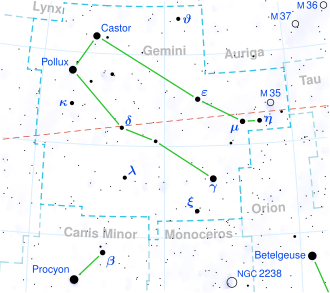
30 Geminorum is a suspected astrometric binary [8] star system in the northern zodiac constellation of Gemini. It is visible to the naked eye as a faint, orange-hued point of light with an apparent visual magnitude of 4.49. [2] The distance to this star, as estimated through the use of parallax, is about 299 light years. [1] It is drifting further away from the Sun with a heliocentric radial velocity of +9.5 km/s. [5]
This is an aging giant star with a stellar classification of K0+ III Ca1, [4] having exhausted the supply of hydrogen at its core and expanded to 22 [1] times the Sun's radius. The suffix notation indicates it displays an overabundance of calcium in its spectrum. It is a red clump giant, [3] which means it is on the horizontal branch and is generating energy through helium fusion at its core. The star is about 1.2 [6] billion years old with 2.3 [6] times the Sun's mass. It is radiating 189 [1] times the luminosity of the Sun from its enlarged photosphere at an effective temperature of 4,518 K. [1]
There is a 13th magnitude visual companion located at an angular separation of 21.20″ along a position angle of 187° from the brighter star, as of 2011. [9]
