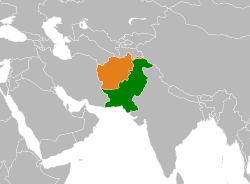
Afghan officials stated that the airstrikes targeted civilian targets and religious centres and resulted in 18 civilian fatalities in Nangarhar province.[25][26][27][16] Pakistani officials denied Afghan authorities' allegations of targeting civilians in Afghanistan, while The Express Tribune, citing military sources, reported 80 militant fatalities.[14][28] While UNAMA also confirmed civilian casualties, Afghanistan condemned Pakistan's airstrikes and vowed a calculated response to the aggression.[29][30]
On 26 February 2026, Afghanistan launched a retaliatory operation against Pakistan, engaging in border clashes and drone attacks on Pakistan. In response, Pakistan launched Operation Ghazab Lil Haq[f] against the Taliban.[31][32] This operation followed an escalation in border skirmishes and cross-border firing incidents along the Durand Line, involving the Afghan Taliban and Pakistan Armed Forces.[33] The following day, Defence Minister of Pakistan Khawaja Asif announced a state of "open war" with Afghanistan, with Pakistan escalating its airstrikes and striking targets throughout Afghanistan, including the capital of Kabul.[34]
The conflict occurred against the backdrop of long-running tensions between Pakistan and the Taliban government of Afghanistan, centred on Pakistan's accusations that Afghan soil is used as a safe haven by the Tehrik-e-Taliban Pakistan (TTP) and other militants to launch attacks inside Pakistan.[30][35] While on 19 October 2025, a Qatar-mediated ceasefire was brokered after the deadliest cross-border clashes in years,[30][35][36][37] its practical implementation was fragile, as the subsequent talks failed to produce a lasting agreement, resulting in continued low-level skirmishes.[30][35][38] The operation took place days after the Saudi Arabian-mediated release of three Pakistani soldiers captured during the October 2025 clashes.[26]
Pakistani Prime Minister Shehbaz Sharif (second from left) visiting Khadija Tul Kubra Mosque in Islamabad on 12 February 2026, following a suicide attack six days prior that Pakistan blamed on Afghanistan
On 11 February 2026, Pakistani Defence Minister Khawaja Asif warned that Pakistan may take action against militants in Afghanistan before the start of the Islamic month of Ramadan if the Taliban fail to deter militant activities from the territory under their control.[39] In February 2026, Pakistan experienced multiple terror attacks on its territory, notably a series of attacks throughout the province of Balochistan over the course of a week from 29 January to 5 February by the Balochistan Liberation Army, a suicide bombing at a Shia mosque on 6 February by the Islamic State's Pakistan Province in the capital city of Islamabad which killed 36 people, and an attack on a checkpoint in Bajaur on 16 February by the Pakistani Taliban which killed 11 soldiers and a child. In response to the latter, the Pakistani government issued a démarche to the Afghan ambassador on 19 February.[40][41][42] A warning followed that Pakistan "would not hesitate" to launch air operations inside Afghanistan if the Taliban government did not take action against militant groups using its territory.[43][44][45]
During the late hours of 21 February, local sources in Afghanistan reported airstrikes in parts of Nangarhar, Paktika, and Khost provinces. In Nangarhar, the strikes were reported in Bihsud and Khogyani districts, while in Paktika, they were reported in Barmal and Urgun districts. Local sources also reported strikes in parts of Khost province, although no further details were provided. Local sources report that the airstrikes in Nangarhar province's Bihsud district struck a civilian home, trapping 23 people beneath the rubble.[16]
In a late-night press release, Pakistani officials confirmed that the Pakistan Air Force had carried out airstrikes in Afghanistan. Officials said the strikes were selective and intelligence-based, and targeted seven militant camps and hideouts linked to the Pakistani Taliban and Islamic State Khorasan Province near the Pakistan–Afghanistan border. Additionally, Pakistan's officials stated that the strikes were conducted as retaliation for the recent terror attacks in Islamabad, Bajaur, and Bannu.[46][14] A Pakistani newspaper, citing military sources, reported that the seven TTP hideouts in Nangarhar, Paktika, and Khost provinces were destroyed and that more than 80 militants were killed;[14] however, Taliban officials in Afghanistan stated that airstrikes took place in Nangarhar and Paktika provinces. They said an airstrike in Bihsud District killed 18 civilians, including 11 children. Afghan Taliban officials also condemned the airstrikes and warned of a calculated response at an appropriate time.[19][47]
Shayesteh Jan Ahadi, former head of the Paktia Provincial Council, stated that Pakistani airstrikes in several districts were very widespread and powerful.[48] The UN Assistance Mission in Afghanistan (UNAMA) reported that Pakistan carried out airstrikes between 11:45 p.m. on 21 February and 12:15 a.m. on 22 February. UNAMA also reported that airstrikes in Paktika province damaged or destroyed infrastructure. On 23 February, UNAMA confirmed that over thirteen civilians had been killed by the Pakistani airstrikes, with an additional seven injured.[18][19][49]
Continued hostilities
24 February
On 24 February, the hostilities resumed as both countries exchanged fire along their borders while both sides blamed each other for provocations. Zabihullah Noorani, head of the Afghan information department in eastern Nangarhar, stated that Pakistani troops carried out the first shots in the Shahkot area near the border.[50]
26 February
On 26 February, at around 20:00 local time (15:30 GMT), Taliban-led Afghanistan's officials announced the launch of what they described as a "retaliatory operation" along the border in the provinces of Nangarhar, Nuristan, Kunar, Khost, Paktia, and Paktika.[51] As per the Taliban officials, 55 Pakistani soldiers were killed, and several others were captured. Taliban-led Afghanistan's officials further added that one military headquarters and 19 border outposts had been captured, while 4 border outposts were destroyed during the operation.[52]Zabihullah Mujahid named seven of the border outposts that Taliban officials claimed to have captured. According to reports, the outposts were located inside Afghanistan, and it remained unclear how border outposts belonging to Pakistani forces were located on Afghan soil.[53] At midnight local time (19:30 GMT), the Taliban-led Afghan Ministry of Defense announced the end of its four-hour operation. Pakistani officials rejected Taliban claims and stated that military action against Taliban forces was continuing. They further added that the attack had been repulsed, that the Taliban had suffered heavy losses, and that two Pakistani soldiers had been killed and three others were injured during the four-hour engagement.[54]
In response to the Taliban's operation, Pakistan launched operation Ghazab Lil Haq and carried out air and ground strikes against Afghan Taliban positions in Kabul, Kandahar, Paktia, and Nangarhar.[55]Faisal Karim Kundi, governor of Khyber Pakhtunkhwa, stated that the Afghan Taliban started the war and Pakistan will be the one to end it,[56] while Khawaja Asif, Pakistan's defense minister, announced the start of 'open war' between the two countries.[57] Pakistani officials stated that around 133 Taliban fighters were killed and more than 200 were injured during the clashes and subsequent operation. They further added that the airstrikes destroyed two corps headquarters, three brigade headquarters, two ammunition depots, one logistics base, three battalion headquarters, two sector headquarters, and more than 80 tanks, artillery pieces, and APCs (armoured personnel carriers). Pakistani officials also said that 27 border posts held by Taliban forces were destroyed and nine were captured.[58] Taliban spokesperson Zabihullah Mujahid confirmed airstrikes in Kabul, Kandahar, Paktia, and several other locations, and stated that these airstrikes did not cause any casualties.[59] The Taliban spokesperson also announced on X (formerly Twitter) that Taliban forces had responded to the airstrikes with attacks against Pakistani military positions in Kandahar and Helmand, two provinces in Afghanistan, although the post was later deleted.[60][61]
In Kabul, residents reported that airstrikes struck an ammunition depot near Darulaman, triggering hours of secondary explosions that rattled homes across the capital.[62][63] Residents also reported hearing the sound of many ambulance sirens following the airstrike on the ammunition depot.[57] Satellite images reviewed by The New York Times confirmed an airstrike on an ammunition depot in Kabul.[64] Additionally, satellite imagery released by Planet Labs revealed damage at two locations in Kabul, which are 400 meters apart. In Gardez, scorch marks and damage to four buildings at a military base belonging to Taliban forces were visible from satellite imagery. Furthermore, NASA gathered and published data indicating a significant heat signature at the military base, suggesting that a sizeable fire had erupted at the site overnight.[65] In Kandahar, Pakistan's officials released aerial footage of a large explosion at an ammunition depot near Kandahar International Airport. BBC News, using satellite imagery, confirmed the location of an ammunition depot in Kandahar. In Paktika, a video shared on social media showed smoke rising from a Taliban military base in the Urgun District. BBC News confirmed the location by matching roads and a distinctive foreground building with satellite imagery.[66] Analysts at Maiar, an intelligence firm, stated that Pakistan's strikes on buildings and other infrastructure in Afghanistan appeared to be largely confined to military sites. They said that one of the buildings struck in Kabul appeared to be a military headquarters or command-and-control centre, and that vehicles parked nearby suggested the building had been occupied. In Kandahar, the analysts reported damage to at least two buildings within a large complex, which they assessed to be a headquarters of some kind.[67]
The airstrikes carried out by the Pakistan Air Force in Kandahar province also struck the former home of Mullah Omar, the late founder of the Taliban, which was currently serving as a base for the Taliban's suicide unit. The property is located about one kilometer from the residence of the current Taliban leader, Hibatullah Akhundzada. According to local Afghan sources, about 15 Taliban members were killed in the strike. Elsewhere in the province, parts of Spin Boldak District were also struck.[13] Additionally, Taliban forces' facility in Pul-e-Charkhi was also struck by Pakistan Air Force.[68] Following Pakistan's airstrikes on Kabul and Kandahar, Zabihullah Mujahid stated that the Taliban were ready to negotiate with Pakistan.[57]
27 February
In the morning, the Pakistan Air Force carried out airstrikes in parts of Paktika and Laghman provinces, according to local Afghan sources. The airstrike in Laghman targeted the 201 Khalid Ibn Walid Corps, while the one in Paktika struck a house.[69] However, according to some Afghan sources, the Taliban-led Afghan armed forces base in Paktika was the one that was struck by the Pakistan Air Force.[70] Afghan local sources also report an airstrike on the Taliban-led Afghan border brigade in Paktika province.[71] Later the same day, at around noon, the Taliban-led Afghan border brigade in Gardez city was also struck by an airstrike carried out by Pakistan's air force.[72] An additional airstrike in parts of Nangarhar was also reported by local Afghan sources.[73] The Taliban-led Afghan armed forces base in Khost Province was also struck in the airstrikes that were carried out on 27 February.[70]
On the same day, the Taliban-led Afghan Ministry of Defense announced that it had carried out airstrikes in Pakistan targeting military sites in Faizabad, Nowshera, Jamrud, and Abbottabad. The ministry did not provide details about the type of aircraft or equipment allegedly used in the attacks.[74] Pakistani officials, however, stated that attempts to strike in Abbottabad, Swabi, and Nowshera using small drones had been foiled using anti-drone systems. They denied that any strike had taken place in Faizabad or Jamrud,[75] and said that these attacks were the work of the Pakistani Taliban rather than the Afghan Taliban.[76] The drone in Swabi crashed near a girls' school, injuring a student.[77] A quadcopter attack on a mosque in Bannu injured five worshippers. Pakistan subsequently imposed a countrywide ban on drone flights.[22]
During the same day, Pakistan's army spokesperson stated that Operation Ghazab Lil Haq was continuing successfully against the Afghan Taliban. He said Pakistani forces had repulsed insurgents at 53 border locations, killing 274 militants, injuring more than 400. He added that 73 Afghan Taliban posts had been destroyed, 18 had been captured, and 115 tanks and armoured vehicles had also been destroyed. He also said Pakistani forces had targeted militant infrastructure at 22 locations in Kandahar, Paktia, Nangarhar, Khost, and Paktika. He added that 12 Pakistani soldiers were killed, 27 were wounded, and one is missing in action.[78] Pakistan's officials also released videos of their strikes in Afghanistan.[79]
Later that day, Afghan Taliban officials announced that they had launched a new wave of attacks against Pakistani border guards in the border areas of Khost and Paktia provinces.[80] The fighting later spread to the border areas of Kunar and Nangarhar provinces.[81] The same day, Pakistani Taliban leader Noor Wali Mehsud ordered the group's fighters to intensify and systematically carry out attacks in support of the Afghan Taliban. He also instructed them to post video evidence of their attacks directly on social media without prior permission.[1] Jamaat ul Ahrar, an offshoot of the Pakistani Taliban, also ordered its fighters to intensify attacks in Pakistan in response to Pakistani airstrikes against the Afghan Taliban. It also said that its fighters would step up attacks in the provinces of Sindh and Punjab.[8] Following these orders, militant attacks on Police stations and outposts were reported in Peshawar, Bannu, Hangu, and Mattani, injuring a police officer and a civilian.[23]
28 February
In the early hours, clashes between Pakistan border guards and Afghan Taliban had been reported along the border areas of Torkham.[82] Later on, an airstrike was carried out by the Pakistan Air Force on an airport in Jalalabad, the provincial capital of Nangarhar province. An AFP journalist reported hearing sounds of two loud explosions from the direction of Jalalabad airport.[83] Pakistan's media outlet also reported an airstrike in Nangarhar province targeting several Taliban headquarters.[84] On the same day, Afghan forces claimed a Pakistani fighter was shot down over Jalalabad using anti-aircraft guns, with the pilot captured alive.[85] Pakistan rejected the Afghan Taliban's claim, labeling it as wartime propaganda.[86] Afterwards, the detained individual was severely beaten by the Afghan Taliban and locals, while being paraded through the market area in Jalalabad, with Taliban officials terming the event as an important war operation. However, later on, it was revealed that the pilot that Afghan forces captured was an ordinary Afghan national who was a parachutist and had no connection to the Pakistani army. Further investigation also revealed that news of downing a fighter jet was false, and the detained individual was later released.[87][88][89]
Elsewhere, the Pakistan Air Force carried out airstrikes in parts of Khost,[90] Kandahar provinces,[91] and Kabul.[92][93] Taliban-led Afghan government deputy spokesperson Hamdullah Fitrat said that 52 people had been killed and 66 others injured as a result of Pakistani attacks on the provinces of Paktika, Khost, Kunar, Nangarhar, and Kandahar. The Taliban-led Afghan Ministry of Defense said that 110 Pakistani soldiers had been killed and 27 Pakistani border posts had been captured.[94] The ministry also said that it had attacked Pakistani military sites in Miranshah and Spinwam, though Pakistan's officials denied that any such attack had taken place.[95][non-primary source needed] On the same day, an attack by Pakistani Taliban on Sra Khawra police checkpost in Khyber Pakhtunkhwa injured one policeman and 6 civilians.[24]
Separately, Pakistan's officials said that 352 Afghan Taliban members had been killed and more than 535 wounded since the fighting began. They added that Pakistani forces had destroyed 130 Taliban border posts, captured 26 others, and destroyed 171 tanks and armoured personnel carriers belonging to Afghan Taliban forces. The officials also said that the Pakistan Air Force had targeted 41 locations in Afghanistan, including brigade and battalion headquarters in Nangarhar province and an army headquarters in Kandahar province.[96] Later on the day, clashes resumed between Pakistan border guards and Afghan Taliban forces along the border areas of Nangarhar, Khost, and Paktia provinces. Taliban-led Afghan armed forces' 203rd Mansouri Corps in Paktia released a video depicting fresh forces being dispatched to areas near the border.[97]
1 March
In the early hours, Pakistan Air Force conducted airstrikes in Kabul with locals reporting hearing sounds of explosions and gunfire in several parts of Kabul, including Darulaman, and areas near the airport and Karte Naw. According to residents, Pakistani fighter aircraft began patrolling and conducting intermittent strikes at about 20:30 local time on 28 February; explosions and gunfire were reported until about 06:00 the following morning. Residents also report hearing sound of explosions and gunfire around Shash Darak neighborhood. Shash Darak is home to several Afghan government and intelligence facilities, including Directorate 40 of the Taliban's intelligence service and offices of the Urban Development Ministry.[98] Afghanistan's Ministry of Defense said that air-defense fire had been directed at Pakistani aircraft over Kabul and advised residents not to be alarmed.[99] Later that day, Pakistan Air Force carried out airstrikes on Bagram Air Base. Taliban officials claimed Pakistan's fighter jets attempted to bomb the base but were repelled by anti-aircraft fire and that no damage was sustained. However, satellite imagery published by The New York Times showed a hangar and two warehouses at the base had been destroyed. Pakistani officials later confirmed the strike on Bagram and said it also destroyed military supplies.[100][101]
On the same day, armed clashes broke out between Taliban and Pakistan border guards along the Torkham border crossing.[102] Afghanistan's Ministry of Defense said that clashes in border areas of Nangarhar, Paktia, Khost, and Kandahar provinces killed 32 Pakistan's soldiers and wounded dozens more. The ministry did not provide figures for casualties among Taliban forces.[103] The ministry also said it had carried out airstrikes on Pakistan's military sites in Khyber Pakhtunkhwa and Balochistan, without specifying the type of aircraft or aerial equipment used. Pakistan's Ministry of Information and Broadcasting rejected the claim and described it as false, stating that no evidence such as satellite imagery, flight data, ground footage, or eyewitness accounts had been provided to substantiate it.[104] In Pakistan's Mohmand District, a drone crashed at Governor Model High School, causing no casualties or significant structural damage.[105] Following the incident, Pakistan's officials temporarily closed a number schools close to the border areas.[106]
Later that day, Pakistan's officials said that Operation Ghazab lil-Haq was ongoing and that, since the start of hostilities, 415 Afghan Taliban fighters had been killed and more than 580 wounded. According to the officials, Pakistan's forces had destroyed 182 Taliban posts, captured 31 others, and disabled 185 tanks and armoured personnel carriers. The officials further add that the Pakistan Air Force has conducted airstrikes at 46 locations inside Afghanistan. The officials also released footage that they said showed Pakistani troops crossing into Afghanistan from North Waziristan and capturing a border outpost belonging to Afghan Taliban.[107][108] Elsewhere, Pakistan's security forces claimed to have taken control of 32 square kilometres (12sqmi) of strategic Afghan territory south of the Zhob sector.[108][109][61] This strategic territory, near the Kandahar Province, is known as the Ghudwana enclave.[110]
At night, local resident in Herat province said that fighter jets were patrolling the skies of the province. In Islam Qala, residents reported hearing two explosions as aircraft flew over. At the same time, armed clashes resumed between Taliban and Pakistan border guards along the border area of Angoor Adda.[111]
2 March
On 2 March, Pakistan Air Force conducted airstrikes in Kabul city, which was confirmed by Taliban officials.[112] According to Afghan local sources, Pakistan Air Force also carried out airstrikes in parts of Panjshir, Kapisa, and Nangarhar provinces. In the provinces of Panjshir and Kapisa, local sources reported that, for the third consecutive night, they had heard aircraft, explosions, and ground-to-air gunfire. According to residents, scattered gunfire was also heard in the area known as Darband Mountain, which connects Panjshir, Kapisa, and Parwan.[113] While in Nangarhar province, Pakistan's warplane bombed a Taliban-led Afghan armed forces' border brigade near the provincial capital Jalalabad. No detail was released about the possible casualty and Taliban officials did not comment on the matter.[114]
On the same day, Pakistani officials stated that, since the start of hostilities, 435 Afghan Taliban fighters had been killed and more than 630 others had been injured. They added that 188 tanks and armoured vehicles had been destroyed, 31 Afghan military posts had been captured, and 51 locations across Afghanistan had been targeted in air strikes.[115] Pakistani security sources also told Reuters that Pakistan's forces had destroyed ammunition depots in Khost and Jalalabad, as well as a drone storage site in Jalalabad, among other targets.[116] Pakistan's officials stated that they were in no hurry to end Operation Ghazab Lil Haq, and that attacks inside Afghanistan would continue until Taliban officials provided credible guarantees that they were taking action to prevent the activities of the TTP in Afghanistan.[117] In Landi Kotal, an artillery shell fired by Taliban forces fell near a residential compound, injuring 4 civilians.[118]
Elsewhere, fighting resumed along the border areas of Afghanistan's Spin Boldak and Pakistan's Mohmand districts.[119]
3 March
On 3 March, the Pakistan Air Force conducted airstrikes in parts of Panjshir, Kabul, Badakhshan, Herat, and Kapisa. Residents of Kabul reported that the city had been subjected to daily airstrikes over the past six days. In Panjshir, residents reported hearing a loud explosion, and said that the Bazarak area was shaken by a strong tremor. In Herat, residents stated that fighter jets were patrolling over the city's airport and that gunfire was heard from the airport. In Badakhshan, residents reported that an airstrike had taken place in the city of Fayzabad.[120] Taliban officials did not release any official details regarding these airstrikes.[121] An airstrike by Pakistan Air Force was also reported in Afghanistan's Nuristan province.[122]
On the same day, a spokesperson for the Taliban-led Afghan government stated that, in the past 24 hours Taliban forces had attacked Pakistan's border outposts along the provinces of Kandahar, Nangarhar, Kunar, Nuristan, Khost, Paktika and Paktika. According to the spokesperson, since the start of the hostilities, Taliban forces had killed more than 150 Pakistan's troops, injured 200 others, and destroyed 40 border outposts belonging to Pakistan.[123] The spokesperson also stated that 28 Taliban fighters had been killed in the clashes, while 42 others had been wounded.[124] As per the spokesperson, 110 Afghan civilians had been killed, while 120 others had been wounded.[17] The spokesperson added that Pakistani attacks in Afghanistan have damaged public facilities, mosques, and houses.[125] The spokesperson also said that Afghanistan has approached Russia, China, the European Union, and United Kingdom to help end the war. The spokesperson warned that as long as Pakistan's attacks inside Afghanistan will continue, Taliban forces will keep on responding.[126] A spokesperson for Taliban-led Afghan Ministry of Defense said that Taliban forces has the ability to block Pakistan's air operations inside Afghanistan.[121]
United Nations Assistance Mission in Afghanistan (UNAMA) announced that at least 42 civilians were killed and 104 others injured in Afghanistan in six days of fighting between the Taliban and Pakistan. The figure include casualties caused by indirect fire during cross-border fighting that struck residential areas in provinces of Paktia, Paktika, Nangarhar, Kunar and Khost, as well as airstrikes in Paktika and Nangarhar. UNAMA urged both countries to halt the clashes, to comply with international law, including international humanitarian law, and to protect civilians.[127][128]
The same day, Pakistan's officials reported clashes with the Taliban at 53 border points along the Afghanistan-Pakistan border that left a number of Taliban and one Pakistani soldier dead.[129][130] Pakistan's officials added that since the start of hostilities, 464 Afghan Taliban personnel had been killed and more than 665 others had been injured. They added that 188 checkposts had been destroyed, 31 posts captured, 192 tanks, armoured vehicles, and artillery pieces destroyed, and 56 locations across Afghanistan targeted in air strikes.[131]
Elsewhere, armed clashes between Taliban and Pakistan's border guards resumed along the border areas of Khost,[132] Kunar,[133] and Zabul provinces. According to Afghan local sources, clashes in Zabul province caused casualties among Taliban forces and destroyed several border outposts belonging to Taliban forces.[134] In Torkham Border Crossing area, Pakistan officials state that they foiled an infiltration bid and killed an Afghan Taliban commander, identified as Qahraman, along with several of his associates.[135]
4 March
The Norwegian Refugee Council reported that a Pakistani artillery attack on an earthquake-affected refugee camp in Khas Kunar District, Kunar province, resulted in three people being killed and seven others being injured, while forcing 650 families from the camp to flee to safety.[136][137] Reuters reported heavy shelling overnight on both sides of the border and that over 1,500 Afghan families had been displaced and many hundreds more having left border villages.[138]
5 March
State broadcaster Radio Pakistan reported that the Pakistani military had destroyed the Afghan Taliban's 205 Corps brigade headquarters in Kandahar with an airstrike.[139][140]
6 March
Several villages in Mohmand District were injured by mortar shells fired from Afghanistan. Both sides claimed to have inflicted significant damage on opposing military targets.[141]
Censorship
During the conflict, the Taliban's intelligence agency (General Directorate of Intelligence) ordered Afghan domestic media outlets not to cover areas targeted in recent Pakistani airstrikes. In some cases, intelligence personnel monitored media offices and newsroom operations to enforce the directive, and media outlets were warned against defying the order.[142] Taliban intelligence officials also warned residents against publishing images or details of locations in Afghanistan targeted by Pakistani strikes.[143] Afghan local sources stated that the Taliban were restricting access to information about their own casualties, as well as those among civilians. They added that only Taliban members were allowed to take images of affected areas and victims, making independent verification of casualties and damage difficult.[144] On 1 March, the Taliban suspended the broadcasts of Rah-e-Farda radio and television in Kabul, a channel affiliated with Mohammad Mohaqiq. The suspension was linked to remarks by Mohammad Mohaqiq, which reportedly criticized the Taliban's recent retaliatory attacks against Pakistan.[145]
Qatar: Qatari Foreign Minister Mohammed bin Abdulaziz Al Khulaifi discussed with Pakistani Foreign Minister Muhammad Ishaq Dar on ways to reduce tension between Pakistan and Afghanistan, thereby strengthening security and stability in the region.[148][failed verification]
Russia: The Russian government offered to mediate the situation and urged both nations to halt cross-border attacks.[148]
Saudi Arabia: Prince Faisal bin Farhan and officials in the Pakistani government discussed ways to reduce regional tensions during a phone call.[149]
United States: The United States stated that it will continue to monitor the situation closely and expressed support for Pakistan against the Taliban attacks.[148] US President Donald Trump praised both Shehbaz Sharif and Asim Munir for fighting against Taliban forces.[150]
In addition, Bangladesh,[151] China,[148] Egypt,[152] Iran,[148] Iraq,[153] Jordan,[154] Malaysia,[155] and Uzbekistan[156] also called for a ceasefire to end hostilities and promoted dialogue to resolve border tensions.
Supranational
United Nations: UN Assistance Mission in Afghanistan (UNAMA) urged both nations to cease hostilities and to take steps to prevent harm to civilians. Richard Bennett, the UN Special Rapporteur on the situation of human rights in Afghanistan, expressed concern over airstrikes in Nangarhar and Paktika, calling on the belligerent parties to exercise "maximum restraint". He stated deep concern for "a significant number of children and civilians" who were killed following the hostilities.[49]
European Union: In a brief statement, the EU Council called on all actors for immediate de-escalation and a halt of hostilities in the area. It reiterated to the Taliban that Afghan territory must not be used to threaten or attack other countries and calls on them to take effective action against all terrorist groups operating in or from Afghanistan.[157]
12Peltier, Elian (28 February 2026). "No Clear Endgame in the Conflict Between Afghanistan and Pakistan". The New York Times. After Pakistan's airstrikes in Afghanistan, the Pakistani Taliban and two other Islamist militant groups urged their fighters to intensify attacks in Pakistan...
This page is based on this Wikipedia article Text is available under the CC BY-SA 4.0 license; additional terms may apply. Images, videos and audio are available under their respective licenses.


 Pakistan