It has been suggested that this article be merged into 2026 Afghanistan–Pakistan war . ( Discuss ) Proposed since February 2026. |
| 2026 Pakistani airstrikes in Afghanistan | |
|---|---|
| Part of 2026 Afghanistan–Pakistan war, Afghanistan–Pakistan clashes (2024–present) | |
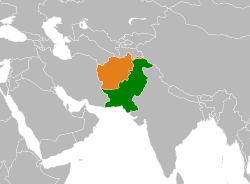
| Map of Pakistan and Afghanistan | |
| Location | Nangarhar Province, Paktika Province, Afghanistan |
| Target | Alleged camps and hideouts of Tehreek-e-Taliban Pakistan and Islamic State – Khorasan Province |
| Date | 22 February 2026 |
| Executed by | Pakistan Air Force |
| Casualties |
|
The 2026 Pakistani airstrikes in Afghanistan were carried out on 22 and 26 February 2026 by Pakistan with multiple airstrikes on targets in eastern Afghanistan, in the provinces of Nangarhar and Paktika that killed at least 18 people. [1] Pakistan stated that the strikes were "intelligence-based, selective operations" against seven camps and hideouts belonging to the Tehreek-e-Taliban Pakistan (TTP, also referred to by Pakistani authorities as Fitna al-Khawarij), its affiliates, and the Islamic State – Khorasan Province (ISKP). [2] [3] [4] [5]
Pakistan described the operation as a retributive response to a series of suicide bombings inside Pakistan, including the 6 February bombing of a Shia mosque in Islamabad that killed 31 worshippers (claimed by ISKP), and attacks in Bajaur and Bannu districts in Khyber Pakhtunkhwa during the early days of Ramadan. This was the seventh time Pakistan has carried out airstrike in Afghanistan since the Afghan Taliban took over in August 2021. [6] [7]
The Taliban-led Afghan government condemned the strikes as a "blatant violation of Afghanistan’s territorial integrity" and a breach of international law, stating that they hit civilian homes, a religious seminary, and other civilian structures, killing at least 18 people (including women and children) and leaving others missing under rubble. Afghan officials vowed an "appropriate and measured response" at a suitable time. [2] [3]
On 26 February 2026, Afghanistan launched a retaliatory operation against Pakistan. In response, Pakistan launched Operation Ghazab Lil Haqq ("Wrath for the Truth") against the Taliban. [8]
The strikes occurred against the backdrop of long-running tensions between Pakistan and the Taliban government of Afghanistan, centred on Pakistan's accusations that Afghan soil is used as a safe haven by the Tehreek-e-Taliban Pakistan (TTP) and other militants to launch attacks inside Pakistan. [3] [7] A fragile ceasefire was agreed in October 2025 after the deadliest cross-border clashes in years, mediated by Qatar, [3] [7] [9] but subsequent talks failed to produce a lasting agreement and low-level incidents continued. [3] [7] The operation took place days after the Saudi Arabia-mediated release of three Pakistani soldiers captured during the October 2025 clashes. [2]
On 11 February 2026, Pakistani defence minister Khawaja Asif warned that Pakistan may take action against militants in Afghanistan before the start of Ramadan if the Taliban did not curb militant activity from its territory. [10] February saw multiple terror attacks in Pakistan, notably a suicide bombing at a Shiite mosque in the capital of Islamabad which killed 36 people and an attack on a checkpoint in Bajaur which killed 11 soldiers and a child. In response to the latter, the Pakistani government issued a démarche to the Afghan ambassador on 19 February. [11] A warning followed that Pakistan "would not hesitate" to launch air operations inside Afghanistan if the Taliban government did not take action against militant groups using its territory. [12] [13] [14] Another suicide attack followed in Bannu on 21 February, after which "Pakistan's patience appeared to have run out". [11]
Pakistan's Ministry of Information and Broadcasting stated that the military conducted "intelligence-based selective targeting" of seven terrorist camps and hideouts along the border region. Specific locations reported by Afghan sources included Girdi Kas village in Bihsud District, Nangarhar Province, and areas in Bermal and Urgun Districts of Paktika Province. The Taliban claimed that the targets included civilian homes and a religious seminary. [2] [6]
Afghan authorities reported at least 18 people killed, including women and children, with one family in Girdi Kas losing 18 of 23 members. Additional casualties were reported in Paktika, and some people remained missing under rubble. A religious seminary and guesthouse struck in Paktika were reported empty at the time of the attacks. [2] [3]