Throughout the 1980s, Marvel embarked on efforts to create film versions of the X-Men stories. After a prolonged development period, Fox purchased the copyrights in 1993 and developed a trilogy comprising X-Men (2000), X2 (2003), and X-Men: The Last Stand (2006). A succession of films followed, expanding the fictional universe. Plans for a reboot led to the production of prequel films chronicling the X-Men as young people, from X-Men: First Class (2011) to Dark Phoenix (2019). Each film was directed and written by various individuals and feature large ensemble casts of actors. Fox oversaw the creation of a trio of Wolverine-centric films, two films centering on Deadpool, and The New Mutants (2020) as X-Menspinoffs. The studio's television networks division produced Legion and The Gifted (both 2017–2019) tangential to the films.
In 2019, The Walt Disney Company purchased Fox in a deal granting Marvel Studios the rights to the X-Men. Films under Disney ownership will be released as part of the Marvel Cinematic Universe (MCU). The first of these films, Deadpool & Wolverine (2024), combined the MCU and Fox universe within the continuity of a multiverse. X-Men actors feature in supporting roles in the MCU, which will continue up to Avengers: Secret Wars (2027). Development of a reboot film is ongoing as of 2025.
Critical opinion about X-Men films differ significantly. Most average at least moderately positive scores on Metacritic and Rotten Tomatoes, but a disparity exists between the best-reviewed entries, X-Men: Days of Future Past (2014) and Logan (2017), and the worst, X-Men Origins: Wolverine (2009), Dark Phoenix, and The New Mutants. At the box office, the films are generally successful and constitute one of the highest-grossing film franchises of all time, grossing over $6billion worldwide.
20th Century Fox films
Throughout the 1980s, Marvel Comics embarked on efforts to develop a theatrical film about the X-Men, a superhero team of mutants created by Stan Lee and Jack Kirby in 1963, whose stories were the company's most popular to that point.[1] Marvel optioned the film rights to create a live-action adaptation with the Toronto-based animation studio Nelvana.[2]Chris Claremont outlined two proposals between 1982 and 1983; his first outline gave particular focus to Kitty Pryde, while the second pitted the X-Men against the Brotherhood of Mutants within the context of the Cold War.[2] Thereafter, Claremont left to concentrate on other endeavors. Around the time Nelvana finalized a distribution agreement with Orion Pictures, Gerry Conway and Roy Thomas were hired to prepare a treatment.[2] The men wrote several treatments, owing to disputes with the Orion producers over the creative direction, triggering a prolonged development phase. The material increasingly deviated from the comics with each subsequent draft.[2] By 1985, Orion was in financial disarray after all but two films failed to yield profits, unravelling the project's development.[2]
Toward the end of the decade, Marvel entered discussions with James Cameron to produce an X-Men film through a venture with his production company Lightstorm Entertainment.[3] Claremont and X-Men co-creator Stan Lee pitched the idea to Lightstorm producers, but the negotiations collapsed as Cameron had obligations to another Marvel property, Spider-Man, with Carolco Pictures at the time.[4] Marvel spent another nine months soliciting bids for the sale of the X-Men film rights, ending when they arranged 20th Century Fox to purchase the copyrights for $2.6 million in June 1993.[5][6] The success of X-Men: The Animated Series (1992–1997) had piqued Hollywood interest in a feature film.[7]
Fox began work on X-Men with producer Lauren Shuler Donner in 1994.[8] The studio approached Bryan Singer early in the film's development and, by July 1996, appointed him as director.[8] Singer was apprehensive about directing but was convinced by his producer Tom DeSanto, an avid fan of the comics.[9] Singer was drawn to the X-Men stories because of their portrayal of the mutants' oppression.[9] Fox engaged a number of writers to develop the finished script,[10] with David Hayter receiving sole credit.[3]
A sequel to X-Men was in development by April 2001.[15] Hayter and Zak Penn produced an early script combining elements of drafts they had written independently.[16] Fox recruited Michael Dougherty and Dan Harris to make revisions to this screenplay; they submitted hundreds of drafts to Singer.[17] The X2 story draws from Claremont's graphic novel X-Men: God Loves, Man Kills (1982).[18] Shooting lasted five months in Vancouver, from June to November 2002.[19]X2 was a trouble-ridden production, and problems were attributed to Singer's escalating dependence on drugs.[8] A confrontation arose when DeSanto urged a pause on filming in response to witnessing Singer inebriated, then another once Fox resumed production the following day, in which the actors threatened to quit.[8]X2 debuted to mostly positive reviews in May 2003 and grossed $407 million at the box office, finishing ninth among the year's highest-grossing films.[20][21]
Singer was preparing a film treatment for a third film, X-Men: The Last Stand, before resigning to direct Superman Returns (2006) in July 2004.[22][23] Fox proceeded with the release of X-Men: The Last Stand without a director until they offered the role to Matthew Vaughn, having been impressed with his work in the crime thriller Layer Cake (2004).[24][25] Vaughn eventually dropped out and was replaced by Brett Ratner.[26] The screenplay was written by Vaughn, Penn, and Simon Kinberg, though only the latter two received credit for their contributions.[27] They drew inspiration from the multi-issue storylines "The Dark Phoenix Saga" and "Gifted" for the film plot.[28] After a five month filming period, Fox released X-Men: The Last Stand in May 2006.[29][30] It drew mixed reviews in the media and was 2006's seventh highest-grossing film.[31][32]
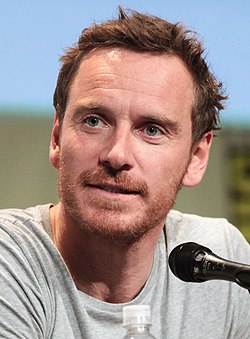
Michael Fassbender (left) and James McAvoy (right) in 2016
The idea of a spinoff chronicling the X-Men as young people was first articulated by Donner in 2003.[33] Kinberg pitched a film version of the comic book series X-Men: First Class, which depicts the characters as teenagers.[33][34] Fox envisioned X-Men: First Class as the first of a trilogy of films.[35] Its main story dwells on Xavier (James McAvoy) and Lehnsherr's (Michael Fassbender) relationship as twenty-somethings and the point at which their friendship dissolves.[34][36]
The script went through multiple revisions from a succession of writers and incorporated ideas gleaned from an abandoned Magneto spinoff written by Sheldon Turner under David Goyer's direction, igniting a dispute over the distribution of screenwriting credits.[34] In response, a Writers Guild of America (WGA) arbitration credited Turner and Singer, who had supervised an early script by Jamie Moss, as the story's creators.[34] The WGA upheld their ruling when Moss appealed.[37] Singer remained involved in X-Men: First Class as a producer.[38] Fox hired Vaughn as the film's director in May 2010.[39] McAvoy and Fassbender lead a fourteen-actor ensemble cast featuring, among others, Jennifer Lawrence, Kevin Bacon, Rose Byrne, January Jones, and Nicholas Hoult.[40] The filmmakers shot X-Men: First Class into early 2011.[41] Despite a poor box office prognosis,[42] the film opened to positive reviews in June 2011, finishing the theatrical run with $353 million.[43][44]
Donner confirmed plans for a sequel, X-Men: Days of Future Past, in a March 2011 cover story published by Empire.[45] Kinberg returned and became the franchise's primary writer.[46][47] The producers originally hired Vaughn to direct; Singer went into the project as Vaughn's replacement after he left to focus on the creation of Kingsman: The Secret Service (2014).[48][49] Kinberg's script borrows from the "Days of Future Past" storyline though features Wolverine time traveling instead of Kitty Pryde (Elliot Page).[50] The filmmakers also used time travel to alter the continuity of events established in X-Men: The Last Stand.[51][52] Fox gave the production a $205 million budget, spending mid-2013 filming X-Men: Days of Future Past in Montreal,[53][54] with reshoots commencing toward the end of the year.[55] Filming was affected by Singer's frequent absences, forcing Kinberg to manage daily operations with Hutch Parker, Newton Thomas Sigel, and John Ottman.[56] The theatrical rollout followed in May 2014.[57]X-Men: Days of Future Past emerged as the sixth highest-grossing film of 2014 with $746 million.[58] At the 87th Academy Awards, the film was nominated for Best Visual Effects.[59]
Preparation for the follow-up film, titled X-Men: Apocalypse, began months before X-Men: Days of Future Past's 2014 release.[60] Singer was rehired as director, while Fox assigned the responsibility for scriptwriting to Kinberg, Dougherty, and Harris.[61][62] For X-Men: Apocalypse, the filmmakers conceived an X-Men origin story inspired by the 1988 story arc "The Fall of the Mutants", introducing Jean Grey (Sophie Turner), Cyclops (Tye Sheridan), Storm (Alexandra Shipp), and Apocalypse (Oscar Isaac).[63][64][65] As well, they wanted resolution for narratives about Xavier, Lehnsherr, Mystique (Lawrence), and Beast (Hoult) that began in X-Men: First Class.[66] Principal photography lasted from April to August 2015,[67][68] and X-Men: Apocalypse opened in May 2016 to mixed reviews and a diminished box office take of $543.9 million.[69][70] After the film's release, Singer came under public scrutiny from reports of his conduct, including allegations of rape.[8][71][72]
Producers had been contemplating a film adapting "The Dark Phoenix Saga" as early as 2003.[73] Largely based on Fox's wishes, they developed the first film version of the story as a subplot for X-Men: The Last Stand, but this treatment was poorly received.[74][75] Kinberg started writing a script for Dark Phoenix in 2016.[76] Fox then ousted Singer for Kinberg as director,[56][71] news of which was confirmed in the media in June 2017.[77] The script portrays an origin story detailing Jean Grey's transformation into the Phoenix, with emphasis on her mental health struggles.[78][79]Dark Phoenix had been imagined as a two-part film; Fox insisted on a single film near the end of pre-production.[56] Shooting occurred from June to October 2017, but reshoots extended the production schedule by a year because the actors had other work commitments.[80] Thus, the studio for a time postponed the exhibition schedule before releasing the film in June 2019.[80]Dark Phoenix was ridiculed by critics and brought Fox a $133 million profit loss, becoming one of the biggest box office bombs of all time.[80][81]
By October 2004, Fox initiated plans for a spinoff exploring Wolverine's origins.[82] The studio hired David Benioff to write the X-Men Origins: Wolverine screenplay,[82] which assembled from a rewrite by Skip Woods and uncredited contributions from David Ayer, James Vanderbilt, and Scott Silver.[83][84][85] Several filmmakers were considered to direct, which Fox eventually assigned to Gavin Hood.[86] Jackman starred and co-produced Wolverine through his production company Seed Productions, earning $20 million.[87][88] The film was shot in New Zealand and Australia beginning in January 2008 and finished in May.[89][90] Critics expressed little enthusiasm upon the film's general release in May 2009 but, having grossed $373 million, Wolverine proved just successful enough to turn a profit.[91][92][93]
A sequel, The Wolverine, was commissioned immediately after X-Men Origins: Wolverine's release.[87] Written by Scott Frank and Mark Bomback,[94][95] the film sees Wolverine dispatched to Japan to protect Mariko Yashida (Tao Okamoto), heiress of Yashida Industries, from yakuza assassins, in a story based on the four-issue miniseries by Claremont and Frank Miller, Wolverine (1982).[96][97] Fox chose James Mangold as The Wolverine's director from a shortlist of eight filmmakers.[98][99] Production took place in Australia from August to November 2012,[100][101] and following its July 2013 debut, the Rotten Tomatoes consensus noted that the film "is one superhero movie that manages to stay true to the comics while keeping casual viewers entertained".[102]The Wolverine ended the theatrical run grossing $414 million.[103]
Logan concludes the Wolverine trilogy and was promoted as Jackman's final performance as Wolverine.[104][105] Mangold once more was tasked with directing.[106] He additionally shares screenwriting credit with Frank and Michael Green, their script depicting a plot derivative of the multi-issue story arc "Old Man Logan", in which an aged Wolverine defends his mutant daughter Laura (Dafne Keen) from a team of cyborg assassins led by Donald Pierce (Boyd Holbrook).[107][108] Mangold cited Western film, Little Miss Sunshine (2006), and the work of Scottish filmmaker Alexander Mackendrick as significant influences on Logan's creative direction.[104] Fox spent three months on principal photography and released the film to critical acclaim in March 2017.[109][110][111] Come the end of its global rollout, Logan amassed $619.2 million and became the first superhero film to receive an Academy Award nomination for Best Adapted Screenplay.[112][113]
Deadpool originated from a joint venture between Marvel and Artisan Entertainment to adapt no fewer than fifteen Marvel superheroes to film in March 2000.[114] The partnership continued into Lionsgate's takeover of Artisan in 2003, but Lionsgate showed little interest in the contingent of characters they inherited and the film rights soon reverted to Marvel.[115] A Deadpool film remained tentatively planned until Fox approved development in May 2009, allocating $50–59 million for the budget.[116][117] It is visual effects specialist Tim Miller's first feature as director, and follows a script written by Rhett Reese and Paul Wernick.[118][119]Ryan Reynolds stars as Deadpool, reprising the role from Wolverine.[116] Filming began in March 2015 and ended in two months.[120] Given its February 2016 release, Deadpool proved popular critically and commercially, grossing an estimated $783 million.[121][122]
After months of speculation, Fox ordered Deadpool 2 while Deadpool ran in theaters in February 2016.[123][124] Reese and Wernick again worked as the screenwriters, developing the script alongside Reynolds and Drew Goddard as an advisor.[125] However, the studio hired a new director, David Leitch, to replace Miller after he dropped out over creative differences with Reynolds.[126] In the film, Deadpool forms the X-Force to save an orphaned mutant (Julian Dennison) from being captured by Cable (Josh Brolin). Shooting for Deadpool 2 started in June 2017, and the film was in production for five months until that October.[127] By the time it opened in May 2018, the film repeated the success of Deadpool, representing the year's ninth highest-grossing film with $785.9 million.[128][129]
Fox's final X-Men film, The New Mutants, had been in the works since 2009.[130]Josh Boone was chosen to direct and shares scriptwriting credit with his childhood friend Knate Lee.[131] The duo produced a comic book based on "The Demon Bear Saga" of The New Mutants (1984) to pitch to Kinberg, which outlined a trilogy of films.[132][133] One goal the filmmakers had was to create a superhero film grounded in horror.[134]
Boone found himself at odds with Fox producers over the film's artistic direction; they disliked the script's comedy and treatment of X-Men characters.[133] The studio mandated multiple rewrites to bring the screenplay closer to their vision, which Boone rejected.[133]The New Mutants features Blu Hunt, Anya Taylor-Joy, Charlie Heaton, Maisie Williams, and Henry Zaga as teenage mutants plotting their escape in captivity from a facility ran by Cecilia Reyes (Alice Braga).[135] It was shot over the summer of 2017,[136] but the production was complicated by dissatisfaction with the film's final cut and Fox's acquisition by The Walt Disney Company.[133][137] Delayed three times, The New Mutants was unsuccessful upon its release in August 2020.[133]
Following the premiere of FX's Fargo in 2014, Noah Hawley deliberated ideas on an X-Men TV adaptation with FX producers.[138] Two concepts were pitched that Hawley rejected, including a show based on the Hellfire Club.[138][139] Afterwards, he turned to Kinberg for guidance and the two discussed David Haller, the mutant son of Xavier with schizophrenia whose hallucinations are an expression of a superpower.[138][140] Hawley said he found this quality fascinating and sought to convey the story using Haller's condition to play on perspective.[138]Legion is situated in a timeline tangential to the X-Men films.[141][142][143]
The show's 13-episode first season debuted on October 2, 2017.[162][163] In January 2018, Fox renewed The Gifted for a second season, which aired to significantly lower ratings than season one.[156][164] The studio inevitably cancelled the program in April 2019.[165]
Marvel Cinematic Universe
In late 2017, Fox began talks with Disney to consolidate their film and television assets.[166] Disney showed interested in Fox's catalog of properties for their subscription streaming service, Disney+, and believed an acquisition could enhance their competitiveness in the industry.[167] A bidding war with Comcast Corporation led to Disney increasing their offer to $71.3 billion in June 2018; Comcast withdrew their bid the next month.[168][169] The deal, finalized on March 20, 2019,[168] conferred rights to the X-Men and Deadpool to Marvel Studios.[170][171] As another result of the acquisition, most planned Fox X-Men films ceased development.[172][173] Films at Disney's behest will be released as part of the Marvel Cinematic Universe (MCU).[173]
Filmmakers at Deadpool & Wolverine Comic-Con panel, 2024
Marvel repurposed a third Deadpool film inherited from Fox into Deadpool & Wolverine.[174]Shawn Levy was hired to direct, having been courted by Reynolds for the job.[174] The men developed the script with Reese, Wernick, and Zeb Wells.[174]Deadpool & Wolverine merges the Fox universe with the MCU through a multiverse story and features several of the associated characters, chiefly Jackman's Wolverine and Reynolds's Deadpool.[174][175][176] Its end-credits scenes include a montage of clips and behind-the-scenes footage as tribute to the Fox films.[177] The shooting, which lasted between May 2023 and January 2024, had been suspended due to an industrywide labor strike by SAG-AFTRA.[178][179]Deadpool & Wolverine premiered in July 2024 and polarized critics, but ended the theatrical run as the highest grossing R-rated film of all time with $1.338 billion.[180][181]
Untitled X-Men film (TBA)
In September 2023, Marvel proceeded with plans to reboot the X-Men.[182] The film will focus on a retelling of the characters in their youth.[183][184] In 2025, Marvel contracted Jake Schreier as director.[185]
Actors from X-Men feature in supporting roles in the MCU. In WandaVision (2021) and Agatha All Along (2024), Evan Peters plays a civilian posing as Pietro Maximoff, deceased twin brother of Wanda (Elizabeth Olsen), directly alluding to the Fox films.[175][186] Stewart's Xavier appears in Doctor Strange in the Multiverse of Madness (2022) as a councillor of the Illuminati.[187] The version of Beast portrayed by Kelsey Grammer makes a cameo appearance in a mid-credits scene in The Marvels (2023).[188] Stewart and Grammer will again reprise their roles with X-Men costars McKellen, Marsden, Romijn, and Alan Cumming for the forthcoming Avengers: Doomsday (2026).[189] Further reprising will continue up to Avengers: Secret Wars (2027).[190]
Timeline
Events in the main continuity X-Men films are traditionally placed in two timelines.[191] The original timeline starts with X-Men Origins: Wolverine, continuing through X-Men: First Class, X-Men, X2, X-Men: The Last Stand, The Wolverine, and up to X-Men: Days of Future Past.[192] The settings are mostly contemporaneous save for X-Men Origins: Wolverine (set between 1845 and 1979), X-Men: First Class (1962), and X-Men: Days of Future Past (partially 2023).[192][193] From X-Men: Days of Future Past, a new timeline emerges corresponding to the prevention of Bolivar Trask's assassination by Wolverine in 1973, which retroactively alters all established film continuity.[191][194][195] This second timeline includes X-Men: Apocalypse and Dark Phoenix, spanning from 1983 to 1992.[192][194]
However, continuity in the films is not uniform and has been subjected to perceived errors related to storytelling and characters.[b] The Deadpool films, for example, feature a distinct interpretation of Deadpool than X-Men Origins: Wolverine despite being played by the same actor,[200] though cameos from the young X-Men in Deadpool 2 attempt to convey these films are also part of the new timeline.[201] Jackman stated that Logan transpires in an alternate timeline, contradicting Mangold's claim that it does in fact occur in tandem with the core films.[202][203]The New Mutants contains some references to the X-Men though bears no obvious relationship to events in the main continuity films.[204] Nevertheless, Marvel designated the X-Men universe as Earth-10005 within the context of their multiverse.[205]
Richard George of IGN stated that the success of the first X-Men film paved the way for comic-book film adaptations such as the Spider-Man series, Fantastic Four (2005), V for Vendetta and Singer's Superman Returns.[334] Chris Hewitt of Empire magazine called the first X-Men film as the "catalyst" for films based on Marvel Comics characters, stating "Singer's 2000 film is the catalyst for everything that's come since, good and bad. Without it, there's no Marvel Studios."[335] Comic-book writer Mark Millar said that Singer's X-Men "revolutionized" superhero films.[336]
Rebecca Rubin of Variety magazine stated that the X-Men franchise has proven there is an audience for a hardline superhero film, while Jeff Bock of Exhibitor Relations said that with films like the Deadpool films and Logan, the studios can do more with an R-rated film and give the audience something new.[337] However, Tim Grierson and Will Leitch of New York magazine's Vulture criticized the series, noting that the best films of the series failed to capture the zeitgeist the way Marvel Cinematic Universe films did.[338]
↑Fleming, Michael & Brodesser, Clause (June 5, 2005). "New master for mutants". Variety. Archived from the original on November 7, 2012. Retrieved December 11, 2010.
↑Michael Fleming; Pamela McClintock (October 30, 2007). "Studios prep back-up plan". Variety. Archived from the original on November 11, 2019. Retrieved February 23, 2026.
Smith, Matthew J. (2013). Duncan, Randy (ed.). Icons of the American Comic Book: From Captain America to Wonder Woman. Bloomsbury Publishing. ISBN9798216100577.
Mell, Eila (2015). Casting Might-Have-Beens: A Film by Film Directory of Actors Considered for Roles Given to Others. McFarland & Company. ISBN9781476609768.
This page is based on this Wikipedia article Text is available under the CC BY-SA 4.0 license; additional terms may apply. Images, videos and audio are available under their respective licenses.