A reserve currency is a foreign currency that is held in significant quantities by central banks or other monetary authorities as part of their foreign exchange reserves. The reserve currency can be used in international transactions, international investments and all aspects of the global economy. It is often considered a hard currency or safe-haven currency.
A virtual economy is an emergent economy existing in a virtual world, usually exchanging virtual goods in the context of an Internet game. People enter these virtual economies for recreation and entertainment rather than necessity, which means that virtual economies lack the aspects of a real economy that are not considered to be "fun". However, some people do interact with virtual economies for "real" economic benefit.

The Malaysian ringgit is the currency of Malaysia. It is divided into 100 sen (cents). The ringgit is issued by the Bank Negara Malaysia.

Second Life is an online virtual world, developed and owned by the San Francisco-based firm Linden Lab and launched on June 23, 2003. By 2013, Second Life had approximately one million regular users; at the end of 2017 active user count totals "between 800,000 and 900,000". In many ways, Second Life is similar to massively multiplayer online role-playing games; however, Linden Lab is emphatic that their creation is not a game: "There is no manufactured conflict, no set objective".
A virtual world is a computer-based simulated environment which may be populated by many users who can create a personal avatar, and simultaneously and independently explore the virtual world, participate in its activities and communicate with others. These avatars can be textual, two or three-dimensional graphical representations, or live video avatars with auditory and touch sensations. In general, virtual worlds allow for multiple users but single player computer games, such as Skyrim, can also be considered a type of virtual world.

Gaia Online is an English language, anime-themed social networking and forums-based website. It was founded as go-gaia on February 18, 2003, and the name was changed to GaiaOnline.com in 2004 by its owner, Gaia Interactive. Gaia originally began as an anime linklist and eventually developed a small community, but following a statement by founder Derek Liu, the website moved towards social gaming, and eventually became forum-based. In 2007, over a million posts were made daily, and 7 million unique users visited each month. Gaia also won the 2007 Webware 100 award in the Community category and was included in Time Magazine's list of 50 best websites in 2008. In January 2011, the company won the Mashable Best User experience Award for 2010.
Entropia Universe is a massively multiplayer online (MMORPG) virtual universe designed by the Swedish software company MindArk, based in Gothenburg.

Philip Rosedale is an American entrepreneur who founded Linden Lab, which develops and hosts the virtual world Second Life.

Linden Research, Inc., doing business as Linden Lab, is a privately held American Internet company that is best known as the creator of Second Life.

The Warsaw Stock Exchange (WSE), Polish: Giełda Papierów Wartościowych w Warszawie, is a stock exchange in Warsaw, Poland. It has a market capitalisation of PLN 1,346 trillion.
Gold farming is the practice of playing a massively multiplayer online game (MMO) to acquire in-game currency later selling it for real-world money.
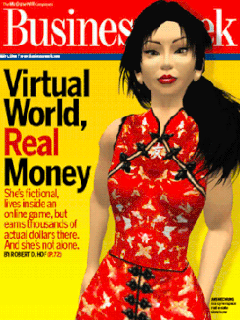
Anshe Chung is an avatar of Ailin Graef in the online world Second Life. Referred to as the Rockefeller of Second Life by a CNN journalist, Graef has built an online business that engages in development, brokerage, and arbitrage of virtual land, items, and currencies, and has been featured in a number of prominent magazines such as Business Week, Fortune and Red Herring.
Due to constant development, and as an open environment accessible by almost anyone with access to the Internet, a number of difficulties have arisen around Second Life. Problems range from the technical to moral (pornography), legal and, in September 2006, security.
The virtual world Second Life has its own economy and a virtual token referred to as Linden Dollars (L$). In the SL economy, users buy from and sell to one another directly, using the Linden, which is a closed-loop virtual token for use only within the Second Life platform. Linden Dollars have no monetary value and are not redeemable for monetary value from Linden Lab. A resident with a surplus of Linden Dollars earned via a Second Life business or experiential play can request to refund their Linden Dollar surplus to PayPal. This economy is independent of the price of the game, which users pay to Linden Lab, not to each other. Linden Lab reports that the Second Life economy generated US$3,596,674 in economic activity during the month of September 2005, and as of September 2006 Second Life was reported to have a GDP of US$64,000,000.
In the virtual world of Second Life, there are a number of in-world business and user-groups founded specifically for the game, some of which have become legal entities in their own right, as well as preexisting companies and organizations that have involved themselves in the world.
Avatars United was a web community for avatars of online games and virtual worlds. It was launched in March 2008 by Sweden-based Enemy Unknown and closed in October 2010. It was owned by Linden Lab, which announced its closure on September 23, 2010.
The Patriotic Nigras are a group of griefers in the online world of Second Life.
Virtual goods are non-physical objects and money purchased for use in online communities or online games. Digital goods, on the other hand, may be a broader category including digital books, music, and movies. Virtual goods are intangible by definition.
GamePal is an online platform for players of massively multiplayer online (MMO) games to buy, sell and trade digital assets such as in-game currency, items, accounts, and power leveling services. The site is a neutral marketplace that supports player-to-player as well as direct selling for popular MMOs.
Sansar is a social virtual reality platform developed and owned by the San Francisco-based firm Linden Lab and launched in “creator beta” to the general public on July 31, 2017. The platform enables user-created 3D spaces where people can create and share interactive social experiences, such as playing games, watching videos, and having conversations in VR. Each participant is represented by a detailed avatar that is the graphical representation of the user including speech-driven facial animations and motion-driven body animations.
