
The 1852 United States presidential election was the 17th quadrennial presidential election, held on Tuesday, November 2, 1852. Democrat Franklin Pierce defeated Whig nominee General Winfield Scott. A third party candidate from the Free Soil party, John P. Hale, also ran and came in third place, but got no electoral votes.
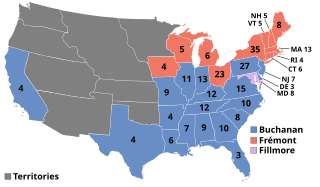
The 1856 United States presidential election was the 18th quadrennial presidential election, held on Tuesday, November 4, 1856. In a three-way election, Democrat James Buchanan defeated Republican nominee John C. Frémont and Know Nothing nominee Millard Fillmore. The main issue was the expansion of slavery as facilitated by the Kansas–Nebraska Act of 1854.

The Prohibition Party (PRO) is a political party in the United States known for its historic opposition to the sale or consumption of alcoholic beverages and as an integral part of the temperance movement. It is the oldest existing third party in the United States and the third-longest active party.

George Wallace Jones was an American frontiersman, entrepreneur, attorney, and judge, was among the first two United States Senators to represent the state of Iowa after it was admitted to the Union in 1846. A Democrat who was elected before the birth of the Republican Party, Jones served over ten years in the Senate, from December 7, 1848 to March 3, 1859. During the American Civil War, he was arrested by Federal authorities and briefly jailed on suspicion of having pro-Confederate sympathies.
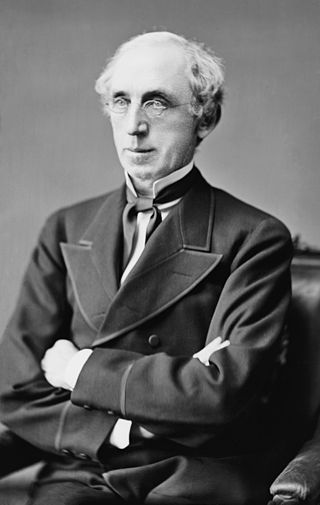
Henry B. Payne was an American politician from Ohio. Moving to Ohio from his native New York in 1833, he quickly established himself in law and business while becoming a local leader in Democratic politics. After serving in the Ohio Senate, Payne was elected to a single term in the United States House of Representatives in 1874. In the House, he worked unsuccessfully for a compromise in the debate over whether all of the nation's currency should be backed by gold. He was defeated for reelection, but served on the Electoral Commission that convened in early 1877 to resolve the dispute over the results of the 1876 presidential election.

William Hayden English was an American politician. He served as a U.S. Representative from Indiana from 1853 to 1861 and was the Democratic Party's nominee for Vice President of the United States in 1880.

The Kansas Republican Party is the state affiliate political party in Kansas of the United States Republican Party. The Kansas Republican Party was organized in May 1859.
In American politics, a conservative Democrat is a member of the Democratic Party with conservative political views, or with views that are conservative compared to the positions taken by other members of the Democratic Party. Traditionally, conservative Democrats have been elected to office from the Southern states, rural areas, the Rust Belt, and the Midwest. In 2019, the Pew Research Center found that 14% of Democratic and Democratic-leaning registered voters identify as conservative or very conservative, 38% identify as moderate, and 47% identify as liberal or very liberal.

The 34th United States Congress was a meeting of the legislative branch of the United States federal government, consisting of the United States Senate and the United States House of Representatives. It met in Washington, D.C., from March 4, 1855, to March 4, 1857, during the last two years of Franklin Pierce's presidency. The apportionment of seats in the House of Representatives was based on the 1850 United States census. The Whig Party, one of the two major parties of the era, had largely collapsed, although many former Whigs ran as Republicans or as members of the "Opposition Party." The Senate had a Democratic majority, and the House was controlled by a coalition of Representatives led by Nathaniel P. Banks, a member of the American Party.

The 1912–13 United States Senate elections were held on various dates in various states. They were the last U.S. Senate elections before the ratification of the Seventeenth Amendment in 1913, establishing direct elections for all Senate seats. Senators had been primarily chosen by state legislatures. Senators were elected over a wide range of time throughout 1912 and 1913, and a seat may have been filled months late or remained vacant due to legislative deadlock. Some states elected their senators directly even before passage of Seventeenth Amendment. Oregon pioneered direct election and experimented with different measures over several years until it succeeded in 1907. Soon after, Nebraska followed suit and laid the foundation for other states to adopt measures reflecting the people's will. By 1912, as many as 29 states elected senators either as nominees of their party's primary or in conjunction with a general election.

The 1856 Republican National Convention was a presidential nominating convention that met from June 17 to June 19 in Philadelphia, Pennsylvania. It was the first national nominating convention of the Republican Party, which had been founded two years before, and was held to nominate the party's candidates for president and vice president in the 1856 election. The convention selected former Senator John C. Frémont of California for president and former Senator William L. Dayton of New Jersey for vice president. The convention also appointed the members of the newly-established Republican National Committee.

Peter Francis Tague was a member of the United States House of Representatives from Boston, Massachusetts.
The 1856 Democratic National Convention was a presidential nominating convention that met from June 2 to June 6 in Cincinnati, Ohio. It was held to nominate the Democratic Party's candidates for president and vice president in the 1856 election. The convention selected former Secretary of State James Buchanan of Pennsylvania for president and former Representative John C. Breckinridge of Kentucky for vice president.

William Henry Hines was an American politician who served as a Democratic member of the U.S. House of Representatives for Pennsylvania's 12th congressional district from 1893 to 1895.

George Frederick Richardson was a politician from the U.S. states of Michigan and Washington.
1856 in the United States included some significant events that pushed the nation closer towards civil war.
The 1856 United States elections elected the members of the 35th United States Congress and the President to serve from 1857 until 1861. The elections took place during a major national debate over slavery, with the issue of "Bleeding Kansas" taking center stage. Along with the 1854 elections, these elections occurred during the transitional period immediately preceding the Third Party System. Old party lines were broken; new party alignments along sectional lines were in the process of formation. The Republican Party absorbed the Northern anti-slavery representatives who had been elected in 1854 under the "Opposition Party" ticket as the second-most powerful party in Congress. Minnesota and Oregon joined the union before the next election, and elected their respective Congressional delegations to the 35th Congress.

Robert M. Veatch (1843–1925), commonly known in his later years as "Uncle Bob," was a teacher, farmer, mercantile owner, and politician in the U.S. state of Oregon. Veatch is best remembered for having served two terms in each the Oregon House of Representatives and Oregon State Senate and for having served as the long-time mayor of Cottage Grove, Oregon.

