
Wilbur W. Marsh (July 14, 1862 - December 23, 1929), was treasurer of the Democratic National Committee. [1]
Wilbur W. Marsh (July 14, 1862 - December 23, 1929), was treasurer of the Democratic National Committee. [1]
He was born in New York on July 14, 1862. He was a Democratic National Committeeman in 1912 and again in 1916. [1] He was the Committee's treasurer from 1916 to 1924. [2] [3]
He was a delegate to 1920 Democratic National Convention and the 1928 Democratic National Convention representing Iowa. [1]
Marsh died at his home in Waterloo, Iowa, on December 23, 1929, after having a stroke while driving his car. [1]

The Democratic National Committee (DNC) is the governing body of the United States Democratic Party. The committee coordinates strategy to support Democratic Party candidates throughout the country for local, state, and national office, as well as works to establish a "party brand". It organizes the Democratic National Convention held every four years to nominate a candidate for President of the United States and to formulate the party platform. While it provides support for party candidates, it does not have direct authority over elected officials. When a Democrat is president, the White House controls the Committee. According to Boris Heersink, "political scientists have traditionally described the parties’ national committees as inconsequential but impartial service providers."

Curtis Dwight Wilbur was an American lawyer, California state judge, 43rd United States Secretary of the Navy and a United States circuit judge of the United States Court of Appeals for the Ninth Circuit.

Oscar Wilder Underwood was an American lawyer and politician from Alabama, and also a candidate for President of the United States in 1912 and 1924. He was the first formally designated floor leader in the United States Senate, and the only individual to serve as the Democratic leader in both the Senate and the United States House of Representatives.
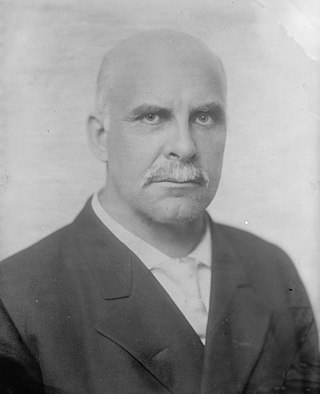
Eugene Wilder Chafin was an American politician and writer who served as the Prohibition Party's presidential candidate during the 1908 and 1912 presidential elections. He was active in local politics in Wisconsin, statewide elections in Wisconsin, Illinois, and Arizona, and campaigned throughout the United States and the world in favor of the prohibition of alcohol.
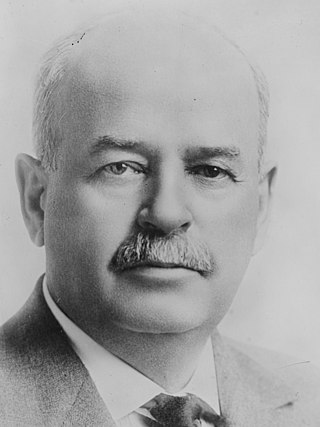
Lennington "Len" Small was an American politician who served as the 26th Governor of Illinois from 1921 to 1929. He previously was a member of the Illinois state senate from the 16th District from 1901 to 1903 and was Illinois state treasurer, from 1905 to 1907, and from 1917 to 1919. He is known for accusations of embezzlement brought against him.

Joseph Christopher O'Mahoney was an American journalist, lawyer, and politician. A Democrat, he served four complete terms as a U.S. Senator from Wyoming on two occasions, first from 1934-1953 and then again from 1954-1961.

The 1924 Republican National Convention was held in Cleveland, Ohio, at the Public Auditorium, from June 10 to 12.

Joseph Maull Carey was an American lawyer, rancher, judge, and politician, who was active in Wyoming local, state, and federal politics.

Charles Winfield Waterman was a Colorado attorney and politician. He is most notable for his service as a United States senator from Colorado.
Walter Walker was a newspaper owner and editor in Colorado who briefly served as Democratic United States Senator in late 1932 after being appointed to fill a vacancy pending a special election.

Ernest Harold Cluett was an American businessman and politician from Troy, New York. A Republican, he was most notable for his service as a United States representative from 1937 to 1943.

Eugene Elliott Reed was a U.S. Representative from New Hampshire.

Scott Ferris was a U.S. Representative from Oklahoma.

Charles Dewey Hilles was a politician from the U. S. state of New York.

Halvor Langdon Halvorson was an American politician and attorney who served as the mayor of Minot, North Dakota and later became a perennial candidate in North Dakota's congressional elections.

James Ross Carpenter was a Wyoming politician and inventor who served in the Wyoming Senate as a member of the Democratic Party. Prior to his political career he helped in the foundation and advertisement of multiple towns in Wyoming.
This is a list of endorsements for declared candidates in the Democratic primaries for the 1928 United States presidential election.
| General | |
|---|---|
| National libraries | |
| Other | |
