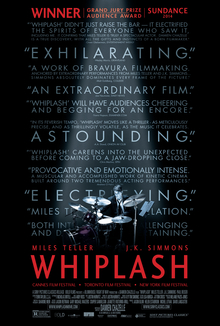
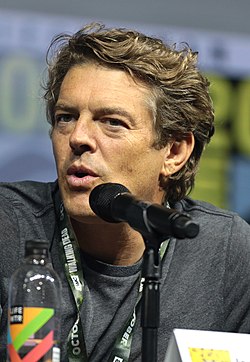
The film was produced by Bold Films, Blumhouse Productions, and Right of Way Films. Sony Pictures acquired distribution rights for most of the world, releasing the film under Sony Pictures Classics in North America, Germany, and Australia, and Stage 6 Films in the UK, Scandinavia, Benelux, Eastern Europe (excluding the CIS), Greece, South Africa, Spain, Italy, Portugal and Latin America.[3][4]
Chazelle completed the script in 2013, drawing upon his experiences in a "very competitive" jazz band in high school. Soon after, Right of Way and Blumhouse helped Chazelle turn fifteen pages of the screenplay into an 18-minute short film. The short film received acclaim after debuting at the 2013 Sundance Film Festival, which attracted investors to produce the complete version of the script. Filming took place in September 2013 throughout Los Angeles over twenty days. The film explores concepts of perfectionism, dedication, and success, and deconstructs the concept of ambition.
Andrew Neiman, a 19-year-old jazz drummer, attends the prestigious Shaffer Conservatory in New York City. Terence Fletcher, the conductor of Shaffer's most prestigious ensemble, overhears Neiman practicing and prompts him to play rudiments and a double-time swing beat. Unimpressed, Fletcher leaves, but later recruits him to perform in his ensemble as a backup for the core drummer, Carl Tanner. Fletcher is relentlessly strict and abuses his students verbally and physically. When Neiman apparently fails to keep tempo on Hank Levy's "Whiplash" during his first ensemble rehearsal, Fletcher throws a chair at him, repeatedly slaps his face, and berates him. Determined to impress Fletcher, Neiman excessively practices, often until his hands bleed.
After their first set at a jazz competition, Neiman misplaces Tanner's sheet music. Tanner cannot play without the sheets, so Fletcher allows Neiman to perform; Shaffer wins the competition. Fletcher promotes Neiman to core drummer, but abruptly reassigns the position to Ryan Connolly, a drummer from a lower-level ensemble within Shaffer. Neiman's single-mindedness toward music leads to him clashing with his family and breaking up with his girlfriend. One day, Fletcher begins rehearsal by announcing that Sean Casey, a former member of the Studio Band, has died in a car accident. He then pushes the three drummers to play at a faster tempo on "Caravan", keeping them for a grueling five-hour practice. Neiman earns the core position back after he is the only one able to perform on tempo.
Neiman's bus gets a flat tire on his way to the next competition. He rents a car, but arrives late and forgets his drumsticks at the rental office. Neiman races back and retrieves them, but his car is hit by a truck on the way back. An injured Neiman runs to the theater, arriving bloodied and weak as the ensemble enters the stage. He struggles to keep tempo and Fletcher halts the performance to dismiss him. Enraged, Neiman attacks Fletcher onstage and is expelled from Shaffer. At the request of his father, Neiman meets a lawyer representing Casey's parents. Casey actually hanged himself after suffering from depression and anxiety due to Fletcher's abuse; his parents want Fletcher held accountable. Neiman agrees to anonymously testify against Fletcher, whom Shaffer fires.
Months later, Neiman, having abandoned drumming, encounters Fletcher playing piano at a jazz club. They have a conversation over drinks. Fletcher admits he was harsh, but insists his methods were necessary to motivate students. He cites a story where Jo Jones allegedly threw a cymbal at Charlie Parker to argue that the next transformative jazz musician would never let themselves be discouraged. Fletcher invites Neiman to perform with his professional band at a New York JVC Jazz Festival, playing the same pieces from Shaffer; Neiman accepts.
At the festival, Fletcher reveals he knows Neiman testified against him; as revenge, he leads the band into a song that Neiman does not know. A humiliated Neiman walks offstage. After his father embraces him, Neiman returns to the stage, reclaims the drum kit, and cuts off Fletcher by cueing the band into "Caravan". Fletcher, though angered, resumes conducting. Towards the end of "Caravan", Neiman improvises a lengthy solo. Impressed, Fletcher nods in approval before cueing the final chord.
While attending Princeton High School, writer-director Damien Chazelle was in a "very competitive" studio band and drew on the dread he felt in those years.[6] He based the conductor, Terence Fletcher, on his former band instructor (who died in 2003) but "pushed it further", adding elements of Buddy Rich and other band leaders known for their harsh treatment.[6] Chazelle wrote the film "initially in frustration" while trying to get his musical La La Land off the ground.[7]
Right of Way Films and Blumhouse Productions helped Chazelle turn fifteen pages of his original screenplay into a short film starring Johnny Simmons as Neiman and J. K. Simmons (no relation)[8] as Fletcher.[9] The eighteen-minute short film received acclaim after debuting at the 2013 Sundance Film Festival, winning the short film Jury Award for fiction,[10][11] which attracted investors to produce the complete version of the script.[12] The feature-length film was financed for $3.3 million by Bold Films.[3]
In August 2013, Miles Teller signed on to star in the role originated by Johnny Simmons; J. K. Simmons remained attached to his original role.[13] Early on, Chazelle gave J. K. Simmons direction that "I want you to take it past what you think the normal limit would be," telling him: "I don't want to see a human being on-screen any more. I want to see a monster, a gargoyle, an animal." Many of the band members were real musicians or music students, and Chazelle tried to capture their expressions of fear and anxiety when Simmons pressed them. Chazelle said that, between takes, Simmons was "as sweet as can be", which he credits for keeping "the shoot from being nightmarish".[6]
Filming
Principal photography began in September 2013, with filming taking place throughout Los Angeles, including the Hotel Barclay, Palace Theater, and the Orpheum Theatre.[14][15] The film was shot in nineteen days, with a schedule of fourteen hours of filming per day.[16] Chazelle was involved in a serious car accident in the third week of filming and was hospitalized with possible concussion, but he returned to set the following day to wrap the shoot on time.[16]
Having taught himself to play drums at age fifteen, Teller performed much of the drumming seen in the film. Supporting actor and jazz drummer Nate Lang, who plays Neiman's rival Carl in the film, trained Teller in the specifics of jazz drumming; this included changing his grip from matched to traditional.[17][18] For certain scenes, professional drummer Kyle Crane served as Teller's drum double.[19]
The soundtrack album was released on October 7, 2014,[20] via the Varèse Sarabande label.[21] The soundtrack consists of 24 tracks divided in three different parts: original jazz pieces written for the film, original underscore parts written for the film, and classic jazz standards written by Stan Getz, Duke Ellington, and other musicians. The actual drummer was Bernie Dresel.[22]
On March 27, 2020, an expanded deluxe edition was released on double CD and 2-LP gatefold sleeve vinyl with new cover art, featuring a bonus track, "Fletcher's Song", and a "Caravan" remix by Timo Garcia.[23]
Reception
Box office
In North America, the film opened in a limited release on October 10, 2014, in six theaters, grossing $135,388 ($22,565 per theater) and finishing 34th at the box office.[2] It expanded to 88 locations, then 419 locations.[24] After three months on release, it had earned $7 million, and finally expanded nationwide to 1000 locations to capitalize on receiving five Academy Awards nominations.[25] As of October 3, 2024, Whiplash grossed $14 million in the U.S. and Canada and $36.3 million in other territories, for a worldwide total of $50.4 million against a budget of $3.3 million.[2]
On the review aggregation website Rotten Tomatoes, the film scored 94% based on 304 reviews, with an average rating of 8.6/10. The site's critical consensus states, "Intense, inspiring, and well-acted, Whiplash is a brilliant sophomore effort from director Damien Chazelle and a riveting vehicle for stars J. K. Simmons and Miles Teller."[26] On Metacritic the film has a score of 89 out of 100, based on reviews from 49 critics, indicating "universal acclaim".[27] Simmons received wide praise for his performance and won the 2015Academy Award for Best Supporting Actor.[28][29]
Peter Debruge, in his review for Variety, said that the film "demolishes the cliches of the musical-prodigy genre, investing the traditionally polite stages and rehearsal studios of a topnotch conservatory with all the psychological intensity of a battlefield or sports arena."[30]Todd McCarthy of The Hollywood Reporter praised the performances of Teller and Simmons, writing: "Teller, who greatly impressed in last year's Sundance entry The Spectacular Now, does so again in a performance that is more often simmering than volatile ... Simmons has the great good fortune for a character actor to have here found a co-lead part he can really run with, which is what he excitingly does with a man who is profane, way out of bounds and, like many a good villain, utterly compelling."[31]Whiplash also won the 87th Academy Award for Best Sound Mixing and the 87th Academy Award for Best Film Editing.[32]
Amber Wilkinson of The Daily Telegraph praised the direction and editing, writing: "Chazelle's film has a sharp and gripping rhythm, with shots beautifully edited by Tom Cross... often cutting to the crash of Andrew's drums."[33] James Rocchi of Indiewire gave a positive review and said, "Whiplash is [...] full of bravado and swagger, uncompromising where it needs to be, informed by great performances and patient with both its characters and the things that matter to them."[34] Henry Barnes of The Guardian gave the film a positive review, calling it a rare film "about music that professes its love for the music and its characters equally."[32]
Forrest Wickman of Slate said the film distorted jazz history and promoted a misleading idea of genius, adding, "In all likelihood, Fletcher isn't making a Charlie Parker. He's making the kind of musician that would throw a cymbal at him."[35] In The New Yorker, Richard Brody said, "Whiplash honors neither jazz nor cinema."[36]
Top ten lists
The film appeared on many critics' end-of-year lists. Metacritic collected lists published by major film critics and publications and in their analysis, recorded that Whiplash appeared on 57 lists and in 1st place on 5 of those lists. Overall the film was ranked in 5th place for the year by Metacritic.[37]
The film received the top audience and grand jury awards in the U.S. dramatic competition at the 2014 Sundance Film Festival;[78] Chazelle's short film of the same name took home the jury award in the U.S. fiction category one year prior.[10] The film also took the grand prize and the audience award for its favorite film at the 40th Deauville American Film Festival.[79]
Whiplash was originally planned to compete for the Academy Award for Best Original Screenplay, but on January 6, 2015, the Academy of Motion Picture Arts and Sciences (AMPAS) announced that the film would instead be competing in the Adapted Screenplay category[80] to the surprise of many including Chazelle,[81] due to the short film premiering at the 2013 Sundance Film Festival (one year before the feature film's release), even though the feature film's script was written first and the short was made to attract investors into producing the feature-length film.[9] Although the Writers Guild of America categorized the screenplay as original, AMPAS classed it as an adaptation of the 2013 short version.[81]
In 2020, it ranked 13 on Empire's list of "The 100 Greatest Movies Of The 21st Century" and number 51 on its 2024 list.[83][84] In 2021, members of Writers Guild of America West (WGAW) and Writers Guild of America, East (WGAE) ranked its screenplay 32nd in WGA's 101 Greatest Screenplays of the 21st Century (so far).[85][86] In 2024, it topped the list of the Sundance Film Festival's Top 10 Films of All Time as the result of a survey conducted with 500 filmmakers and critics in honor of the festival's 40th anniversary.[87][88]
To celebrate the film's 10th anniversary, a new 4K remaster of the film was released theatrically on September 20, 2024, following a special anniversary screening at the 2024 Toronto International Film Festival on September 9.[91]
In June 2025, Tom Bernard, co-President of Sony Pictures Classics, cited Whiplash as among the best films to come from the studio in the 21st century. It also ranked number 60 on The New York Times' list of "The 100 Best Movies of the 21st Century" and number 19 on the "Readers' Choice" edition of the list.[90][92][93]
This page is based on this Wikipedia article Text is available under the CC BY-SA 4.0 license; additional terms may apply. Images, videos and audio are available under their respective licenses.