The Chelmsford Center Historic District is a historic district encompassing the historic heart of the town of Chelmsford, Massachusetts. It extends from the town's central square in the east, where the intersection of Billerica Road and Chelmsford Street is located, west beyond the junction of Littleton and North Roads with Westford Street, and from there north along Worthen Road. It includes the area that was the 17th-century heart of the town, including its common and first burying ground, and has been the town's civic heart since its founding.

Hillside Cemetery, also known as the North Burying Ground, is a historic cemetery on Depot and Nutting Roads in Westford, Massachusetts. The cemetery was established in 1753, and is the burial site of a number of people important in local history. It contains approximately 300 burials, and continues in active use. The cemetery was listed on the National Register of Historic Places in 2005.

Fairview Cemetery is a cemetery on Main Street in Westford, Massachusetts. This cemetery is located on Main Street at the corner of Tadmuck Road. It was originally called East Burying Ground and Snow Cemetery. The oldest tombstone dates to 1702, making it one of the town's oldest cemeteries. The cemetery sits on 10.5 acres, a substantial enlargement that began in the 1860s, when new portions of the cemetery were laid out in the then-fashionable rural cemetery style.
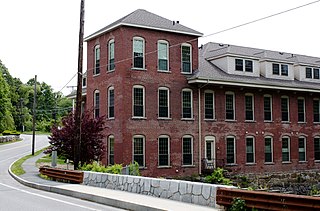
The Brookside Historic District of Westford, Massachusetts encompasses surviving elements of the 19th century Brookside mill village, the smallest of the town's three 19th-century industrial villages. Developed between about 1860 and 1904, it includes surviving mill buildings and a variety of mill-related worker housing. The district was listed on the National Register of Historic Places in 2003.

The Forge Village Historic District of Westford, Massachusetts, United States encompasses one of the town's historic 19th century mill villages. The focal point of the district is the mill complex of the Abbot Worsted Company, around which the village expanded after its founding in 1854. Prior to its founding the area was the site of a number of blacksmithies and iron forging operations, and was the site of a fulling mill in the 18th century. The center of the district is at the junction of East and West Prescott Streets with Pleasant Street, radiating away to ballfields on West Prescott, Abbot Street at Pleasant, and just beyond Orchard Street on East Prescott. Worker housing occupies a number of adjacent streets in the area.

The Henry Fletcher House is a historic house at 224 Concord Road in Westford, Massachusetts. Built c. 1810–13, it is a rare example of very late Georgian style timber-frame construction, with a large central chimney characteristic of colonial-era houses. It is styled with a mix of late Georgian and Federal style woodwork. The property's barn was also built by Henry Fletcher using the same construction methods. The house was listed on the National Register of Historic Places in 1993.

The Graniteville Historic District of Westford, Massachusetts, United States, encompasses one of the town's historic 19th century industrial villages. The area was, until the arrival of the railroad in 1847, primarily known for its granite quarries. The railroad's arrival prompted the construction of an industrial mill by Charles G. Sargent, and the area developed rapidly thereafter. A significant amount of housing stock, as well as civic institutional buildings, were built during the second half of the 19th century. The district is bounded on the east by River Street and on the south by Bridge Street and North Main Street. The western edge of the district runs just before North Main Street's junction with West Street, northward and then eastward to encompass a number of quarry sites, before meeting North Main Street at River Street.

Westford Town Farm is a historic poor farm in Westford, Massachusetts. Its main building is a 2+1⁄2 story brick building, five bays wide and six deep, that was built in 1837. It was twice enlarged, in c. 1840 and c. 1900. The enlargement consists of a wood-frame addition on the north side of the building; the 1900 addition was built to replace that from 1840, and stands on its foundation. It served as the focal point for the town's support of its indigent population until 1959, a later date than many similar facilities statewide remained open. Since its closing it has continued to house town facilities, including as police and fire stations, and most recently as school administrative offices.

The Parker Village Historic District of Westford, Massachusetts encompasses a historic rural village center. The district extends from the junction of Carlisle Road and Griffin Road, westward along Carlisle Road to a triangular green where it meets Concord Road and Old Lowell Road. The oldest building in the village is the Parker Village Schoolhouse, built in 1787 out of brick and wood, and restored in the 1990s. The majority of the houses in the district date from the 18th and 19th centuries, with eclectic Victorian styles predominating.

The former Reading Municipal Building is a historic building at 49 Pleasant Street in Reading, Massachusetts. Built in 1885, this two-story brick building was the town's first municipal structure, housing the town offices, jail, and fire station. In 1918 all functions except fire services moved out of the building. It now serves as Reading's Pleasant Street Senior Center. The building was listed on the National Register of Historic Places in 1984.
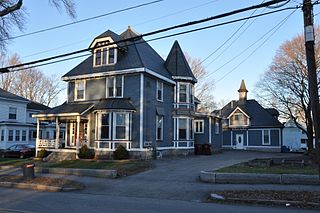
The Wilder Street Historic District is a historic district in Lowell, Massachusetts. The section of Wilder Street between Westford Street and Branch Road contains a remarkable collection of large late 19th-century houses. About one dozen wealthy businessmen built elaborate houses in Queen Anne, Italianate, Stick, and Second Empire styles in this area, which was developed by its landowner, Charles Wilder, and it was considered one of the city's most fashionable addresses of the time.

The First Congregational Church is an historic church in Stoneham, Massachusetts, United States. Built in 1840, it is a fine local example of Greek Revival architecture, and is a landmark in the town center. It was listed on the National Register of Historic Places on April 13, 1984. The church is affiliated with the United Church of Christ; the current pastor is the Rev. Ken McGarry.

The Common District encompasses the main civic center of Wakefield, Massachusetts. It is centered on the historic town common, just south of Lake Quannapowitt, which was laid in 1644, when it became the heart of Old Reading. The area was separated from Reading as South Reading in 1818, and renamed Wakefield in 1868. The 25 acre district includes the buildings that line the common on Common Street and Main Street, which include the town hall, public library, YMCA, post office, and several churches. It was listed on the National Register of Historic Places in 1990.

The Yale Avenue Historic District is a residential historic district near the center of Wakefield, Massachusetts. It encompasses eight residential properties, all but one of which were developed in the 1860s and 1870s, after the arrival of the railroad in town. These properties were built primarily for Boston businessmen, and mark the start of Wakefield's transition to a suburb.

The Central Square Historic District is a historic district encompassing much of the central business district of Stoneham, Massachusetts. It includes the town's largest concentration of 19th and early-20th century commercial architecture, in an area that developed in importance as a commercial center after the construction of the Andover-Medford Turnpike. The district was added to the National Register of Historic Places in 1990.

The West Ward School is a historic school at 39 Prospect Street in Wakefield, Massachusetts. Built in 1847, it is the only surviving Greek Revival schoolhouse in the town. The building was listed on the National Register of Historic Places in 1989. It is now maintained by the local historical society as a museum property.

The Brookline Town Green Historic District encompasses the historic colonial heart of the town of Brookline, Massachusetts. Centered on a stretch of Walnut Street between Warren and Chestnut Streets, this area is where the town's first colonial meeting house and cemetery were laid out, and was its center of civic life until the early 19th century. The district was listed on the National Register of Historic Places in 1980.

The Amherst Village Historic District encompasses the historic village center of Amherst, New Hampshire. Centered on the town's common, which was established about 1755, Amherst Village is one of the best examples of a late-18th to early-19th century New England village center. It is roughly bounded on the north by Foundry Street and on the south by Amherst Street, although it extends along some roads beyond both. The western boundary is roughly Davis Lane, the eastern is Mack Hill Road, Old Manchester Road, and Court House Road. The district includes the Congregational Church, built c. 1771-74, and is predominantly residential, with a large number of Georgian, Federal, and Greek Revival houses. Other notable non-residential buildings include the Farmer's Bank, a Federal-style brick building built in 1806, and the Amherst Brick School, a brick Greek Revival structure that has served as the School Administrative Unit 39 offices since 1997.

The Sandy Pond School is a historic school building at 150 Sandy Pond Road in Ayer, Massachusetts. Built in 1868, it is the only surviving district school building in the town. Now a local museum, it was listed on the National Register of Historic Places in 2017.

The Jonathon Keyes Sr. House, also known incorrectly in town histories as the Solomon Keyes House, is a historic house at 16 Frances Hill Road in Westford, Massachusetts. It was probably built in the mid-18th century, and is one of the town's oldest surviving buildings. It was listed on the National Register of Historic Places in 2019.