Within the academy, the study of this East–West exchange contributed to the eventual formation of the academic field of Western esotericism itself.[18][19] The discipline emerged partly as a critical response to the universalist interpretations of earlier esoteric writers, also called perennialism or religionism in this field,[20][21] seeking to distinguish historical scholarship from the apologetic and syncretic narratives of the modern spiritual movements it analyzes. In this way, the academic study of esotericism functions both as a product and as a critical reflection of the very intercultural processes that shaped the Western esoteric tradition in dialogue with Eastern thought.[22][23]
Conceptual and historical background
Scope and definitions
The academic use of the term Western esotericism refers to a specific field of historical and religious studies that examines a set of currents, movements, and systems of thought within Western culture traditionally regarded as "rejected knowledge."[24][25][26] Rather than describing a single doctrine, the term designates a "family of currents" that includes Hermeticism, Neoplatonism, Christian Kabbalah, alchemy, Rosicrucianism, occultism, and theosophy, among others.[27][28] Following Faivre's typological model, Western esotericism is characterized by key features such as correspondences, living nature, imagination and mediation, transmutation, and the pursuit of gnosis through inner experience.[29][30][31]
In contrast, the term Eastern religions is used in comparative religion to denote the diverse traditions that originated in South, East, and Southeast Asia, including Hinduism, Buddhism, Jainism, Sikhism, Taoism, Confucianism, and Chinese folk religion.[32] In the context of Western esotericism, "Eastern religions" typically refers to those aspects of Asian thought that were historically appropriated, reinterpreted, or assimilated within Western esoteric frameworks — most notably Vedānta, Yoga, Tantra, Tibetan Buddhism, Zen Buddhism, and Taoist alchemy.[33][34] While many observers attempt to distinguish between Eastern philosophies and religions, this is a modern distinction that does not exist or is not emphatic in ancestral Eastern traditions.[35]
A further conceptual distinction concerns the difference between Orientalism and Eastern spirituality. Following Edward Said's framework, Orientalism denotes the historical discourse through which European intellectuals constructed and represented "the Orient," often through idealized or essentialized categories.[32] By contrast, Eastern spirituality in esoteric contexts refers to the actual reception and reinterpretation of Asian religious practices, cosmologies, and symbols within Western spiritual and metaphysical milieus.[36][37] This distinction allows scholars to analyze how Western esotericists engaged with Asian traditions not merely as exotic others, but as sources for philosophical synthesis, spiritual authority, and universal metaphysical frameworks.
The scope of this article therefore concerns the historical processes, doctrinal exchanges, and cultural transformations through which elements of Asian religious thought entered Western esoteric currents — and, reciprocally, how Western esotericism influenced modern interpretations of Eastern spirituality in the age of globalization.[38]
Historiography and conceptual foundations
Early scholarly and popular attempts to understand the relationship between Western and Eastern thought often emerged from within the esoteric and comparative frameworks of the nineteenth and early twentieth centuries. Writers such as H. P. Blavatsky, Max Müller, and Aldous Huxley employed universalist or perennialist models that posited a shared transcendent truth underlying all religions.[39][40] These currents tended to dissolve historical distinctions in favor of a metaphysical unity of Western esotericism and Eastern religions, what later scholars would call religionism or perennialism—a tendency to interpret esoteric and mystical traditions as expressions of a single perennial wisdom.[41]
Renaissance marble inlay of Hermes Trismegistus (Siena Cathedral, 1488), presented as an Egyptian sage and "founder of human wisdom" within a Christian iconographic program inspired by Lactantius. Such early modern Hermetic–Platonic genealogies that locate primordial wisdom in an authoritative "East" (e.g., Egypt/Persia, Ancient Near East) are discussed by historians under the rubric of Platonic Orientalism.
Later historians have traced these modern universalist syntheses to older European "ancient wisdom" macrohistories. Hanegraaff has discussed one influential strand under the label Platonic Orientalism: the widespread view—rooted in Hellenistic antiquity and amplified in the Renaissance (early modern age) prisca theologia traditions—that Platonism (and related Hermetic and theurgical currents) conveyed a salvific wisdom ultimately derived from an authoritative "East" (variously Egyptian, Persian, Hebrew, or even Indian), rather than constituting a purely Greek philosophical school;[44][45] this usage should not be confused with Said's modern concept of Orientalism.[46][47] In this perspective, nineteenth-century esoteric authors could present selected Hindu and Buddhist materials as privileged witnesses to a "single primordial truth", translating them into familiar Hermetic and Neoplatonic idioms.[47]
The systematic historical study of Western esotericism developed as a response to such metaphysical unity approaches. From the late twentieth century, scholars sought to delimit esotericism as a distinct field of historical inquiry rather than as a trans-historical "wisdom tradition."[48][49]Antoine Faivre's typological model (1992) established the first widely accepted academic definition of Western esotericism, emphasizing recurrent structural features rather than metaphysical claims.[48] This "empirical-historical" approach was soon expanded by Wouter J. Hanegraaff, who framed esotericism as a form of "rejected knowledge" within the broader history of Western culture.[50] The institutionalization of this academic perspective began in France with the creation of the chair for "History of Esoteric and Mystical Currents in Modern and Contemporary Europe" at the École pratique des hautes études in 1992, where Faivre served as its first occupant.[48] In the Netherlands, Hanegraaff established the study of Western esotericism at the University of Amsterdam in 1999, integrating it into the broader framework of religious studies.[49] These developments marked the consolidation of Western esotericism as an autonomous field of research, further strengthened by the founding of the journal Aries (Brill, 2001–) and the European Society for the Study of Western Esotericism (ESSWE) in 2005.[37]
A second generation of scholars, including Kocku von Stuckrad and Egil Asprem, further refined the field by highlighting its discursive, sociocultural, and global dimensions.[51][37] Von Stuckrad emphasized esotericism as a "discursive field" of negotiations about hidden or alternative knowledge, while Asprem and Julian Strube proposed its integration into a global history of religions that transcends the Western/Oriental dichotomy.[38]
Within this historiographical evolution, the comparative study of Western esotericism and Eastern religions gained methodological clarity: rather than seeking metaphysical synthesis, it came to analyze how esoteric currents historically appropriated, transformed, and recontextualized Asian religious concepts. This shift from esoteric perennialism to critical historiography laid the conceptual foundations for examining East–West interactions as a reciprocal process of translation, reinterpretation, and globalization.[37][36]
Periodisation and typological overview of the East-West exchange
Western esotericism before orientalization: vitalist biology, medicalization of the supernatural, and astral cosmology (1750s–1880s)
From the mid-eighteenth century, a distinctive intellectual ecology emerged in Europe that helps explain why, a century later, Western esotericism proved unusually receptive to Indic—and to a lesser degree Sinic—models of the subtle body and energetic cosmologies. Two intertwined currents set the stage, both related to non-mechanistic theories of biology and medicine later marginalized within mainstream science. First, vitalist biology—from the Montpellier school of medicine in France to German Naturphilosophie—sacralized organismic life against mechanical reductionism, articulating a cosmos suffused with formative forces and micro–macrocosmic correspondences.[52][53][54] Second, new experimental protocols "medicalized the supernatural," treating trance, clairvoyance and extraordinary agency as objects for clinical observation and natural explanation.[55] Read through this lens, ancient hermetic–Neoplatonic and Paracelsian motifs of subtle embodiment—received in the West episodically and fragmentarily rather than through an unbroken lineage—were rearticulated and consolidated in the nineteenth century into what may be described as a Western "astral cosmology" and "astral anatomy": a modern vocabulary of subtle vehicles (e.g., the astral body or the body of light), planes, and fluids/forces articulated within vitalist–mesmeric naturalism and hermetic registers.[56][57][55][58][59] This episodic, fragmentary transmission also helps explain why, in the late nineteenth century, Western esoteric actors proved especially receptive to importing and re-anchoring Indic (and secondarily Sinic) concepts as putative lineages of continuity and as strategies of legitimation—relabeling established astral vocabularies (e.g., "astral light" as ākāśa; vital fluids/forces as prāṇa).[59][60]
Sacralizing the life sciences (1750s–1830s). In the Montpellier milieu (e.g., Théophile de Bordeu and Paul-Joseph Barthez) and later German Naturphilosophie (e.g., F. W. J. Schelling, Lorenz Oken), living beings were modeled as dynamic unities animated by formative forces rather than passive mechanisms; early-modern idioms of sympathy and correspondence were rehabilitated without abandoning naturalism.[52][53][54] This quest for "non-mechanistic" sciences of life fed into what is sometimes termed Romantic science; by the 1840s, however, much of it lost ground in academic life-science settings to more strictly experimental and less speculative theories.[53][54]
A nineteenth-century depiction of animal magnetism (mesmerism), illustrating early attempts to frame trance and extraordinary agency in quasi-medical terms.
Éliphas Lévi, a key figure of the French occult revival whose reformulations of "astral light" and correspondences shaped later esoteric vocabularies of subtle forces.
Occult Revival: Vitalist biologization of hermetic astral cosmology (1850s–1870s). From the 1850s Éliphas Lévi reframed Renaissance hermetic–Paracelsian lore—lumière astrale (astral light), signatures, universal correspondences—into a modern occult vocabulary circulating through salons, journals, and later in fin-de-siècleRosicrucian-themed and ceremonial magic fraternities, doing so within a vitalist–mesmeric physiological idiom that had recently medicalized trance, magnetism and clairvoyance.[64][55][58] Read retrospectively, Paracelsian iatromedical nature supplied an early template linking correspondences and arcana to therapeutic practice, which Lévi rearticulated in nineteenth-century terms.[57][56] British and French networks then elaborated cognate schemas of subtle body vehicles (see astral light as theory of magic, body of light) and planes—the cluster treated here as a nineteenth-century Western "astral anatomy."[60] Across francophone and British fin-de-siècle networks, this vitalist-tinged astral vocabulary entered common use; in France it proved formative, while in Britain it became a major strand alongside theosophical and kabbalistic–Enochian repertoires, often filtered through the Golden Dawn's curriculum.[60] Periodical and handbook circulation helped codify an "occultist" idiom taken up by later French authors (e.g., Gérard Encausse, "Papus") and reworked in British ceremonial orders.[64][60] In broader periodizations labeled "occult revival," the starting point varies by emphasis (mid-nineteenth century in the francophone milieu; 1875 with the Theosophical Society; or the fin-de-siècle with the Golden Dawn), but the shared doctrinal kernel is the lexicon of "astral cosmology" and "astral anatomy".
Early Theosophy before the Indo-centric turn (1875–1879). In its New York phase, early Theosophy (Blavatsky with H. S. Olcott and W. Q. Judge) worked within a Western occult idiom—"astral light", subtle vehicles, and a naturalistic vocabulary of forces shaped by magnetism—that overlapped (without being identical) with Éliphas Lévi's hermetic reform and the broader vitalist horizon of the period.[65][56][55] After the move to India (1878–79), that astral vocabulary was increasingly reframed through Vedāntic and Tantra schemata (e.g., akasha, prāṇa, sūkṣma śarīra), producing an Indo-Western translation rather than a simple continuation of the Lévi template.[66]
Relevance to East–West intersections. Against the backdrop of episodic transmission in Western esotericism, such borrowings also functioned as strategies of legitimation by invoking imagined continuity with Asian lineages, thereby resemanticizing older astral vocabularies within Indo-Western hybrids.[59][65][62] Framed this way, nineteenth-century exchanges between Western esotericism and Indic (and secondarily Sinic) traditions were enabled by the tandem of vitalist ontologies and the clinical normalization of trance/clairvoyance; translating prāṇa, kuṇḍalinī and qi into the existing idiom of astral light, fluids and planes yielded an Indo-Western lingua franca that shaped twentieth-century "orientalization" of Western esotericism and the internationalization of Eastern traditions, including religions and traditional medicine (e.g. Indic traditional medicine, Chinese traditional medicine).[60][62][59]
Proto-Asian studies in Western intellectual circles and Indomania (1790s-1840s)
The earliest preconditions for Western esoteric engagement with Asian traditions arose not from direct institutional contact but from the late eighteenth–early nineteenth-century milieu of Romanticism and emerging Orientalist philology. In this phase, European intellectuals fashioned conceptual frames—idealism, comparative hermeneutics, and a search for "ancient wisdom"—that later enabled explicitly esoteric appropriations of the "East."[67][68]
Early modern authors provided conceptual templates later used to draw analogies with Asian metaphysics. Emanuel Swedenborg elaborated a doctrine of "correspondences" linking spiritual and material realms, while Franz Anton Mesmer proposed a theory of "animal magnetism," a universal subtle fluid permeating all living beings. These concepts, recast in the nineteenth century through harmonial and vitalist vocabularies, helped Western interpreters relate esoteric notions of "magnetic energy" to Indian prāṇa and Chinese qì as parallel expressions of an animating life force.[69][70][71] Swedenborg's theology further advanced a form of universalism unusual for its time, teaching that individuals from all faiths who live in accordance with their conscience partake in the divine influx. This inclusive soteriology—echoing later perennialist notions—helped make Asian religions appear spiritually compatible with Christian revelation, and was widely cited in nineteenth-century metaphysical religion.[48][69]
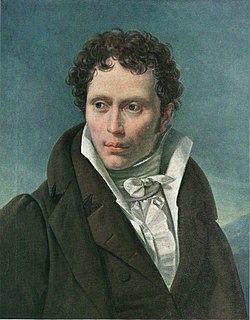
Arthur Schopenhauer, whose nineteenth-century reception of Hindu and Buddhist sources shaped European "Indomania" and later constructions of the "East" as a reservoir of timeless interior wisdom.
In the Romantic era, an "Indomania" took hold among philosophers and poets—Arthur Schopenhauer, Johann Wolfgang von Goethe, Friedrich Schlegel—who read Hindu and Buddhist sources through European idealism, projecting their metaphysical concerns onto Asian texts.[72] Schopenhauer, sometimes dubbed the "Buddha of Frankfurt" by contemporaries,[73] saw in Buddhism a philosophical kinship with his own pessimistic metaphysics of will and compassion.[72] This symbolic construction of the East as a reservoir of timeless interior wisdom shaped nineteenth-century occultist and metaphysical milieus.[74]
Ralph Waldo Emerson, a central figure in American Transcendentalism, which selectively reframed Asian texts within Western metaphysical and esoteric-compatible idioms.
Although sinology and Japan-related studies also advanced in this period, their impact on esoteric circles was comparatively limited at first; Chinese and Japanese materials circulated mainly through philological and aesthetic channels, with more explicit religious–philosophical receptions (e.g., Taoism, Zen) crystallizing only in the twentieth century via translators and mediators.[67][74]
By mid-century, this romantic–philological vocabulary allowed Western esotericists to recognize the "wisdom of the East" as compatible with Hermetic and Neoplatonic frameworks, setting the stage for later organized movements such as Theosophy and the popularization of Indian and Tibetan spiritualities in the West.[68][48]
Late antique "Gnosticism" in nineteenth-century scholarship and India-centred esoteric receptions (1860s–1970s)
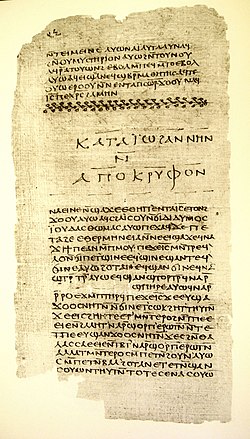
Abraxas gem as reproduced in Charles William King's antiquarian study The Gnostics and their remains (2nd rev. ed., 1887). Victorian scholarship treated such "gnostic" amulets as key evidence for reconstructing late antique religion; King also interpreted Abraxas names and formulas through comparisons with South Asian and Tibetan sacred-name traditions (e.g., AUM / Om mani padme hum), exemplifying a nineteenth-century scholarly "Oriental" and indocentric frame later echoed in East–West esoteric syntheses.Folio 32 of Nag Hammadi Codex II (4th century), with the ending of the Apocryphon of John and the beginning of the Gospel of Thomas. The 1945 discovery and subsequent publication of the Nag Hammadi codices greatly expanded the primary source base for late antique "gnosticism", undermining several influential prewar constructions and encouraging recontextualization in eastern Mediterranean frames, even as esoteric receptions continued in new forms.
Modern Western esoteric engagements with late antique materials classified as Gnostic in scholarship (often framed by a cosmogonictheodicy of rupture/alienation from the divine) are best understood as a history of modern reception rather than as a continuous lineage from the Gnosis of Renaissance Hermeticism tradition (more often grounded in an ordered cosmology of correspondences/continuity). In this history, emic esoteric claims (e.g., that "Gnostic gnosis" preserves a primordial wisdom rooted in "the Orient") can be distinguished from etic reconstructions that treat "gnosticism" as a historically contingent scholarly category and situate late antique movements in their eastern Mediterranean contexts.[76][77][78]
A key precondition is that early modern prisca theologia genealogies and related forms of Platonic Orientalism did not rehabilitate "gnostic" as a positive category in the Latin West, where it remained closely associated with polemics about "gnostic heresies" in early Christianity; modern occult and esoteric uses were therefore largely mediated through nineteenth-century scholarship and popularization rather than direct continuity from Renaissance Hermeticism revivals.[76] In this same early nineteenth-century scholarly environment, the French noun ésotérisme was first used by Jacques Matter in connection with the historical study of "gnosticism" (Critical History of Gnosticism, 1828), illustrating how "esotericism" initially emerged as an academic descriptor before later becoming an occult self-designation.[79]
Within Victorian antiquarian scholarship, Charles William King's The Gnostics and their remains (1864; 2nd rev. ed. 1887) became a major Anglophone reference point: he traced "Gnosticism" to "Indian speculative philosophy" as an early Christian window to buddhism and historical Vedic religioncosmogonies, proposed strong affinities between late antique Christian systems (including Valentinian teaching) and "Nepalese Buddhists," and read Abraxas (a "Great Archon" in Gnostic Christianity) talismanic traditions through analogies drawn from South Asian materials and Tibetan sacred-name traditions (e.g., AUM / Om mani padme hum).[80][78] Such works provided a form of scholarly "epistemic capital" that could be appropriated in the occult revival, especially where authors sought historical scaffolding for universalist/perennialist East–West narratives.[78]
In the United Kingdom, scholar David Robertson notes that "Gnosticism" became closely connected to Theosophy: Blavatsky's knowledge of it drew directly on King, and his narrative enabled her to link Indian philosophy historically to nineteenth-century esotericism and to present the "Gnostics" as forerunners of the modern occult revival.[78] Scholar Dylan Burns shows that G. R. S. Mead—Blavatsky's associate and later a major Theosophical mediator—translated Pistis Sophia (1896) and framed the Askew/Bruce materials as "ancient Theosophy", describing their sources as "the Orient" and glossing key soteriological themes with Asian-derived terms in ways that supported a Christian idiom within Theosophical East–West universalism.[77]
This fin-de-siècle reception was not confined to Theosophy alone. Scholar Paul Linjamaa shows that Pistis Sophia circulated widely across multiple European esoteric milieus around 1900, where it was often hailed as evidence of "ancient" spiritual wisdom even when not discussed with detailed historical or theological precision.[81] Robertson further notes that self-identified neo-Gnostic ecclesial revivals appeared in fin-de-siècle France, while other contexts (such as Germany) often engaged the theme more through literature than through Theosophical orientalization.[78] Within Neo-Theosophical networks, explicitly Christian institutions such as the Liberal Catholic Church (founded 1916 by James Ingall Wedgwood and C. W. Leadbeater) provided an additional setting for Christian–esoteric rearticulations alongside broader universalist programs.[82]
After 1945, the discovery of the Nag Hammadi library and the later publication and wider availability of the corpus (especially from the 1970s) transformed scholarly understandings of "Gnosticism": Robertson notes that many influential prewar and mid-century constructions were "completely at odds" with the newly available primary sources, helping to marginalize strong "India-as-fountainhead" narratives that had flourished in fin-de-siècle syntheses toward eastern Mediterranean frames.[78] Separately from academic scholarship, Jungian and Eranos-associated milieus recoded gnostic myth as a symbolic map of psychic transformation and aligned it with psychologized accounts of Western spiritual development; Segal surveys this interpretive alignment between analytical psychology and gnostic mythmaking.[83] In later decades, such postwar recodings and the expanded textual archive also fed diverse "neo-gnostic" afterlives within alternative spiritual environments, where "Gnostic" materials continued to be recontextualized alongside other globalized esoteric repertoires.[84][81]
Popular, therapeutic, and psychologizing orientalization in New Thought and relaxationism (1860s–1950s)
Title page of Science of Breath by Yogi Ramacharaka (William Walker Atkinson), 1903. Early twentieth-century occult–New Thought handbooks presented breath and "pranic" hygiene as tools for self-development, popularising hybrid vocabularies (energy, will, subtle forces) that later circulated in counselling, coaching and wellness as body–attention techniques under interpretive (non-realist) frames.
A mid-nineteenth-century vector of East–West exchange emerged in the American metaphysical milieu through the mind-cure and New Thought movements. Rather than ritual or occult initiation, these currents translated selected Hindu and Buddhist motifs into a language of mental causation, moral healing, and practical spirituality.[85]
Within this intellectual and therapeutic environment, mesmerist Phineas Parkhurst Quimby acted as a pioneering healer whose practice inspired—rather than systematized—the metaphysical doctrines later developed within New Thought. Warren Felt Evans—a former Swedenborgian minister—was among the first to provide a philosophical framework for these ideas. Drawing on Berkeleyan idealism and Swedenborgian correspondences, Evans argued for the primacy of spirit over matter to ground claims about mental influence on the body and the re-reading of "Eastern" ideas (karma, meditation, prāṇa) in therapeutic terms.[85][86]Horatio W. Dresser, both historian and advocate of the movement, helped consolidate New Thought's genealogy (from Quimby through Swedenborgian and transcendentalist channels) and framed its universalist ethos in terms that resonated with Vedāntic non-dualism without abandoning a broadly Christian idiom.[85]
Emma Curtis Hopkins—often called the "teacher of teachers"—bridged mind-cure and the institutional flowering of New Thought. Her seminars and correspondence courses trained founders of several denominations (e.g., Divine Science, Unity, Religious Science), giving organizational form to a therapeutic metaphysics that increasingly referenced Asian ideas as techniques of mental hygiene and self-realization rather than as doctrinal commitments.[87] By the early twentieth century, an international network of study groups and periodicals—Unity magazine, The Nautilus, Science of Mind, Suggestion—popularized contemplation, affirmation, and breath/"energy" exercises in a vitalist vocabulary that readers could align with prāṇa and qi.[88]
Closely related yet distinct, Christian Science (founded by Mary Baker Eddy) pursued a Bible-centered path that polemicized against mesmerism and spiritualism, construing healing as Christian revelation rather than occult technique. Consequently, most scholars locate Christian Science within American metaphysical religion rather than Western esotericism proper.[85][89]
Historians also note that the "breath culture" repertoire systematized in the 1900s by New Thought advocate William Walker Atkinson (as "Yogi Ramacharaka") drew largely on Western hygienic and psychological currents subsequently reframed in Indic vocabulary of pranayama; scholarship interprets this as a case of Western re-signification rather than direct transmission from South Asian sources.[90]:3–10
In sum, New Thought's psychologizing reinterpretation of Asian motifs—especially meditation, mantra, and karma translated into moral causation—shifted Western esotericism toward an interiorized, experiential paradigm that prefigured later developments in analytical psychology, the human potential movement, and New Age healing.[85][89][88]
Theosophy and the institutional–doctrinal orientalization of Western esotericism (1870s–1930s)
Helena P. Blavatsky (1831–1891), co-founder of the Theosophical Society and a central figure in the modern esoteric reception of Asian religious repertoires.
The institutionalization of East–West exchange within Western esotericism began with the foundation of the Theosophical Society in New York in 1875 by Helena Petrovna Blavatsky, Henry Steel Olcott, and William Quan Judge.[91] The Society marked a turning point in the history of modern esotericism by combining Western occultist ideas with reinterpreted Hindu and Buddhist doctrines. Its stated goals of promoting universal brotherhood and studying "Eastern and Western philosophy" reflected a new synthesis that blurred the boundaries between comparative religion and esoteric practice.[92]
Between 1880s and 1910s the rising of Theosophy generated intra-occultist debates over "orientalization" of Western esotericism. In late nineteenth-century occult-revival milieus, "the East" often functioned as a polemical boundary-marker rather than a neutral descriptor: Theosophists promoted karma, rebirth and "yoga" as universal laws and techniques, whereas critics in Christian-Hermetic and neo-Rosicrucian/Martinist settings framed such Sanskritic vocabularies as an "Oriental" deviation from a properly Western lineage. These disputes shaped organizational splits and curricular choices (including, in the German-speaking sphere, Rudolf Steiner's break with the Theosophical Society and the formation of Anthroposophy), before later scholarship reinterpreted the opposition as historically situated boundary-work within modern esotericism rather than evidence for transhistorical "Eastern" and "Western" essences.[93][94]
Conceptually, Theosophy built upon earlier layers of spiritualism and Swedenborgianism. The writings of Emanuel Swedenborg and the "harmonial philosophy" of Andrew Jackson Davis—sometimes called "the American Swedenborg"—had already articulated cosmologies of subtle planes and progressive spiritual evolution through reincarnation.[68] Building on Swedenborg's correspondences, Davis's "harmonial philosophy" articulated a doctrine of progressive spiritual evolution through successive spheres of being—an ascent rather than reincarnation—that anticipated later Theosophical notions of karmic development.[95] These notions of hierarchical spheres and communication with exalted beings provided a bridge between the spirit-mediumship of the mid-nineteenth century and the later Theosophical teaching on mahatmas and ascended masters. Olcott himself emerged from these circles, linking American spiritualism with Blavatsky's esoteric orientalism.[91]
Blavatsky's writings, particularly Isis Unveiled (1877) and The Secret Doctrine (1888), reinterpreted Asian cosmologies and symbols through a Hermetic and Neoplatonic framework. Concepts such as karma, reincarnation, and mahatmas were presented as ancient esoteric truths compatible with Western occultism and Christian mysticism.[48][96] Through its global correspondence network and publications like The Theosophist (founded 1879), the Society circulated an Orientalized esotericism that profoundly influenced both the Western occult revival and early modern Hindu reform movements such as the Arya Samaj.[97]
Historians of religion regard Theosophy as the first fully transnational esoteric movement that systematically "Orientalized" Western occultism while simultaneously providing new frameworks for Asian modernities.[38] Julian Strube argues that the polemical category "Western esotericism" emerged in response to the success of the Theosophical Society, "an esoteric society that had relocated its headquarters to India and had many thousands of 'non-Western' members."[98] In the same discussion, Strube cites Hanegraaff's characterization of Theosophy as "the most influential esoteric movement of the nineteenth century … that created essential foundations for much of twentieth-century esotericism."[99][100] Hanegraaff further notes how Mahatma Gandhi read "Hinduism" through "the Western esoteric or occultist prism of Blavatsky's Key to Theosophy."[101]
Theosophical claims of an "Oriental Kabbalah" (Ancient Near East to India)
Isis Unveiled (1877), Blavatsky's early Theosophical work; it includes an extended discussion about a "universal kabbalah" (e.g., the sefirot) used to frame claims about an "Oriental" source of "ancient wisdom". The book is connected to the late 19th century esoteric debates over the "East" and "West" identity in Western esoteric genealogy.
In the early Theosophical Society, kabbalah—in Jewish contexts a form of esoteric, often theurgic mysticism and scriptural interpretation— functioned not only as a Jewish tradition but as a vocabulary of occult authority and an argument about origins. Wouter Hanegraaff notes that Blavatsky could present her "theosophy" as grounded in "the Kabbalah" or a "primitive Oriental Cabala," and that her use of "Oriental" in 1875 was not primarily a reference to India or the Far East but to nineteenth-century constructions of a "universal kabbalah" with non-Jewish roots, promoted by authors ranging from the academic Adolphe Franck to the French occultist Éliphas Lévi and linked (in contemporary scholarship available to her) to Zoroastrian/Chaldaean antiquity in Ancient Near East.[102]
In New York, this "kabbalistic" idiom was publicly legible in explicitly operative terms: the scholar Marco Pasi notes that the Society's foundation was associated with George H. Felt's lecture on "Egyptian Kaballah," and that such episodes illustrate how kabbalah in occultist discourse could be identified with promised magical demonstrations (evoking "elementals," manipulating "occult" forces).[103] Pasi argues that Blavatsky's appeal to an "Oriental Cabala/Kabbalah" was primarily an origin-claim that helped stage an emerging boundary between "East" and "West": "Oriental" wisdom was treated as superior, while Jewish kabbalah could be portrayed as a later, altered or derivative form—an ambiguity that Blavatsky did not clearly resolve at the level of content or institutional custodianship.[104] In Isis Unveiled (1877), Blavatsky devoted an extended discussion to kabbalah (especially the sefirot and Shekhinah); Pasi notes that her principal secondary sources were Franck and Lévi and that she reinforced her priority-of-the-East narrative through analogies between kabbalistic concepts and Hindu materials.[105]
Hanegraaff emphasizes that the "kabbalistic chapter" did not end with the move to India (1878–1879), but that the relocation opened a new phase of mutual "fertilization" between Indian religions and Western esotericism.[47] Pasi further notes that Blavatsky's privileging of "Eastern" sources stimulated a "Hermetic reaction" that re-valued kabbalah as a pillar of a distinctly Western esoteric tradition (alongside Rosicrucianism, alchemy, and the tarot), a shift associated with initiatives such as Anna Kingsford and Edward Maitland's Hermetic Society of 1884 and S. L. MacGregor Mathers' translation of the Kabbalah Denudata, which became a major reference point for later westernizing occultist receptions.[106]
Neo-Theosophy phase: codifying chakras, clairvoyant investigation, and the World Teacher (1890s–1930s)
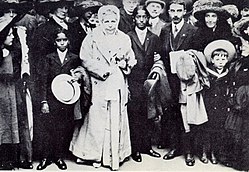
Annie Besant with Jiddu Krishnamurti and companions (London, 1911). In the Neo-Theosophical period, the Society's "World Teacher" project—closely associated with the Indian-born Krishnamurti and promoted through the transnational networks centred on Adyar, Chennai—illustrates how Theosophy mediated between Western esoteric frameworks and South Asian religious contexts, recontextualizing Asian ideas within a universalist (and sometimes christianizing) idiom.
Under Annie Besant and Charles Webster Leadbeater, the Society entered its "Neo-Theosophical" phase (1890s–1930s), emphasizing clairvoyant cosmology, easternizing esoteric Christianity, and the idea of a coming World Teacher.[107] This phase popularized hybrid doctrines such as "seven planes of existence" and "subtle bodies," integrating Indian, Platonic, and occultist categories. Through Besant's presidency and Olcott's residence in Adyar, Chennai, Theosophy established itself as a transnational esoteric institution with centers across Europe, India, and the Americas.[108]
Although early Theosophical writings referred to "tantras" only in general terms, a more systematic discourse on kundalinī and a standardized subtle anatomy of "chakras" crystallized in the early twentieth century under Annie Besant and C. W. Leadbeater, in dialogue with contemporary Indological syntheses. This codified vocabulary circulated widely through Theosophical print networks and became a key bridge between Hindu sources and Western occultist frameworks.[109][33][110]
In addition to doctrinal syntheses, Theosophical writers described modes of "clairvoyant investigation" of the subtle medium called akasha, later popularized in post-Theosophical literature as Akashic records. Functionally, this served as an epistemic device to authorize reconstructions of "occult history" and invisible planes—akin, though not identical, to claims of exceptional access in Spiritualism (mediumistic testimony) and early parapsychology (psychical investigation).[107][111]
Splits and post-Theosophical reconfigurations (1910s-1920s)
The Society's influence extended far beyond its own ranks. Rudolf Steiner's Anthroposophy emerged from Theosophical roots with a re-westernization of its cosmology through Christian esotericism and European "Romanticist science" (see Goetheanism).[48][112] The 1912–1913 split of Rudolf Steiner from the Theosophical Society of Germany and the formation of the Anthroposophical Society was a counter-point in the process of orientalization of Western esotericism. While retaining selected Theosophical notions and terminology such as karma and rebirth, Steiner rejected the orientalist framework of "Eastern Masters" and the "World Teacher" project of Besant (Jiddu Krishnamurti), re-anchoring esotericism in a Christian–Rosicrucian matrix and developing Western-facing meditative and pedagogical disciplines (e.g., the "six basic exercises," eurythmy). Unlike ceremonial-magical orders, Anthroposophy did not adopt Tantric–yogic technique or qi-cosmology; typologically it operated as a re-westernizing response within the 1880–1910 debates rather than as a vector of Asian import.[112][48]
Alice Bailey's writings on "Tibetan Masters" and their "Ageless Wisdom Teachings" and her Lucis Trust organization reconfigured Theosophy into a new esoteric language that foreshadowed the New Age movement.[113] At the same time, Indian figures such as Swami Vivekananda and Jiddu Krishnamurti—initially promoted by Theosophists—transformed and, in some cases, rejected Theosophical interpretations of their traditions, thus contributing to the emergence of global Hindu and Buddhist modernities.[114]
Inner Asia as "occult geography" in Western esotericism (c. 1880s–1930s), decline, and postwar afterlives
The Potala Palace in Lhasa: Tibet became a key locus of Western esoteric imaginaries of hidden adepts and "sacred geography", later contested by historical scholarship and diaspora institutions.
From the late nineteenth century to the 1930s, Western esoteric literature repeatedly imagined Inner Asia—from the Tibetan Plateau and Himalayan rimlands (Ladakh, Kashmir) to Mongolia, the Gobi Desert, and the South Siberian ranges (Altai–Sayan–Baikal)—as a privileged "sacred geography" where hidden adepts guarded a unified, primordial science of spirit. Classic Greco-Roman motifs about far-northern lands of wisdom (e.g., Hyperborea) were reactivated and redirected toward Inner Asia, providing a deep cultural reservoir upon which modern occult narratives could draw.[115]
Mount Kailash, a key landmark in Himalayan sacred geographies that became central in Western esoteric imaginaries of Inner Asia as a zone of hidden wisdom and initiation.
The cartography of this imaginary was unusually concrete. Tibet was mapped as a monastic heartland (Lhasa; hidden valleys; Mount Kailash) and a zone of yogic "powers"; Kashmir—long associated with Kashmir Shaivism—appeared as a Himalayan gateway to esoteric gnosis; Mongolia and the Gobi were cast as corridors of steppe wisdom (variously linked to Shambhala or Agartha), while the South Siberian arc (Altai, Tuva, Buryatia) was described as a northern threshold to the same "central" wisdom. Explorers such as Sven Hedin and Francis Younghusband helped fix Tibet and Inner Asia as an esoteric frontier within European geographical imagination through widely read travelogues and reportage.[116]
The Theosophical Society had already configured an "Occult Tibet" peopled by hidden "Mahatmas" and trans-Himalayan Masters; subsequent authors translated that myth into a hybrid of adventure narrative, comparative religion, and occult speculation. Alexandra David-Néel's blend of first-hand learning and psychical vocabulary; Nicholas Roerich's "Asian expeditions" (1925–1935) that repeatedly shifted centers of wisdom from Tibet to Altai–Gobi Siberia; and Ferdinand Ossendowski's best-seller Beasts, Men and Gods (1922) together fixed Inner Asia as a liminal zone between revelation and lost civilization. The fictional Shangri-La of James Hilton's Lost Horizon (1933) consolidated this landscape into a widely shared esoteric geography.[117][118][119]
Nicholas Roerich's "Song of Shambhala" (1943), emblematic of the Inner-Asian sacred geography and Shambhala imaginaries in modern esoteric culture.
Within this map, "Tibetanism"—a cluster of popular and esoteric representations of Tibet—functioned less as ethnography than as a symbolic mirror of Western longings for spiritual order, ascetic purity, and esoteric authority. Travel writing and popular ethnography became media that blurred reportage and revelation, using geographic remoteness as a metaphor for inner initiation. David-Néel's Magic and Mystery in Tibet (1929) framed tantric ritual and yogic powers in a language resonant with Western occultism and vitalist science; Roerich's paintings, diaries, and the Agni Yoga circle embedded Inner Asia in apocalyptic, messianic, and Theosophical motifs.[120][119]
A Himalayan–Kashmir vector reinforced the same esoteric geography. The romanticization of the upper Indus and the Vale of Kashmir as a repository of subtle metaphysics intersected with Anglophone engagements with Tantra and Shaiva texts (e.g., the translations associated with John Woodroffe/"Arthur Avalon"). Although focused on India, this scholarship and popularization positioned Kashmir and adjacent Himalayan polities as gateways to a trans-Himalayan gnosis contiguous with the Tibetan imaginary, thereby blurring textualized Tantra with the landscape of Inner Asian initiation mapped by travel writers.[121][118]
A recurring sub-theme involved reports of pre-Buddhist Himalayan "magical cults" and oracular practices later correlated by scholars with aspects of Bön. Early Western interpreters lacked the philological and ethnographic tools to distinguish Bön as a discrete religion; nevertheless, these notices were read within esoteric discourse as vestiges of a "primordial religion of spirit" that supposedly underlay tantric Buddhism across Tibet, Mongolia, and adjacent Siberia. Modern scholarship treats the relationships among pre-Buddhist Bön, later Yungdrung Bön, and Inner Asian shamanic complexes as a separate historical question beyond the travel-romance frame.[122][123]
A Tibetan manuscript page associated with the Bardo Thodol tradition, illustrating how Tibetan ritual–textual materials entered Western reception circuits and were repeatedly reinterpreted through occult and psychological vocabularies.
Mediators between textual prestige and occult geography amplified the imaginary. Walter Evans-Wentz's 1927 Anglophone "Tibetan Book of the Dead" reframed funerary liturgy as a universal manual of after-death states and diffused it through occult networks; mid-century reappropriations (e.g., Leary/Metzner/Alpert's The Psychedelic Experience, 1964) recoded its soteriology in the idiom of ego-death and visionary psychology, extending the life of the Inner Asian template in a postwar key.[124]
In parallel, G. I. Gurdjieff propagated an Inner Asian genealogy for his "Fourth Way," invoking monasteries, brotherhoods, and dances linked in his narrative to Tibet, Central Asia, and the Caucasus. Scholarly reconstructions treat these claims as a mythic genealogy rather than a verifiable itinerary, noting that the resulting system integrates elements from Eastern Christian asceticism, Sufism, yoga, and possible Caucasus/Ottoman dance repertoires. Regardless of historical sources, the rhetoric of an Inner Asian origin embedded his movement within the same sacred geography that sustained Theosophical and travel-ethnographic imaginaries.[125][126]
Roerich's oeuvre added overt political eschatology to the map. His Altai–Gobi relocations of Shambhala/Agartha and his messianic "culture-pact" activism situated Inner Asia as both a sanctuary of hidden wisdom and a future axis of civilizational renewal. Historians have read these projects in dialogue with pan-Asianist currents and with regional nationalist imaginaries (including Mongolian millenarian expectations), underlining how esoteric geography could be recruited to geopolitical visions.[119]
The imaginary also resonated—sometimes directly, sometimes by analogy—with modern political mythologies that valorized Inner or Northern Asia. Bal Gangadhar Tilak's The Arctic Home in the Vedas (1903) projected a polar homeland for Vedic peoples, lending scholarly rhetoric to a broader "Arctic/Inner Asia" discourse later echoed in some Hindutva milieus; interwar romantic nationalisms around Pan-Mongolism mobilized steppe unities; and Russian Eurasianism (and later neo-Eurasianism) re-symbolized the steppe heartland as a civilizational core. These genealogies are distinct from Western occultism, but they shared and sometimes cross-pollinated symbolic geographies, reinforcing the aura of Inner Asia as a metaphysical center.[127][128][115][129]
By the 1930s the Inner Asian esoteric imaginary began to contract. Border closures and geopolitical ruptures (Soviet consolidation in Siberia; Republican and then Communist control in China), the discrediting of "Nordic/Inner Asia" occult geopolitics linked to radical nationalism, and the rise of philological and anthropological Tibetan studies replaced romantic projections with historical-textual scrutiny. After the 1959 Tibetan uprising, exiled teachers built institutional frameworks in the West that corrected earlier fantasies by emphasizing lineage, pedagogy, and ritual practice.[130][117][129]
Nevertheless, postwar "afterlives" persisted. From the late 1950s into the 1970s, countercultural travelers followed the "Hippie trail" to Kathmandu, recoding Nepal as an accessible Himalayan enclave of authenticity and altered states (Freak Street/Jhochhen Tole). Motivations blended spiritual seeking, ethnographic curiosity, and recreational experimentation rather than a focused hunt for hidden Masters; yet the older Inner Asia imaginary supplied frames and idioms through which many interpreted their journeys.[131][132]
A parallel intellectual afterlife reframed Inner Asia via psychology and the human potential movement. The "Tibetan Book of the Dead" was repurposed for psychedelic and transpersonal vocabularies; travel-ethnography morphed into popular anthropology; and elements of Himalayan and steppe ritual repertoires circulated in New Age milieus. Scholars have interpreted these trends as modern iterations of the same Western habit of projecting a unifying "secret science" onto a macro-region whose indigenous traditions are, in fact, multiple and internally differentiated.[124][123]
Historiographically, the arc comprising Theosophical myth-making, travel ethnography, Roerich's Inner Asian relocations, the classical "Shangri-La" synthesis, its interwar decline, and the countercultural afterlives is read as a single discourse in which Western esotericism conflated tantric soteriologies, Himalayan oracular cults, and Inner Asian steppe traditions under one landscape of initiation. Later academic work has insisted on differentiating these fields and locating them in their proper textual, ritual, and regional histories; a separate subsection treats the typologies and critiques around Inner Asian shamanism and its modern Western receptions.[118][117][123]
Religious missions, universalist reformers of Hinduism, and "scientific spiritualities" from India (1890s–1940s)
Swami Vivekananda (1863–1902), a key mediator of neo-Vedāntic universalism in the global East–West exchange, especially after the 1893 Parliament of the World's Religions.Paramahansa Yogananda (1927), who presented Jesus as a realized yogi and read the Gospels through a neo-Vedāntic frame (e.g., aligned with Kriya Yoga) within 20th-century Indo–Western missionary exchange.
From the late nineteenth century onward, Indian reformers and missions helped redefine the East–West encounter by rearticulating Hindu and Buddhist ideas in a universalist, rationalized, and often "scientific" idiom. In this phase, the intersection did not occur only between Western esotericists and an external "Orient," but also within colonial India itself, where Western esoteric categories and neo-Vedāntic reform met, overlapped, and were re-exported to Euro-American audiences.[97][38] The result was a multidirectional circulation of ideas—anti-colonial, reformist, and transnational—in which Indian intellectuals selectively adopted and reinterpreted esoteric vocabularies to modernize their own metaphysical traditions.
Figures associated with the Ramakrishna Mission and the Vedanta Society—notably Swami Vivekananda, Sarvepalli Radhakrishnan, and Sri Aurobindo—presented Vedānta cosmology and yoga as universal philosophies compatible with science and reason. Through the Ramakrishna Mission, Vivekananda popularized Rāja Yoga and Jnana Yoga as disciplines of self-realization accessible to all faiths. Radhakrishnan later described Hinduism as a "scientific religion" grounded in inner experience, while Aurobindo's Integral Yoga reinterpreted classical Vedānta as a teleological evolution of consciousness blending mysticism and naturalism. These reinterpretations resonated with Western esoteric notions of a "science of the spirit," bridging idealist philosophy, Theosophy, and New Thought metaphysics.[33][89][85]
In the early twentieth century, missions such as the Self-Realization Fellowship founded by Paramahansa Yogananda (1920) extended this synthesis by framing Kriya Yoga as a "scientific method of God-realization." Yogananda's language of energy, vibration, and magnetism echoed both Western vitalism and mind-cure psychology, while his Autobiography of a Yogi (1946) popularized an image of India as the cradle of an experimental spirituality open to all seekers. This "scientific spirituality" functioned as a bridge between Hindu mysticism and Western metaphysical therapeutics, appealing simultaneously to esotericists and secular readers attuned to psychology and psychosomatic health.[88][36]
Within India, the Theosophical Society—headquartered in Adyar from 1882—became a key meeting ground for esoteric universalism and indigenous reform. Its fusion of Western occultism with Hindu and Buddhist categories influenced Indian intellectuals and nationalists such as Vivekananda and Annie Besant, while also provoking reactions from thinkers like Aurobindo or Swami Dayananda Saraswati, who rejected Theosophical syncretism as a dilution of scriptural authenticity. Historians describe this as a "transcultural loop," in which Western esoteric ideas—karma, planes of being, subtle bodies—were absorbed into Indian religious apologetics and then re-exported to the West as "authentic Eastern wisdom."[97][100][38]
Parallel to these reformist and universalist movements, more explicitly esoteric syntheses emerged within India itself. The Theosophical center at Adyar served as a laboratory of cross-cultural esotericism where Indian initiates and European members co-developed cosmologies of subtle energies, reincarnation, and spiritual evolution. This internal intersection of Western esotericism and Eastern religion generated new forms of "Indian occultism," particularly in Bengali and Tamil milieus of the early twentieth century that combined tantric ritual, yogic physiology, and theosophical metaphysics.[97][38]
A notable example of this syncretic current was the reinterpretation of Tantra through colonial and esoteric lenses. British orientalist and judge John Woodroffe (writing under the pseudonym Arthur Avalon) sought to rehabilitate Tantra as a philosophical and scientific discipline rather than superstition. His The Serpent Power (1919) presented kuṇḍalinī-yoga as an experimental "occult physiology," a concept that circulated in both Indian reformist and Western magical contexts. In India, Woodroffe's work was read as a defense of indigenous knowledge; in Europe and America, it became a source for occult and psychophysical reinterpretations of yoga, prefiguring the later "tantric modernism" of the twentieth century.[109][133]
Another crucial factor enabling these exchanges was the spread of English-language education under the British Raj, which provided a shared linguistic platform for circulation. This colonial lingua franca allowed lectures, periodicals, and mission tracts to move seamlessly between Calcutta, London, and New York. Paradoxically, the colonizer's language became the medium through which Indian reformers "recolonized" the Western imagination, portraying the East as the rightful custodian of a perennial synthesis of religion and science.[67][36]
Henry Steel Olcott, whose Theosophical activism intersected with Buddhist modernist reforms and "rational" presentations of Buddhism.
A parallel trajectory unfolded in the reformist reinterpretation of Buddhism within India and Ceylon. Supported by Theosophical networks and sympathetic Orientalists, Buddhist modernizers such as Anagarika Dharmapala (founder of the Maha Bodhi Society in 1891 and one of the major figures in the movement for the revival of Buddhism in Ceylon during the British colonial rule) and Henry Steel Olcott emphasized rational ethics, meditation, and psychological introspection over ritual and metaphysical cosmology. This movement—later termed Protestant Buddhism—illustrated a paradoxical exchange: Western esotericists sought in Buddhism an ancient esoteric gnosis, while reformist Buddhists recast their faith as a rational and non-theistic philosophy aligned with science and humanism. The result was a hybrid modern Buddhism that paralleled the "scientific Vedānta" movement and anticipated later psychologized interpretations of meditation in the West.[100][67]
The rhetoric of "spiritual science," though expressed in empirical and universalist terms, remained outside the standards of experimental verification. Scholars such as Wouter Hanegraaff and Julian Strube interpret these discourses as forms of "rejected knowledge": epistemic systems that emulate the language of science while claiming authority through experiential or initiatory insight. In this respect, neo-Vedāntic and modern Buddhist universalism shared not only thematic parallels with Western esotericism but also its epistemological position between religion and rationality.[41][37]
By the 1940s, these "scientific spiritualities" had established durable frameworks for the global diffusion of Eastern metaphysics in secularized form. The cross-fertilization of Theosophy, Vedānta, reformist Buddhism, and colonial esotericism laid the groundwork for the later globalization of modern yoga, mindfulness, and transpersonal psychology. The dialogue between Indian universalists and Western esotericists thus represents a pivotal stage in the mutual reshaping of "East" and "West," where spiritual modernities emerged through hybrid vocabularies of science, psychology, and esotericism.[33][88][89]
The "Hinduizing" of Jesus Christ as yogi and avatar in neo-Hindu movements and missions and Theosophy (1870s–1950s)
From the late nineteenth century a set of Indo-Western exchanges recast Jesus of Nazareth as a yogi and as an avatar within Vedāntic and esoteric frames. Historians describe this "Hinduizing" (an analytic label) as part of neo-Hindu universalism and of Theosophical reinterpretations: a move that relocated Jesus inside Hindu cosmology or within a perennialist hierarchy of "Masters," thereby legitimizing Hindu ideas for Euro-American audiences and reshaping Western esoteric discourse around universal religion and subtle hierarchies.[134][135]
The 1893 Parliament of the World's Religions (Chicago), a milestone in public East–West religious exchange and universalist/perennial reform rhetoric.Hemis Monastery (Ladakh). Whereas neo-Hindu and Theosophical "Hinduizing" readings of Jesus were largely doctrinal (Jesus as yogi or avatar), the modern "Life of Saint Issa" legend attempted an additional step by presenting a putatively historical anchor at Hemis: a Tibetan manuscript tradition first promoted by Russian journalist Nicolas Notovitch (1894) and later defended by Swami Abhedananda after a reported 1921 visit.
In Bengal the devotional and experiential matrix was set by Ramakrishna (1836–1886), whose practice and visions included Jesus as an iṣṭa-devatā; his disciples, notably Swami Vivekananda, systematized a universalist Vedānta in which Jesus could be presented as a perfected yogi or world-teacher rather than as the unique saviour of Christian orthodoxy. Vivekananda's appearances at the Parliament of the World's Religions (Chicago, 1893) and the subsequent founding of Vedanta Societies in North America publicized this reading to Western publics, framing it as the ethical-mystical core common to religions and as compatible with modern rationality.[136][137][138]
In parallel, Theosophy (founded New York, 1875; headquarters at Adyar from 1882) elaborated an esoteric Christianity that placed Jesus among the "Masters of Wisdom." Works by Annie Besant (Esoteric Christianity, 1899) and C. W. Leadbeater (The Masters and the Path, 1925) presented a graded cosmos where "Master Jesus" and the "Christ" functioned within a perennial dispensation; mid-century extensions (e.g., Alice Bailey's The Reappearance of the Christ, 1948) carried this scheme into a modern occult idiom. This synthesis, while distinct from neo-Hindu Vedānta, converged with it in normalizing universal religion, subtle bodies and initiatory hierarchies for Western esoteric readers, with India cast as a privileged source of ancient wisdom.[139][140][141]
In the United States the Vedānta export acquired a literary-pedagogical form. The Vedanta Society of Southern California circulated translations and commentaries that read the Gospels through Advaita; Swami Prabhavananda and Christopher Isherwood's The Sermon on the Mount According to Vedanta (1946) became a touchstone of this genre. In Los Angeles, Paramahansa Yogananda's Self-Realization Fellowship (founded 1920) taught Jesus as a realized yogi whose message aligned with Kriya Yoga; his Autobiography of a Yogi (1946) and lectures anticipated later, extended Gospel commentaries. Yogananda's guru Sri Yukteswar had earlier written The Holy Science (1894), an attempt to harmonize biblical and Sanskrit scriptures via yuga cosmology and Jyotisha, illustrating how scriptural concordism underwrote these cross-readings.[142][143][144]
Across these networks the effect was twofold. For Hindu reformers and missionaries, presenting Jesus as yogi or avatar articulated a universalist apologetic that elevated Vedānta as the framework capable of accommodating Christianity; for Western esotericists and seekers, it offered a legitimation for adopting karma, rebirth and yoga by integrating Jesus into a trans-traditional soteriology. The result was neither a simple dialogue nor a wholesale conversion, but a shared field in which Hindu and esoteric actors co-produced a portable Christology compatible with perennialism, subtle-body models and modern claims to rationality. This field matured by the mid-twentieth century, before later, more secularized appropriations of yoga and meditation reframed the conversation after the 1960s.[145][146][147]
Building of the Western tantric–yogic cosmology and its popular visual cultures (1900s-1980s)
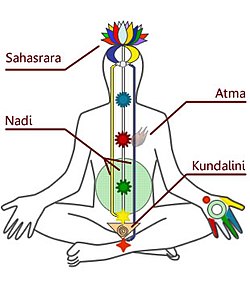
A popularized chakra scheme in modern esoteric literature (associated with early twentieth-century Theosophical visual culture; created by C. W. Leadbeater in 1927), illustrating how standardized "seven-chakra" templates circulated in Western print and teaching.
From the late nineteenth century onwards, Western esoteric currents gradually assembled a "tantric–yogic" subtle-body cosmology that combined Indian terms such as chakra, nāḍī, kuṇḍalinī and prāṇa with older European notions of the astral body and vital force. The familiar modern template—seven major chakras aligned along the spine, traversed by three main nāḍīs (iḍā, piṅgalā, suṣumṇā) and animated by rising kuṇḍalinī—does not reproduce any single premodern Indian map. Rather, it reflects a selective hybridization of Sanskrit sources, Theosophical speculation, occult astral medicine and twentieth-century psychologies.[148][149]
The earliest strata belong to nineteenth-century occultist reworkings of Indian vocabulary into an existing European discourse on subtle bodies. Esoteric authors such as Éliphas Lévi elaborated ideas of "astral light" and graded spiritual planes inhabited by spirits and thought-forms, themselves drawing on Mesmerist vitalism, Romantic "fluidic" theories and Christian esoteric speculation.[150] The Theosophical Society then adopted the Sanskrit ākāśa ("space", "ether") as a universal subtle medium. Around 1900, writers including Annie Besant and C. W. Leadbeater popularized the notion of "Akashic records": a cosmic memory-field in which all thoughts and events are stored and from which clairvoyants can retrieve information, in works such as Besant's The Ancient Wisdom and Leadbeater's manuals on occult development.[151] This specific idea of a literal "record archive" has no premodern usage in Hinduism or Buddhism; it arises from fusing Indian ākāśa language with Western notions of astral light, universal mind and spiritualist mediumship. The modern "Akashic reader", offering life-readings from an impersonal etheric archive, can thus be seen as a variant of the nineteenth-century trance medium who now accesses a cosmic library rather than channeling a particular spirit guide.
Within this occultist framework, Theosophical and related authors began to synthesize Indian subtle-body schemes into standardized diagrams. Leadbeater's booklet The Chakras (first issued in the early twentieth century, widely circulated from the 1920s) presented seven major chakras mapped to the spine, each with a fixed number of petals, a colour and a set of psycho-spiritual functions; Leadbeater combined Sanskrit terminology with clairvoyant observations, Western occult colour symbolism and a quasi-scientific language of etheric vortices.[152]Rudolf Steiner's anthroposophy developed a parallel subtle physiology (lotus flowers, higher bodies, etheric and astral sheaths), while the trance "readings" of Edgar Cayce (1877–1945) linked spinal centres, endocrine glands and spiritual growth in ways that anticipated later chakra–gland correlations, even when the word "chakra" was not consistently used.[153] Together, these currents established a template of vertically stacked psycho-spiritual centres in the body, integrated with Western ideas of vital force, astral planes and spiritual evolution.
Diagram of yogic "centres" (lotuses) reproduced in Arthur Avalon's The Serpent Power of 1919, illustrating how translated Tantric materials supplied authoritative templates for later Western esoteric and yoga syntheses.
A key bridge between Sanskrit textual traditions and this emerging Western system was the work of Arthur Avalon (1865–1936). His influential English-language synthesis The Serpent Power (1919), based on translations and commentaries on Śākta and Śaiva tantric sources, presented a seven-centre kuṇḍalinī-yoga scheme with detailed descriptions of chakras, nāḍīs, mantras and deities.[154] Although scholars note that even Avalon's reconstruction selectively harmonizes divergent Indian materials, his book became a standard reference for both Western occultists and later yoga teachers, providing Sanskrit authority and elaborate diagrams that could be aligned with Theosophical and occult subtle-body models.[155] In this way, Avalon's system helped stabilize the idea that there "should" be seven principal chakras in a vertical sequence, even though classical Indian lists and uses vary considerably.
Twentieth-century yoga reformers and "modern yoga" teachers then provided concrete practices and narratives through which this hybrid cosmology could be embodied. Figures such as Swami Sivananda, Paramahansa Yogananda, Swami Kuvalayananda, B. K. S. Iyengar and later Swami Satyananda Saraswati popularized postural yoga and prāṇāyāma in Euro-American contexts, often integrating schematic accounts of nāḍīs and chakras into handbooks aimed at lay practitioners from the 1930s onward.[156] In these presentations, the classical triad of iḍā, piṅgalā and suṣumṇā—originally embedded in specific Haṭha-yogic and tantric ritual contexts—was reinterpreted as a set of subtle "energy channels" that could be harmonized through breathing techniques, sometimes correlated with the autonomic nervous system or with psycho-emotional polarities (solar/lunar, masculine/feminine).[157] At the same time, Western occult healing and alternative medicine discourse reframed prāṇa as "bioenergy" or "life force", continuous with Mesmerist and vitalist notions, and increasingly described illness in terms of blockages or imbalances in these channels and centres.[158] Mantras associated with chakras were promoted as vibratory "formulas" to tune or unlock these centres, in ways that partly echoed older Western assumptions about sacred names, magic words and the creative power of speech, even as they were presented as authentically "Eastern".[159]
From the 1950s to the 1970s, the emerging human potential movement and transpersonal psychologies further psychologized this hybrid subtle-body map. Carl Jung's earlier interest in kuṇḍalinī symbolism—mediated through the Eranos seminars and his lectures published as The Psychology of Kundalini Yoga—encouraged reading tantric diagrams as maps of psychological development rather than literal esoteric anatomy.[160] At centres such as the Esalen Institute, experimenters including Stanislav Grof wove chakras and kuṇḍalinī into narratives of spiritual emergence and crisis, first in the context of psychedelic therapy and later through holotropic breathwork.[161] Reports of spontaneous bodily movements, heat, visions and altered states were framed as "Kundalini awakenings" or "Kundalini crises", blending Indian language, Theosophical subtle-body models and psychodynamic interpretations. Accounts by figures such as Gopi Krishna (Kundalini: The Evolutionary Energy in Man, 1967) and the charismatic guru Swami Muktananda (Play of Consciousness, 1971) circulated widely in this milieu, providing dramatic narratives of kuṇḍalinī rising as both a goal and a risk within intensive meditation and devotional practice.
A particularly influential codification of the modern system took shape in the 1970s with the standardization of a seven-chakra "rainbow body". Authors such as Christopher Hills (Nuclear Evolution, 1977) and Ken Dychtwald (Bodymind, first published 1977–1978) presented vertically aligned centres coloured according to the spectrum (from red at the base to violet at the crown) and associated them with endocrine glands, psychological themes and stages of human potential.[162] Hills in particular integrated this with a hierarchy reminiscent of Abraham Maslow's "pyramid" of needs—survival, creativity, love, communication, intuition, transcendence—while Dychtwald tied the chakras to body-psychotherapy notions of somatic memory and personal growth. Although spectrum colours and strict chakra–gland correlations have no basis in premodern Indian sources, this sevenfold rainbow scheme soon became the dominant popular template in New Age publishing, workshop culture and therapeutic settings.[162]
In parallel, a rich visual culture crystallized around these hybrid maps. Poster art, book illustrations and meditation cards depicted the chakras as stacked disks or wheels along a silhouetted body, often combining elements from Sanskrit yantras (geometric forms, seed syllables, petal counts) and Buddhist or Hindu mandala aesthetics with Western occult colour theory and aura painting.[163] Practitioners and therapists encouraged clients to "visualize" or colour in chakras as part of guided meditations, creative therapies and self-help exercises; mandala drawing and colouring, popularized in part through Jungian circles and art therapy, was marketed as a way to access deep layers of the psyche while resonating with Asian mandala imagery.[164] In many contemporary manuals, these visualizations coexist with discussions of Akashic records, past lives and aura-reading, where practitioners claim to "scan" a client's chakras and subtle bodies as a way of accessing information stored in a universal field—effectively reworking older spiritualist mediumship techniques through the language of chakras and Akashic memory. Some occultists also explicitly link yantras and chakra diagrams to Western ideas of sacred geometry and magical sigils, treating them as powerful symbols that structure and influence subtle realities.[159]
By the 1980s–1990s, this Western tantric–yogic cosmology had become a modular resource across the wider New Age and holistic-health milieu. Chakra diagrams were integrated into Reiki lineages, crystal healing, massage therapies and coaching practices; authors such as Anodea Judith systematized the seven-chakra model as a developmental template linking childhood stages, body regions, emotions and social issues.[165] At the same time, the Akashic-records motif fed into a broader market of intuitive readings and channelled literature, where subtle-body models provided both a diagnostic grid and a rhetoric of empowerment ("releasing karmic patterns", "upgrading one's vibration"). Although many practitioners present these frameworks as ancient "Eastern wisdom", scholarly research emphasizes their twentieth-century construction out of Theosophy, occultism, spiritualism, vitalist medicine and psychologized yoga.[158][148][149]
Asian actors have also played an active role in propagating and re-exporting this hybrid cosmology. Indian gurus and yoga entrepreneurs have adopted rainbow-chakra posters, Western-style subtle-body diagrams and psychologized readings of kuṇḍalinī in international teaching, sometimes even in India itself; Tibetan Buddhist teachers in Europe and North America occasionally recast vajrayāna subtle-body practices in terms of chakra balancing for modern audiences; and South Asian and Tibetan artists have produced works tailored to New Age and yoga markets.[166] At the same time, some Hindu and Buddhist scholars and practitioners have criticized these developments as oversimplifications or distortions of their traditions, while others pragmatically embrace them as effective pedagogical or missionary tools. The resulting tantric–yogic cosmology is therefore best understood not as a direct survival of any one Asian esoteric system, but as a dynamic field of Western esoteric creativity in constant dialogue—sometimes collaborative, sometimes contentious—with South and Inner Asian religious worlds.[167][168]
Occultist–magical iniciatic orders and the orientalization of esotericism: disputes and adoptions (1890s–1930s)
Aleister Crowley, whose Thelemic curricula incorporated yoga and reinterpreted Indic and Buddhist techniques within a Western ceremonial-magical framework.
Between the 1880s and 1910s, European and North American occultist milieus argued over the growing presence of Indic (and other Asian) repertoires within Western esoteric currents. Around the Theosophical Society (H. P. Blavatsky, Olcott, later Annie Besant), doctrines framed with Sanskritic vocabulary —karma, rebirth, yoga— were advanced as universal wisdom; critics in French-, German-, and English-speaking occult circles cast these imports as an "Oriental" deviation from a Christian–Hermetic lineage. In this polemical context, the contrast between "Eastern" and "Western" esotericism functioned primarily as an intra-occultist boundary concept rather than a neutral scholarly typology.[93][169] Decades later, scholars reframed "Western esotericism" (and, by implication, "Eastern esotericism") as heuristic labels for historically traceable formations, explicitly critical of perennialist conflations — relocating what had been a boundary device of occult polemics into analytical categories for historical study.[170]
Flashpoints included Parisian and Lyonnais networks around Papus and neo-Rosicrucian/Martinist currents (c. 1890–1910); British controversies around the Hermetic Order of the Golden Dawn and its successors. Occult journals, publishing houses, lodge circuits, and ritual orders served as the infrastructure for importation, critique, and retooling.[169][171] "Orientalization" proceeded at several levels: doctrinally (discussions of karma/rebirth and subtle anatomies associated with yogic/tantric sources), practically (experiments with meditation and yoga as techniques of self-cultivation within occult psychology and will-training), and aesthetically/lexically (Sanskrit terms, "Masters of the East" narratives, and related imagery in lodge ritual and print culture).[93][172] A notable strand of criticism framed objections in explicitly Western—often Christian–Hermetic—terms: even while pursuing heterodox paths, some occultists defended a self-understood Western Christian identity against what they perceived as non-Christian intrusions, disputing Theosophical universalism.[169]
From the 1890s to the 1930s, a parallel but distinct development saw lodge-based, ceremonial orders adopt Asian repertoires as operative technique. Building on Theosophical cosmology and terminology, the Hermetic Order of the Golden Dawn, A∴A∴, and the Ordo Templi Orientis (O.T.O.) reinterpreted yogic and tantric concepts through the lens of Western ceremonial magic. The Theosophical codification of chakras and kuṇḍalinī informed both magical circles and early modern yoga pedagogies; tantric terms were reframed as a psychophysical "energy" model integrable into initiatory practice and bodily disciplines, aligning occult ritual, subtle-body theories, and yogic technique within a shared esoteric vernacular.[173][174][175][176]
Under Aleister Crowley, Thelemic curricula assimilated elements of Yoga, Tantra, and Vedānta. Thelema framed realization as the attainment of "True Will," explicitly compared to Vedāntic ātman and Tantric śakti. Through texts such as Liber AL vel Legis (1904) and Eight Lectures on Yoga (1939), Crowley introduced Hindu and Buddhist meditation frameworks into a Western magical syllabus, while eroticizing Tantric symbolism within his sex-magical system (Magick). Scholars characterize this adaptation as a form of "tantric modernism," reflecting fascination with and distortion of South Asian sources through the prism of Western esoteric eroticism.[177][174]
A second line of lodge-centered orientalization unfolded within modern Rosicrucianism. The Rosicrucian Fellowship (founded by Max Heindel in 1909) and the Ancient Mystical Order Rosae Crucis (AMORC, established by Harvey Spencer Lewis in 1915) combined Western mystical symbolism with references to reincarnation, karma, and subtle energy (prāṇa) and the Ātman drawn from Hindu–Buddhist contexts.[178] Although AMORC retained a broadly Hermetic and Christian-esoteric vocabulary, its teachings invoked Indic concepts as universal laws accessible through initiatic discipline rather than dogma, reflecting early twentieth-century strategies to present occult organizations as vehicles of perennial wisdom harmonizing Eastern and Western traditions within a single "spiritual science."[179]
Across Thelemic and Rosicrucian settings, the hybridations of Eastern doctrines served a double purpose: legitimizing magical practice through the prestige of "ancient Orient" traditions and recasting esoteric gnosis in psychological and energetic terms. These hybrid constructions anticipated later developments in New Age esotericism and transpersonal psychology; subsequent scholarship reads Crowley's synthesis of yoga, sex-magical technique, and initiatory cosmology as a structural precursor of twentieth-century "tantric modernism."[174][177] The Asian religions narrative and adoptions of this period also touched adjacent arenas. Elements associated with "nature-cure" (e.g., vegetarianism, breathwork) appeared in some occult circles.[180]
Orientalization of sex magic and "Tantra" claims in occultist lodges and ceremonial magic milieu (1890s–1930s)
Nineteenth-century debates on vital forces, mesmerism, and marital reform supplied much of the conceptual ground on which later occultist invocations of "Tantra" would grow. Before Sanskrit terms entered lodge curricula, Anglo-American experiments with continence, trance, and erotic mysticism had already framed sexuality as a controllable medium of spiritual power; only in the fin-de-siècle did occultists retrofit these ideas with Indian labels and a selective citation of tantric practices.
Ida Craddock, an American occult/sexual-reform writer whose "marital mysticism" fed fin-de-siècle esoteric and continence discourses.
The earliest durable synthesis is associated with Paschal Beverly Randolph, who in the 1850s–1870s fused mesmerism and harmonial metaphysics with ritualized intercourse in a small Rosicrucian setting, casting erotic union as a vehicle for will, healing, and visionary contact. Later occult histories canonized him as a pioneer of sex magic, although his idiom and sources remained primarily Western (vital fluids, magnetism, clairvoyant trance) rather than Sanskritic.[181] Parallel, non-esoteric reform currents experimented with non-ejaculatory intercourse as moral hygiene and psychophysical discipline. The Oneida Community promoted "male continence" (a form of coitus reservatus);[182] physician Alice Bunker Stockham systematized Dianism/karezza for marital spirituality and health;[183] and Ida Craddock (1869–1902) blended biblical exegesis, comparative "Oriental" references, and practical sexual counsel, treating intercourse as a liturgical discipline for married couples while drawing primarily on American metaphysical and reformist milieux.[184] In Britain, popularizer Hargrave Jennings projected a romantic "phallus-cult" narrative (Phallicism; The Rosicrucians) onto eclectic materials, prefiguring later occult journalism that read ancient and "Eastern" sexual wisdom into disparate sources.[185]
Within the lodge world that was already adopting Yoga and subtle body schemas via Theosophy, founders of the Ordo Templi Orientis—Carl Kellner and Theodor Reuss—recast high-degree work as repositories of a "tantric" gnosis. From the 1890s they blended earlier Western continence or erotically charged techniques with Sanskrit terminology and scattered references to practices such as Vajroli mudra and maithuna, though independent documentation for Kellner's claimed Asian initiations remains sparse and contested in scholarship.[186][187] Under Aleister Crowley, Thelema integrated Vedānta and yogic meditation with a sex-magical soteriology inside a Western ceremonial magic syllabus; Crowley selectively cited Indian and Tibetan terms, eroticized tantric symbolism, and framed attainment as alignment with "True Will."[188][109] Crowley's students and associates helped routinize specific techniques and mythologies in the Anglophone occult sphere; later figures such as C. F. Russell in the Agapé milieu contributed to the diffusion of Thelemic and O.T.O. sexual teachings in the United States during the interwar and immediate postwar years.[189]
On the European continent, Maria de Naglowska led a short-lived Parisian confraternity (1930–1934) that developed ritual-erotic liturgies ("Third Term of the Trinity") under the sign of ancient—often "Oriental"—antecedents, while operating within modern occult print culture.[190] In the United States, the sensational career of Pierre Bernard—promoter of "tantrik yoga" from the 1900s and founder of the Clarkstown Country Club—popularized the idea of a secret "yoga of sex," though the historical record suggests a mix of genuine South Asian contacts, showmanship, and American esoteric reinterpretation rather than a transparent transmission of Śākta/Kaula ritual.[191]
In the United States, the sensational career of Pierre Bernard included renaming an estate the "Clarkstown Country Club" and making it "the site of his own utopian Tantric community".[192] Urban summarizes Bernard's significance by noting that he was "a pioneer in the early transmission of Tantra to America" and "one of the first figures in the reinterpretation of Tantra as something primarily concerned with sex and physical pleasure".[193]
The vocabulary of "Tantra" in these circles overlapped with other currents of lodge orientalization. The Theosophical Society and cognate movements had already popularized chakras, kuṇḍalinī, and prāṇa as universal "energy" schemata;[194] ceremonial orders such as the Hermetic Order of the Golden Dawn and the A∴A∴ used yogic meditation in will-training and astral work; and Rosicrucian bodies (e.g., Rosicrucian Fellowship; AMORC) referenced karma, rebirth, and subtle "prāṇa" as universal laws within a Western Christian-Hermetic idiom.[195] Within this broader synthesis, sexual techniques were presented as a capstone or "operant" key to already familiar esoteric grammars of planes, energies, and astral vehicles rather than as a self-standing Asian system.
Contemporaneous talk of "Taoist sexual practices" played little role in this period's lodge discourse; sustained Anglophone treatments of Chinese sexual cultivation (e.g., huanjing bunao) and their diffusion into Western esoteric and wellness markets are mid-twentieth-century developments and are treated elsewhere in this article. Tibetan sexual imagery such as yab-yum and doctrinal terms like mahāmudrā were occasionally cited in exoticizing ways, but scholarship stresses that these refer respectively to iconography and contemplative/philosophical frameworks, not to portable sex rites of the type imagined in modern occultism.[196]
From a South Asian perspective, the modern "tantric sex" imagined in Euro-American occultism does not reproduce any single Śākta or Kaula ritual corpus. Classical sources embed sexual rites for a restricted elite within elaborate initiatory, liturgical, and doctrinal frames; even there, emphasis falls on visualization, mantra, and subtle-body yogas rather than on physiological techniques such as retrograde semen control.[197] By contrast, the lodge literature selectively lifted elements (terms like maithuna, motifs such as vajra-yoni union, or references to Vajroli) and inserted them into Western vitalist, psychological, and initiatory narratives. In medical and reformist milieus, techniques of continence were interpreted through hygiene and self-control rather than through Śākta cosmology; later occult texts sometimes conflated these with Indian yogic aims, producing a hybrid field where retrograde ejaculation, trance induction, and "energy" talk were treated as commensurable.
By the 1930s, this sex-magical strand had stabilized in Anglophone and francophone occult subcultures and began to circulate in small lodge networks and handbooks. Its afterlives include post-war Thelemic transmission and, in Spanish-language esotericism, the influential synthesis of Samael Aun Weor, who combined Thelemic and Rosicrucian motifs with a moralized sexual alchemy; those later developments fall outside the present chronology.[198] For the post-1960s reframing of "tantra" as secular/psychological "sacred sexuality" in therapeutic and wellness settings (e.g., Osho's movement and Neotantra), see the dedicated subsection; for non-sexualized Kundalini pedagogies and rainbow-chakra visual culture, see Kundalini-centered movements.
Traditionalist and perennialist reinterpretations of Eastern traditions (1910s–1950s)
René Guénon (c. 1925), a foundational Traditionalist author whose perennialist reading of Asian metaphysics shaped twentieth-century antimodern esoteric discourse.
The early twentieth century witnessed a reformulation of the relationship between Western esotericism and Asian traditions through the emergence of the so-called Traditionalist School; the core method of this reformulation was the use of a non-syncretic metaphysical comparative analysis of orthodox religious esotericisms that was created by the Swedish artist Ivan Aguéli for his personal study of Sufism. Figures such as René Guénon, Frithjof Schuon, and Ananda Coomaraswamy used this method and then articulated an explicitly antimodern and pesimistic worldview—critical of scientific methods, rational epistemology, and secular institutions—that posited a primordial and transcendent source of truth underlying all authentic religious forms. Drawing on Vedānta, Sufism, and Neoplatonism, they reinterpreted Hindu and Islamic metaphysics as expressions of a perennial "sacred science" in contrast to what they regarded as the "materialism"—understood as the scientific naturalism and mechanistic epistemology—and the spiritual decline of the modern West.[40][199]
The Traditionalist School developed in early twentieth-century Europe as a continuation of the romantic and idealist reaction against Enlightenmentrationalism. Like nineteenth-century Romanticism, it reimagined history through mythic narratives of origin and decline—such as the Greek Golden Age and the "fall of man" but orientalized as the myth of the Indian Yugas—and opposed the quantitative, secular, and utilitarian ethos of modern civilization.[40][41][199] Historians of Western esotericism therefore interpret Traditionalism not as a survival of ancient wisdom but as a modern European construction rooted in romantic antimodernism and mythic historiography.[48]
For Traditionalist writers, modernity represented a cosmic crisis: the loss of transcendental knowledge, hierarchy, and sacred order; while initiated esotericism was the higher manifestation of that knowledge, hierarchy, and order. Their diagnosis of "the modern world in crisis" opposed the rational, scientific, and secular worldview of modern Europe, which emphasized empirical inquiry and equality before the law. While Traditionalist texts called for a return to "sacred knowledge," scholars such as Wouter Hanegraaff and Egil Asprem interpret this antimodern discourse as a cultural symptom of modernity rather than a viable alternative to scientific rationalism.[41][37]
The Traditionalist interpretation of Asian traditions emphasized metaphysical unity but was selective and hierarchical: Hinduism, Sufism, and Platonism were treated as pure reflections of primordial wisdom, while modern or reformist interpretations were dismissed as degenerate. This selective admiration reflected both the European intellectual climate of the interwar years and the continuing legacy of Romantic Orientalism.[40][133]
By contrast, the mid-twentieth-century "universalist" perennialism of Vedantist writers such as Aldous Huxley and Christopher Isherwood—related to the Vedanta Society—expressed a more modern and optimistic adaptation of the idea of a shared spiritual core among religions. Although more compatible with pluralistic and scientifically informed societies, this universalism remains a philosophical and spiritual interpretation rather than a historical or anthropological framework.[39][133]
In contemporary scholarship, both the Traditionalist and the universalist perennialist currents are recognized as key phases in the twentieth-century encounter between Western esotericism and Eastern religions: the first representing a reactionary and hierarchical antimodernism, the second an evolutive and psychologized universalism. Each, in different ways, reinterpreted Asian philosophies to define the spiritual identity of the modern West.[40][41][37]
Jungian psychological orientalization and the psychologization of religious symbology (1920s–1970s)
Carl Gustav Jung, whose analytical psychology strongly shaped modern Western psychologized readings of Asian symbols and contemplative traditions.
A new mode of East–West encounter took shape through the work of Carl Gustav Jung, inaugurating a psychological reinterpretation of Eastern spirituality within the framework of analytical psychology. Jung's system redefined religious symbols as expressions of the collective unconscious rather than as metaphysical realities. His writings on the I Ching, The Tibetan Book of the Dead, and Indian yoga sought to translate Asian cosmologies into a universal language of archetypes and psychic transformation.[133][200]
In contrast to the theosophical and occultist Orientalism of the late nineteenth century, Jung's approach "psychologized" Eastern symbols, interpreting them as projections of universal psychic structures rather than revelations of transcendent realities. This reframing allowed Western intellectuals to engage Asian ideas within a modern scientific and therapeutic discourse, bridging metaphysical speculation and empirical psychology.[133]
Through his collaboration with Indologist Heinrich Zimmer and participation in the Eranos Foundation circle—alongside Mircea Eliade, Henry Corbin, and D. T. Suzuki—Jung's interpretive model became one of the most influential vehicles for the psychological assimilation of Asian religiosity in the West.[48][37] Within this paradigm, concepts such as karma, mandala, and yoga were recast as symbolic representations of inner psychic processes, a move that enabled Eastern spirituality to be integrated into modern psychotherapy and humanistic culture.
The reception of Jungian ideas produced two distinct trajectories. On one hand, clinical and academic interpreters emphasized analytical psychology as a descriptive science of symbols, incorporating Asian motifs into psychotherapeutic and cultural discourse. On the other, esoteric and transpersonal circles appropriated Jung's terminology to frame traditional practices—alchemy, astrology, and meditation—as forms of psychological initiation stripped of supernatural metaphysics.[133][37] This dual legacy made "Jungianism" a bridge between Western esotericism and the emerging psychospiritual movements of the mid-twentieth century, anticipating the synthesis of Eastern meditation and Western depth psychology in the human potential movement and transpersonal psychology.[133][200]
Contemporary scholarship regards this Jungian "psychological Orientalism" as both an innovative mediation and a reduction of Asian traditions to Western symbolic frameworks. While it expanded cross-cultural understanding, it also exemplified how modern esotericism translated metaphysical doctrines into models of the psyche, reflecting broader twentieth-century negotiations between spirituality and psychology.[200][37]
Quantum mysticism, vibratory cosmology, and scientized analogies in hybrid East–West esotericism (1950s–1990s)
David Bohm, whose holistic interpretations (e.g., implicate order) became a major reference-point for late-twentieth-century analogies between modern physics and Asian non-dual or "field" cosmologies.
From the mid-twentieth century, a distinct channel of reception reframed topics from Western esotericism—subtle forces, acausality, cosmic mind—together with Vedāntic, Buddhist and Taoist ideas in the vocabulary of modern science (especially quantum mechanics, systems thinking and "fields"). The label quantum mysticism took hold later, often polemically, but the historical object is the repertoire of analogies that lent cultural legitimacy to non-mechanistic cosmologies and facilitated their diffusion into New Age and experiential psychology milieux. Interwar antecedents existed (e.g., the Albert Einstein–Rabindranath Tagore debate in 1930; Erwin Schrödinger's Vedānta and What Is Life?), yet the main arc runs from the 1950s to the 1990s.[201][202]
A theoretical preface came with the Jung–Pauli collaboration. In the early 1950s, synchronicity was presented by Carl Jung as an acausal principle linking psyche and world, in sustained dialogue with Wolfgang Pauli's interest in quantum foundations; perennialist readers aligned it, by analogy rather than proof, with the Upanishads and the Tao Te Ching.[203][204]
Philosophically, David Bohm was more consequential. In Wholeness and the Implicate Order (1980) he argued for "implicate/explicate order" and "holomovement" as a critique of fragmentation; his dialogues with Jiddu Krishnamurti offered a holistic hermeneutic many mapped—again analogically—onto Vedāntic non-duality or Buddhist emptiness, without laboratory claims.[208][209][210]
In biology, a parallel "field" discourse amplified the turn. Rupert Sheldrake's Morphic resonance (1981) proposed formative fields; reception ranged from New Age uptake to disciplinary critique, illustrating how field rhetoric migrated into esoteric and Asian vocabularies (ākāśa, prāṇa) without securing scientific consensus.[211][212]
"Vibration" became a common denominator between popular physics and Asian sound doctrines. Joachim-Ernst Berendt's Nada Brahma: The World Is Sound (1983) linked nāda/śabda brahman to acoustics and contemplative listening; the theme fed into vibrational medicine and the sound-based practices treated elsewhere in this article.[213][214]
By the early 1990s the genre consolidated with holographic metaphors (Talbot) and mass-market "quantum consciousness," alongside explicit boundary-work by scientists and philosophers who used "quantum mysticism" to demarcate science from spirituality.[215][216][217] For the history of Western esotericism, the point is not to arbitrate physics but to trace how scientific metaphors conferred legitimacy on long-standing esoteric motifs—subtle bodies and planes, acausal connections, universal mind—and on Asian energetic/non-dual cosmologies, easing their absorption into New Age, Human Potential Movement and spiritual-wellness ecologies mapped in adjacent sections.[218][219]
Inner Asian shamanism in Western esotericism milieu (1950s–1990s)
A Tuvan shaman (Tuva/South Siberia), representing the Inner Asian ritual ecologies that became central to 20th-century scholarly typologies of "shamanism" and later fed Western esoteric and therapeutic reinterpretations.
Western esoteric engagements with the shamanic traditions of Inner Asia developed along two intertwined tracks: (a) a romantic–occult imagination of an "occult Inner Asia" (from the 1890s) in which vestiges of pre-Buddhist rites and ecstatic specialists were read as clues to a hidden order of wisdom, and (b) a twentieth-century scholarly typology—built first by Russian and European ethnographers and canonized by Mircea Eliade—that, in turn, fed modern esoteric and therapeutic adaptations.[220][221] In esoteric (emic) discourse, Inner Asia—ranging from the Altai–Sayan and Tuva through Mongolia to the Amur–Russian Far East and Manchuria—was imagined as a landscape of concealed adepts and operative "cosmic" techniques; in academic (etic) treatments, the same region provided much of the comparative evidence for defining "shamanism."[222]
From the late nineteenth to early twentieth century, popular travelogues and esoteric ethnographies associated the Tibetan plateau and its margins with occult orders and pre-Buddhist "magical" cults. Writers such as Alexandra David-Néel and Nicholas Roerich moved between tantric vocabulary and reports of ritual experts in the Himalayas, western Mongolia, and the Gobi, projecting a unified "Asiatic gnosis" onto diverse local practices; Ferdynand Antoni Ossendowski's best-selling narrative added sensational tales of subterranean kingdoms (Agharti).[223][224][225] As Donald S. Lopez Jr. has shown, this "Tibetanism" adapted occultist and comparative religion motifs to landscape writing, often blurring tantric monastic culture with reports of local spirit-mediums and mountain cults.[226] Although these authors rarely used the word shamanism, modern scholarship recognizes that some of the practices they romanticized (or misunderstood) correspond to Himalayan and Mongol–Siberian forms of ecstatic expertise later classed as "shamanic," alongside tantric ritual repertoires.[220][221]
Before mid-century, Russian, Siberian and Manchurian ethnographers had already documented Tungusic, Buryat and other Inner Asian ritual specialists whose roles (healing, spirit-journeying, drum-trance) became paradigmatic for the category "shaman." Sergei Shirokogoroff's studies in the Amur–Manchurian zone and among the Evenki emphasized a complex nexus of ritual, kinship and cosmology that would shape later definitions.[227][228] This ethnographic bedrock—together with earlier imperial and missionary reports—located the classic shamanic complex in South Siberia/Mongolia and the Amur–Manchurian belt (see Siberian shamanism, Mongolian shamanism, Manchu shamanism), even as practices and deities varied regionally (e.g., Buryat böö, Evenki šaman, Turkic–Mongol sky-cults).[222]
Mircea Eliade, whose mid-20th-century synthesis of "shamanism" as "techniques of ecstasy" became a major scholarly reference point later re-used in esoteric and spiritual adaptations.
The decisive modern typology appeared with Eliade's Shamanism: Archaic Techniques of Ecstasy (1951; Eng. 1964), which synthesized Inner Asian materials into a universal model of the shaman as "technician of ecstasy," traveling to upper and lower worlds aided by a drum and spirit-helpers.[229] Eliade's perennialist framing strongly influenced both academic and esoteric receptions; later historians note that his construction universalized Siberian–Inner Asian patterns and resonated with mid-century traditionalist currents.[222][230]
In the 1950s–1960s, esoteric and countercultural interpreters connected Eliade's model with older "occult Inner Asia" motifs. Walter Evans-Wentz's editions of Tibetan texts (notably the Tibetan Book of the Dead, 1927) popularized a rhetoric of initiatory science and bardic states that later fed psychedelic manuals such as The Psychedelic Experience (1964).[231][232] This syncretic reading—conflating tantric soteriology with shamanic-style "soul journeys"—prepared the ground for therapeutic and New Age adaptations that explicitly invoked Inner Asian shamanism.
Chronologically prior to the popularization of "core shamanism," Stanislav Grof's work bridged clinical psychedelics and comparative ecstatic techniques. Beginning in the late 1950s and 1960s, Grof's LSD research in Prague and Baltimore drew on cross-cultural reports (including Eliade's synthesis) to frame non-ordinary states; in the 1970s–1990s he and Christina Grof developed Holotropic Breathwork as a drug-free method sometimes explicitly compared to shamanic "technologies of the sacred."[233][234] Grof did not claim lineage in Inner Asia, but his comparative language—linking trance, visionary geography, and psychopompic motifs—helped normalize an esoteric-therapeutic reading of shamanism within Western alternative spirituality.
Only afterward did Michael Harner codify an explicitly teachable, lineage-free system under the label "core shamanism" (The Way of the Shaman, 1980), and found the Foundation for Shamanic Studies (1985), the kernel of what has been called "neoshamanism". Harner's synthesis abstracted from Siberian/Inner Asian patterns (drumming to 4–7 Hz, upper/lower world journeys, spirit-helpers) and from his Amazonian fieldwork to offer a portable set of practices to Western seekers.[235] In the 1980s–1990s this "technique-first" approach intersected with New Age esotericism and psychospiritual therapy, often citing Eliade as scholarly warrant while minimizing local cosmologies and ritual ecologies.[230]
Historians and anthropologists have since debated the category and its Western uses. Ronald Hutton traced the modern imagination of "Siberian shamanism" within European thought, cautioning against treating Inner Asian evidence as a timeless template; Andrei Znamenski examined how Eliade, Harner and New Age authors aestheticized "the primitive," turning Inner Asia into a mirror for Western quests; and Geoffrey Samuel highlighted a spectrum between "shamanic" and "clerical" religious modes in Tibetan societies, complicating any strict divide between tantric monasticism and indigenous spirit-mediumship.[222][221][236] These critiques helped separate emic esoteric constructions (hidden Masters, unified Inner Asian "gnosis") from etic, historically bounded ritual complexes.
Geographically, the shamanism that most shaped Western esoteric reception clustered in southern Siberia (Altai, Khakassia, Tuva, Buryatia), across Mongolia (including Buryat and Khalkha milieus), and eastward into the Amur–Manchurian zone of the Evenki and related Tungusic groups—precisely the areas documented by pre-1950 ethnography and later generalized by Eliade.[227][222] While some writers briefly referenced Korean shamanism or Sino-Mongol borderlands, these played a marginal role in Western esoteric adaptations compared to the Inner Asian core.
From the late Soviet era into the post-1991 period, Inner Asian shamanic revivals and neo-traditionalisms (e.g., Buryat and Tuvan "national" shamanisms; Turkic–Mongol Tengrism) developed in dialogue with both ethnographic scholarship and transnational esoteric markets. These movements sometimes recycled earlier "occult Inner Asia" tropes—sacred mountains, cosmic geography, primordial sky-cults—while engaging with heritage politics and identity revival.[237][238] Western esoteric and therapeutic circles adopted elements from these revivals, reinforcing a feedback loop between academic typologies, local reinventions, and global esoteric imaginaries.
Scholarly consensus now stresses that "shamanism" is a heuristic umbrella built from particular Inner Asian cases (among others), not a single archaic religion. Ranging from hunting-taiga spirit work to steppe sky-cults and Himalayan oracular practices, these traditions intersected with Buddhism and Bön in varied, historically specific ways; modern Western esotericism often collapsed those differences into a myth of unified, portable technique.[222][236][221]
Within the broader article's architecture, this subsection complements the "occult Inner Asia" block by shifting the focus from territory and travel writing to the category "shamanism" itself—its pre-1950 ethnographic construction, Eliade's mid-century systematization, and the downstream esoteric, therapeutic and revivalist adaptations (Grof, Harner, New Age). It thus clarifies how an Inner Asian ritual ecology became, in Western esotericism, both a source of imagined origins and a kit of techniques detached from place.
The Fourth Way: scenic orientalism (1910s-1940s), and the turn to mantra meditation (1950s–1970s)
G. I. Gurdjieff, whose "Fourth Way" used an Inner Asian travel-myth as an authority backdrop while developing a modern system of self-observation and disciplined practice.
Originating in Moscow and Petrograd circles (1914–1915) and institutionalized through the "Institute for the Harmonious Development of Man" in Tiflis (1919), work with émigré groups in Constantinople (1920) and Berlin (1921), and the Prieuré at Fontainebleau-Avon (1922),[239]George Gurdjieff presented the Fourth Way (often called "the Work") between the 1920s and 1940s as a modern path of inner transformation—self-observation, conscious effort, and the codified Movements—staged against a travel narrative through the Caucasus and Inner Asia but without affiliation to any specific Asian religious lineage. Historians describe this as a form of "scenic orientalism": a mythic geographic backdrop lending authority rather than a doctrinal transplant from a living Eastern tradition.[240]
Gurdjieff's closest early interpreter in the English-speaking world, P. D. Ouspensky, disseminated the Work through lectures and study groups in London, initially presenting himself as a transmitter of Gurdjieff's ideas. After organizational crises in 1924–1925 and growing pedagogical disagreements, Ouspensky separated institutionally and taught independently for the next two decades, cultivating a distinct "London line" that emphasized systematic instruction, written materials, and a more academic ethos.[240] This divergence produced the postwar bifurcation: a Paris-centered Gurdjieff Foundation led by Jeanne de Salzmann that preserved Movements and sittings faithful to Gurdjieff's ethos, and a British network of Ouspensky pupils that maintained Work terminology while reassessing sources and methods.[241]
In postwar Britain, Ouspensky's students sought both to conserve the Work and to clarify its putative Asian origins. Among his closest pupils, Francis C. Roles founded The Study Society in 1951 at Colet House (London) as the principal institution for maintaining Ouspensky's curriculum.[242] While the Paris lineage sustained Gurdjieff's Movement-centered pedagogy without adopting an Indian lineage, the London milieu became the site of a deliberate search for a living contemplative framework that could stabilize practice and authority.[241]
From the late 1950s, Roles and Leon MacLaren—head of the School of Economic Science (later the School of Philosophy and Economic Science)—pursued what they regarded as the "source" behind Ouspensky's teaching. Their inquiry brought them first to Maharishi Mahesh Yogi and, through him, to Shantanand Saraswati, the Shankaracharya of Jyotir Math and successor to Swami Brahmananda Saraswati. Under Shantanand's guidance they adopted mantra meditation and study of Advaita Vedanta, introducing a regularized sādhanā and a non-dual doctrinal framework into the Ouspenskian milieu.[243][244] Roles moved from an initial association with Maharishi to direct reliance on Shantanand Saraswati as spiritual guide, framing mantra practice as complementary to Ouspenskian self-observation rather than as a replacement for the Work.[245]
In 1961, Roles and MacLaren co-organized Maharishi's lecture at the Royal Albert Hall, one of the earliest large-scale public presentations of Transcendental Meditation in Europe. This collaboration led to the founding of the School of Meditation (London), which initiated members of The Study Society and the School of Economic Science into mantra meditation; within these institutions, meditation was embedded in "Practical Philosophy" curricula and linked the Gurdjieffian pursuit of inner work to Indic contemplative stillness.[246][247]
While The Study Society continued as successor to Ouspensky's London group, MacLaren's organization developed parallel programs drawing on both European and Indian sources—Plato, Marsilio Ficino, Swami Vivekananda, and Adi Shankara—within a broadly perennialist synthesis. Over time, its higher courses centered on Advaita Vedānta, incorporating Sanskrit study and sustained guidance from Shantanand Saraswati.[248] This Vedānta-inflected trajectory characterized the Ouspensky–Roles–MacLaren stream and did not extend to all postwar Gurdjieff lineages.[249]
Scholars interpret this British shift as a pivotal moment in the postwar evolution of Western esotericism: rather than founding a new initiatory order, Roles and MacLaren **reframed** the Work within an established Indic lineage, translating its vocabulary of effort and attention into Vedāntic terms. Sociologically, this addressed a post-charismatic vacuum by importing a stable contemplative discipline and a recognizable chain of authority; the trade-off was a reduced emphasis on Gurdjieff's Movements and cosmology in favor of a perennialist bridge to non-dualism.[250][251]
Ouspensky's own late-life statements in 1947—reported by students as a renunciation of "the System"—are attested yet ambivalent; they were **interpreted** in London as a mandate to seek renewal beyond Gurdjieff's pedagogy.[250] In effect, the British line did not abolish the Fourth Way but recontextualized it under an Indic paramparā, while the Paris line conserved Gurdjieff's original performative and experiential pedagogy.
By the 1970s, both The Study Society and the School of Economic Science functioned as hybrid institutions—half esoteric school, half Advaitin saṅgha—offering courses in philosophy, meditation, and Sanskrit to thousands of participants in the UK and abroad. Their integration of mantra meditation and Advaita Vedānta exemplifies a mid-twentieth-century convergence between Western esoteric psychology and Eastern metaphysics, bridging the "Fourth Way" of Gurdjieff and Ouspensky with the living tradition of the Shankaracharyas of India.[244][252]
Modern Zen and the minimalist psychologization of religious experience (1950s–1960s)
D. T. Suzuki, a key mediator of modern Zen in the West, whose translations and interpretations supported a psychologized, experience-centered reception in postwar intellectual and spiritual milieus.
Although Zen Buddhism is not an esoteric tradition in itself, its postwar reinterpretation in the West profoundly influenced the modern vocabulary of Western esotericism. Through its emphasis on direct experience and psychological transformation, Zen provided a new model for articulating inner change—one that replaced the language of occult symbolism with that of awareness, authenticity, and lived insight.[111]
Following Japan's defeat and the Allied occupation of Japan (1945–1952), Buddhist institutions sought renewed international visibility through education, cultural diplomacy, and translation. By the mid-1950s, organized teams of translators in Kyoto and missionary teachers abroad began presenting Zen as a nonsectarian discipline of insight compatible with science and psychology. Figures such as D. T. Suzuki and Alan Watts reformulated Buddhist and Taoist ideas in a psychological idiom—of awareness, immediacy, and integration—that resonated with postwar existentialism and depth psychology. The Eranos circle and Jungian networks provided an intellectual bridge, reading Zen as a symbolic language of transformation accessible to both esoteric and therapeutic audiences.[41]
A crucial early moment was the 1957 seminar in Cuernavaca, Mexico—later published as Zen Buddhism and Psychoanalysis (1960)—where Erich Fromm, Suzuki, and Richard de Martino explored the convergence of Zen practice and humanistic psychotherapy. This dialogue reframed meditation as a "science of the mind," translating mystical realization into psychological integration and existential authenticity.[253]
In the United States, psychologized Zen intersected with the Beat Generation and the postwar search for personal authenticity. Writers such as Jack Kerouac (The Dharma Bums, 1958) and Gary Snyder—who trained in Rinzai monasteries in Japan—popularized Zen as a path of spontaneity and inner freedom. Their romanticized portrayals diffused Zen ideas into Western artistic, esoteric, and psychological subcultures, preparing the ground for later countercultural appropriations.[254]
From the 1960s onward, institutional networks such as the San Francisco Zen Center and Rochester Zen Center established enduring Western communities linked to Japanese lineages. Their practices—especially Zazen and sesshin retreats—combined contemplative rigor with the vocabulary of inner transformation, making Zen legible to psychotherapy, humanistic psychology, and modern esotericism alike.[255]
Scholars such as Robert H. Sharf and Bernard Faure have critiqued the "myth of pure experience" underlying this modern Zen. According to Sharf, the idea of an unmediated, universal enlightenment experience is itself a modern construct shaped by Protestant, romantic, and scientific assumptions; actual meditation experiences remain linguistically and institutionally conditioned.[256][257] This "experience-centered" psychologization differed from contemporaneous Jungian approaches: whereas Jungian interpreters preserved symbolic and archetypal frameworks for esoteric meaning, Zen modernists minimized symbolism in favor of direct awareness and therapeutic applicability.[258]
The significance of this transformation for Western esotericism lies not in doctrinal borrowing but in a shift of language and authority. By emphasizing experiential verification over symbolic tradition, Zen modernism helped to redefine esotericism as a psychology of consciousness and self-cultivation. The modern seeker no longer required initiation into a secret order but could achieve transformation through disciplined introspection. This experiential model later informed Transpersonal psychology, the Human Potential Movement, and secular mindfulness practices, all of which reconfigured esoteric ideals into empirical and therapeutic terms.[111][255]
In Western Europe, teachers such as Taisen Deshimaru in France and Karlfried Graf Dürckheim and Hugo Enomiya-Lassalle in Germany integrated Zen with psychotherapy and Christian dialogue, further normalizing it as a psychological and intercultural discipline. Popular interpretations of Zen and Taoism also reinforced older Western traditions of vitalism and harmonial philosophy, shaping new esoteric psychologies that emphasized energy, awareness, and the unity of mind and body.[90]:3–10[110]
By the late 1960s, this psychologized mysticism had become normalized within Western counterculture. Its vocabulary of awareness and self-realization anticipated the secular contemplative movements of the 1970s, bridging Western esotericism and Eastern mysticism in a shared framework of psychological transformation and lived experience.[111][255][254]
Modern postural yoga and pranayama breathwork with an Indo-Western hybrid system of tantric-yogic cosmology (1950s–1970s)
Modern postural yoga emerged not as a direct survival of premodern practice but as a transnational hybrid of colonial-era body culture, Western esotericism, and Indian reform movements. Scholars such as Mark Singleton, Elizabeth De Michelis, and Joseph S. Alter have shown that what is often called "traditional yoga" was largely reconfigured during the late nineteenth and early twentieth centuries through the combined impact of Theosophy, Indian nationalism, and Western physical culture. Figures like Swami Vivekananda and the Theosophical Society popularized simplified versions of Raja yoga and the idea of a universal "spiritual science," which later intersected with urban, middle-class concerns for health, discipline, and moral vigor under the British Raj.[33][110][90]:3–10
B. K. S. Iyengar, a major figure in the internationalization of modern postural yoga in the mid-twentieth century, helping standardize pedagogical formats for global audiences.
After the independence of India in 1947, the newly sovereign state promoted yoga as part of its cultural diplomacy and national self-definition. Under Jawaharlal Nehru, the Indian Council for Cultural Relations (ICCR) created networks of exchange, lectures, and cultural missions that made India's spiritual and scientific identity more visible abroad. This diplomatic "soft power" climate facilitated the work of independent teachers who were already prepared for transnational outreach. Charismatic figures such as Sivananda Saraswati and his disciple Vishnudevananda Saraswati—who founded the International Sivananda Yoga Vedanta Centre in Montreal in 1959—combined devotional missions with modern publicity methods, using English-language publishing, photography, and travel networks to reach Western audiences. Meanwhile, B. K. S. Iyengar's international tours (beginning in London in 1954, at the invitation of Yehudi Menuhin) and his widely read Light on Yoga (1966) introduced the idiom of asana-based yoga to Europe and North America.[110][33][259] Alongside āsana, these lineages normalized a portable set of prāṇāyāma for general audiences (e.g., ujjāyī, nāḍī śodhana/"alternate nostril", kapālabhātī, bhastrikā), framed as hygienic and therapeutic regulation of "prāṇa" rather than as advanced kumbhaka practice.[110][259][33]
The mid-1950s therefore mark the historiographic "take-off" of modern yoga as a global form: the post-independence framework supplied international legitimacy, while well-established Indian institutions such as the Kaivalyadhama Health and Yoga Research Center and the Divine Life Society provided the expertise, publications, and personnel to sustain its export. In this postcolonial context, yoga was simultaneously presented as a scientific discipline of bodily control and as a metaphysical path of inner energy and moral purification, allowing different rhetorical registers to coexist for different publics.[259][110][33]
The international standardization of the subtle-body system in modern yoga. A modern schematic of nāḍīs, chakras and kuṇḍalinī, representative of the standardized seven-center "energy anatomy" widely used in twentieth-century yoga pedagogy and popular teaching.
Prāṇāyāma thus operated as a key bridge in the Indo–Western translation of subtle-body cosmology: counting-based breath regulation could be taught as nervous hygiene and self-regulation to urban publics, while remaining legible—via Theosophical vocabulary of "subtle bodies", "planes", and "prāṇa"—to Western esoteric readers. Stand-alone prāṇāyāma workshops proliferated later as pedagogical specializations within modern yoga rather than as an independent movement.[90]:3–10[89]
Swami Kuvalayananda, a key interwar proponent of "scientific yoga," associated with Kaivalyadhama's attempt to translate yogic concepts such as prāṇa into biomedical and experimental idioms.
A key feature of this modern synthesis was the standardization of the subtle-body system of the so called "tantrism"—the network of nāḍīs, chakras, prāṇa, and kuṇḍalinī—into a pedagogically clear, seven-center "energy anatomy." Far from being a fixed ancient doctrine, this template was a twentieth-century construction drawing from diverse sources: late-medieval yoga texts, Bengali tantric manuals, neo-Vedāntic reinterpretations, and theosophical diagrams of the subtle body by Charles Leadbeater and Annie Besant. Through the mediation of colonial print culture and esoteric societies active in India, these visual and conceptual models circulated between East and West and were eventually reabsorbed into Indian yoga discourse as a "scientific" spirituality.[110][260][89] In popular teaching, breath cues and color/center visualizations were routinely yoked, reinforcing a pragmatic coupling of prāṇāyāma with seven-center maps that had been consolidated through Theosophical and neo-Vedāntic print culture.[110][260]
In the interwar period, pioneers such as Swami Kuvalayananda, founder of Kaivalyadhama (1924), combined physiological measurement with esoteric physiology, producing what Alter calls the discourse of "scientific yoga." His laboratories and journals legitimized notions like prāṇa through biomedical vocabulary, paving the way for figures such as Sivananda Saraswati and Satyananda Saraswati to present yoga as a moral and therapeutic discipline suited for modern society. The period from the 1950s to the 1970s thus marks the international consolidation of yoga as a global system: English-medium instruction, transnational networks, and publishing infrastructures allowed India to become both source and mediator of a reimagined "spiritual science."[259][110][33]
Bihar School of Yoga (Munger), an example of an Indian institutional setting through which hybridized, globally legible yoga frameworks—including standardized chakra discourse—were taught and further re-exported.
This phase also reflects what historians describe as a cultural feedback loop. As Andrea Jain and Suzanne Newcombe have emphasized, many of the metaphysical ideas embedded in modern yoga—the seven chakras, the energy body, and the notion of prāṇa as universal life-force—had already been reframed in the early twentieth century through Western esoteric interpretations, particularly those of the Theosophical movement. When Indian teachers re-imported these ideas and re-exported them to Europe and North America, they effectively transmitted a hybrid product: an Indianized form of Western esotericism that returned to the West as an "Eastern" spiritual science.[261][262][36]
Building on this historiographical insight, Hugh Urban interprets these developments within a broader framework of "tantric modernism," in which tantric ideas are reinterpreted through universalist, scientific, and therapeutic idioms and circulate via popular yoga, New Age spirituality, and global wellness culture.[260] From this perspective, modern postural yoga—especially where teachers invoked prāṇa, nāḍīs, chakras, or kuṇḍalinī as operative principles of mind–body transformation—became one of the most visible meeting points between Indian metaphysics and Western esotericism in the postwar decades, a truly Indo–Western hybrid of spiritual modernity.
Kundalini-centered movements and therapies with an Indo-Western hybrid system of tantric-yogic cosmology (1960s–1990s)
A cluster of twentieth-century movements placed kuṇḍalinī (kundalini)—understood in modern usage as a latent psycho-physical power that can be "awakened" and directed through bodily centres—at the heart of their discourse and practice. Their emergence is often explained by the long East–West circulation described in this article: Western occultist grammars of subtle bodies and "energies" (occult revival, Theosophy) provided a ready-made vocabulary into which Indian tantric–yogic materials were translated; conversely, Indian reformers and missions reframed esoteric techniques in universalist and scientific idioms aimed at transnational publics, especially after 1900.[33][110][89][260]
Early Anglophone codification is commonly traced to John Woodroffe ("Arthur Avalon"), whose The Serpent Power (1919) assembled Sanskrit sources on kuṇḍalinī-yoga, standardised key terms (cakra, nāḍī, kuṇḍalinī) and diffused diagrammatic subtle anatomies among readers in Europe and India.[260][110] Mid-century publishing programmes around the Divine Life Society (Sivananda) and, later, the Bihar School of Yoga (Satyananda) offered accessible handbooks on prāṇāyāma and "kundalini yoga," materials that would circulate widely in post-1945 export pedagogies and intersect with Western esoteric and therapeutic milieus.[33][110]
Harbhajan Singh Khalsa (Yogi Bhajan) with students at the Khalsa Women's Training Camp (New Mexico, c. 1987), representing the institutionalization of "Kundalini Yoga" (3HO) as a standardized transnational practice format.
From the late 1960s, several movements consolidated kundalini as a public label across Euro-American settings. In Los Angeles in 1969 Yogi Bhajan launched 3HO ("Kundalini Yoga as taught by Yogi Bhajan"), organising fixed kriyā routines that combine rapid diaphragmatic breathing, muscular locks (bandha), mantra recitation and postural holds, disseminated through a global teacher-training network and Aquarian Age rhetoric.[260][263] In the early 1970s, Siddha Yoga under Muktananda expanded from Ganeshpuri to North America and Europe, centring śaktipāt (initiation by touch, gaze or mantra) as the activation of kundalini; the SYDA Foundation was incorporated in New York in 1974.[263][260]Sahaja Yoga (founded by Shri Mataji Nirmala Srivastava at Nargol, Gujarat, in 1970; established in the United Kingdom during the same decade) promoted a brief "self-realization" protocol mapping three nāḍīs and seven cakras with standardised didactic diagrams for daily practice and collective meetings.[263] A related, but pedagogically distinct, current around Osho in Pune systematised branded "active meditations," including a timed "Kundalini Meditation" (shaking, dancing, sitting, lying), which entered Euro-American growth and therapy circuits alongside other currents of the human potential movement.[264]
In these settings, techniques can be described operationally rather than in occult causal terms. Śaktipāt is administered in ritualised contexts combining suggestion, close guidance and sonic cues (chant, mantra); recipients frequently report warmth, tremors, tears and absorption. 3HO kriyā formats prescribe set breath rates (often fast, nasal, diaphragmatic), isometric postures and repetitive vocalisation that can induce fatigue and autonomic arousal unless paced; manuals typically warn about over-exertion and advise graded practice. Sahaja protocols use brief self-inductions with hand placements, affirmations and a cooling externalisation (e.g., hand above the crown); participants often describe tingling in the fingers or a "cool breeze" at the crown. Osho's "Kundalini Meditation" sequences a motor discharge followed by down-regulation without doctrinal commitment. Such procedures are therefore amenable to physiological and psychological description (breathing patterns, muscular engagement, attentional focus, group setting) even when framed emically as "energy" phenomena.[89][260]
Therapeutic framings and clinical debates developed in parallel. The autobiographical account of Gopi Krishna (1967) helped popularise kundalini as a psychophysiological process that could include destabilising episodes; transpersonal clinicians such as Lee Sannella discussed clusters of autonomic and perceptual symptoms under the rubric "kundalini syndrome," while recommending differential diagnosis and supportive care.[265][266] In the 1990s, case material circulated in specialist networks; the DSM-IV (1994) introduced a general "Religious or Spiritual Problem" code to register distress associated with religious practices without pathologising content—"kundalini syndrome" itself has no nosological status and presentations are assessed under standard criteria of the Diagnostic and Statistical Manual of Mental Disorders.[267]
A partly overlapping visual and pedagogical stream standardised the now-familiar "rainbow chakras." From the late 1970s authors such as Christopher Hills (Nuclear Evolution, 1977) and Ken Dychtwald (Bodymind, 1977) correlated seven stacked centres with spectrum colours, endocrine glands and psycho-developmental themes. This template does not reproduce any single premodern Indian map, but it rapidly entered yoga therapy, "New Age" counselling and wellness manuals, and is often combined—explicitly or tacitly—with kundalini rhetoric in Western teaching materials; its genealogy lies in twentieth-century occultism, Theosophy and psychologised self-help rather than in a continuous tantric lineage.[268][269][110]
Within the history of Western esotericism these movements are read as cases of "tantric modernism": Indian esoteric repertoires reinterpreted through universalist, scientific and therapeutic idioms and disseminated via infrastructures of occult publishing, alternative medicine and human-potential organisations. Their doctrines and diagrams presuppose Western esoteric grammars already in circulation since the nineteenth century (subtle bodies, graded planes, vital forces), much of it mediated by Theosophy; conversely, Indian actors adopted and re-exported those grammars to present their programmes as simultaneously ancient and modern in Euro-American publics.[260][89][33]
Reception has been mixed. Biomedical critics question "subtle energy" explanations and prefer accounts in terms of breathing styles, autonomic response, expectation and group dynamics; Hindu and Buddhist interlocutors differentiate these global movements from specific tantric lineages with their ritual and textual disciplines. Scholarly treatments therefore distinguish emic claims (awakening, transmission) from etic reconstructions of mediation chains, pedagogies and reported outcomes within the broader East–West exchanges traced in this article.[37][89][260]
Psychologized sexual "tantra" (neotrantra) in wellness cultures (1960s–1990s)
From the late 1960s to the 1990s a distinct Euro-American current recast "tantra" as a secular–therapeutic pathway of personal growth centred on sexuality, communication skills and a modern subtle-energy anatomy. Rather than transplanting Śākta or Kaula liturgies, its exponents assembled methods from the Human Potential Movement—encounter group marathons, Gestalt therapy stage work, Reichian body-emphasis and forms of breathwork—and narrated them with Indic terms (śakti, kuṇḍalinī, cakras). Historians therefore treat this "neotantra" as a late Indo-Western hybrid: Asian vocabulary and imagery persisted, while pedagogy and aims were structured by growth psychology and modular workshop culture. Its difference from fin-de-siècle lodge-based sex magic is typological: the organising logic is therapeutic and relational rather than initiatory and occult.[270][271][272]
The print and visual prehistory crystallised first. In the 1970s Anglophone publishers popularised "tantra" for general readers as a psychology of sexual fulfilment and "energy work" largely detached from restricted ritual corpora. Penny Slinger's collaborations with Nik Douglas—The Tantric Dakini Oracle (1977) and Sexual Secrets: The Alchemy of Ecstasy (1979)—canonised an illustrated iconography and a didactic rhetoric that blended Sanskrit motifs, theosophical subtle bodies and modern sex-education. In parallel, Ajit Mookerjee (with Madhu Khanna) curated a museum-style "tantric art" (The Tantric Way, 1977; Kundalini: The Arousal of the Inner Energy, 1981) that fixed visual repertoires—yantras, chakra and kuṇḍalinī diagrams, yoginīs—as portable signs for a global audience. Through galleries and illustrated imprints this editorial–visual circuit supplied the "look and language" that workshop pedagogies would later mobilise.[273][274][275][276]
Pedagogical codification came through the Californian growth-psychology milieu associated with the Esalen Institute. Encounter formats influenced by William Schutz, Gestalt work associated with Fritz Perls, and Reichian emphases on bodily armouring and sexuality (after Wilhelm Reich; later formalised by Alexander Lowen's bioenergetics) normalised catharsis, sustained eye contact and body-focused relational exercises. In 1968 Charles Berner's Enlightenment Intensive formalised face-to-face dyads—timed gazing and alternating self-inquiry prompts—which spread through growth networks. When Bhagwan Shree Rajneesh's ashram opened in Pune (1974), its daily rhythm braided branded "active meditations" with a roster of HPM groups (including encounter, Gestalt, neo-Reichian/bioenergetic work and Berner-style dyads), translating those methods into a guru-centred initiatory schedule. By the early 1980s observers described Poona as an "Esalen of the East," where sexuality functioned as a vector of deconditioning within a broader choreography of witnessing and catharsis.[277][278][279]
Mantak Chia and instructors, emblematic of the modern Western popularization of "Taoist sexual practices" within wellness/self-help markets.
Two additional streams consolidated the field between the late 1970s and the 1990s. First, a colour-coded seven-centre "rainbow chakra" template—popularised by Christopher Hills's Nuclear Evolution (1977)—offered a developmental grid (centres, glands, psychological themes) that became the default anatomy in workshops despite lacking a direct premodern precedent as a fixed spectrum scheme.[280] Second, a modern stream of Taoist sexual practices associated with Mantak Chia entered Euro-American markets; in the 1990s public crossovers with U.S. partner-tantra trainers such as Charles Muir signalled a pragmatic fusion of breath, arousal management and partner routines across brands. Together these crossings illustrate a modular pedagogy: exercises and diagrams travelled more readily than liturgies, and New Age subtle-body vocabularies (prāṇa, qi, chakras) provided a lingua franca linking Indic and Sinic repertoires.[281][282][283]
By the mid-1990s the canonical toolkit was effectively fixed across retreat centres, yoga studios and festival culture: partner eye-gazing in dyads; scripted communication and consent exercises; breath–sound–movement protocols aimed at "energy flow"; guided touch framed by a seven-chakra template; and a rhetoric of healing, intimacy and self-actualisation. Within this consolidation, Margot Anand's The Art of Sexual Ecstasy (1989) codified Poona-derived methods for mainstream audiences in Europe and North America; U.S. partner schools propagated similar curricula; and independent editorial vectors (Douglas/Slinger; Mookerjee/Khanna) continued to shape iconography and expectations.[284][285][286] Post-2000 adaptations added overlays from consent education, somatic and trauma-informed facilitation and coaching, but did not alter the doctrinal kernel consolidated in the 1980s–1990s.[287][288]
Scholarly surveys emphasise that the popular equation "tantra = therapeutic sexual practice" is a recent Western construction, distinct both from classical Śākta/Kaula ritual frames and from the lodge cosmologies of early twentieth-century sex magic.[289][290]
The Maharishi movement: mantra technique, "Vedic Science," and biomedicalized esoteric claims (1960s–1990s)
Maharishi Mahesh Yogi, whose Transcendental Meditation movement popularized mantra practice in the West and framed it in universalist and biomedicalized idioms.
From 1959, tours by Maharishi Mahesh Yogi in North America and Western Europe introduced Transcendental Meditation (TM) as a simple "effortless" mantra practice taught through a standardized course: introductory lectures on the Science of Creative Intelligence, individual instruction in a personalized mantra, and follow-up meetings. The technique consists of silent repetition of a mantra for about twenty minutes twice daily, presented as a universal, non-sectarian method for reducing stress and cultivating higher states of consciousness. Scholarly appraisals note that, from the 1970s, the organisation increasingly framed esoteric assertions drawn from modern Vedānta and yoga (mantric efficacy, higher states, subtle "coherence") in biomedical and social-scientific terms (stress markers, blood pressure, EEG patterns), a strategy described as the scientization of religious claims.[291][292] Public visibility expanded sharply in 1967–1968 with celebrity interest (notably The Beatles) and the rapid formation of national TM organizations; institutionalization followed with the founding of Maharishi International University (1971, Fairfield, Iowa), which positioned meditation as a technology compatible with modern education and research rather than a confessional doctrine.[293][294] For comparison with secular medical models, researchers often contrast TM's metaphysical rationale with Herbert Benson's relaxation response paradigm, which explains similar physiological effects without invoking a Vedic cosmology.[295]
In 1975 the movement launched the TM-Sidhi program, drawing on aphorisms from the Yoga Sutras to promise cultivation of siddhis; its most publicized practice, "Yogic flying", was promoted as evidence of heightened mind–body coherence. In parallel, claims about the "Maharishi Effect" asserted that large groups of practitioners could measurably improve social indicators by producing coherence in "collective consciousness". Historians of religion classify these rhetorics as a late twentieth-century form of "spiritual science": empirical in vocabulary yet anchored in a modernized Vedic cosmology, situated at the boundary of science, religion and esoteric discourse as a case of "rejected knowledge".[296][297]
From the late 1970s into the 1990s the Maharishi network broadened beyond mantra meditation into a comprehensive "Vedic" portfolio: Maharishi Ayurveda (popularized in the 1980s by figures including Deepak Chopra), Sthapatya Veda (Vāstu-based architecture), Jyotisha services and large-scale yajña projects. In 2000 the Global Country of World Peace was announced as an umbrella entity for these initiatives, while the Fairfield campus promoted "consciousness-based education" and research supportive of TM's claims.[298][299] Biomedical commentators questioned evidential claims associated with Maharishi Ayur-Veda and flagged conflicts of interest around "Vedic" health products in the early 1990s, illustrating the contested status of the movement's scientized language.[300][301]
Diffusion beyond TM's own institutions proceeded along two tracks. One was mass-market mind–body discourse: Deepak Chopra translated "Vedic" ideas into the language of preventive medicine and self-help before developing an independent brand, amplifying the movement's reach in the 1990s even as debates about evidence continued.[302] The other was philanthropy and public-interest programs: the David Lynch Foundation (founded 2005) funded TM instruction in schools, veterans' programs and prisons, helping maintain the technique's profile without overt occult rhetoric.[303] Former associates also created independent organisations, most prominently Sri Sri Ravi Shankar's Art of Living Foundation, which retained mantra-based and "Vedic" frames while developing distinct pedagogies and transnational networks.[304]
Within the historiography of Western esotericism, the Maharishi movement is relevant less as a conduit of lodge-based occultism than as a normalizer of a scientized esoteric imaginary. TM avoided explicit occult symbolism, yet it disseminated ideas long associated with esoteric currents—higher states of consciousness, efficacious mantras, powers or siddhis, and a cosmos ordered by subtle law—recoded as universal "Vedic Science". This translation helped shift mantra meditation from sectarian practice to portable "technology of consciousness" across Euro-American publics, with downstream uptake in New Age and wellness markets. In this sense, the movement contributed to a twentieth-century turn toward method-driven spirituality articulated in biomedical language, while critics and historians have continued to situate many of its claims as "rejected knowledge" despite their scientific vocabulary.[305][306]
Human potential movement, experiential psychologization of religious practices ("the religion of no-religion"), and the origins of spiritual wellness (1960s–1990s)
Esalen Institute (Big Sur), a key hub where Asian-derived contemplative practices were recontextualized within experiential psychology, self-culture, and late-20th-century spiritual wellness.
Spiegelberg's phrase "the religion of no religion" had deep existential roots. It was based on a mystical encounter with the natural world he experienced as a young theology student. [...], Spiegelberg developed and theorized what was essentially (or non-essentially) an apophatic mystical theology that approaches religious language, symbol, and myth as non-literal projective expressions of some deeper metaphysical truth that, paradoxically, is simultaneously immanent and transcendent—a kind of dialectical or mystical humanism, if you will. It was just such a comparative mystical theology grounded in the natural world, and just such a critical but deep engagement with the religious traditions of the world, that inspired Murphy and his colleagues in their new venture.
—Jeffrey J. Kripal (2007), summarizing Frederic Spiegelberg's "religion of no religion"; Spiegelberg was a major influence in the founding the Esalen Institute by his former students Michael Murphy and Dick Price.[307]
Emerging on the U.S. West Coast in the early 1960s around the Esalen Institute (1962), the Human Potential Movement (HPM) recontextualized Asian practices—Zen and Vipassanā meditation, Yoga (āsana and prāṇāyāma), and assorted "energy" regimens—inside laboratories of experiential psychology (encounter groups, Gestalt therapy, bodywork). Rather than transmitting lineages or liturgies, HPM treated such practices as techniques for self-actualization and peak experience—a program articulated by Abraham Maslow and fellow humanistic psychologists, and consolidated when the transpersonal field coalesced at decade's end (launch of Journal of Transpersonal Psychology, 1969).[264][308][309]
What distinguished this interface from earlier Jungian symbolist readings was its experimental and pragmatic orientation. Humanistic therapy (e.g., Carl Rogers; Fritz Perls's Gestalt) reframed meditation, āsana, prāṇāyāma, and related exercises as methods for here-and-now change—heightening awareness, catalyzing catharsis, and structuring interpersonal encounter—while transpersonal psychologists theorized altered states and "peak"/"mystical" experience as legitimate objects of empirical inquiry.[264][309][310] This reframing normalized Asian esoteric repertoires inside secular clinics, growth centers, and retreat settings, loosening ties to temple authority and rite while retaining talk of subtle energies, enlightenment, or non-ordinary consciousness.[311]
From the late 1970s into the 1990s, observers noted the convergence of these psychologized imports with a wider New Age milieu that sacralized subjectivity ("the sacred self") and translated religious capital into therapeutic and consumer formats—what Paul Heelas later analyzed as "self-spirituality," and critics diagnosed as the commodification of religious resources.[312][313][314] In this ecology, Asian "devices" (mindfulness, yoga-breath, compassion or mantra practices, and elements of Qigong) circulated as plug-and-play modules within growth curricula and wellness markets, cross-fertilizing with established Western esoteric themes (subtle bodies, energies, planes) but couched in therapeutic language and evidence-seeking rhetoric.[315][264][311]
As an episode in the history of Western esotericism and Eastern religions, the HPM marks a shift from doctrinal translation to method-driven instrumentalization: Asian traditions were neither adopted wholesale nor reduced to mere metaphors; they were operationalized as techniques of self-transformation and then generalized into the late-twentieth-century field of "spiritual wellness." This pathway—distinct from guru-centered convert milieus and from purely academic comparativism—proved pivotal for the "orientalization" of Western esoteric discourse in psychotherapeutic, corporate, and lifestyle settings.[264][312][314]
Religionization of the experiential psychology of the Human Potential Movement: the "religion of experience" of the Rajneesh movement (1960s–1980s)
Osho (Bhagwan Shree Rajneesh) with disciples at Poona (Pune), illustrating the ashram-based packaging and re-export of encounter/therapy repertoires as "meditation" and initiation.
From the late 1960s to the 1980s, the trajectory of Rajneesh/Osho illustrates a reverse-flow pattern in the East–West exchange. Western growth-psychology repertoires—encounter marathons, Gestalt therapy stage work, primal catharsis, Reichian-style bioenergetics and related bodywork—were re-imported through India, reframed in the language of meditation and initiation, and then exported again to Euro-American publics with Indic legitimation. The result was not the transplantation of a single Asian lineage, but the routinization of Human Potential Movement (HPM) techniques inside a guru-centred new religious movement that presented itself as a religion of experience rather than of doctrine. Scholars read this as a hinge in the late twentieth-century shift from textual comparativism to method-driven spiritualities of experience.[316][317][318]
The Indian prehistory was compact but programmatic. In the 1960s Rajneesh toured the Hindi- and English-speaking lecture circuit with a perennialist critique of institutional religion, arguing for direct experience, psychological deconditioning and an affirmative stance toward sexuality. By 1964 followers had organized Jīvan Jāgruti Kendra (Life Awakening Centers); in 1971 he instituted a laicized neo-sannyas (new name, mālā, personal vow) for urban seekers and adopted the title "Bhagwan Shree Rajneesh." Early books and transcribed discourses pressed the same point: meditation must pass through the body, repression turns toxic, and techniques are means rather than dogma.[319]
In 1974 the first ashram opened at Poona. Daily life braided active meditations—Dynamic, Kundalinī, Nataraj, Nādabrahma, Gourishankar—with an intensive schedule of process groups. Therapists trained in the California and European growth circuits were invited to run programmes, and the campus was soon described by observers as an "Esalen of the East": the same encounter-style confrontations, empty-chair technique improvisations from Gestalt, primal re-experiencing and Reichian discharge, now sequenced within an initiatory day and under a guru's gaze. Participants learned the choreography of catharsis, witnessing and silence through a cycle of morning meditation, afternoon group and evening discourse. Indic vocabulary—sannyas, kundalinī, dhyān—offered a translation bridge to the wider esoteric and New Age public, while the pedagogy remained operationally close to HPM laboratories of experience.[320][321][322][318]
The American interlude (1981–1985) at Rajneeshpuram in Oregon scaled up organization and visibility while sharpening tensions with neighbours and authorities that ended the experiment and precipitated Rajneesh's departure from the United States. When activities resumed in Poona (1987–1990), the most aggressive encounter formats had already been softened or retired; what endured—and later travelled most widely—was a codified suite of active meditations and a rhetoric of direct experience that could be detached from communal life and exported as technique.[323][324]
Doctrinally the system was thin by design. Talks recommended a posture of witnessing (sakṣin), a dismantling of moralistic asceticism, an embrace of embodied life—including sexuality—and a pragmatic perennialism that quoted across traditions while refusing scholastic closure. The ashram supplied what HPM lacked: initiation, daily forms, ritual repetition and a charismatic guarantor. Analysts thus speak of the religionization of the growth ethos: rather than adding theology, the movement routinized experience.[317][325][316]
After 1990 two legacies stabilized. One was an experiential-meditation and wellness line: publishers, retreat centres and facilitators disseminated active meditations as modular practices for stress regulation and attention training, often marketed without devotional commitments and absorbed into a wider economy of self-spirituality. The other was a sexualized workshop line later grouped under neotantra in wider growth-training markets; in this branch, conscious-sexuality curricula were systematized by disciples and sympathizers, sometimes citing Osho while operating outside his organizational orbit. This sexualized branch differs typologically from the lodge-based sex-magical currents of the fin-de-siècle; its logics are therapeutic and relational rather than initiatory-occult.[326][327]
Placed within this article's broader periodization, the Rajneesh movement marks a pivotal moment in the intersection of Western esotericism and Eastern religions: a re-export of HPM techniques through an Indian ashram that stabilized a language of meditation, energy and catharsis as a portable technology of the self, and that seeded two enduring afterlives—experiential meditation in spiritual-wellness markets, and a sexualized neotantra stream downstream from Poona.[318][316][328]
Aquarian-age millenarianism and Indian gurus centered new religious movements (1960s–1980s)
From the late 1960s, an "Age of Aquarius" imaginary from Neo-Theosophy and countercultural openness to Asian wisdom created receptive publics in the United States and Western Europe for Indian guru movements that blended devotional authority with psychophysical technique. In quick succession, high-visibility groups and teachers—e.g., Transcendental Meditation under Maharishi Mahesh Yogi (U.S. tours from 1959, mass uptake after 1967–68), ISKCON (founded New York, 1966), Integral Yoga (S. S. Satchidananda; Woodstock, 1969), Kundalini Yoga as taught by Yogi Bhajan (Los Angeles, 1968), Siddha Yoga (Baba Muktananda's U.S. tours, early 1970s), and the Divine Light Mission (Guru Maharaj Ji, 1971)—introduced mantra meditation, kīrtan, and initiatory rites (e.g., śaktipāt) to wide audiences. Rather than reproducing classical sectarian theologies, many of these movements foregrounded a modernized subtle-body vocabulary of chakras, nāḍīs, kuṇḍalinī awakening, and "energy," which scholars have analyzed as part of a twentieth-century "tantric modernism"—a reframing of Indic esoteric repertoire for global, often therapeutic, consumption.[121][263][329]
The social drivers of this surge were multiple: a millenarian-utopian rhetoric of cultural renewal ("New Age"), the liberalizing effects of immigration reform on transnational religious traffic (1965), youth-culture networks and rock-media visibility, and a burgeoning market of how-to manuals and trainings. In this ecology, "conversion" frequently took an instrumental form: seekers sampled mantra or meditation for experiential results (stress relief, insight, catharsis) more than for doctrinal assent, a pattern documented in contemporaneous sociologies of new religious movements.[311]:11–40[315]:188–193[330] As practices and promises circulated through bookstores, ashrams, and seminar circuits, Indian esoteric cosmology and anatomies were re-coded into a broader Western esoteric vernacular—"subtle energy," "vibrations," "planes"—while retaining the charisma of the guru as guarantor of initiation and technique.[329][121]
By the mid-to-late 1970s the movement diversified and also drew intensified scrutiny. Some organizations routinized and professionalized (e.g., TM's standardized courses and corporate stress-reduction offerings), while others pursued more radical communitarian or therapeutic experiments (e.g., Rajneesh). Media controversies, legal pressures, and the rise of an anti-cult discourse contributed to a visible cooling by the mid-1980s; yet many of the era's key imports—mantra-based meditation, chakra/kundalinī schemas, and guru-mediated initiatory paradigms—remained woven into Western esoteric and "spiritual wellness" repertoires, often detached from strict sectarian allegiance.[263][330][315] Survey histories of Indian spirituality in the West note that this guru-centric wave both overlapped with and fed into adjacent human-potential and spiritual-esoteric themed markets, helping to normalize Indic techniques as portable modules for self-transformation.[331][332]
As an episode in the broader history of Western esotericism and Eastern religions, this period marks a shift from textual comparativism to movement-driven transmission: Indian teachers, leveraging charismatic authority and experiential techniques, catalyzed a mass "orientalization" of Western esoteric vocabularies. The outcome was neither wholesale adoption of Hindu traditions nor mere metaphorization, but a selective operationalization of tantric-yogic cosmology—kuṇḍalinī, chakras, subtle channels—as practical technologies of self-change, later routinized across wellness, therapy, and esoteric niches.[121][315]:232–238[330]
Chinese folk religion devices, 'Taoism' labels, and qi cosmology in the West (1960s–1990s)
The eight trigrams (bagua) as presented in early modern European reception (Leibniz), exemplifying how Chinese cosmological diagrams entered Western intellectual and later esoteric repertoires.
A distinctive pattern of East–West exchange took shape when elements of the Chinese religious cosmos—above all the modular "devices" of divination, geomancy, and breath–energy cultivation—circulated in Western esoteric and therapeutic milieus largely detached from temple ritual and lineage institutions. Earlier European engagements with Chinese classics existed—Jesuit figurists and Joachim Bouvet's exchanges with Leibniz in the seventeenth century; nineteenth-century philological translations (e.g., sinological editions of the Yijing and the Tao Te Ching)—but these moved mostly within scholarly and comparative-religion circles rather than esoteric networks.[67] The modern, mass-market intersection with Western esotericism began only decades later, when a cluster of portable techniques—Yijing divination, feng shui, qigong/taijiquan—were reassembled in occult, New Age, and wellness contexts through a generalized cosmology of qi.
From the late 1960s to the early 1970s, paperback and book-club circulations turned the Yijing from a sinological classic into a routine divinatory tool in Western esoteric settings—an uptake anchored in the influential translation by Richard Wilhelm (English by Cary F. Baynes), framed by Carl Jung's forewords and commentaries.[333][200] In the same decade, popular currents of "scientific mysticism" helped generalize "Taoism" as a portable label for qi-based cosmology beyond institutional Daoism, easing its migration into occult/New Age bookstores and self-help repertoires.[111][37] Precedents did exist: Wilhelm's German editions of the Yijing (1920s) and of the inner-alchemy treatise The Secret of the Golden Flower (with Jung's commentary) circulated earlier but mainly in restricted learned circles; only later did these works feed Western esoteric interpretations of divination and Neidan as psychophysical techniques.[334][200]
Taijiquan practiced in a public setting, illustrating the "health exercise" framing through which qigong/taiji circulated internationally in late twentieth-century wellness and self-culture contexts.
During the 1980s–1990s, Feng shui moved from Chinese diasporic environments into broader Western markets, reframed as a universal "energy" geomancy compatible with interior design, business consulting, and personal development. This popular feng shui minimized ritual obligations and cosmological formalism while amplifying claims about flow, balance, and environmental qi, thereby fitting neatly into New Age esoteric vernaculars and wellness consumer culture.[37] In parallel, Qigong and Taijiquan entered health and spirituality circuits as breath–movement disciplines promising vitality and mind–body integration. Their adoption overlapped with long-standing Western harmonial and vitalist vocabularies ("vital force", "bioenergy"), which eased translation into esoteric healing and alternative medicine without requiring initiation into Daoist temples or registers.[90]:3–10[111]
Building on these developments, by the late 1970s and 1980s a durable ecology of kits, manuals, and consultancy practices had emerged in Euro-American popular esotericism and holistic lifestyle markets in which feng shui-style room arrangements functioned as a key module alongside chakra charts, colour meditations, yoga nidra scripts, "energy" breathwork, and sound-based relaxation practices. In these contexts, Chinese diagrams such as the Bagua, together with notions of directional qi, yin–yang balance, and elemental correspondences, were selectively simplified and combined with Western ideas of psychological well-being, creativity, and environmental psychology. Degrees of "orientalization" ranged from light uses of Chinese symbols as aesthetic markers of "Zen" or "Asian" ambience to more elaborate "energy design" systems that framed furniture placement, colour schemes, and clutter management in terms of subtle-body health and personal destiny.[335][336][337] In this broader repertoire, Asian references operated as a shared lingua franca for embodied expertise: practitioners could appeal to qi, meridians, or feng shui without close engagement with Chinese religious institutions, while clients navigated between explicitly esoteric framings and secularized claims about stress reduction, productivity, or "harmonious living"; some of these popularized feng shui templates were later re-imported into Chinese and other East Asian urban contexts as part of global lifestyle and business cultures.[336][338]
By contrast, scholarship on Daoism in North America emphasizes the predominance of self-cultivation models oriented toward health and healing. Komjathy notes that the predominant model in North America centers on self-cultivation, specifically on health and healing.[339] He adds that a ritual model tends to exist in Chinese immigrant communities.
In sum, the Chinese case differs from Indo-Western hybrids not by lack of esoteric content but by its modular re-assembly: Western actors selected devices—Yijing, feng shui, qigong/taijiquan—and knit them into an already familiar esoteric-therapeutic language of subtle forces. This process also produced a characteristic taoization—the tendency to call varied qi-based practices "Taoist" regardless of their historical loci within Chinese folk religion, state ritual, or medicine—while reinforcing twentieth-century tendencies to psychologize and therapeutize Asian esoteric notions for mass audiences.[111][335][37][200][337]
Tibetan Buddhist diaspora and the institutionalization-adaptation of Vajrayana cosmology in the West (1970s–1990s)
A stupa at Kagyu Samye Ling (Scotland), an early Tibetan Buddhist center in the West, illustrating post-1959 institutional transplantation and adaptation.
Following the 1959 Tibetan uprising and the ensuing exile of thousands of monks, teachers, and lay practitioners, Tibetan Buddhism entered a phase of global relocation and reinterpretation that reshaped both its institutional structure and its engagement with Western intellectual and spiritual environments. Historiographically, this period marks a turning point in the modern encounter between Western esotericism and living Asian esoteric systems: for the first time, an intact Vajrayāna lineage engaged Western societies directly and institutionally, rather than through earlier Theosophical or Orientalist representations of Tibet.[340]
Tibetan masters and institutions established themselves in multiple Western countries—especially the United Kingdom (e.g., Samye Ling in Scotland, 1967), France and Switzerland (early Nyingma centers under Kalu Rinpoche), the United States (Colorado, California, New York), Canada (Quebec and Montreal), as well as Germany and Italy. The diaspora produced a transnational network of monasteries, study centers, and publishing houses that integrated Vajrayāna—the esoteric branch of Tibetan Buddhism—into Western cultural life. Figures such as Chögyam Trungpa (founder of Naropa Institute), Tarthang Tulku (founder of the Nyingma Institute), and Lama Thubten Yeshe (co-founder of the Foundation for the Preservation of the Mahayana Tradition, FPMT) established institutions for teaching initiatory transmission and practices of Tibetan Buddhism in Western settings.[341][342]
Operating in coordination with the Central Tibetan Administration in exile, many monastic leaders acted as both spiritual authorities and cultural diplomats, intertwining religious transmission with the political project of identity preservation. This shift marked the move from Western projections about Tibet to a documented encounter with a living form of Esoteric Buddhism and Eastern esotericism.
The adaptation of Tibetan Buddhism to new audiences involved what scholars describe as strategic "code-switching." Tantric symbols and initiatory frameworks were reframed through idioms of psychology, creativity, and "inner technology," facilitating dialogue with Western esoteric seekers, psychotherapists, and countercultural movements. While maintaining ritual secrecy and lineage authority, Tibetan teachers reinterpreted karma, meditation, and visualization in terms compatible with twentieth-century esoteric and therapeutic vocabularies. This hermeneutic flexibility corresponds to what Hugh Urban has analyzed as "tantric modernism": the circulation of tantric concepts through universalist, scientific, and self-transformational registers without abandoning their initiatory structure.[343]
A distinctive feature of the diaspora was its ability to bridge esoteric and scientific paradigms. From the 1970s onward, sustained exchanges between monastic scholars and Western researchers reframed meditation as a legitimate field of empirical inquiry, culminating in the establishment of the Mind and Life Institute in 1987 and the subsequent development of neuroscience of meditation.[344] Unlike the minimalist Zen modernism of earlier decades, Tibetan institutions combined initiatory ritual, scholastic study, and contemplative science within the same transnational framework.
As Donald S. Lopez Jr. and David L. McMahan note, this Western Vajrayāna did not merely "purify" earlier fantasies but selectively reinterpreted its heritage for multiple publics: outreach emphasized ethics, compassion, and meditation, while esoteric practices—deity yoga, visualization, mandala—were often explained in symbolic or psychological terms without dissolving their ritual coherence.[345][340] By the 1980s, a distinct Western Vajrayāna had emerged, characterized by networked transmission, academic collaboration, and a dual discourse of lineage esotericism and contemplative science. In this sense, the Tibetan diaspora represents a pivotal stage in the broader history of interaction between Western esotericism and Eastern religions—not the projection of esoteric fantasies onto the East, but the first sustained encounter with an Eastern esoteric system in its own living form.[346]
Sound meditation and sound healing (1970s-2000s)
Metal standing bells, Newar cratfs (often marketed as "Tibetan" in Western wellness contexts), emblematic of late-modern sound-based meditation and New Age–esoteric commodification.
From the 1970s onwards, a cluster of practices emerged at the intersection of Western esotericism, New Age spirituality and popularized forms of Asian religions in which sound itself was treated as a primary medium of meditation, healing and "energy" work. Practitioners and promoters refer to these activities with overlapping terms such as "sound healing", "sound meditation", "sound therapy" and "sound baths", and combine devices and ideas drawn from Buddhism, Hinduism, Inner Asian shamanism and Western esoteric currents. Scholars have therefore treated "sound healing" as one of the clearest examples of how Asian religious materials are reconfigured within late-modern Western esoteric and New Age milieus, rather than as a direct continuation of any single Asian lineage.[347]
A central device in this field is the metal "singing bowl", usually marketed in the West as a "Tibetan singing bowl" or "Tibetan healing bowl". Historically, however, two different material traditions are involved. In Japan and parts of China, Buddhist temples have long used standing bells such as the Japanese rin or orin: thick-walled metal bowls resting on cushions, struck with a padded mallet to mark liturgy and meditation in Zen and other schools.[348] These bells are struck, not rubbed, and their ritual use is well documented. In the Western Himalayas and Nepal, by contrast, Newar metalworkers produced thin-walled bronze household bowls (often called bati, bata or dabaka in Nepali) used as tableware and domestic utensils rather than as musical instruments.[349] From the later 1960s and early 1970s, Newar artisans on the Hippie trail began to market some of these bowls to Euro-American travellers as "Tibetan singing bowls", sometimes adding pseudo-Tibetan inscriptions, in response to growing Western fascination with Tibetan Buddhism and "Eastern wisdom".[350] The modern technique of making these bowls "sing" by friction with a wooden or leather-wrapped stick appears in this period and is not documented in pre-1950 Tibetan sources.[351]
One of the earliest widely documented Western uses of these bowls as meditative sound instruments appears on the LP Tibetan Bells (1972) by Henry Wolff and Nancy Hennings, who combined friction-played metal bowls with gongs and electronics to evoke a loosely "Tibetan" soundscape for Western listeners.[352] In the 1980s the German practitioner Peter Hess developed standardized sets of bowls for "sound massage", designed to be placed on specific parts of the body and struck gently to transmit vibration, and founded training institutes in Europe that framed this practice as a quasi-therapeutic modality using putatively "Eastern" sound principles.[353] By the early 2000s, metal bowls and newly manufactured quartz-crystal bowls had become ubiquitous props in Western yoga studios, wellness centres and "sound bath" events, often accompanied by claims of ancient Himalayan, Tibetan or Vedic origins that are contested by historians and by Tibetan and Newar informants themselves.[354] Contemporary scholarship thus tends to see the "Tibetan singing bowl" as a hybrid object born from the encounter between Newar craft traditions and Western countercultural tourism, later stabilized as a New Age commodity.
Multiple gongs arranged for contemporary sound-based meditation and "gong bath" practice.
The refunctionalization of East Asian gongs follows a parallel but distinct trajectory. Large flat gongs (Chinese tam-tam, feng gong, etc.) have long been used in Chinese music and ritual contexts. In the late 1960s and 1970s, they were adopted into Kundalini Yoga as taught in the United States by Yogi Bhajan and his organisation 3HO. Bhajan's student Don Conreaux (often styled "Gong Master") became a key figure in translating the gong into Western esoteric-wellness settings: from 1969 onwards he taught Kundalini Yoga and developed formats such as the "Gong Bath" and "Gong Puja", night-long group sessions in which participants lie down while one or several gongs are played continuously.[355] Conreaux's writings link gongs to astrological correspondences, Theosophical ideas of cosmic vibration and references to composers like Alexander Scriabin and Dane Rudhyar, while the events themselves are framed as both relaxation and "sound healing". From the 1990s onwards, "gong baths" spread beyond Kundalini Yoga into yoga studios, holistic centres and festival culture, where their Chinese or "Tibetan" provenance is often blurred in favour of a generic "ancient Eastern" aura.
A third strand centres on the human voice, especially overtone singing and mantra. In the mid-1970s, the American composer David Hykes founded the Harmonic Choir, pioneering a style of sustained, meditative overtone chanting in New York and Paris that drew on Central Asian throat singing and Gregorian chant while being framed in terms of "sacred sound".[356] Around the same period, the British author and teacher Jill Purce began to offer workshops on "the healing voice" and overtone chanting; she later described herself as a practitioner of Tibetan Buddhism and emphasized that her methods were influenced by Tibetan, Mongolian and Tuvan masters, presented as both contemplative practice and subtle-energy healing.[357] Other musicians such as Frank Perry, Karma Moffett and Alain Présence produced recordings with gongs, bowls and voice that circulate between experimental music, New Age and sound healing scenes; their liner notes and interviews often combine Western esoteric notions (chakras, subtle bodies, planetary correspondences) with references to Tibetan, Hindu or "shamanic" sound cosmologies. In parallel, modern kirtan movements associated with Bhakti yoga—including westernized devotional singing around the ISKCON milieu and independent kirtan artists—have repositioned Sanskrit mantras as tools for emotional healing and personal growth in yoga studios and festivals, rather than primarily as liturgy within Hinduism.[358]
These practices were given a influential conceptual framing by the German jazz critic and author Joachim-Ernst Berendt in his book Nada Brahma: Die Welt ist Klang (1983; English: Nada Brahma: The World Is Sound), which popularized the Indian notion of śabda/nāda brahman ("sound as ultimate reality") for a Western readership and linked it to ideas about cosmic vibration, psychoacoustics and listening as a spiritual path.[359] Berendt's synthesis became a touchstone for both New Age sound healers and some experimental musicians, reinforcing the idea that Asian sound doctrines and Western esoteric vibration theories converge.
A partly overlapping but distinct field is that of neo-shamanic and Inner Asian-inspired sound work. Since the late 1970s, promoters of "core shamanism" and transpersonal psychology have used monotonous frame-drum rhythms in workshops advertised as shamanic journeying, breathwork and "sound healing", often drawing implicitly on Siberian, Mongolian or Native American imagery while operating within Western New Age networks.[360] In the 1990s and 2000s, some retreat centres and individual practitioners began to combine references to Mongolian and Buryat shamanism, Inner Asian throat singing and Tibetan Buddhism in "shamanic sound journeys", marketed in Europe and North America as portals to healing, spirit-guides or ancestral wisdom. Commercial recordings by musicians such as Byron Metcalf, Steve Roach and their collaborators use frame drums, rattles, low overtone singing and synthesized drones as background for meditation, shamanic journeying and yoga, blurring the boundary between experimental ambient, drum circle culture and explicitly sacralized sound healing. Academic observers have noted that these neo-shamanic sound practices tend to project generic "shamanic" and "Eastern" qualities onto highly eclectic musical materials, while relying on Western esoteric and psychological vocabularies of energy, vibration, archetypes and altered states.
Throughout these developments, scholars and Buddhist and Hindu critics have stressed the importance of distinguishing between the original liturgical uses of bells, drums and chant within Asian religious contexts, and their recontextualization in Western esoteric-wellness settings. Japanese rin bells had been used in Zen temples and in early Zen centres in the West decades before they were folded into "sound baths"; mantra chanting in Hindu and Buddhist settings long predates its marketing as secular "mantra meditation" for stress reduction; and frame-drum ceremonies in indigenous traditions have their own ritual logics that differ markedly from neo-shamanic workshops advertised to Euro-American spiritual seekers.[361] Critics therefore frame these practices as exemplary cases of the twentieth-century esoteric reinterpretation of Asian materials—hybrid formations shaped by Western metaphysics, psychology, and market logics rather than by direct continuity with Buddhist, Hindu, or shamanic traditions.[362]
Transnational feedback loops and returns to Asia (1950s–present)
From the mid-twentieth century onward, Euro-American formats that had already recontextualized Asian repertoires as portable techniques—postural yoga taught as hygienic or therapeutic exercise, standardized Qigong and taijiquan sets framed as "health practices", and clinic-friendly attention/relaxation protocols later grouped under Mindfulness—also circulated back into Asian settings through schools, clinics, tourism, and the global wellness market. In these returns, practices often travelled with a pedagogical and quasi-clinical register (posture, breath, attention, relaxation) and with explanatory vocabularies that had become legible in Western esoteric and alternative-health milieus ("energy", subtle anatomy charts, functional talk of balance), even when local actors re-embedded them in distinct institutional or religious contexts.[363][364]
Historiography treats these loops not as evidence for timeless "East" and "West" essences, but as historically traceable transfers and recontextualizations mediated by concrete infrastructures—publishers, studios, gyms, research settings, and teacher-training pipelines—that lowered translation costs in both directions. In this sense, feedback loops help explain why some late twentieth-century globalized formats can appear simultaneously "Asian" in iconography and "Western" in therapeutic or evidence-seeking rhetoric, while remaining contested by religious and biomedical critics in different publics.[365]
Receptions, disputes, and reconfigurations of East–West exchange
Commemorative plaque at the Theosophical Society's Adyar headquarters (Chennai, India), listing member countries and accession dates—an emblem of the movement's transnational institutional infrastructure through which debates over "Eastern" vocabularies and lineages unfolded.
This section offers a cross-cutting view of recurring reception patterns and controversies that accompany the periodised developments outlined above, without restating the chronological narrative. Across the long twentieth century, exchanges between Western esotericism and repertoires associated with Asian religions (Indic, Tibetan, Sinic, Japanese) repeatedly moved through three linked mechanisms: intra-esoteric boundary-work (where "the East" functioned as a polemical category); transfer into adjacent arenas of self-culture (irregular therapeutics and physical culture); and psychologization and clinical reframing (where techniques were recoded as attention, relaxation, or self-regulation).[93][366]
In late nineteenth- and early twentieth-century occult milieus, "orientalization" often operated as emic boundary-work rather than as a neutral description: Theosophical advocacy of karma, rebirth, and "yoga" as universal wisdom was countered by actors who marked the same lexicon as an "Oriental" deviation from a Christian–Hermetic "Western" lineage, with disputes unfolding through lodge politics, curricula, and print economies.[94][93][172] These polemics also intersected with adjacent practices of self-reform (diet, breath, "nature-cure"), foreshadowing later migrations of Asian-coded techniques into health and self-help contexts.[180]
Psychology, wellness, physical culture and biomedicine
Beyond lodges, Asian-coded vocabularies and diagrams circulated widely in irregular/alternative medicine and popular body-education. In handbooks, clinics, and lecture circuits, vital-force idioms were increasingly mapped onto prāṇa, qì, chakras, and meridians, enabling breathing drills, relaxation, and simple contemplative routines to be presented as portable techniques of self-cultivation and "energy" hygiene.[367] In the same alternative-therapy and holistic-health milieus, Indic traditional medicine and Chinese traditional medicine were frequently introduced as part of "natural" and holistic self-care, often alongside yoga/meditation and "energy" vocabularies.[368][369] In biomedical arenas, "biofield" modalities (often grouped under energy medicine) have remained controversial when marketed as healthcare; a review of clinical studies reported mixed results across populations and outcomes and concluded that further high-quality research is needed.[370]
Aikido demonstration: Japanese budō practices often circulated in the West as secular training of posture, attention, and self-cultivation, alongside (and sometimes apart from) religious genealogies.
In parallel, somatic and educational settings normalized technique-first transfer with muted metaphysical commitments, including via community classes and institutions such as the YMCA, while selected Japanese Budō pedagogies (e.g., Judo and Aikido with popular "ki" rhetoric) were frequently framed as training of posture, attention, and calm.[371][365]
Psychologization produced another major reception pathway. From interwar and postwar decades onward, Asian repertoires (especially "meditation" and selected readings of Zen and yoga) were reinterpreted as techniques for personality development and therapy. Depth-psychological approaches associated with Carl Jung and the Eranos circle emphasized symbolic and phenomenological translation; humanistic and transpersonal milieus treated practices as methods for growth and altered-state exploration; and late-century clinical framings operationalized attention and relaxation through instruments and outcome measures, including Biofeedback, studies of Transcendental Meditation and EEG, the physiology of the relaxation response, and Mindfulness-based stress reduction.[366][372][373] In late twentieth-century clinical psychology, so-called "third wave" CBT approaches incorporated mindfulness and acceptance-based methods; a review hosted by PubMed Central notes that third-wave models emphasized "mindfulness" and included Acceptance and commitment therapy and Dialectical behavior therapy.[374] In describing the clinical framing of mindfulness, Kabat-Zinn characterized early MBSR as "Buddhist meditation without the Buddhism."[375]
These translations helped stabilize a market of "Asian-branded" hybrid products in Euro-American popular esotericism and wellness. Examples include the mass-market normalization of a simplified seven-chakra template, mandalas, and yantras, used as tools of visualization and "inner balance" where graphics and décor carried esoteric meaning while also operating as wellness branding (within a larger trend of sacred geometry beliefs in Western esotericism);[367] relaxationist "Yoga nidra" packaging; and modern "Tibetan" sound-healing commodities (e.g., singing bowls) promoted with generalized rhetoric of vibration, balance, and energy, echoing wider New Thought/law-of-attraction idioms in which thoughts and practices are framed as transmitting "energy" or "vibration."[376][371][167] Across such hybrids, "orientalization" ranged from light lexical/aesthetic gloss to intense causal claims about subtle anatomies and healing, with controversies tracking these gradients (biomedical skepticism, religious objections, and scholarly critiques of perennialist essentialism).[377][378]
Finally, late twentieth-century exchanges increasingly moved in feedback loops: standardized Euro-American formats of postural yoga, "health" qigong/taijiquan, and clinical attention/relaxation protocols circulated back into Asian institutional and commercial settings and then re-entered global markets in revised forms. The periodised overview above treats these return circuits in detail.[363][364][365]
Christian churches (late 20th–21st centuries)
A Chinese Manichaean hanging scroll (12th–13th century) depicting "Buddha Jesus" (Jesus rendered in a Buddhist visual idiom). Manichaeism since the 3rd century blended gnosticism with Jesus, Buddha and Zoroaster teachings, offering an earlier precedent for the history of East–West religious transfers. Such late antique–medieval precedents of hybridization and recontextualization complicate later essentialist claims about what counts as "Eastern" practice in Christian settings.
Religious objections—distinct from the earlier Christian–Hermetic boundary-work within occult and esoteric milieus discussed above—have also accompanied the secularization of Asian-coded techniques in late twentieth- and early twenty-first-century public culture. In some conservative Christian publics and advocacy settings, yoga and mindfulness have been treated as essentially Hindu or Buddhist and therefore inappropriate for Christian participants or for public institutions; scholarship has analysed this opposition as cultural boundary-making ("yogaphobia"), noting its reliance on essentialist premises about religion and polemical constructions of "the East," despite the well-documented hybridization and recontextualization of many popular modern formats.[381][382] Christian responses, however, have been heterogeneous rather than uniform: alongside rejectionist campaigns, other Christian actors have sought to domesticate or re-anchor practice (for example, "Christian yoga" or prayer-centered adaptations).[381] In Roman Catholic contexts, the scale of these cross-cultural borrowings prompted magisterial guidance: the Congregation for the Doctrine of the Faith's 1989 letter on Christian meditation responded explicitly to growing Christian interest in "eastern" methods, allowing that elements from other traditions may be used only if reformulated toward Christian prayer while warning against impersonal techniques and the misreading of bodily or euphoric states as spiritual attainment.[383]
In the United States, parallel disputes have repeatedly entered litigation and policy debates over school-based yoga and mindfulness programs, these disputes are especially promoted by evangelical Christian campaigns; courts have generally distinguished between historical genealogies and present-day curricular content, noting that widely practiced activities (for example, acupuncture or martial arts such as karate and taekwondo) can have historical religious associations without thereby constituting religious instruction in a public-school setting.[384][385] In this sense, late-modern controversies extend earlier intra-esoteric boundary-work into arenas of law and public education, where "religious" and "secular" are operationalized through institutional criteria rather than through claims of essential religious essence.[385][381]
Formation of the academic field of Western esotericism and its implications for East–West exchange (late 20th–21st centuries)
A significant consequence of the long East–West reception history traced in this article was the consolidation of the academic study of Western esotericism as a field. Rather than treating "Eastern" and "Western" esotericism as timeless essences, scholars reframed them as historically traceable transfers and recontextualizations—especially around Theosophical and post-Theosophical appropriations of Sanskritic and Sinic materials—turning East–West conflations into objects of source criticism and reception history.reception history.reception history.[386][167] Field-defining work explicitly contrasted this historicizing program with popular universalist syntheses (for example, Aldous Huxley's The Perennial Philosophy), insisting that emic claims of timeless wisdom be distinguished from etic reconstructions of mediation chains.[386]
A key milestone was Antoine Faivre's typological articulation of modern esoteric currents and his chair at the École pratique des hautes études, which normalized the topic within a history-of-religions framework. Building on and revising typological approaches, Kocku von Stuckrad advanced discourse-analytical perspectives that treat "esotericism" as historically situated constellations of knowledge, secrecy, and identity rather than as a hidden perennial core—an approach that sharpens analysis of East–West transfers.[387] Subsequent syntheses by Wouter J. Hanegraaff argued for strict historicization and for abandoning perennialist shortcuts that had blurred the difference between doctrinal assertion and documentable reception processes.[386]
Within this scholarly frame, the polemics of c. 1880–1910 are read as boundary-work inside Western esotericism tied to publishing economies and lodge politics, not as a primordial "East/West" clash. The same approach traces how Asian-coded vocabularies (prāṇa, qì, chakras, meridians) migrated into irregular medicine, physical culture, and later clinical psychologies, producing the portable language of "energy," subtle anatomies, and transferable techniques mapped across this article.[389][390][167]
↑Pokorny, Lukas K.; Winter, Franz (2024). "China in the Euro-American Esoteric Imagination: Contouring a Lacuna". Appropriating the Dao: The Euro-American Esoteric Reception of China(PDF). London and New York: Bloomsbury Academic. p.8. ISBN978-1-350-28957-4. Jung's encounter with Daoism and the Yijing ... proved enormously influential for the area of alternative religiosities
↑Jammes, Jérémy; Palmer, David A. (2020). "The Bible of the Great Cycle of Esotericism: From the Xiantiandao Tradition to a Cao Ðài Scripture in Colonial Vietnam". In Clart, Philip; Ownby, David; Wang, Chien-chuan (eds.). Text and Context in the Modern History of Chinese Religions: Redemptive Societies and Their Sacred Texts(PDF). Leiden and Boston: Brill. p.11. ISBN978-90-04-42413-5. ...practices which clearly fall into the same category as Western Esotericism, Spiritism, Freemasonry, and Theosophy.
↑Deeg, Max (2008). "Introduction". In Deeg, Max; Scheid, Bernhard (eds.). Religion in China(PDF). Vienna: Österreichische Akademie der Wissenschaften. p.1. ...the diffuse range of "folk religions" that flow as an undercurrent in Chinese traditions...
↑Lewis, Todd; Bicknell, Kent (2011). "The Asian Soul of Transcendentalism"(PDF). Education About Asia. 16 (2): 12. Western currents such as German Romanticism.
↑Lewis, Todd; Bicknell, Kent (2011). "The Asian Soul of Transcendentalism"(PDF). Education About Asia. 16 (2): 12. they assiduously borrowed and eagerly read the first translations of dozens of Asian and Islamic texts
↑"The influence of the East". Encyclopaedia Britannica. Retrieved 2026-03-05. the Theosophical Society, founded by Helena Petrovna Blavatsky, and its many offshoots—integrated Indian philosophical and religious concepts
↑"Rosicrucians". Encyclopaedia Britannica. Retrieved 2026-03-05. The Ancient Mystical Order Roase Crucis (AMORC) was founded in New York City in 1915 by H. Spencer Lewis (1883–1939).
↑"Jung, Carl Gustav, and Eastern Religious Traditions". Encyclopedia of Psychology and Religion. Springer. Retrieved 2026-03-05. C. G. Jung's dialog with Eastern religious traditions, spanning almost 50 years, was profoundly influential on the development of analytical psychology
↑"Hope in Nonreligious Spirituality". The Oxford Compendium of Hope. Oxford University Press. Retrieved 2026-03-05. believing that all religions shared common themes; on this, he wrote The Perennial Philosophy (1945).
↑Strube, Julian (2021). "Towards the Study of Esotericism without the "Western": Esotericism from the Perspective of a Global Religious History". In Asprem, Egil; Strube, Julian (eds.). New Approaches to the Study of Esotericism. Leiden and Boston: Brill. p.48. doi:10.1163/9789004446458_004. Hanegraaff has transparently discussed the "religionist" context of emergence of Western esotericism as a field of study
↑Strube, Julian (2021). "Towards the Study of Esotericism without the "Western": Esotericism from the Perspective of a Global Religious History". In Asprem, Egil; Strube, Julian (eds.). New Approaches to the Study of Esotericism. Leiden and Boston: Brill. p.49. doi:10.1163/9789004446458_004. had relocated its headquarters to India and had many thousands of "non-Western" members.
↑Strube, Julian (2021). "Towards the Study of Esotericism without the "Western": Esotericism from the Perspective of a Global Religious History". In Asprem, Egil; Strube, Julian (eds.). New Approaches to the Study of Esotericism. Leiden and Boston: Brill. p.48. doi:10.1163/9789004446458_004. ...avoid universalist notions that esotericism denotes a perennial truth manifesting across time and space.
↑Strube, Julian (2021). "Towards the Study of Esotericism without the "Western": Esotericism from the Perspective of a Global Religious History". In Asprem, Egil; Strube, Julian (eds.). New Approaches to the Study of Esotericism. Leiden and Boston: Brill. p.48. doi:10.1163/9789004446458_004. Faivre developed his approach from an overtly "insider" or "religionist" understanding towards a critical historical method.
↑Strube, Julian (2021). "Towards the Study of Esotericism without the "Western": Esotericism from the Perspective of a Global Religious History". In Asprem, Egil; Strube, Julian (eds.). New Approaches to the Study of Esotericism. Leiden and Boston: Brill. p.49. doi:10.1163/9789004446458_004. Western esotericism is not simply the object of the field, but an integral part of its conceptualization up to the present day.
↑Strube, Julian (2021). "Towards the Study of Esotericism without the "Western": Esotericism from the Perspective of a Global Religious History". In Asprem, Egil; Strube, Julian (eds.). New Approaches to the Study of Esotericism. Leiden and Boston: Brill. p.49. doi:10.1163/9789004446458_004. The historical polemics raging about "Eastern" versus "Western" esotericism were the outcome of globally entangled developments.
↑Hanegraaff, Wouter J. (2013). Western Esotericism: A Guide for the Perplexed(PDF). Bloomsbury Academic. p.vi. This Guide for the Perplexed is conceived as a practical and accessible guide into Western esotericism as a field of study
↑Hanegraaff, Wouter J. (2013). Western Esotericism: A Guide for the Perplexed(PDF). Bloomsbury Academic. p.14. approaches to knowledge that have played an important although always controversial role in the history of Western culture.
↑Bogdan, Henrik (2007). Western Esotericism and Rituals of Initiation(PDF). Albany: State University of New York Press. p.11. ISBN9780791470695. hermeticism, Christian Kabbalah, Rosicrucianism, spiritual alchemy, astrology, magic, theosophy, occultism, etc.
↑Bogdan, Henrik (2007). Western Esotericism and Rituals of Initiation(PDF). Albany: State University of New York Press. p.11. ISBN9780791470695. The four constituting components are: (1) The idea of correspondence; (2) Living nature; (3) Imagination and mediations; (4) The experience of transmutation
12App, Urs (2010). The Birth of Orientalism. University of Pennsylvania Press. pp.18–22.
123456789101112De Michelis, Elizabeth (2004). A History of Modern Yoga: Patanjali and Western Esotericism. Continuum. pp.12–15.
↑Urban, Hugh B. (2003). Tantra: Sex, Secrecy, Politics, and Power in the Study of Religion. University of California Press. pp.115–120.
↑Morgan, Diane. The Best Guide to Eastern Philosophy and Religion. St. Martin's Griffin (2001). ISBN 1-58063-197-5. Pp 9-11.
12345Hanegraaff, Wouter J. (1996). New Age Religion and Western Culture: Esotericism in the Mirror of Secular Thought. Leiden: Brill. pp.391–396.
1234567891011121314Asprem, Egil; Strube, Julian, eds. (2021). New Approaches to the Study of Esotericism. Brill. pp.25–30.
123456Strube, Julian (2021). "Towards the Study of Esotericism without the "Western": Esotericism from the Perspective of a Global Religious History". In Asprem, Egil; Strube, Julian (eds.). New Approaches to the Study of Esotericism. Brill. pp.47–49.
12Huxley, Aldous (1945). The Perennial Philosophy. Harper & Brothers. pp.1–6.
12345Sedgwick, Mark (2004). Against the Modern World: Traditionalism and the Secret Intellectual History of the Twentieth Century. Oxford University Press. pp.32–36.
123456Hanegraaff, Wouter J. (2012). Esotericism and the Academy: Rejected Knowledge in Western Culture. Cambridge University Press. pp.284–289.
↑"PAVIMENTO". Opera Duomo Siena. Opera della Metropolitana di Siena. Retrieved 2026-02-25.
↑Hanegraaff, Wouter J. (2012). Esotericism and the Academy: Rejected Knowledge in Western Culture. Cambridge University Press. pp.12–17. ISBN978-0-521-19621-5.
↑Hanegraaff, Wouter J. (2020). "Western Esotericism and the Orient in the First Theosophical Society". In Strube, Julian; Krämer, Helmut (eds.). Theosophy across Boundaries: Transcultural and Interdisciplinary Perspectives on a Modern Esoteric Movement. Albany: State University of New York Press. pp.49–51. Platonism was a spiritual wisdom tradition ultimately derived from Oriental (Egyptian, Persian, Hebrew, even Indian) origins rather than just a rational philosophy.
↑Hanegraaff, Wouter J. (2012). Esotericism and the Academy: Rejected Knowledge in Western Culture. Cambridge University Press. pp.12–17.
12345678910Faivre, Antoine; Needleman, Jacob (1992). Modern Esoteric Spirituality. New York: Crossroad. pp.xvii–xxii.
12Hanegraaff, Wouter J. (2013). Western Esotericism: A Guide for the Perplexed. Bloomsbury. pp.4–7.
↑Hanegraaff, Wouter J. (2012). Esotericism and the Academy: Rejected Knowledge in Western Culture. Cambridge University Press. pp.6–8.
↑von Stuckrad, Kocku (2005). Western Esotericism: A Brief History of Secret Knowledge. Acumen / Routledge. pp.182–186. ISBN978-1-84553-034-1.
12Reill, Peter Hanns (2005). Vitalizing Nature in the Enlightenment. Berkeley: University of California Press. ISBN978-0-520-24135-0.
123Richards, Robert J. (2002). The Romantic Conception of Life: Science and Philosophy in the Age of Goethe. University of Chicago Press. ISBN0-226-71210-9.
123Williams, Elizabeth A. (1994). The Physical and the Moral: Anthropology, Physiology, and Philosophical Medicine in France, 1750–1850. Cambridge University Press. ISBN978-0-521-43067-8.
12345Winter, Alison (1998). Mesmerized: Powers of Mind in Victorian Britain. University of Chicago Press. ISBN0-226-90219-6.
123Faivre, Antoine (1994). Access to Western Esotericism. Albany: State University of New York Press. ISBN0-7914-2178-3.
12Pagel, Walter (1982). Paracelsus: An Introduction to Philosophical Medicine in the Era of the Renaissance. S. Karger. ISBN978-3-8055-3518-2.
1234Oppenheim, Janet (1985). The Other World: Spiritualism and Psychical Research in England, 1850–1914. Cambridge: Cambridge University Press. ISBN0-521-34767-X.
1234Hanegraaff, Wouter J. (2012). Esotericism and the Academy: Rejected Knowledge in Western Culture. Cambridge University Press. pp.284–289. ISBN978-0-521-19621-5.
12345Owen, Alex (2004). The Place of Enchantment: British Occultism and the Culture of the Modern. University of Chicago Press. ISBN0-226-64201-1.
↑Crabtree, Adam (1993). From Mesmer to Freud: Magnetic Sleep and the Roots of Psychological Healing. New Haven: Yale University Press. ISBN0-300-05588-9.
123Albanese, Catherine L. (2007). A Republic of Mind and Spirit: A Cultural History of American Metaphysical Religion. Yale University Press. ISBN0-300-11089-8.
↑Haynes, Renée (1982). The Society for Psychical Research 1882–1982: A History. London: Macdonald. ISBN0-356-07875-2.
12McIntosh, Christopher (1972). Éliphas Lévi and the French Occult Revival. London: Rider.
12Godwin, Joscelyn (1994). The Theosophical Enlightenment. Albany: State University of New York Press. ISBN0-7914-2151-1.
↑Hanegraaff, Wouter J. (2012). Esotericism and the Academy: Rejected Knowledge in Western Culture. Cambridge University Press. pp.262–266. ISBN978-0-521-19621-5.
12345App, Urs (2010). The Birth of Orientalism. University of Pennsylvania Press. pp.45–51.
123Goodrick-Clarke, Nicholas (2008). The Western Esoteric Traditions: A Historical Introduction. Oxford University Press. pp.77–82.
12Goodrick-Clarke, Nicholas (2008). The Western Esoteric Traditions: A Historical Introduction. Oxford University Press. pp.3–7.
12Albanese, Catherine L. (2007). A Republic of Mind and Spirit: A Cultural History of American Metaphysical Religion. Yale University Press. pp.61–68.
↑Darnton, Robert (1968). Mesmerism and the End of the Enlightenment in France. Harvard University Press. pp.35–42.
12App, Urs (2010). The Birth of Orientalism. University of Pennsylvania Press. pp.96–103.
↑Zimmer, Robert (2014). "›Europäische Erziehung‹und das Leiden an der Welt". In Schubbe, Daniel; Koßler, Matthias (eds.). Schopenhauer-Handbuch: Leben – Werk – Wirkung (in German). Stuttgart: J.B. Metzler. p.10. ISBN978-3-476-02444-2. In den Augen der Zeitgenossen galt er als der »Buddha von Frankfurt«.
12Hanegraaff, Wouter J. (1996). New Age Religion and Western Culture: Esotericism in the Mirror of Secular Thought. Leiden: Brill. pp.107–113.
↑Versluis, Arthur (1993). American Transcendentalism and Asian Religions. Oxford University Press. pp.45–51.
12Hanegraaff, Wouter J. (2016). "Gnosis". In Magee, Glenn Alexander (ed.). The Cambridge Handbook of Western Mysticism and Esotericism. Cambridge University Press. pp.383–385. doi:10.1017/CBO9781139027649.033.
12Burns, Dylan M. (2019). "Weren't the Christians Up Against a Gnostic Religion? G. R. S. Mead at the Dawn of the Modern Study of Gnosticism". In Hanegraaff, Wouter J.; Forshaw, Peter J.; Pasi, Marco (eds.). Hermes Explains: Thirty Questions about Western Esotericism. Amsterdam: Amsterdam University Press. pp.60–69. ISBN978-90-485-4285-7.
↑Stroumsa, Guy G. (2005). Hidden Wisdom: Esoteric Traditions and the Roots of Christian Mysticism (2nd rev.ed.). Leiden and Boston: Brill. p.18. ISBN978-90-04-13635-9.
↑Wessinger, Catherine (2013). "The Second Generation Leaders of the Theosophical Society (Adyar)". In Hammer, Olav; Rothstein, Mikael (eds.). Handbook of the Theosophical Current. Leiden and Boston: Brill. pp.39–40. ISBN978-90-04-23596-0.
↑DeConick, April D. (2016). The Gnostic New Age: How a Countercultural Spirituality Revolutionized Religion from Antiquity to Today. New York: Columbia University Press. pp.25–27. ISBN978-0-231-17076-5.
123456Albanese, Catherine L. (2007). A Republic of Mind and Spirit: A Cultural History of American Metaphysical Religion. Yale University Press. pp.165–172.
↑Shopf, Kevin (2018). The Influence of Eastern Thought on the New Thought Movement (Thesis). University of Calgary. pp.42–47.
↑Albanese, Catherine L. (2007). A Republic of Mind and Spirit: A Cultural History of American Metaphysical Religion. Yale University Press. pp.173–180.
1234Singleton, Mark (2007). "Suggestive Therapeutics: New Thought's Relationship to Modern Yoga". Asian Medicine. 3 (1): 64–84. doi:10.1163/157342107X207218.
12345678910Hanegraaff, Wouter J. (1996). New Age Religion and Western Culture: Esotericism in the Mirror of Secular Thought. Leiden: Brill. pp.232–238.
12345Foxen, Anya P. (2020). Inhaling Spirit: Harmonialism, Orientalism, and the Western Imagination of Yoga. Oxford University Press. ISBN978-0-19-008220-8.
↑Albanese, Catherine L. (2007). A Republic of Mind and Spirit: A Cultural History of American Metaphysical Religion. Yale University Press. pp.111–117.
↑Goodrick-Clarke, Nicholas (2008). The Western Esoteric Traditions: A Historical Introduction. Oxford University Press. pp.193–198.
↑Strube, Julian (2021). "Towards the Study of Esotericism without the "Western": Esotericism from the Perspective of a Global Religious History". In Asprem, Egil; Strube, Julian (eds.). New Approaches to the Study of Esotericism. Leiden and Boston: Brill. pp.49–51. doi:10.1163/9789004446458_003. … an esoteric society that had relocated its headquarters to India and had many thousands of "non-Western" members.
↑Strube, Julian (2021). "Towards the Study of Esotericism without the "Western": Esotericism from the Perspective of a Global Religious History". In Asprem, Egil; Strube, Julian (eds.). New Approaches to the Study of Esotericism. Leiden and Boston: Brill. pp.50–51. doi:10.1163/9789004446458_004. Theosophy was also "the most influential esoteric movement of the nineteenth century … that created essential foundations for much of twentieth-century esotericism".
123Hanegraaff, Wouter J. (1996). New Age Religion and Western Culture: Esotericism in the Mirror of Secular Thought. Leiden: Brill.
↑Hanegraaff, Wouter J. (2020). "Western Esotericism and the Orient in the First Theosophical Society". In Strube, Julian; Krämer, Helmut (eds.). Theosophy across Boundaries: Transcultural and Interdisciplinary Perspectives on a Modern Esoteric Movement. Albany: State University of New York Press. p.51. Gandhi read "Hinduism" originally through the Western esoteric or occultist prism of Blavatsky's Key to Theosophy.
123Urban, Hugh B. (2003). Tantra: Sex, Secrecy, Politics, and Power in the Study of Religion. University of California Press. pp.115–125. ISBN978-0-520-23656-1.
12345678910111213Singleton, Mark (2010). Yoga Body: The Origins of Modern Posture Practice. Oxford University Press. pp.1–12.
1234567Hanegraaff, Wouter J. (1996). New Age Religion and Western Culture: Esotericism in the Mirror of Secular Thought. Leiden: Brill. pp.361–390.
12Goodrick-Clarke, Nicholas (2008). The Western Esoteric Traditions: A Historical Introduction. Oxford University Press. pp.198–201.
↑Hammer, Olav (2001). Claiming Knowledge: Strategies of Epistemology from Theosophy to the New Age. Brill. pp.125–130.
↑Sedgwick, Mark (2004). Against the Modern World: Traditionalism and the Secret Intellectual History of the Twentieth Century. Oxford University Press. pp.105–110.
12Godwin, Joscelyn (1993). Arktos: The Polar Myth in Science, Symbolism, and Nazi Survival. Thames & Hudson.
↑Bishop, Peter (1989). The Myth of Shangri-La: Tibet, Travel Writing, and the Western Creation of Sacred Landscape. Berkeley: University of California Press. pp.5–10. ISBN978-0-520-06684-7.
123Lopez, Donald S. Jr (1998). Prisoners of Shangri-La: Tibetan Buddhism and the West. University of Chicago Press. pp.1–10.
123Bishop, Peter (1989). The Myth of Shangri-La. University of California Press. pp.15–20.
123Markus Osterrieder (2012). "From Synarchy to Shambhala: The Role of Political Occultism and Social Messianism in the Activities of Nicholas Roerich". In Menzel, Birgit; Hagemeister, Michael; Rosenthal, Bernice Glatzer (eds.). The New Age of Russia: Occult and Esoteric Dimensions. Peter Lang.
↑Lopez, Donald S. Jr (1998). Prisoners of Shangri-La. University of Chicago Press. pp.100–110.
1234Urban, Hugh B. (2003). Tantra: Sex, Secrecy, Politics, and Power in the Study of Religion. University of California Press. pp.115–120. ISBN978-0-520-23656-1.
↑Lopez, Donald S. Jr (1998). Prisoners of Shangri-La. University of Chicago Press. pp.110–115.
123Znamenski, Andrei A. (2007). The Beauty of the Primitive: Shamanism and the Western Imagination. Oxford University Press.
12Lopez, Donald S. Jr (1998). Prisoners of Shangri-La. University of Chicago Press. pp.120–130.
↑Moore, James (1991). Gurdjieff: The Anatomy of a Myth. Element.
↑Sedgwick, Mark (2004). Against the Modern World: Traditionalism and the Secret Intellectual History of the Twentieth Century. Oxford University Press.
↑Tilak, Bal Gangadhar (1903). The Arctic Home in the Vedas. Tilak Bros.
↑Laruelle, Marlène (2008). Russian Eurasianism: An Ideology of Empire. Woodrow Wilson Center Press/Johns Hopkins University Press.
12Goodrick-Clarke, Nicholas (1992) [1985]. The Occult Roots of Nazism: Secret Aryan Cults and Their Influence on Nazi Ideology. New York University Press.
↑Bishop, Peter (1989). The Myth of Shangri-La. University of California Press. pp.25–30.
↑Liechty, Mark (2017). Far Out: Countercultural Seekers and the Tourist Encounter in Nepal. University of Chicago Press.
↑Gemie, Sharif; Ireland, Brian (2017). The Hippie Trail: A History. Manchester University Press.
1234567Hanegraaff, Wouter J. (1996). New Age Religion and Western Culture: Esotericism in the Mirror of Secular Thought. Leiden: Brill. pp.383–388.
↑King, Richard (1999). Orientalism and Religion: Postcolonial Theory, India and "The Mystic East". Routledge. pp.89–123. ISBN978-0-415-20258-9.
↑Halbfass, Wilhelm (1988). India and Europe: An Essay in Understanding. SUNY Press. pp.218–244. ISBN978-0-7914-0127-9.
↑Beckerlegge, Gwilym (2000). The Ramakrishna Mission: The Making of a Modern Hindu Movement. Oxford University Press. pp.40–72. ISBN978-0-19-564798-3.
↑Seager, Richard Hughes (1995). The World's Parliament of Religions: The East/West Encounter, Chicago, 1893. Indiana University Press. pp.131–164. ISBN978-0-253-20884-2.
↑King, Richard (1999). Orientalism and Religion. pp.122–133.
↑Godwin, Joscelyn (1994). The Theosophical Enlightenment. State University of New York Press. pp.279–311. ISBN978-0-7914-2151-2.
↑Washington, Peter (1995). Madame Blavatsky's Baboon: A History of the Mystics, Mediums, and Misfits Who Brought Spiritualism to America. Schocken. pp.173–201, 247–268. ISBN978-0-8052-1015-6.
↑Hanegraaff, Wouter J. (1996). New Age Religion and Western Culture: Esotericism in the Mirror of Secular Thought. Brill. pp.445–460. ISBN978-90-04-10340-5.
↑Goldberg, Philip (2010). American Veda: From Emerson and the Beatles to Yoga and Meditation—How Indian Spirituality Changed the West. Harmony. pp.97–134, 189–210. ISBN978-0-385-52793-4.
↑Prabhavananda, Swami; Christopher Isherwood (1946). The Sermon on the Mount According to Vedanta. New American Library.
↑Sri Yukteswar, Swami (1894). The Holy Science. Yogoda Satsanga Society.
↑King, Richard (1999). Orientalism and Religion. pp.134–161.
↑Beckerlegge, Gwilym (2000). The Ramakrishna Mission. pp.189–226.
↑Hanegraaff, Wouter J. (1996). New Age Religion and Western Culture. pp.385–406.
↑Deveney, John Patrick (1997). Paschal Beverly Randolph: A Nineteenth-Century Black American Spiritualist, Rosicrucian, and Sex Magician. State University of New York Press.
↑Klaw, Spencer (1993). Without Sin: The Life and Death of the Oneida Community. Penguin.
↑Stockham, Alice B. (1896). Karezza: Ethics of Marriage. Alice B. Stockham & Co.
↑Schmidt, Leigh Eric (2010). Heaven's Bride: The Unprintable Life of Ida C. Craddock. Basic Books.
↑Urban, Hugh B. (2006). Magia Sexualis: Sex, Magic, and Liberation in Modern Western Esotericism. University of California Press.
↑Goodrick-Clarke, Nicholas (2008). The Western Esoteric Traditions: A Historical Introduction. Oxford University Press. pp.188–193.
↑Bogdan, Henrik (2013). "The O.T.O. and the Orientalist Imaginary". In Bogdan, Henrik; Djurdjevic, Gordan (eds.). Occultism in a Global Perspective. Acumen.
↑Djurdjevic, Gordan (2014). India and the Occult: Theosophical Appropriations of Hinduism in the Western Esoteric Tradition. Palgrave Macmillan. pp.121–139.
↑Kaczynski, Richard (2010). Perdurabo: The Life of Aleister Crowley. North Atlantic Books. pp.377–392.
↑Urban, Hugh B. (2006). Magia Sexualis: Sex, Magic, and Liberation in Modern Western Esotericism. University of California Press.
↑Urban, Hugh B. (2000). "The Yoga of Sex: Tantra, Orientalism, and Sex Magic in the United States, 1870–1930". Journal of the American Academy of Religion. 68 (4): 769–817.
↑Urban, Hugh B. (2004). "Magia Sexualis: Sex, Secrecy, and Liberation in Modern Western Esotericism". Journal of the American Academy of Religion. 72 (3): 718. doi:10.1093/jaarel/lfh064. By 1918 Bernard had moved out to a large seventy-two-acre estate in Nyack, New York, which he renamed the "Clarkstown Country Club" and made the site of his own utopian Tantric community.
↑Urban, Hugh B. (2004). "Magia Sexualis: Sex, Secrecy, and Liberation in Modern Western Esotericism". Journal of the American Academy of Religion. 72 (3): 722. doi:10.1093/jaarel/lfh064. First, he was a pioneer in the early transmission of Tantra to America ... Second, he was one of the first figures in the reinterpretation of Tantra as something primarily concerned with sex and physical pleasure.
↑Singleton, Mark (2010). Yoga Body: The Origins of Modern Posture Practice. Oxford University Press. pp.1–12.
↑Churton, Tobias (2009). The Invisible History of the Rosicrucians. Inner Traditions. pp.358–362.
↑White, David Gordon (2003). Kiss of the Yogini: "Tantric Sex" in Its South Asian Contexts. University of Chicago Press.
↑Flood, Gavin (2006). The Tantric Body: The Secret Tradition of Hindu Religion. I.B. Tauris.
↑Introvigne, Massimo (2016). The Occult and Satanism. Brill. pp.212–220.
12Versluis, Arthur (2007). Magic and Mysticism: An Introduction to Western Esoteric Traditions. Rowman & Littlefield. pp.143–147. ISBN978-0-7425-5836-6.
123456Schiavetta, Giorgio (2020). Western Esotericism: A Cosmopolitan History and Historiography. Brill. pp.312–317.
↑Hanegraaff, Wouter J. (1996). New Age Religion and Western Culture: Esotericism in the Mirror of Secular Thought. Leiden: Brill. pp.361–406. ISBN978-90-04-10340-5.
↑Hammer, Olav (2001). Claiming Knowledge: Strategies of Epistemology from Theosophy to the New Age. Brill. pp.93–130, 263–286. ISBN978-90-04-12147-8.
↑Jung, C. G. (1973) [1952]. Synchronicity: An Acausal Connecting Principle. Collected Works, vol. 8. Princeton University Press.
↑Peat, F. David (1987). Synchronicity: The Bridge Between Matter and Mind. Bantam.
↑Capra, Fritjof (1975). The Tao of Physics. Shambhala.
↑Zukav, Gary (1979). The Dancing Wu Li Masters. Bantam.
↑Kaiser, David (2011). How the Hippies Saved Physics: Science, Counterculture, and the Quantum Revival. W. W. Norton.
↑Bohm, David (1980). Wholeness and the Implicate Order. Routledge.
↑Bohm, David; Jiddu Krishnamurti (1980). The Ending of Time. Harper & Row.
↑Bohm, David; F. David Peat (1987). Science, Order, and Creativity. Routledge.
↑Sheldrake, Rupert (1981). A New Science of Life. Blond & Briggs.
↑Hanegraaff, Wouter J. (1996). New Age Religion and Western Culture. Brill. pp.361–406.
↑Hammer, Olav (2001). Claiming Knowledge. Brill. pp.93–130.
12Bishop, Peter (1989). The Myth of Shangri-La: Tibet, Travel Writing, and the Western Creation of Sacred Landscape. Berkeley: University of California Press. pp.5–30. ISBN978-0-520-06684-7.
1234Znamenski, Andrei A. (2007). "Introduction; chs. 5–6". The Beauty of the Primitive: Shamanism and the Western Imagination. Oxford University Press. ISBN978-0-19-533123-3.
123456Hutton, Ronald (2001). Shamans: Siberian Spirituality and the Western Imagination. Hambledon and London. pp.1–20, 325–332. ISBN978-1-85285-229-0.
↑David-Néel, Alexandra (1932) [1929]. Magic and Mystery in Tibet. Penguin. pp.1–30, 215–260.
↑Roerich, Nicholas (1930). Shambhala. New York: Frederick A. Stokes. pp.ix–xiii, 1–40.
↑Ossendowski, Ferdinand A. (1922). Beasts, Men and Gods. New York: E. P. Dutton. pp.269–310.
↑Lopez, Donald S. Jr (1998). Prisoners of Shangri-La: Tibetan Buddhism and the West. University of Chicago Press. pp.1–10, 100–130. ISBN978-0-226-49311-4.
12Shirokogoroff, S. M. (1935). Psychomental Complex of the Tungus. London: Kegan Paul. pp.1–20, 309–330.
↑Shirokogoroff, S. M. (1929). Social Organization of the Northern Tungus. Shanghai: Commercial Press. pp.1–15, 210–240.
↑Eliade, Mircea (1964) [1951]. Shamanism: Archaic Techniques of Ecstasy. Bollingen Series. Princeton University Press. pp.3–12, 87–104, 459–469.
12Znamenski, Andrei A. (2007). The Beauty of the Primitive: Shamanism and the Western Imagination. Oxford University Press. pp.77–104.
↑Evans-Wentz, W. Y. (1927). The Tibetan Book of the Dead. Oxford University Press. pp.xxi–xxxiv, 1–20.
↑Leary, Timothy; Ralph Metzner; Richard Alpert (1964). The Psychedelic Experience: A Manual Based on the Tibetan Book of the Dead. New York: University Books. pp.11–25.
↑Grof, Stanislav (1975). Realms of the Human Unconscious: Observations from LSD Research. New York: Viking Press. pp.1–12, 119–156.
↑Grof, Stanislav; Christina Grof (2010). Holotropic Breathwork: A New Approach to Self-Exploration and Therapy. Albany: State University of New York Press. pp.3–20, 229–246.
↑Harner, Michael (1980). The Way of the Shaman. San Francisco: Harper & Row. pp.1–36, 57–83.
↑Znamenski, Andrei A. (2007). The Beauty of the Primitive: Shamanism and the Western Imagination. Oxford University Press. pp.211–250.
↑Aitamurto, Kaarina; Simpson, Scott, eds. (2012). The New Age of Russia: Occult and Esoteric Dimensions of Nationalism and Securitization. Sheffield: Equinox. pp.1–18, 131–170. ISBN978-1-84553-904-7.
↑Webb, James (1980). The Harmonious Circle: The Lives and Work of G. I. Gurdjieff, P. D. Ouspensky, and Their Followers. Thames and Hudson. pp.210–245. ISBN978-0-500-01243-7.
12Webb, James (1980). The Harmonious Circle: The Lives and Work of G. I. Gurdjieff, P. D. Ouspensky, and Their Followers. Thames and Hudson. pp.300–320. ISBN978-0-500-01243-7.
12Webb, James (1980). The Harmonious Circle: The Lives and Work of G. I. Gurdjieff, P. D. Ouspensky, and Their Followers. Thames and Hudson. pp.370–375. ISBN978-0-500-01243-7.
↑Webb, James (1980). The Harmonious Circle: The Lives and Work of G. I. Gurdjieff, P. D. Ouspensky, and Their Followers. Thames and Hudson. pp.345–360. ISBN978-0-500-01243-7.
↑Newcombe, Suzanne (2019). Yoga in Britain: Stretching Spirituality and Educating Yogis. Equinox Publishing. pp.120–132. ISBN978-1-78179-020-5.
12"History". School of Meditation. Retrieved 30 October 2025.
↑Newcombe, Suzanne (2019). Yoga in Britain: Stretching Spirituality and Educating Yogis. Equinox Publishing. pp.128–130. ISBN978-1-78179-020-5.
↑Webb, James (1980). The Harmonious Circle: The Lives and Work of G. I. Gurdjieff, P. D. Ouspensky, and Their Followers. Thames and Hudson. pp.350–352. ISBN978-0-500-01243-7.
↑Newcombe, Suzanne (2019). Yoga in Britain: Stretching Spirituality and Educating Yogis. Equinox Publishing. pp.125–128. ISBN978-1-78179-020-5.
↑"Timeline". School of Philosophy and Economic Science. Retrieved 30 October 2025.
↑Webb, James (1980). The Harmonious Circle: The Lives and Work of G. I. Gurdjieff, P. D. Ouspensky, and Their Followers. Thames and Hudson. pp.372–375. ISBN978-0-500-01243-7.
12Webb, James (1980). The Harmonious Circle: The Lives and Work of G. I. Gurdjieff, P. D. Ouspensky, and Their Followers. Thames and Hudson. pp.362–364. ISBN978-0-500-01243-7.
↑Newcombe, Suzanne (2019). Yoga in Britain: Stretching Spirituality and Educating Yogis. Equinox Publishing. pp.130–132. ISBN978-1-78179-020-5.
↑Webb, James (1980). The Harmonious Circle: The Lives and Work of G. I. Gurdjieff, P. D. Ouspensky, and Their Followers. Thames and Hudson. pp.365–368. ISBN978-0-500-01243-7.
↑Fromm, Erich; D. T. Suzuki; Richard de Martino (1960). Zen Buddhism and Psychoanalysis. Harper & Row.
12Gleig, Ann (2019). American Dharma: Buddhism Beyond Modernity. Yale University Press. pp.1–14.
123Wilson, Jeff (2014). Mindful America: The Mutual Transformation of Buddhist Meditation and American Culture. Oxford University Press. pp.1–12.
↑Sharf, Robert H. (1995). "Buddhist Modernism and the Rhetoric of Meditative Experience". Numen. 42 (3): 228–283.
↑Faure, Bernard (1991). The Rhetoric of Immediacy: A Cultural Critique of Chan/Zen Buddhism. Princeton University Press.
↑McMahan, David L. (2008). The Making of Buddhist Modernism. Oxford University Press. pp.130–170.
1234Alter, Joseph S. (2004). Yoga in Modern India: The Body Between Science and Philosophy. Princeton: Princeton University Press. pp.7–15. ISBN978-0-691-11874-1.
12345678910Urban, Hugh B. (2003). Tantra: Sex, Secrecy, Politics, and Power in the Study of Religion. Berkeley: University of California Press. pp.110–120. ISBN978-0-520-23656-1.
↑Jain, Andrea R. (2015). Selling Yoga: From Counterculture to Pop Culture. New York: Oxford University Press. pp.35–50. ISBN978-0-19-939024-3.
↑Newcombe, Suzanne (2019). Yoga in Britain: Stretching Spirituality and Educating Yogis. Sheffield: Equinox Publishing. pp.12–22. ISBN978-1-78179-661-0.
12345Williamson, Lola (2010). Transcendent in America: Hindu-Inspired Meditation Movements as New Religion. New York University Press. ISBN978-0-8147-9529-3.
12345Kripal, Jeffrey J. (2007). Esalen: America and the Religion of No Religion. University of Chicago Press. ISBN978-0-226-45368-2.
↑Krishna, Gopi (1967). Kundalini: The Evolutionary Energy in Man. Shambhala.
↑Sannella, Lee (1976). Kundalini: Psychosis or Transcendence?. Integral Publishing.
↑Diagnostic and Statistical Manual of Mental Disorders (4thed.). American Psychiatric Association. 1994.
↑Hills, Christopher (1977). Nuclear Evolution. University of the Trees Press.
↑Urban, Hugh B. (2003). Tantra: Sex, Secrecy, Politics, and Power in the Study of Religion. University of California Press. pp.115–147. ISBN978-0-520-23656-1.
↑Heelas, Paul (1996). The New Age Movement: The Celebration of the Self and the Sacralization of Modernity. Oxford: Blackwell. pp.60–86. ISBN978-0-631-19332-6.
↑White, David Gordon (2003). Kiss of the Yogini: "Tantric Sex" in Its South Asian Contexts. University of Chicago Press. ISBN978-0-226-89484-3.
↑Mookerjee, Ajit (1981). Kundalini: The Arousal of the Inner Energy. Destiny Books.
↑Kripal, Jeffrey J. (2007). Esalen: America and the Religion of No Religion. University of Chicago Press. pp.180–210. ISBN978-0-226-45368-2.
↑Urban, Hugh B. (2015). Zorba the Buddha: Sex, Spirituality, and Capitalism in the Global Osho Movement. University of California Press. pp.65–95, 115–147. ISBN978-0-520-28118-9.
↑Heelas, Paul (1996). The New Age Movement. Blackwell. pp.79–84.
↑Hills, Christopher (1977). Nuclear Evolution. University of the Trees Press.
↑Chia, Mantak; Michael Winn (1984). Taoist Secrets of Love: Cultivating Male Sexual Energy. Aurora Press.
↑Muir, Charles; Caroline Muir (1989). Tantra: The Art of Conscious Loving. Backbeat Books.
↑Hanegraaff, Wouter J. (1996). New Age Religion and Western Culture: Esotericism in the Mirror of Secular Thought. Brill. pp.232–238, 347–399. ISBN978-90-04-10340-5.
↑Anand, Margot (1989). The Art of Sexual Ecstasy. Jeremy P. Tarcher.
↑Urban, Hugh B. (2003). Tantra. University of California Press. pp.115–147.
↑White, David Gordon (2003). Kiss of the Yogini. University of Chicago Press.
↑Heelas, Paul (1996). The New Age Movement. Blackwell. pp.60–86.
↑Hanegraaff, Wouter J. (1996). New Age Religion and Western Culture. Brill. pp.381–406.
↑Urban, Hugh B. (2003). Tantra. University of California Press. pp.115–147.
↑White, David Gordon (2003). Kiss of the Yogini. University of Chicago Press.
↑Williamson, Lola (2010). Transcendent in America: Hindu-Inspired Meditation Movements as New Religions. New York University Press.
↑Hanegraaff, Wouter J. (1996). New Age Religion and Western Culture: Esotericism in the Mirror of Secular Thought. Brill. pp.232–238, 381–406. ISBN978-90-04-10340-5.
↑Goldberg, Philip (2010). American Veda: From Emerson and the Beatles to Yoga and Meditation—How Indian Spirituality Changed the West. Harmony.
↑Williamson, Lola (2010). Transcendent in America. NYU Press.
↑Benson, Herbert (1975). The Relaxation Response. William Morrow.
↑Hanegraaff, Wouter J. (1996). New Age Religion and Western Culture. Brill. pp.232–238, 381–406. ISBN978-90-04-10340-5.
↑Williamson, Lola (2010). Transcendent in America. NYU Press.
↑Williamson, Lola (2010). Transcendent in America. NYU Press.
↑Skolnick, Andrew A. (1991). "Maharishi Ayur-Veda: Guru's enterprise". JAMA. 266 (13): 1741–1748. PMID1886193.
↑Skolnick, Andrew A. (1992). "Letters: Authors' reply (re: Maharishi Ayur-Veda)". JAMA. 267 (19): 2602–2603. PMID1572152.
↑Williamson, Lola (2010). Transcendent in America. NYU Press.
↑"David Lynch Wants to Teach the World to Meditate". Smithsonian. 8 July 2024.
↑"Who is Sri Sri Ravi Shankar?". Scroll.in. 12 March 2017.
↑Hanegraaff, Wouter J. (1996). New Age Religion and Western Culture. Brill. pp.232–238, 381–406.
↑Williamson, Lola (2010). Transcendent in America. NYU Press.
↑Kripal, Jeffrey J. (April 2007). "Esalen"(PDF). The University of Chicago Divinity School (Web Forum). Archived from the original(PDF) on 12 September 2015.
↑Maslow, Abraham H. (1964). Religions, Values, and Peak-Experiences. Ohio State University Press.
12Sutich, Anthony J. (1969). "Some considerations regarding transpersonal psychology". Journal of Transpersonal Psychology. 1 (1): 11–20.
↑Grof, Stanislav (2008). "Brief history of transpersonal psychology". International Journal of Transpersonal Studies. 27: 46–54.
123Tipton, Steven M. (1982). Getting Saved from the Sixties: Moral Meaning in Conversion and Cultural Change. University of California Press. ISBN0-520-04388-X.
12Heelas, Paul (2008). Spiritualities of Life: New Age Romanticism and Consumptive Capitalism. Wiley-Blackwell. ISBN978-1-4051-3937-3.
↑Heelas, Paul; Linda Woodhead (2005). The Spiritual Revolution: Why Religion is Giving Way to Spirituality. Blackwell. ISBN978-1-4051-1959-7.
12Carrette, Jeremy R.; Richard King (2005). Selling Spirituality: The Silent Takeover of Religion. Routledge. ISBN978-0-415-30209-8.
1234Hanegraaff, Wouter J. (1996). New Age Religion and Western Culture: Esotericism in the Mirror of Secular Thought. Leiden: Brill. pp.383–388. ISBN978-90-04-10695-6.
123Hanegraaff, Wouter J. (1996). New Age Religion and Western Culture: Esotericism in the Mirror of Secular Thought. Leiden: Brill. pp.381–406. ISBN978-90-04-10340-5.
12Heelas, Paul (1996). The New Age Movement: The Celebration of the Self and the Sacralization of Modernity. Oxford: Blackwell. pp.60–86. ISBN978-0-631-19332-6.
123Kripal, Jeffrey J. (2007). Esalen: America and the Religion of No Religion. Chicago: University of Chicago Press. pp.180–210. ISBN978-0-226-45368-2.
↑Urban, Hugh B. (2015). Zorba the Buddha: Sex, Spirituality, and Capitalism in the Global Osho Movement. University of California Press. pp.25–64. ISBN978-0-520-28118-9.
↑Urban, Hugh B. (2015). Zorba the Buddha. University of California Press. pp.65–95.
↑Heelas, Paul (1996). The New Age Movement: The Celebration of the Self and the Sacralization of Modernity. Oxford: Blackwell. pp.79–84. ISBN978-0-631-19332-6.
↑Goldman, Marion S. (1999). Passionate Journeys: Why Successful Women Joined a Cult. University of Michigan Press. pp.31–74. ISBN978-0-472-08541-5.
↑Urban, Hugh B. (2015). Zorba the Buddha. University of California Press. pp.147–198.
↑Goldman, Marion S. (1999). Passionate Journeys. University of Michigan Press. pp.145–182.
↑Urban, Hugh B. (2015). Zorba the Buddha. University of California Press. pp.101–131.
↑Heelas, Paul (1996). The New Age Movement. Blackwell. pp.1–29.
↑Urban, Hugh B. (2015). Zorba the Buddha. University of California Press. pp.115–147.
↑Urban, Hugh B. (2015). Zorba the Buddha. University of California Press. pp.1–18.
12Aravamudan, Srinivas (2006). Guru English: South Asian Religion in a Cosmopolitan Language. Princeton University Press. ISBN978-0-691-12048-5.
123Heelas, Paul (1996). The New Age Movement: The Celebration of the Self and the Sacralization of Modernity. Oxford: Blackwell. ISBN978-0-631-19332-6.
↑Goldberg, Philip (2010). American Veda: From Emerson and the Beatles to Yoga and Meditation—How Indian Spirituality Changed the West. Harmony. ISBN978-0-385-52135-2.
↑Jain, Andrea R. (2015). Selling Yoga: From Counterculture to Pop Culture. Oxford University Press. ISBN978-0-19-939024-3.
↑Wilhelm, Richard (1950). The I Ching or Book of Changes. Translated by Cary F. Baynes. Foreword by C. G. Jung. Princeton, NJ: Princeton University Press.
↑Wilhelm, Richard (1931). The Secret of the Golden Flower: A Chinese Book of Life. Translated by Cary F. Baynes. Commentary by C. G. Jung. New York: Harcourt, Brace & Company.
12Hanegraaff, Wouter J. (1996). New Age Religion and Western Culture: Esotericism in the Mirror of Secular Thought. Leiden: Brill. pp.42–61. ISBN978-90-04-10340-5.
12Hanegraaff, Wouter J. (1996). New Age Religion and Western Culture: Esotericism in the Mirror of Secular Thought. Leiden: Brill. pp.59–60. ISBN978-90-04-10340-5.
12Menzel, Birgit; Stašulāne, Anita; Kačāne, Ilze (2022). "Esotericism and the East: Introduction"(PDF). Journal of Comparative Studies (15 (44)). Daugavpils University: 8–10. Retrieved 22 February 2026.
↑Asprem, Egil; Strube, Julian, eds. (2021). "Introduction". New Approaches to the Study of Esotericism. Brill.
↑Komjathy, Louis (2004). "Tracing the Contours of Daoism in North America". Nova Religio. 8 (2): 5–27. doi:10.1525/nr.2004.8.2.5. By far, the predominant model in American Daoism centers on self-cultivation, focusing particularly on personal health and healing
12Lopez, Donald S. Jr (1998). Prisoners of Shangri-La: Tibetan Buddhism and the West. University of Chicago Press. pp.130–140.
↑"Naropa University". Britannica (Students). Retrieved 2026-03-03. It was founded by the Tibetan Buddhist teacher Chögyam Trungpa Rinpoche in 1974 as Naropa Institute.
↑Peter Hess, Klang-Massage mit Therapieklangschalen (Uenzen: Verlag Peter Hess, 1990).
↑Skjerdal, "The myth of the Tibetan singing bowl".
↑Don Conreaux, "Gong Consciousness", in: Jens Zygar (ed.), Gong: Sound of the Universe (Remscheid: Peter Hess Verlag, 2013).
↑Robert G. Beahrs, "Valuing Tuvan Voices in the New Age: Cultural Intimacy, Sound Healing, and the Sacred Exotic", Ethnomusicology Forum 26/3 (2017), pp. 357–379.
↑Matthias von der Ruhr, "Jill Purce: Der heilsame Klang der Stimme", Herder Korrespondenz 74/6 (2020), pp. 39–42.
↑Guy L. Beck, Sonic Theology: Hinduism and Sacred Sound (Columbia: University of South Carolina Press, 1993).
↑Joachim-Ernst Berendt, Nada Brahma: Die Welt ist Klang (Frankfurt: Insel, 1983).
↑Michael Harner, The Way of the Shaman (San Francisco: Harper & Row, 1980).
↑Gulácsi, Zsuzsanna (2009). "A Manichaean "Portrait of the Buddha Jesus": Identifying a Twelfth- or Thirteenth-Century Chinese Painting from the Collection of Seiun-Ji Zen Temple". Artibus Asiae. 69 (1): 91–145. doi:10.61342/daus3151.
↑Lieu, Samuel N. C. (1985). Manichaeism in the Later Roman Empire and Medieval China: A Historical Survey. Manchester University Press. ISBN978-0-7190-1088-0.
Albanese, Catherine L. (2007). A Republic of Mind and Spirit: A Cultural History of American Metaphysical Religion. Yale University Press. ISBN0-300-11089-8.
App, Urs (2010). The Birth of Orientalism. University of Pennsylvania Press.
Asprem, Egil; Strube, Julian, eds. (2021). New Approaches to the Study of Esotericism. Brill.
Bishop, Peter (1989). The Myth of Shangri-La: Tibet, Travel Writing, and the Western Creation of Sacred Landscape. Berkeley: University of California Press. ISBN978-0-520-06684-7. OCLC18351750.
Carrette, Jeremy R.; Richard King (2005). Selling Spirituality: The Silent Takeover of Religion. Routledge. ISBN978-0-415-30209-8.
Churton, Tobias (2009). The Invisible History of the Rosicrucians: The World's Most Mysterious Secret Society. Inner Traditions.
Darnton, Robert (1968). Mesmerism and the End of the Enlightenment in France. Harvard University Press.
De Michelis, Elizabeth (2004). A History of Modern Yoga: Patanjali and Western Esotericism. Continuum.
Djurdjevic, Gordan (2012). "The Great Beast as a Tantric Hero: The Role of Yoga and Tantra in Aleister Crowley's Magick". In Bogdan, Henrik; Starr, Martin P. (eds.). Aleister Crowley and Western Esotericism. Oxford University Press. pp.121–139.
Faivre, Antoine; Needleman, Jacob, eds. (1992). Modern Esoteric Spirituality. New York: Crossroad.
Foxen, Anya P. (2020). Inhaling Spirit: Harmonialism, Orientalism, and the Western Imagination of Yoga. Oxford University Press. ISBN978-0-19-008220-8.
Gleig, Ann (2019). American Dharma: Buddhism Beyond Modernity. Yale University Press.
Goldberg, Philip (2010). American Veda: From Emerson and the Beatles to Yoga and Meditation—How Indian Spirituality Changed the West. Harmony. ISBN978-0-385-52793-4.
Goodrick-Clarke, Nicholas (2008). The Western Esoteric Traditions: A Historical Introduction. Oxford University Press.
Hammer, Olav (2001). Claiming Knowledge: Strategies of Epistemology from Theosophy to the New Age. Brill.
Hanegraaff, Wouter J. (1996). New Age Religion and Western Culture: Esotericism in the Mirror of Secular Thought. Leiden: Brill. ISBN978-90-04-10340-5.
Hanegraaff, Wouter J. (2012). Esotericism and the Academy: Rejected Knowledge in Western Culture. Cambridge University Press. ISBN978-0-521-19621-5.
Hanegraaff, Wouter J. (2013). Western Esotericism: A Guide for the Perplexed. Bloomsbury.
Hanegraaff, Wouter J. (2020). "Western Esotericism and the Orient in the First Theosophical Society". In Krämer, Hans-Martin; Strube, Julian (eds.). Theosophy Across Boundaries: Transcultural and Interdisciplinary Perspectives on a Modern Esoteric Movement. SUNY Press.
Heelas, Paul (1996). The New Age Movement: The Celebration of the Self and the Sacralization of Modernity. Oxford: Blackwell. ISBN978-0-631-19332-6.
Huxley, Aldous (1945). The Perennial Philosophy. Harper & Brothers.
Irwin, Lee (2001). "Western Esotericism, Eastern Spirituality, and the Global Future". Esoterica. 3: 1–47.
Jain, Andrea R. (2015). Selling Yoga: From Counterculture to Pop Culture. Oxford University Press. ISBN978-0-19-939024-3.
Kripal, Jeffrey J. (2007). Esalen: America and the Religion of No Religion. University of Chicago Press. ISBN978-0-226-45368-2.
Menzel, Birgit; Stašulāne, Anita; Kačāne, Inese (2020). Western Esotericism and the East. University of Latvia Press.
Menzel, Birgit; Stašulāne, Anita; Kačāne, Ilze (2022). "Esotericism and the East: Introduction"(PDF). Journal of Comparative Studies (15 (44)). Daugavpils University: 8–14. Retrieved 22 February 2026.
Newcombe, Suzanne (2009). "The Development of Modern Yoga: A Survey of the Field". Religion Compass. 3 (6): 986–1002. doi:10.1111/j.1749-8171.2009.00171.x.
Pasi, Marco (2010). "Oriental Kabbalah and the Parting of East and West in the Early Theosophical Society". In Huss, Boaz; Pasi, Marco; von Stuckrad, Kocku (eds.). Kabbalah and Modernity: Interpretations, Transformations, Adaptations. Leiden and Boston: Brill. pp.151–166. ISBN978-90-04-18284-4.
Rush, Mike (2016). "The contribution of Western Esotericism to transpersonal psychology". Transpersonal Psychology Review. 18 (1): 32–43. doi:10.53841/bpstran.2016.18.1.32.
Samuel, Geoffrey (2008). The Origins of Yoga and Tantra: Indic Religions to the Thirteenth Century. Cambridge University Press. ISBN978-0-521-69534-3.
Schiavetta, Giorgio (2020). Western Esotericism: A Cosmopolitan History and Historiography. Brill.
Sedgwick, Mark (2004). Against the Modern World: Traditionalism and the Secret Intellectual History of the Twentieth Century. Oxford University Press.
Singleton, Mark (2007). "Suggestive Therapeutics: New Thought's Relationship to Modern Yoga". Asian Medicine. 3 (1): 64–84. doi:10.1163/157342107X207218.
Singleton, Mark (2010). Yoga Body: The Origins of Modern Posture Practice. Oxford University Press.
Snodgrass, Judith (2003). Presenting Japanese Buddhism to the West: Orientalism, Occidentalism, and the Columbian Exposition. University of North Carolina Press.
Strube, Julian (2021). "Towards the Study of Esotericism without the "Western": Esotericism from the Perspective of a Global Religious History". In Asprem, Egil; Strube, Julian (eds.). New Approaches to the Study of Esotericism. Brill. pp.47–49.
Urban, Hugh B. (2003). Tantra: Sex, Secrecy, Politics, and Power in the Study of Religion. University of California Press. ISBN978-0-520-23656-1.
Versluis, Arthur (1993). American Transcendentalism and Asian Religions. Oxford University Press.
Versluis, Arthur (2007). Magic and Mysticism: An Introduction to Western Esoteric Traditions. Rowman & Littlefield. ISBN978-0-7425-5836-6.
von Stuckrad, Kocku (2005). Western Esotericism: A Brief History of Secret Knowledge. Acumen / Routledge. ISBN978-1-84553-034-1.
Williamson, Lola (2010). Transcendent in America: Hindu-Inspired Meditation Movements as New Religion. New York University Press. ISBN978-0-8147-9529-3.
Wilson, Jeff (2014). Mindful America: The Mutual Transformation of Buddhist Meditation and American Culture. Oxford University Press.
Zysk, Kenneth G. (2001). "New Age Āyurveda, or What Happens to Indian Medicine When It Comes to America?". Traditional South Asian Medicine. 6: 10–26.
Unschuld, Paul U. (2018). Traditional Chinese Medicine: Heritage and Adaptation. Translated by Bridie Andrews. New York: Columbia University Press. ISBN978-0-231-17501-2.
Brown, Candy Gunther (2019). Debating Yoga and Mindfulness in Public Schools: Reforming Secular Education or Reestablishing Religion?. Chapel Hill, NC: University of North Carolina Press. ISBN978-1-4696-4848-4.
Jain, Andrea R. (2014). "Who Is to Say Modern Yoga Practitioners Have It All Wrong? On Hindu Origins and Yogaphobia". Journal of the American Academy of Religion. 82 (2): 427–471. doi:10.1093/jaarel/lft099.
This page is based on this Wikipedia article Text is available under the CC BY-SA 4.0 license; additional terms may apply. Images, videos and audio are available under their respective licenses.