Related Research Articles
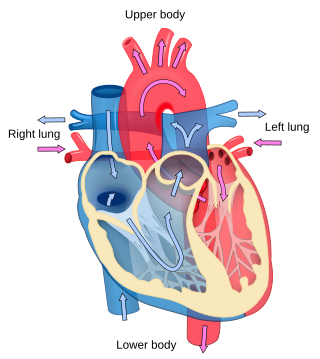
Cardiology is the study of the heart. Cardiology is a branch of medicine that deals with disorders of the heart and the cardiovascular system. The field includes medical diagnosis and treatment of congenital heart defects,coronary artery disease,heart failure,valvular heart disease,and electrophysiology. Physicians who specialize in this field of medicine are called cardiologists,a sub-specialty of internal medicine. Pediatric cardiologists are pediatricians who specialize in cardiology. Physicians who specialize in cardiac surgery are called cardiothoracic surgeons or cardiac surgeons,a specialty of general surgery.

Coronary artery disease (CAD),also called coronary heart disease (CHD),ischemic heart disease (IHD),myocardial ischemia,or simply heart disease,involves the reduction of blood flow to the cardiac muscle due to build-up of atherosclerotic plaque in the arteries of the heart. It is the most common of the cardiovascular diseases. Types include stable angina,unstable angina,and myocardial infarction.

Atherosclerosis is a pattern of the disease arteriosclerosis,characterized by development of abnormalities called lesions in walls of arteries. This is a chronic inflammatory disease involving many different cell types,and driven by elevated levels of cholesterol in the blood. These lesions may lead to narrowing of the arterial walls due to buildup of atheromatous plaques. At onset there are usually no symptoms,but if they develop,symptoms generally begin around middle age. In severe cases,it can result in coronary artery disease,stroke,peripheral artery disease,or kidney disorders,depending on which body part(s) the affected arteries are located in the body.
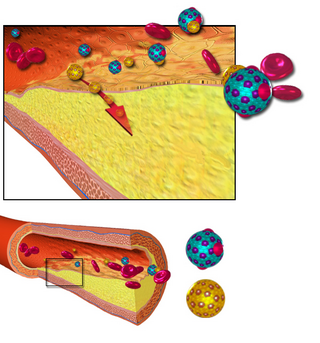
Arteriosclerosis,literally meaning "hardening of the arteries",is an umbrella term for a vascular disorder characterized by abnormal thickening,hardening,and loss of elasticity of the walls of arteries;this process gradually restricts the blood flow to one's organs and tissues and can lead to severe health risks brought on by atherosclerosis,which is a specific form of arteriosclerosis caused by the buildup of fatty plaques,cholesterol,and some other substances in and on the artery walls.

Aortic stenosis is the narrowing of the exit of the left ventricle of the heart,such that problems result. It may occur at the aortic valve as well as above and below this level. It typically gets worse over time. Symptoms often come on gradually with a decreased ability to exercise often occurring first. If heart failure,loss of consciousness,or heart related chest pain occur due to AS the outcomes are worse. Loss of consciousness typically occurs with standing or exercising. Signs of heart failure include shortness of breath especially when lying down,at night,or with exercise,and swelling of the legs. Thickening of the valve without causing obstruction is known as aortic sclerosis.

Cardiovascular disease (CVD) is any disease involving the heart or blood vessels. CVDs constitute a class of diseases that includes:coronary artery diseases,heart failure,hypertensive heart disease,rheumatic heart disease,cardiomyopathy,arrhythmia,congenital heart disease,valvular heart disease,carditis,aortic aneurysms,peripheral artery disease,thromboembolic disease,and venous thrombosis.

The coronary arteries are the arterial blood vessels of coronary circulation,which transport oxygenated blood to the heart muscle. The heart requires a continuous supply of oxygen to function and survive,much like any other tissue or organ of the body.
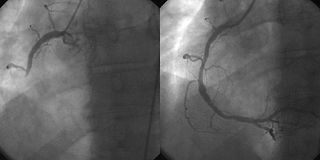
Interventional cardiology is a branch of cardiology that deals specifically with the catheter based treatment of structural heart diseases. Andreas Gruentzig is considered the father of interventional cardiology after the development of angioplasty by interventional radiologist Charles Dotter.
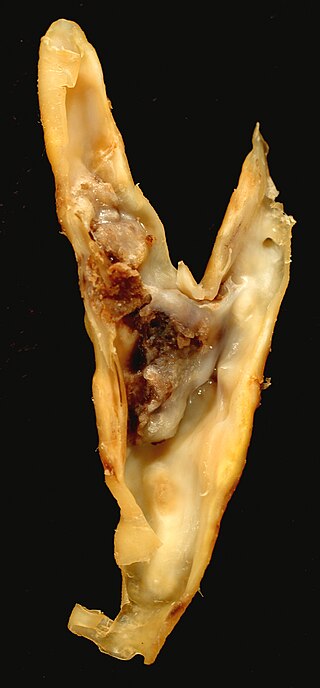
An atheroma,or atheromatous plaque,is an abnormal accumulation of material in the inner layer of an arterial wall.
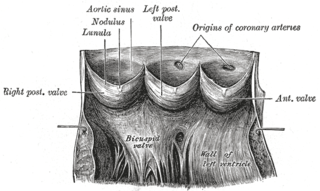
An aortic sinus,also known as a sinus of Valsalva,is one of the anatomic dilations of the ascending aorta,which occurs just above the aortic valve. These widenings are between the wall of the aorta and each of the three cusps of the aortic valve.
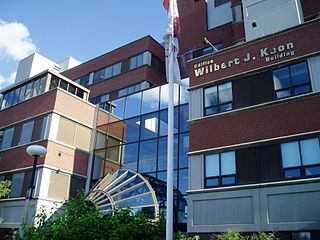
The University of Ottawa Heart Institute (UOHI) (French:Institut de cardiologie de l'Universitéd'Ottawa ) is Canada's largest cardiovascular health centre. It is located in Ottawa,Ontario,Canada. It began as a department in The Ottawa Hospital,and since has evolved into Canada's only complete cardiac centre,encompassing prevention,diagnosis,treatment,rehabilitation,research,and education.

Valvular heart disease is any cardiovascular disease process involving one or more of the four valves of the heart. These conditions occur largely as a consequence of aging,but may also be the result of congenital (inborn) abnormalities or specific disease or physiologic processes including rheumatic heart disease and pregnancy.

The Ross procedure,also known as pulmonary autograft,is a heart valve replacement operation to treat severe aortic valve disease,such as in children and young adults with a bicuspid aortic valve. It involves removing the diseased aortic valve,situated at the exit of the left side of the heart,and replacing it with the person's own healthy pulmonary valve (autograft),removed from the exit of the heart's right side. To reconstruct the right sided exit,a pulmonary valve from a cadaver (homograft),or a stentless xenograft,is used to replace the removed pulmonary valve. Compared to a mechanical valve replacement,it avoids the requirement for thinning the blood,has favourable blood flow dynamics,allows growth of the valve with growth of the child and has less risk of endocarditis.

Mönckeberg's arteriosclerosis,or Mönckeberg's sclerosis,is a non-inflammatory form of arteriosclerosis or vessel hardening,which differs from atherosclerosis traditionally. Calcium deposits are found in the muscular middle layer of the walls of arteries with no obstruction of the lumen. It is an example of dystrophic calcification. This condition occurs as an age-related degenerative process. However,it can occur in pseudoxanthoma elasticum and idiopathic arterial calcification of infancy as a pathological condition,as well. Its clinical significance and cause are not well understood and its relationship to atherosclerosis and other forms of vascular calcification are the subject of disagreement. Mönckeberg's arteriosclerosis is named after Johann Georg Mönckeberg,who first described it in 1903.
The following outline is provided as an overview of and topical guide to cardiology,the branch of medicine dealing with disorders of the human heart. The field includes medical diagnosis and treatment of congenital heart defects,coronary artery disease,heart failure,valvular heart disease and electrophysiology. Physicians who specialize in cardiology are called cardiologists.
Coronary ischemia,myocardial ischemia,or cardiac ischemia,is a medical term for abnormally reduced blood flow in the coronary circulation through the coronary arteries. Coronary ischemia is linked to heart disease,and heart attacks. Coronary arteries deliver oxygen-rich blood to the heart muscle. Reduced blood flow to the heart associated with coronary ischemia can result in inadequate oxygen supply to the heart muscle. When oxygen supply to the heart is unable to keep up with oxygen demand from the muscle,the result is the characteristic symptoms of coronary ischemia,the most common of which is chest pain. Chest pain due to coronary ischemia commonly radiates to the arm or neck. Certain individuals such as women,diabetics,and the elderly may present with more varied symptoms. If blood flow through the coronary arteries is stopped completely,cardiac muscle cells may die,known as a myocardial infarction,or heart attack.

A hybrid cardiac surgical procedure in a narrow sense is defined as a procedure that combines a conventional,more invasive surgical part with an interventional part,using some sort of catheter-based procedure guided by fluoroscopy imaging in a hybrid operating room (OR) without interruption. The hybrid technique has a reduced risk of surgical complications and has shown decreased recovery time. It can be used to treat numerous heart diseases and conditions and with the increasing complexity of each case,the hybrid surgical technique is becoming more common.

Samin K. Sharma is an American philanthropist of Indian descent and an interventional cardiologist who co-founded the Eternal Heart Care Centre and Research Institute in Jaipur (EHCC). Sharma has served on New York State’s Cardiac Advisory Board since 2004. As of 2021,he is Senior Vice-President,Operations &Quality at The Mount Sinai Hospital in New York and runs the Dr. Samin K. Sharma Family Foundation Cardiac Catheterization Laboratory. As of 2018,he is Chairman Board of Trustees,Association of Indians in America (AIA). As of 2022,he has been an investigator on 86 grants and multi-center trials and authored 486 peer-reviewed articles that have been cited 21,734 times.
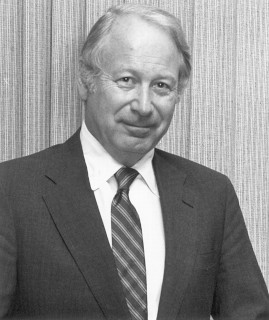
Richard Gorlin was an American cardiologist known for his contributions to the fields of valvular heart disease,coronary artery disease and cardiac catheterization,digitalis and vasodilators in congestive heart failure,and thrombolysis in myocardial infarctions. Along with his father,developed the Gorlin formula used to calculate valve areas in aortic valve stenosis and mitral valve stenosis.
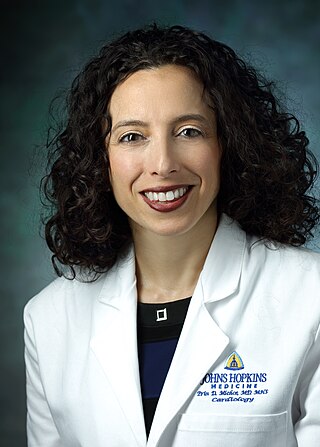
Erin Kathleen Donnelly Michos is an American cardiologist. She is an associate professor of Medicine and Director of Women's Cardiovascular Health at Johns Hopkins School of Medicine. Michos is also an Associate Faculty of the Welch Center for Prevention,Epidemiology and Clinical Research at Johns Hopkins,and has a joint faculty appointment in the Department of Epidemiology at the Johns Hopkins Bloomberg School of Public Health.
References
- ↑ "Wendy Post and Roger Blumenthal". The New York Times. April 13, 1997. Archived from the original on March 10, 2015. Retrieved November 23, 2020.
- ↑ Sugg, Diana K. (August 30, 1999). "Research offers clues on estrogen, heart disease". The Sun (Baltimore) . No. 163 #242. pp. 1A, 4A. Retrieved February 13, 2022– via Newspapers.com.
- ↑ Post, Wendy S; Goldschmidt-Clermont, Pascal J; Wilhide, Calvin C; Heldman, Alan W; Sussman, Mark S; Ouyang, Pamela; Milliken, Emily E; Issa, Jean-Pierre J (1 September 1999). "Methylation of the estrogen receptor gene is associated with aging and atherosclerosis in the cardiovascular system". Cardiovascular Research. 43 (4): 985–991. doi: 10.1016/S0008-6363(99)00153-4 . PMID 10615426.
- ↑ "Wendy S. Post CV" (PDF). hopkinsmedicine.org. Retrieved November 23, 2020.
- ↑ "Recalling an Outstanding Year, By the Numbers" (PDF). hopkinsmedicine.org. 2013. p. 4. Retrieved November 23, 2020.
- ↑ "Genetic Variation Doubles Risk of Aortic Valve Calcification". hopkinsmedicine.org. February 7, 2013. Retrieved November 23, 2020.
- ↑ "Johns Hopkins Study Shows Link Between HIV Infection and Coronary Artery Disease". hopkinsmedicine.org. March 31, 2014. Retrieved November 23, 2020.
- ↑ "Wendy S. Post, MD, MS". the-asci.org. Retrieved November 23, 2020.
- ↑ "Message from the Director" (PDF). hopkinsmedicine.org. 2017. p. 4. Retrieved November 23, 2020.
- ↑ "MESSAGE FROM THE DIRECTOR" (PDF). hopkinsmedicine.org. 2018. p. 4. Retrieved November 23, 2020.
