Related Research Articles
Concubinage is an interpersonal and sexual relationship between two people in which the couple does not want to, or cannot, enter into a full marriage. Concubinage and marriage are often regarded as similar, but mutually exclusive.

Sexual slavery and sexual exploitation is an attachment of any ownership right over one or more people with the intent of coercing or otherwise forcing them to engage in sexual activities. This includes forced labor that results in sexual activity, forced marriage and sex trafficking, such as the sexual trafficking of children.

Harem refers to domestic spaces that are reserved for the women of the house in a Muslim family. A harem may house a man's wife or wives, their pre-pubescent male children, unmarried daughters, female domestic servants, and other unmarried female relatives. In the past, harems also housed enslaved concubines. In former times, some harems were guarded by eunuchs who were allowed inside. The structure of the harem and the extent of monogamy or polygyny have varied depending on the family's personalities, socio-economic status, and local customs. Similar institutions have been common in other Mediterranean and Middle Eastern civilizations, especially among royal and upper-class families, and the term is sometimes used in other contexts. In traditional Persian residential architecture, the women's quarters were known as andaruni, and in the Indian subcontinent as zenana.
Forced prostitution, also known as involuntary prostitution or compulsory prostitution, is prostitution or sexual slavery that takes place as a result of coercion by a third party. The terms "forced prostitution" or "enforced prostitution" appear in international and humanitarian conventions, such as the Rome Statute of the International Criminal Court, but have been inconsistently applied. "Forced prostitution" refers to conditions of control over a person who is coerced by another to engage in sexual activity.
Slavery has been called "deeply rooted" in the structure of the northwest African country of Mauritania and estimated to be "closely tied" to the ethnic composition of the country, although it has also been estimated that "Widespread slavery was traditional among ethnic groups of the largely nonpastoralist south, where it had no racial origins or overtones; masters and slaves alike were black", despite the cessation of slavery across other African countries and an official ban on the practice since 1905.
Living in a wide range of circumstances and possessing the intersecting identity of both black and female, enslaved women of African descent had nuanced experiences of slavery. Historian Deborah Gray White explains that "the uniqueness of the African-American female's situation is that she stands at the crossroads of two of the most well-developed ideologies in America, that regarding women and that regarding the Negro." Beginning as early on in enslavement as the voyage on the Middle Passage, enslaved women received different treatment due to their gender. In regard to physical labor and hardship, enslaved women received similar treatment to their male counterparts, but they also frequently experienced sexual abuse at the hand of their enslavers who used stereotypes of black women's hypersexuality as justification.
The continent of Africa is one of the regions most rife with contemporary slavery. Slavery in Africa has a long history, within Africa since before historical records, but intensifying with the trans-Saharan and Indian Ocean slave trade and again with the trans-Atlantic slave trade; the demand for slaves created an entire series of kingdoms which existed in a state of perpetual warfare in order to generate the prisoners of war necessary for the lucrative export of slaves. These patterns persisted into the colonial period during the late 19th and early 20th century. Although the colonial authorities attempted to suppress slavery from about 1900, this had very limited success, and after decolonization, slavery continues in many parts of Africa despite being technically illegal.
Human rights in Mauritania are generally seen as poor according to international observers, including Freedom House, the United States Department of State, and Amnesty International.
In 2009, Niger was a source, transit, and destination country for children and women subjected to trafficking in persons, specifically forced labor and forced prostitution. Caste-based slavery practices, rooted in ancestral master-slave relationships, continued primarily in the northern part of the country. Children are trafficked within Niger for forced begging by religious instructors known as marabouts; forced labor in gold mines, agriculture, and stone quarries; as well as for involuntary domestic servitude and forced prostitution. The ILO estimates at least 10,000 children work in gold mines in Niger, many of whom may have been forced to work. Nigerien children, primarily girls, were also subjected to commercial sexual exploitation along the border with Nigeria, particularly in the towns of Birni N'Konni and Zinder along the main highway, and boys are trafficked to Nigeria and Mali for forced begging and manual labor. There were reports Nigerien girls entered into "false marriages" with citizens of Nigeria, Saudi Arabia, and the United Arab Emirates: upon arrival in these countries, the girls are often forced into involuntary domestic servitude. Child marriage was a problem, especially in rural areas, and may have contributed to conditions of human trafficking. Niger is a transit country for women and children from Benin, Burkina Faso, Gabon, Ghana, Mali, Nigeria, and Togo en route to Northern Africa and Western Europe; some may be subjected to forced labor in Niger as domestic servants, forced laborers in mines and on farms, and as mechanics and welders. To a lesser extent, Nigerien women and children were sometimes trafficked from Niger to North Africa the Middle East, and Europe for involuntary domestic servitude and forced commercial sexual exploitation."
Slavery in Niger involves different practices which have been practiced in the Sahel region for many centuries and which persist to this day. The Bornu Empire in the eastern part of Niger was an active part of the trans-Saharan slave trade for hundreds of years. Other ethnic groups in the country similarly had a history of slavery, although this varied and in some places slavery was largely limited to the political and economic elite.
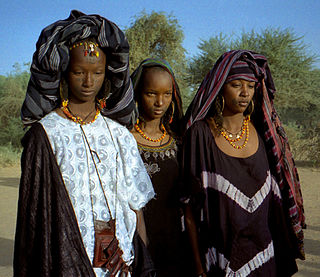
Women in Niger are women that are from or live in the West African country of Niger. These women belong to a population in which 98% are practitioners of Islam. Laws adopted by the government of Niger to protect the rights of Nigerien women are most often based on Muslim beliefs.
Slavery in Afghanistan was present in the post-Classical history of Afghanistan, continued during the Middle Ages, and persisted into the 1920s.
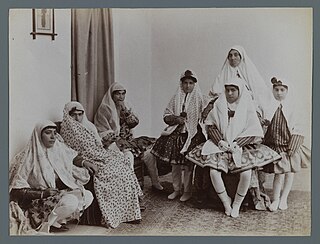
Concubinage in the Muslim world was the practice of Muslim men entering into intimate relationships without marriage, with enslaved women, though in rare, exceptional cases, sometimes with free women. If the concubine gave birth to a child, she attained a higher status known as umm al-walad.

Cariye was a title and term used for category of enslaved women concubines in the Islamic world of the Middle East. They are particularly known in history from the era of Ottoman Empire, where they existed until the early 20th century, when the Ottoman Imperial Harem was closed.
Slavery has existed in various forms throughout the history of Nigeria, notably during the Atlantic slave trade and Trans-Saharan trade. Slavery is now illegal internationally and in Nigeria. However, legality is often overlooked with different pre-existing cultural traditions, which view certain actions differently. In Nigeria, certain traditions and religious practices have led to "the inevitable overlap between cultural, traditional, and religious practices as well as national legislation in many African states" which has had the power to exert extra-legal control over many lives resulting in modern-day slavery. The most common forms of modern slavery in Nigeria are human trafficking and child labor. Because modern slavery is difficult to recognize, it has been difficult to combat this practice despite international and national efforts.
In classical Islamic law, a concubine was an unmarried slave-woman with whom her master engaged in sexual relations. Concubinage was widely accepted by Muslim scholars in pre-modern times. Most modern Muslims, both scholars and laypersons, believe that Islam no longer permits concubinage and that sexual relations are religiously permissible only within marriage.
Slavery in Egypt existed up until the early 20th century. It differed from the previous slavery in ancient Egypt, being managed in accordance with Islamic law from the conquest of the Caliphate in the 7th century until the practice stopped in the early 20th-century, having been gradually phased out when the slave trade was banned in the late 19th century. British pressure led to the abolishment of slavery trade successively between 1877 and 1884. Slavery itself was not abolished, but it gradually died out after the abolition of the slave trade, since no new slaves could be legally acquired, and existing slaves where given the right to apply for freedom. Existing slaves were noted as late as the 1930s.
Open chattel slavery existed in Kuwait until 1949. Slavery was formally abolished in Kuwait in 1949. In practice, slavery was not actually abolished as such, but the law no longer recognized it after 1949, which meant that every slave who applied for manumission was guaranteered to be freed.
Open slavery existed in Bahrain until the 1930s. Slavery was formally abolished in Bahrain in 1937. Slavery ended earlier in Bahrain than in any other Gulf state, with the exception of Iran and Iraq. Many members of the Afro-Arabian minority are descendants of the former slaves. Slavery of people from Africa and East Asia was succeeded by the modern Kafala system of poor workers from the same region were slaves had previously been imported.
Descent-based slavery is a form of slavery based on the assignment of a so-called hereditary "slave status". Although slavery has been officially abolished by law, stigmatisation and discrimination based on genealogy persist locally.