Chorale settings refer to a wide variety of musical compositions, almost entirely of Protestant origin, which use a chorale as their basis. A chorale is a simple melody, often based on Gregorian chant, written for congregations to sing hymns. Chorale settings can be vocal, instrumental, or both.
The chorale motet was a type of musical composition in mostly Protestant parts of Europe, principally Germany, and mainly during the 16th century. It involved setting a chorale melody and text as a motet.

Wachet auf, ruft uns die Stimme, BWV 140, also known as Sleepers Awake, is a church cantata by Johann Sebastian Bach, regarded as one of his most mature and popular sacred cantatas. He composed the chorale cantata in Leipzig for the 27th Sunday after Trinity and first performed it on 25 November 1731.

Philipp Nicolai was a German Lutheran pastor, poet, and composer. He is most widely recognized as a hymnodist.

Sechs Chorale von verschiedener Art: auf einer Orgel mit 2 Clavieren und Pedal vorzuspielen, commonly known as the Schübler Chorales, BWV 645–650, is a set of chorale preludes composed by Johann Sebastian Bach. Johann Georg Schübler, after whom the collection came to be named, published it in 1747 or before August 1748, in Zella St. Blasii. At least five preludes of the compilation are transcribed from movements in Bach's church cantatas, mostly chorale cantatas he had composed around two decades earlier.

Jesu, meine Freude, BWV 227, is a motet by Johann Sebastian Bach. The longest and most musically complex of Bach's motets, it is set in eleven movements for up to five voices. It is named after the Lutheran hymn "Jesu, meine Freude" with words by Johann Franck, first published in 1653. The motet contains the six stanzas of the hymn in its odd-numbered movements. The hymn tune by Johann Crüger appears in all of these movements in different styles of chorale settings. The text of the motet's even-numbered movements is taken from the eighth chapter of the Epistle to the Romans, a passage that influenced key Lutheran teachings. The hymn, written in the first person with a focus on an emotional bond with Jesus, forms a contrasting expansion of the doctrinal biblical text. Bach set both texts alternating with and complementing each other, in a structure of symmetries on different layers.
Johann Sebastian Bach composed the church cantata Wär Gott nicht mit uns diese Zeit, BWV 14, in Leipzig in 1735 for the fourth Sunday after Epiphany and first performed it on 30 January 1735, a few weeks after his Christmas Oratorio. The cantata, in Bach's chorale cantata format, is based on Martin Luther's hymn "Wär Gott nicht mit uns diese Zeit". Its text paraphrases Psalm 124, focussing on the thought that the believers' life depends on God's help and is lost without it.

"Wachet auf, ruft uns die Stimme" is a Lutheran hymn written in German by Philipp Nicolai, first published in 1599 together with "Wie schön leuchtet der Morgenstern". It appears in German hymnals and in several English hymnals in translations such as "Wake, Awake, for Night Is Flying", "Wake, O wake! with tidings thrilling", and "Up! Awake! From Highest Steeple". Johann Sebastian Bach based a chorale cantata on the hymn, Wachet auf, ruft uns die Stimme, BWV 140, one of its many musical settings.

Johann Sebastian Bach composed the church cantata O Ewigkeit, du Donnerwort, BWV 20, in Leipzig for the first Sunday after Trinity and first performed it on 11 June 1724. Bach composed it when beginning his second year as Thomaskantor in Leipzig. It is the first cantata he composed for his second annual cycle which was planned to contain chorale cantatas, each based on a Lutheran hymn. The cantata is focused on Johann Rist's 1642 hymn "O Ewigkeit, du Donnerwort", with a chorale melody by Johann Schop. As usual for Bach's chorale cantatas to come in the cycle, selected hymn stanzas were retained while the others were paraphrased by a contemporary poet who transformed their ideas into a sequence of alternating recitatives and arias. For this cantata, the first stanza was used unchanged, and two more stanzas to conclude the cantata's two parts. The first part was performed before the sermon, the second part after the sermon. The first part is in seven movements, and the second part is in four movements.
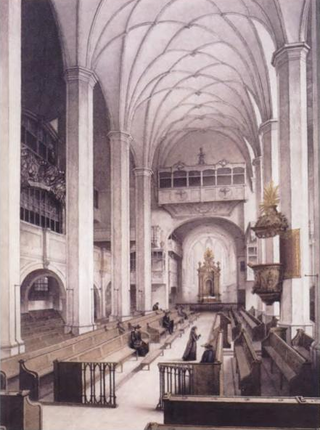
Johann Sebastian Bach composed the church cantata Schwingt freudig euch empor, BWV 36, in Leipzig in 1731 for the first Sunday in Advent. He drew on material from previous congratulatory cantatas, beginning with Schwingt freudig euch empor, BWV 36c (1725). The Gospel for the Sunday was the Entry into Jerusalem, thus the mood of the secular work matched "the people's jubilant shouts of Hosanna". In a unique structure in Bach's cantatas, he interpolated four movements derived from the former works with four stanzas from two important Advent hymns, to add liturgical focus, three from Luther's "Nun komm, der Heiden Heiland" and one from Nicolai's "Wie schön leuchtet der Morgenstern". He first performed the cantata in its final form of two parts, eight movements, on 2 December 1731.
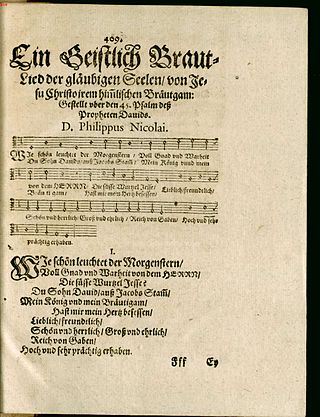
"Wie schön leuchtet der Morgenstern" is a Lutheran hymn by Philipp Nicolai written in 1597 and first published in 1599. It inspired musical settings through centuries, notably Bach's chorale cantata Wie schön leuchtet der Morgenstern, BWV 1, but also vocal and instrumental works by Baroque composers, Peter Cornelius, Felix Mendelssohn, Max Reger, Hugo Distler, Ernst Pepping, Mauricio Kagel and Naji Hakim.

Erhalt uns, Herr, bei deinem Wort, BWV 126, is a cantata by Johann Sebastian Bach for use in a Lutheran service. He composed the chorale cantata in 1725 in Leipzig for the Sunday Sexagesimae, the second Sunday before Lent, and first performed it on 4 February 1725. It is based on the hymn "Erhalt uns, Herr, bei deinem Wort" by Martin Luther, published in 1542. The hymn text at Bach's time also included two stanzas by Justus Jonas and Luther's "Verleih uns Frieden gnädiglich".
There are 52 chorale cantatas by Johann Sebastian Bach surviving in at least one complete version. Around 40 of these were composed during his second year as Thomaskantor in Leipzig, which started after Trinity Sunday 4 June 1724, and form the backbone of his chorale cantata cycle. The eldest known cantata by Bach, an early version of Christ lag in Todes Banden, BWV 4, presumably written in 1707, was a chorale cantata. The last chorale cantata he wrote in his second year in Leipzig was Wie schön leuchtet der Morgenstern, BWV 1, first performed on Palm Sunday, 25 March 1725. In the ten years after that he wrote at least a dozen further chorale cantatas and other cantatas that were added to his chorale cantata cycle.
Sleepers Awake may refer to:

Erhard Egidi was a German cantor, organist and composer of sacred music. He was Kantor at the Neustädter Kirche, Hannover, from 1972 to 1991, where he focused on music in church services, but also conducted concerts, with a preference for works of Johann Sebastian Bach and his own teacher Ernst Pepping. He was appointed Kirchenmusikdirektor, responsible for the church music of Hanover.
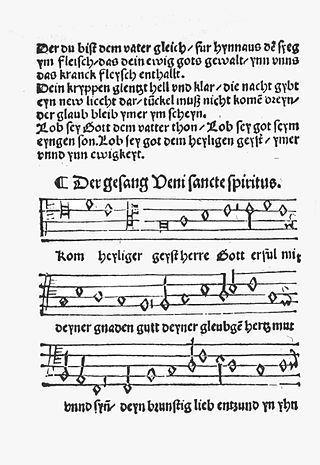
"Komm, Heiliger Geist, Herre Gott" is a Lutheran hymn for Pentecost, with words written by Martin Luther based on "Veni Sancte Spiritus, reple tuorum corda fidelium". The hymn in three stanzas was first published in 1524. For centuries the chorale has been the prominent hymn (Hauptlied) for Pentecost in German-speaking Lutheranism. Johann Sebastian Bach used it in several chorale preludes, cantatas and his motet Der Geist hilft unser Schwachheit auf, BWV 226.

"Jesu, meine Freude" is a hymn in German, written by Johann Franck in 1650, with a melody, Zahn No. 8032, by Johann Crüger. The song first appeared in Crüger's hymnal Praxis pietatis melica in 1653. The text addresses Jesus as joy and support, versus enemies and the vanity of existence. The poetry is bar form, with irregular lines from 5 to 8 syllables. The melody repeats the first line as the last, framing each of the six stanzas.
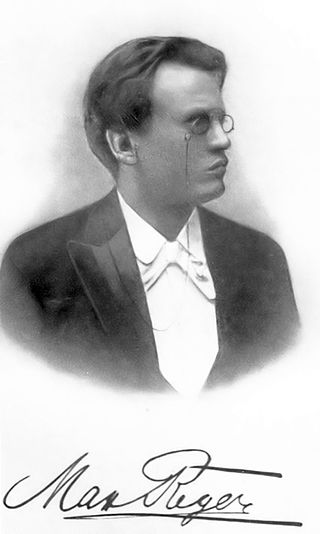
Three chorale fantasias, Op. 52, are chorale fantasias for organ by Max Reger. He composed the fantasias on three chorales in September 1900: Phantasie über den Choral "Alle Menschen müssen sterben", Phantasie über den Choral "Wachet auf, ruft uns die Stimme" and Phantasie über den Choral "Halleluja! Gott zu loben bleibe meine Seelenfreud". They were all first performed individually by Reger's friend Karl Straube, and were first published by Breitkopf & Härtel.

Chorale is the name of several related musical forms originating in the music genre of the Lutheran chorale:
"Nun liebe Seel, nun ist es Zeit", alternatively written "Nun, liebe Seel, nun ist es Zeit", is a Lutheran hymn for Epiphany, in five stanzas of six lines each, by Georg Weissel. It was first printed in 1642, set as a motet by Johannes Eccard. A version with an additional stanza is attributed to Johann Christoph Arnschwanger.


