
George Balanchine was a Georgian-American ballet choreographer, recognized as one of the most influential choreographers of the 20th-century. Styled as the father of American ballet, he co-founded the New York City Ballet and remained its artistic director for more than 35 years. His choreography is characterized by plotless ballets with minimal costume and décor, performed to classical and neoclassical music.
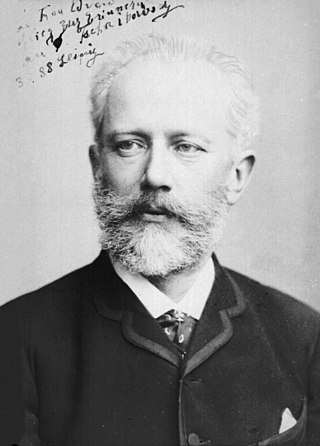
The Nutcracker, Op. 71, is an 1892 two-act classical ballet by Pyotr Ilyich Tchaikovsky, set on Christmas Eve at the foot of a Christmas tree in a child's imagination featuring a Nutcracker doll. The plot is an adaptation of Alexandre Dumas' 1844 short story The Nutcracker, itself a retelling of E. T. A. Hoffmann's 1816 short story The Nutcracker and the Mouse King. The ballet's first choreographer was Marius Petipa, with whom Tchaikovsky had worked three years earlier on The Sleeping Beauty, assisted by Lev Ivanov. Although the complete and staged The Nutcracker ballet was not initially as successful as the 20-minute Nutcracker Suite that Tchaikovsky had premiered nine months earlier, it became popular in later years.

New York City Ballet (NYCB) is a ballet company founded in 1948 by choreographer George Balanchine and Lincoln Kirstein. Balanchine and Jerome Robbins are considered the founding choreographers of the company. Léon Barzin was the company's first music director. City Ballet grew out of earlier troupes: the Producing Company of the School of American Ballet, 1934; the American Ballet, 1935, and Ballet Caravan, 1936, which merged into American Ballet Caravan, 1941; and directly from the Ballet Society, 1946.

Neoclassical ballet is the style of 20th-century classical ballet exemplified by the works of George Balanchine. The term "neoclassical ballet" appears in the 1920s with Sergei Diaghilev's Ballets Russes, in response to the excesses of romanticism and post-romantic modernism. It draws on the advanced technique of 19th-century Russian Imperial dance, but strips it of its detailed narrative and heavy theatrical setting while retaining many key techniques, such as pointe technique.
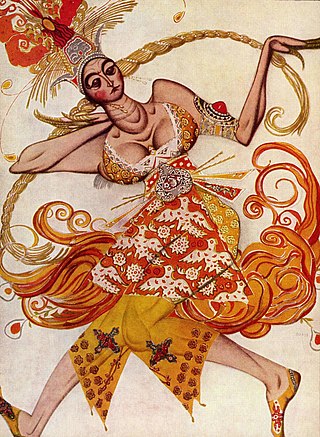
The Firebird is a ballet and orchestral concert work by the Russian composer Igor Stravinsky. It was written for the 1910 Paris season of Sergei Diaghilev's Ballets Russes company; the original choreography was by Michel Fokine, who collaborated with Alexandre Benois and others on a scenario based on the Russian fairy tales of the Firebird and the blessing and curse it possesses for its owner. It was first performed at the Opéra de Paris on 25 June 1910 and was an immediate success, catapulting Stravinsky to international fame and leading to future Diaghilev–Stravinsky collaborations including Petrushka (1911) and The Rite of Spring (1913).

Violette Verdy was a French ballerina, choreographer, teacher, and writer who worked as a dance company director with the Paris Opera Ballet in France and the Boston Ballet in the United States. From 1958 to 1977 she was a principal dancer with the New York City Ballet where she performed in the world premieres of several works created specifically for her by choreographers George Balanchine and Jerome Robbins. She was Distinguished Professor of Music (Ballet) at the Jacobs School of Music, Indiana University, in Bloomington, and the recipient of two medals from the French government.

Pyotr Ilyich Tchaikovsky's Piano Concerto No. 2 in G major, Op. 44, was written in 1879–1880 and dedicated to Nikolai Rubinstein, who had insisted he perform it at the premiere as a way of making up for his harsh criticism of Tchaikovsky's First Piano Concerto. But Rubinstein never played it, as he died in March 1881, and the work has never attained much popularity.
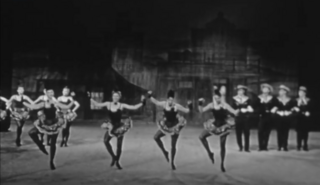
Western Symphony is a ballet made by New York City Ballet co-founder and founding choreographer George Balanchine to American folk tunes arranged by Hershy Kay. It premiered on September 7, 1954 at the City Center of Music and Drama in New York. The ballet was originally presented in practice clothes without scenery. Scenery by John Boyt and costumes by Karinska were added in 1955. Lighting was originally by Jean Rosenthal and subsequently Mark Stanley. Set in the Western United States, the ballet features cowboys and dance hall girls.
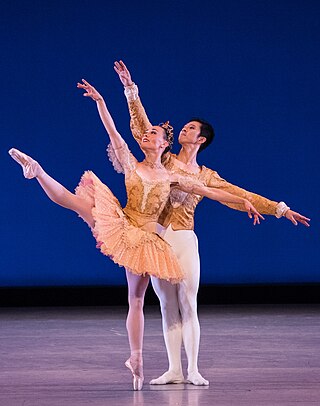
Theme and Variations is a ballet choreographed by George Balanchine to the final movement of Tchaikovsky's Orchestral Suite No. 3. The ballet was made for Ballet Theatre, and premiered on November 26, 1947, at the City Center 55 Street Theater, with the two leads danced by Alicia Alonso and Igor Youskevitch.

Tchaikovsky Pas de Deux is a ballet choreographed by George Balanchine to a composition by Pyotr Ilyich Tchaikovsky originally intended for act 3 of Swan Lake. With costumes by Barbara Karinska and lighting by Jack Owen Brown, it was first presented by New York City Ballet at the City Center of Music and Drama, New York, on 29 March 1960. Robert Irving conducted the New York City Ballet Orchestra. The dancers were Violette Verdy and Conrad Ludlow.
Chant du Rossignol, as it was published in 1921, is a poème symphonique by Igor Stravinsky adapted in 1917 from his 1914 opera The Nightingale.
Tschaikovsky Piano Concerto No. 2, also titled Ballet Imperial, is a ballet choreographed by George Balanchine to Tchaikovsky's Piano Concerto No. 2. Ballet Imperial was choreographed for American Ballet Caravan's 1941 South American tour, and was aimed at showing that the Americans were capable of the classical ballet traditions. The ballet pays tribute to Tchaikovsky, the classical ballet choreographer Marius Petipa, and Imperial Saint Petersburg, where Balanchine received his ballet training. The ballet featured academic steps and alludes to Imperial Russia through the costumes and scenery. Ballet Imperial premiered on June 25, 1941, at Teatro Municipal, Rio de Janeiro.
Liebeslieder Walzer is a two-part neoclassical ballet choreographed by George Balanchine to Johannes Brahms' Liebeslieder Waltzes, Op. 52 and Neue Liebeslieder, Op. 65, with original sets and lighting designed by David Hays, and costumes designed by Barbara Karinska. The ballet premiered on 12 November 1960 at the New York City Center, performed by the New York City Ballet.
Ivesiana is a ballet choreographed by George Balanchine to compositions by Charles Ives. The ballet premiered on September 14, 1954, four months after Ives's death, at the City Center of Music and Drama, performed by the New York City Ballet. Balanchine made several changes to the ballet since, including adding and removing sections of the ballet, and the final version of Ivesiana consists of Central Park in the Dark, The Unanswered Question, In the Inn and In the Night.

Allegro Brillante is a ballet choreographed by George Balanchine to Tchaikovsky's Piano Concerto No. 3. The ballet is danced by a principal couple and a corps de ballet of eight. Balanchine said it "contains everything I knew about classical ballet." Allegro Brillante was made for the New York City Ballet, and premiered on March 1, 1956, at the City Center of Music and Drama, with Maria Tallchief and Nicholas Magallanes originating the two principal roles.
Margaret Tracey is an American ballet dancer and educator. She joined the New York City Ballet in 1986, was promoted principal dancer in 1991, and retired in 2002. She served as the director of the Boston Ballet School between 2007 and 2021, dean of the Colburn School's Trudl Zipper Dance Institute since 2023, and slated to become the artistic director of Canada's National Ballet School in 2024.
Maria Calegari is an American ballet dancer, teacher and répétiteur. She joined the New York City Ballet in 1974 and became a principal dancer in 1983. She left the company in 1994, then occasionally performed until 2004. She also teaches ballet and began working as a répétiteur for the Balanchine Trust and Robbins Rights Trust in 1996 and 2003 respectively.
Kammermusik No. 2 is a ballet choreographed by George Balanchine to Paul Hindemith's music of the same name. The ballet premiered on January 26, 1978, at the New York State Theater, danced by the New York City Ballet.

Soirées musicales,, Op. 9, is a suite of five movements by Benjamin Britten, using music composed by Gioachino Rossini. The suite, first performed in 1937, derives its title from Rossini's collection of the same name, dating from the early 1830s, from which Britten drew much of the thematic material.