英文互译镜像站

Trithuria bibracteata

Last updated

Trithuria bibracteata
Scientific classification OOjs UI icon edit-ltr.svg
Kingdom: Plantae
Clade: Tracheophytes
Clade: Angiosperms
Order: Nymphaeales
Family: Hydatellaceae
Genus: Trithuria
Section: Trithuria sect. Trithuria
Species:
T. bibracteata
Binomial name
Trithuria bibracteata
Western Australia in Australia.svg
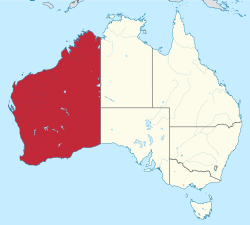
Trithuria bibracteata is endemic to Western Australia [1]

Trithuria bibracteata is a species of aquatic plant in the family Hydatellaceae endemic to Western Australia. [1]

Contents

Description

Vegetative characteristics

Trithuria bibracteata is a small, annual, aquatic herb [2] with simple, linear, 5-20 mm long, and 0.4 mm wide leaves. [3] The red plants are 1 cm wide, [4] and max. 2 cm high. [3] The short stem bears max. 2 mm long hairs. [4]

Generative characteristics

It is monoecious, [3] and the reproductive units ("flowers") are bisexual. [5] The reproductive units are sessile, [4] or pedunculate. [6] The reproductive unit consists of two lanceolate, 2-3 mm long, and 1.2 mm wide involucral bracts, 1-2 stamens, and 6-10 carpels. [4] The dehiscent fruit [3] bears 0.4-0.6 mm long, [4] desiccation-tolerant, [7] black to brown, [8] ellipsoid to ovoid seeds, [3] which require light to germinate. [9] [10] Flowering occurs from September to November. [2] [3]

Distribution

It occurs in the Southwest region of the state Western Australia. [2] [3]

Taxonomy

It was described in 1983 as Trithuria bibracteata Stapf ex D.A.Cooke by David Alan Cooke based on previous work by Otto Stapf. [1] [4] The type specimen was collected by R. D. Royce in Boyanup, Western Australia in 1947. [4] It is placed in Trithuria sect. Trithuria. [11]

Etymology

The specific epithet bibracteata is derived from the prefix bi- meaning two, [12] [13] and -bracteata meaning "with bracts". [14] [15] The reproductive units have two bracts. [4]

Conservation

It is not threatened. [2]

Ecology

Habitat

It occurs in clay and mud along stream edges, [2] ephemeral pools, [16] and swamps. [8] [9] It inhabits winter-wet habitats, [2] [9] which dry in the Australian summer from December to February. [9] It can occur sympatrically with Trithuria occidentalis . [17]

Seed dispersal

The desiccation-tolerant seeds [7] may be dispersed by water birds. [10]

References

  1. 1 2 3 4 "Trithuria bibracteata Stapf ex D.A.Cooke". Plants of the World Online . Royal Botanic Gardens, Kew . Retrieved 29 October 2024.
  2. 1 2 3 4 5 6 Western Australian Herbarium & Department of Biodiversity, Conservation and Attractions. (n.d.). Trithuria bibracteata D.A.Cooke. Florabase—the Western Australian Flora. Retrieved October 29, 2024, from https://florabase.dbca.wa.gov.au/browse/profile/1139
  3. 1 2 3 4 5 6 7 Trithuria bibracteata Stapf ex D.A.Cooke. (n.d.). Atlas of Living Australia. Retrieved October 29, 2024, from https://bie.ala.org.au/species/https://id.biodiversity.org.au/node/apni/2914405#overview
  4. 1 2 3 4 5 6 7 8 Cooke, D. A. (1983). Two Western Australian Hydatellaceae. Muelleria, 5, 123-125.
  5. Taylor, M. L., Macfarlane, T. D., & Williams, J. H. (2010). Reproductive ecology of the basal angiosperm Trithuria submersa (Hydatellaceae). Annals of Botany, 106(6), 909-920.
  6. Sokoloff, D. D., Remizowa, M. V., Yadav, S. R., & Rudall, P. J. (2010). Development of reproductive structures in the sole Indian species of Hydatellaceae, Trithuria konkanensis, and its morphological differences from Australian taxa. Australian Systematic Botany, 23(4), 217-228.
  7. 1 2 Dalziell, E. L., Funnekotter, B., Mancera, R. L., & Merritt, D. J. (2019). Seed storage behaviour of tropical members of the aquatic basal angiosperm genus Nymphaea L.(Nymphaeaceae). Conservation Physiology, 7(1), coz021.
  8. 1 2 Tillich, H. J., Tuckett, R., & Facher, E. (2007). Do Hydatellaceae belong to the monocotyledons or basal angiosperms? Evidence from seedling morphology. Willdenowia, 37(2), 399-406.
  9. 1 2 3 4 Tuckett, R. E., Merritt, D. J., Rudall, P. J., Hay, F., Hopper, S. D., Baskin, C. C., ... & Dixon, K. W. (2010). A new type of specialized morphophysiological dormancy and seed storage behaviour in Hydatellaceae, an early-divergent angiosperm family. Annals of Botany, 105(6), 1053-1061.
  10. 1 2 Sokoloff, D. D., Remizowa, M. V., Macfarlane, T. D., Yadav, S. R., & Rudall, P. J. (2011). Hydatellaceae: a historical review of systematics and ecology. Rheedea, 21(2), 115-138.
  11. Iles, W. J. D. (2013). The phylogeny and evolution of two ancient lineages of aquatic plants (Doctoral dissertation, University of British Columbia).
  12. Paleontological Research Institution, Ithaca, New York. (n.d.). Greek & Latin in Botanical Terminology. Digital Atlas of Ancient Life. Retrieved October 29, 2024, from https://www.digitalatlasofancientlife.org/learn/embryophytes/botanical-terminology/
  13. Glossary A-H. (n.d.). Missouri Botanical Garden. Retrieved October 29, 2024, from https://www.mobot.org/MOBOT/research/APweb/top/glossarya_h.html
  14. A Grammatical Dictionary of Botanical Latin. (n.d.-c). Missouri Botanical Garden. Retrieved October 29, 2024, from http://www.mobot.org/mobot/latindict/keyDetail.aspx?keyWord=bracteate
  15. Baptisia bracteata var. leucophaea  - Plant Finder. (n.d.). Missouri Botanical Garden. Retrieved October 29, 2024, from https://www.missouribotanicalgarden.org/PlantFinder/PlantFinderDetails.aspx?taxonid=290598&isprofile=0&n=1
  16. Sokoloff, D. D., Remizowa, M. V., Macfarlane, T. D., Tuckett, R. E., Ramsay, M. M., Beer, A. S., ... & Rudall, P. J. (2008). Seedling diversity in Hydatellaceae: implications for the evolution of angiosperm cotyledons. Annals of Botany, 101(1), 153-164.
  17. Department of Environment and Conservation (2012) Western Trithuria (Trithuria occidentalis) Interim Recovery Plan 2012–2017. Interim Recovery Plan No. 327. Department of Environment and Conservation, Western Australia
镜像软件 蚂蚁镜像站群 泛域名镜像 烟雨镜像程序 301镜像站群