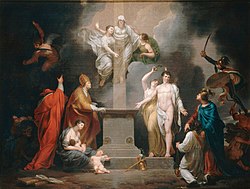
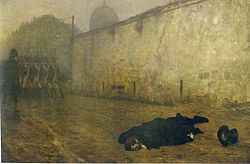
In the 19th century, France experienced a succession of political regimes, rapid industrialization, and significant social upheaval. It transitioned through two empires, two monarchies, and two republics and evolved from a centralized military power (often governed by kings or self-proclaimed emperors) into a modern industrial democracy. After undergoing frequent and violent revolutions–notably in 1830, 1848, and 1871–the century concluded with the stabilization of the Third Republic and the construction of the institutional foundations of modern France.
This timeline is organized in the following sections:
Rise and Fall of the First Empire (1800–1815) – This was the empire ruled by Napoleon Bonaparte, who established French hegemony over much of continental Europe at the beginning of the 19th century.
1800: Napoleon establishes the Bank of France to stabilize the economy after the Revolution. Three years later, the Bank received its first official charter granting it the exclusive right to issue paper money in Paris for fifteen years.[2]
1801: The Concordat of 1801 is signed with Pope Pius VII, reconciling the French state with the Catholic Church and solidified the Catholic Church as the majority church of France, with most of its civil status restored after having been taken away during the Revolution.[3] It remained in effect until 1905, except in Alsace–Lorraine, where it remains in force.[4]
1802: The Legion of Honour (Légion d'honneur) is established as the highest and most prestigious French national order of merit, both military and civil. The order has been retained, with occasional minor alterations, by all subsequent French governments and regimes.[5]
Flag raising in the Place d'Armes (now Jackson Square), New Orleans, marking the transfer of sovereignty over French Louisiana to the United States, December 20, 1803, as depicted by Thure de Thulstrup in 1902
1803: France sells the Louisiana territory to the United States (Louisiana Purchase) in order to fund impending wars. The territory consisted of most of the land in the Mississippi River's drainage basin west of the river.[6]
1804:
The Napoleonic Code (a Civil Code) is promulgated.It recognized the principles of civil liberty, equality before the law (but not in the same way for women) and the secular nature of the state. With regard to family, the code established the supremacy of the husband over his wife and children – the status quo in Europe at the time. Women had even fewer rights than children. Divorce by mutual consent was abolished.[7] The Code strongly influenced the law of many of the countries evolved during and after the Napoleonic Wars.[8][9][10]
Napoleon Bonaparte is consecrated Emperor of the French. Napoleon's coronation was a sacred ceremony – invented by him – held in the cathedral of Notre Dame de Paris in the presence of Pope Pius VII.
1805: Napoleon's victory at the Battle of Austerlitz cements French dominance in Central Europe. The battle is often cited by military historians as one of Napoleon's tactical masterpieces.[11]
Napoleon's withdrawal from Russia, painting by Adolph Northen
1808: The Baccalauréat is created by Napoleon. It remains the standard French high school exit exam today.[12]
1814: The Treaty of Fontainebleau is concluded on 11 April 1814 between Napoleon and representatives of Austria, Russia and Prussia.[16] The treaty was signed in Paris on 11 April by the plenipotentiaries of both sides and ratified by Napoleon on 13 April.[17] With this treaty, the allies ended Napoleon's first rule as emperor of the French and sent him into exile on Elba. Louis XVIII returned to Paris as monarch.[16]
1815:
Napoleon's Departure from Elba by Joseph Beaume, 1836March 1: The Hundred Days of Napoleon re-taking power begins as he escapes from Elba and he and his followers land on the French mainland at Golfe-Juan. Marching towards Paris, they pass through the foothills of the Alps, taking the route now known as Route Napoléon.[18][19] They encounter little resistance and entered Paris on 20 March. Napoleon then launches his restored, but short-lived rule.[20]
March 20: With Napoleon at the gates of Paris, Louis XVIII quits the capital with a small escort at midnight, first traveling to Lille, and then crossing the border into the United Kingdom of the Netherlands, halting in Ghent.[21]
June 22: Napoleon abdicates for the second time. The British government decides to imprison him and deport him to the island of Saint Helena, situated in the middle of the Atlantic Ocean, with the intention of ensuring that he could no longer "disturb the tranquility of the world."[23]
Louis XVIII is restored to the King of France after an absence of only a few months.
The Congress of Vienna is convened as a series of international diplomatic meetings to discuss and agree upon a possible new layout of the European political and constitutional order after the downfall of Napoleon.[24]
1816–1820: With Louis XVIII as king of France, the "Second White Terror" inflicts reprisals against former revolutionaries and Bonapartists.[25][26] Several hundred are killed by angry mobs or executed after a quick trial.[27]
1821: Napoleon Bonaparte dies in exile on the island of Saint Helena. In 1815, the British government had selected Saint Helena as the place of exile, following his defeat at Waterloo and subsequent abdication.[28] He was taken to the island in October 1815 and died there on 5 May 1821.[29]
1824: Death of Louis XVIII: His’ brother, the ultra-royalist Charles X, ascends to the throne. The governments appointed under his reign reimbursed former landowners for the abolition of feudalism at the expense of bondholders, increased the power of the Catholic Church, and reimposed capital punishment for sacrilege.
1827: The first French railway begins operations between Saint-Étienne and Andrézieux (it was horse-drawn initially). The 21 kilometer line carried coal from the Saint Etienne mines to ports on the Loire river.[30]
Louis Philippe d'Orléans leaving the Palais-Royal to go to the Town Hall, 31 July 1830, two days after the July Revolution
1830:
July 5: French forces capture Algiers, marking the beginning of the French conquest of Algeria. This initiated a campaign of conquest that was largely completed by 1847, shortly before Algeria's formal annexation by France.[31]
July 26: The July Ordinances are issued, suspending freedom of the press and dissolving the Chamber of Deputies. The Ordinances were intended to restore the previous political order, but they had the opposite effect of angering the French citizens.[32]
July 27–29: The July Revolution (Trois Glorieuses) consisted of three days of street fighting, leading to the abdication of Charles X and the end of the Bourbon dynasty.
The July Monarchy (1830–1848)
Suppression of the Second Canut revolt in April 1834
1830: Louis-Philippe I is proclaimed "King of the French" (rather than King of France), signaling a shift toward popular sovereignty.
1832: A major Cholera epidemic hits Paris, killing nearly 20,000 people and sparking the June Rebellion (the uprising depicted in Victor Hugo's Les Misérables).
1836: The Arc de Triomphe is inaugurated, 30 years after it was commissioned by Napoleon. It was commissioned to honor those who fought and died for France during the French Revolutionary and Napoleonic Wars.
1840: The Return of the Ashes (Retour des cendres): Napoleon's remains are brought back from Saint Helena and interred at Les Invalides.
1842: The Railway Law of 1842 is passed, creating a national network with Paris as the "hub" (the étoile system), which still defines French rail today.
1847: The "Banquet Campaign" begins. Since political meetings were illegal, the opposition held large private dinners to organize against Louis-Philippe.
Abolition of Slavery: France officially abolishes slavery in all its colonies for the second and final time.
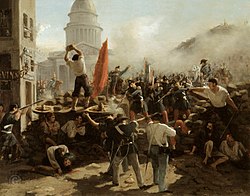
Painting of a barricade on Rue Soufflot (with the Panthéon behind), Paris, June 1848. By Horace Vernet.France becomes the first nation to permanently adopt universal male suffrage. This is form of voting rights in which all adult male citizens within a political system are allowed to vote, regardless of income, property, religion, race, or any other qualification.
June Days Uprising was a bloody crackdown on Parisian workers protesting the closure of National Workshops (state-funded jobs). The number of insurgents killed was estimated at between 3,000 and 5,000, in addition to approximately 1,500 who were shot without trial. Several thousand were deported to Algeria.[34]
December: Louis-Napoleon Bonaparte (nephew of Napoleon I) wins a landslide presidential election. He receives the votes of all segments of the population: the peasants unhappy with rising prices and high taxes; unemployed workers; small businessmen who wanted prosperity and order; and intellectuals such as Victor Hugo. He won the votes of 55.6 percent of all registered voters, and won in all but four of France's departments.[35]
1851: Coup d'état of 2 December: Prevented by the constitution from running for a second term, Louis-Napoleon seizes power and dissolves the National Assembly. This coup d’état was staged by Louis-Napoléon against his own government. The coup dissolved the National Assembly, granted dictatorial powers to the president and preceded the establishment of the Second French Empire a year later.
The Second Empire (1852–1870)
The official declaration of the Second Empire, at the Hôtel de Ville, Paris on December 2, 1852, one year after the coup d’état
1852: Following a national referendum, the Second Republic is abolished and the Second Empire is declared. Louis-Napoleon becomes Emperor Napoleon III.
1853: Napoleon III appoints Baron Haussmann to begin the "Renovation of Paris," during which he demolished medieval slums to create the boulevards and parks seen today. To a degree Haussmann's boulevards were planned to facilitate the deployment of troops and artillery, but their main purpose was to help relieve traffic congestion in a dense city and interconnect its landmark buildings.[36] His renovation also added water and sewage infrastructure.
1854–1856: France participates in the Crimean War against Russia, consolidating its return as a major European power. The War's proximate cause was a dispute between France and Russia over the rights of Catholic and Orthodox minorities in Palestine.[37]
1858: Assassination attempt on Napoleon III leads to the construction of the Palais Garnier (Paris Opera), which was built with a protected area for the arrival of carriages. The assassination attempt was led by Felix Orsini, an Italian revolutionary, who wanted to punish Napoleon III for betraying the Italian republican movement.[38]
1869: The Suez Canal, a French-led project directed by Ferdinand de Lesseps, officially opens. Construction of the canal lasted from 1859 to 1869. The canal offers vessels a direct route between the North Atlantic and northern Indian oceans via the Mediterranean Sea and the Red Sea, thereby reducing the journey distance from the Arabian Sea to London by approximately 8,900 kilometres (5,500mi).[40]
1870: The Franco-Prussian War: France declares war on Prussia. The war lasted only 6 months and resulted in a decisive defeat for France. Napoleon III is captured at the Battle of Sedan (September 2), ending the Second Empire .
The Third Republic and the Belle Époque (1870–1900)
A barricade constructed by the Commune in April 1871 on the Rue de Rivoli near the Hotel de Ville. The figures are blurred due to the camera's lengthy exposure time, an effect commonly seen in early photographs.
1871:
The Siege of Paris (September 1870 - January 1871): Prussian forces surround the city, leading to a famine. By January, 3,000–4,000 people were dying per week from the effects of cold and hunger.[41] There were sharp rises in cases of smallpox, typhoid, and especially pneumonia.[42]
The Paris Commune: A radical socialist government rules Paris for two months before being suppressed during the "Bloody Week" (Semaine sanglante).[43]
Treaty of Frankfurt signed on May 10: France loses Alsace-Lorraine to the new German Empire. The treaty formalizes the French defeat and provides for the cession of Alsace-Lorraine, which becomes a territory of the German Reich, as well as the payment of a war indemnity of five billion gold francs guaranteed by the occupation of part of the territory.[44]
1875: The constitutional laws of 1875 are passed, finalizing the legal structure of the Third Republic.[45]
1881–1882: The Jules Ferry laws establish free, mandatory, and secular education for all children. The dual system of state and church schools that were largely staffed by religious officials was replaced by state schools and lay school teachers.[46]
Aerial view of the Exposition Universelle, as seen from a ballon (1889)
1889: The Exposition Universelle celebrates the centenary of the French Revolution; the Eiffel Tower is inaugurated as its temporary centerpiece. It was the fifth of ten major expositions held in the city between 1855 and 1937. It attracted more than 32 million visitors.[47]
1894: The Dreyfus Affair begins when Jewish artillery officer Alfred Dreyfus is wrongly convicted of treason, sparking a decade of political crisis and civil rights debate. The affair was a major political scandal that convulsed France from 1894 until its resolution in 1906, and then had reverberations for decades more.[48]
1895: The Lumière Brothers hold the first commercial film screening on 28 December in Paris, thereby giving rise to the birth of cinema.[49]
1900: Paris hosts the Olympic Games and the Great Exposition, featuring line 1 of the Paris Métro. The responsibility for organizing the Olympic Games was assigned to the organizers of the Great Exposition, who knew little about sports.[50]
↑William, Roberts (1999). "Napoleon, the Concordat of 1801, and Its Consequences". In Coppa, Frank J. (ed.). Controversial Concordats: The Vatican's Relations with Napoleon, Mussolini, and Hitler. pp.34–80.
↑"The Code Napoléon: French Legislation on Divorce," Exploring the European Past: Texts & Images, Second Edition, ed. Timothy E. Gregory (Mason: Thomson, 2007), 62–64.
↑29 - The French Revolution and the Law, in Part IV - The Age of Reforms (1750–1814), Cambridge University Press, 31 July 2017; Antonio Padoa-Schioppa, Translated by Caterina Fitzgerald
↑Gwynn Lewis, "The White Terror of 1815 in the Department of the Gard: Counter-Revolution, Continuity and the Individual" Past & Present No. 58 (Feb., 1973), pp. 108-135 online
↑The Treaty of Frankfurt. Theodor Scheider. Oxford Public International Law. 1984. https://opil.ouplaw.com/display/10.1093/law:epil/9780199231690/law-9780199231690-e704?print=pdf
This page is based on this Wikipedia article Text is available under the CC BY-SA 4.0 license; additional terms may apply. Images, videos and audio are available under their respective licenses.