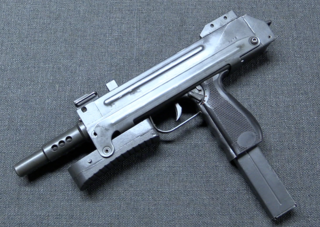
The Man from U.N.C.L.E. gun often referred to as the U.N.C.L.E. Special is a fictional firearm depicted on the popular TV show The Man from U.N.C.L.E. which ran from September 1964 until it was canceled mid-season in 1968. Onscreen it was semi-automatic pistol that could be converted to a carbine-sniper rifle that could fire full automatic.
The series began as a feature-length television pilot film written by Sam Rolfe titled Solo that was filmed in late November 1963. In the film Napoleon Solo carried a standard Luger pistol which in one scene he called an "X-38 Automatic".
Rolfe's attention to detail included specifying special props necessary to create the show's illusion of world spycraft, including the famous "Man from U.N.C.L.E. gun". Rolfe said
"I wanted one gun capable of shooting single shots or rapid-fire automatic shots, with sound or silently. I also wanted sleep inducing darts, explosive bullets and just bullets, and a gun that could convert to a long-range rifle. I wanted everything in the U.N.C.L.E. gun, and the one thing I had forgot, I had put in the Thrush gun - an infra-red light, so the Thrush people could shoot at night."[1]
Stanley Weston, who had handled the toy licensing rights for Dr. Kildare, another MGM Television series produced by Norman Felton, was engaged to do the same for the show retitled The Man from U.N.C.L.E. After viewing the Solo pilot in February, 1964, Weston wrote a letter to Felton expressing excitement over the show's merchandising potential. Weston made a list of 35 suggestions for emblem designs and spy gadgets that could be exploited for marketing purposes. Among them was the proposal for a distinctive pistol that should feature a silencer. "Also, from our viewpoint," Weston added, "it would be great if Solo uses a machine gun from time to time."[2]
Robert Vaughn with his P-08 "The Vulcan Affair"Robert Vaughn with his modified P-38 (1964)
The U.N.C.L.E. Special was originally based on a 1934 7.65mm German Mauser pistol. While early episodes were being shot, the Mauser jammed frequently, and visually all the accessories added to convert the pistol to a carbine seemed to overwhelm the small pistol. It was soon replaced by the Walther P389mm Parabellum that the producers borrowed from the Combat! television series that was also shot on the MGMbacklot.[3] The standard barrel of the P-38 was shortened and modified to accept a bird-cage flash suppressor. The Special was depicted on screen as firing "sleep darts". Although the non-lethal feature of the gun was always the intent of its creators, this was not always clearly shown to the audience especially in later seasons, and as producers changed.
For situations where more firepower was necessary, the concealable pistol was modified to accept a barrel extension with hand-grip and silencer, a Bushnell Phantom (Model One) pistol scope, an extended magazine and a collapsible shoulder stock. The bird cage suppressor, silencer and barrel extension were attached by threaded plugs. Though a sophisticated weapon on screen, the U.N.C.L.E. Special Carbine in reality could not shoot real bullets, only blanks. However the pistol alone was still a working firearm. It was also modified by the studio to allow it to fire in full automatic "machine gun" mode. Unfortunately, this caught the attention of the US Treasury Department- the manufacture of automatic weapons without a license is illegal, and the show nearly had the guns confiscated. In the end MGM was fined $2000 and the matter was closed.
The prop masters of the series created six U.N.C.L.E. Specials at a cost of approximately $1,500 per gun, but only two had the full array of attachments.[4]
In the episodes, the gun(s) were used by Napoleon Solo and Illya Kuryakin. The gun was extremely popular with viewers. MGM began to get fan mail addressed to "The Gun". At one point the gun was getting 500 letters per week. A US Army Ordnance General once asked if a few of the guns were available, he would like to borrow them for testing as possible weapons for the armed forces.
The UNCLE Special in popular culture
Reuben Klamer[5] of Toylab designed a cap firing toy version of the weapon that included a bipod for the Ideal Toy Company as the "Napoleon Solo Gun" and also designed an "Illya Kuryakin" gun based on the AR-7.
Larami offered a Z-Matic toy P-38 in the early 1980s with the scope mount molded onto the non-working slide. The pistol was offered both by itself and with a carbine barrel that slid over the stock pistol barrel, a detachable scope and a detachable stock.
RMI (Replica Models Incorporated) offered the U.N.C.L.E. P-38 variant with all the silencer, extended magazine, stock and scope accessorie along with a shoulder holster, in their early 1970's catalog. Constructed of metal, with black plastic grips. Pulling the trigger moved the slide back, chambered a solid brass round, and ejected it, repeating the process for each trigger pull.
In 1983, a toy U.N.C.L.E. gun that could fire rubber projectiles and convert into a robot action figure was made in Japan as part of Takara's Microman line under the name "MC-13 Gun Robo Walther P38 U.N.C.L.E."
In 1984, the Microman "MC-13 Gun Robo Walther P38 U.N.C.L.E." toy mentioned above was imported to the US by Hasbro and renamed to create the original Transformers character Megatron. This version of the toy was modified to disable the projectile firing mechanism, and stickers were added to identify the toy as a Decepticon.[6]
By 2011, fans of The Man from U.N.C.L.E. had created an actual, live-firing gun based on the show version.[7]
↑ pp. 203-205 Walker, C. W. The Gun as Star and the "U.N.C.L.E. Special" in Bang Bang, Shoot Shoot!: Essays on Guns and Popular Culture edited by Murray Pomerance and John Sakeris Pearson Education, 2000
↑ Heitland, J. The Man From U.N.C.L.E. Book: The Behind the Scene Story of a Television Classic St. Martin's Press New York 1987
↑ p. 48 Walker, Cynthia M. The Future Just Beyond the Coat Hook in Channeling the Future: Essays on Science Fiction and Fantasy Television edited by Lincoln Geraghty Scarecrow Press 2 Apr 2009
A carbine is a long gun that has a barrel shortened from its original length. Most modern carbines are rifles that are compact versions of a longer rifle or are rifles chambered for less powerful cartridges.
A firearm is any type of gun that uses an explosive charge and is designed to be readily carried and operated by an individual. The term is legally defined further in different countries.
A machine pistol is a handgun that is capable of fully automatic fire, including stockless handgun-style submachine guns.
The Man from U.N.C.L.E. is an American spy fiction television series produced by Metro-Goldwyn-Mayer Television and first broadcast on NBC. The series follows secret agents Napoleon Solo, played by Robert Vaughn, and Illya Kuryakin, played by David McCallum, who work for a secret international counterespionage and law-enforcement agency called U.N.C.L.E.. The series premiered on September 22, 1964, and completed its run on January 15, 1968. The program was part of the spy-fiction craze on television, and by 1966 there were nearly a dozen imitators. Several episodes were successfully released to theaters as B movies or double features. There was also a spin-off series, The Girl from U.N.C.L.E., a series of novels and comic books, and merchandising.
A muzzle brake or recoil compensator is a device connected to, or a feature integral to the construction of, the muzzle or barrel of a firearm or cannon that is intended to redirect a portion of propellant gases to counter recoil and unwanted muzzle rise. Barrels with an integral muzzle brake are often said to be ported.
The StG 44 is a German assault rifle developed during World War II by Hugo Schmeisser. It is also known by its early designations as the MP 43 and MP 44. The StG 44 was an improvement of an earlier design, the Maschinenkarabiner 42(H).
A semi-automatic pistol is a handgun that automatically ejects and loads cartridges in its chamber after every shot fired. Only one round of ammunition is fired each time the trigger is pulled, as the pistol's fire control group disconnects the trigger mechanism from the firing pin/striker until the trigger has been released and reset.
The Walther P5 is a 9mm semi-automatic pistol developed in the mid-1970s by the German small arms manufacturer Carl Walther GmbH Sportwaffen. It was designed with the German police forces in mind, who sought to replace existing 7.65mm pistols with a modern service sidearm incorporating enhanced safety features and chambered in 9×19mm Parabellum. A subsequent bid resulted in the Walther P5 being introduced into service alongside the SIG Sauer P225 and Heckler & Koch P7.
The Walther P38 is a 9 mm semi-automatic pistol that was developed by Carl Walther GmbH as the service pistol of the Wehrmacht at the beginning of World War II. It was intended to replace the comparatively complex and expensive to produce Luger P08. Moving the production lines to the more easily mass producible P38 once World War II started took longer than expected, leading to the P08 remaining in production until September 1942 and copies remained in service until the end of the war.
The BXP is a 9×19mm submachine gun developed by Andries Piek, with the fully automatic version finalised in 1978, and the semi-automatic version for civilians coming later in 1984. Due to an international arms embargo against South Africa, South Africans designed and manufactured some weapons as a small firearms industry developed locally. The BXP was one of these locally designed and developed firearms, and is considered the final stage of development of the line of hand machine carbines that started with the LDP in Rhodesia and the Kommando in South Africa. Produced originally by the South African company Milkor (Pty) Ltd, its name 'BXP' stands for 'Blowback eXperimental Parabellum', hinting both at its operating mechanism as well as its caliber. The original automatic version of the BXP was intended for use by South African law enforcement, including the South African Police, the Correctional Services, and the specialised airport security unit based at the then Jan Smuts International Airport, Johannesburg.
The Claridge Hi-Tec and its antecedent the Goncz High-Tech Long Pistol are semi-automatic pistols designed by Hungarian inventor Lajos John Goncz. This unique firearm features a telescopic bolt design encased in a tubular upper receiver with a forged steel frame, button rifled match barrels, and 16-round magazines standard.
A handgun is a firearm designed to be usable with only one hand. It is distinguished from a long barreled gun which typically is intended to be held by both hands and braced against the shoulder. Handguns have shorter effective ranges compared to long guns, and are much harder to shoot accurately. While most early handguns are single-shot pistols, the two most common types of handguns used in modern times are revolvers and semi-automatic pistols.
The M6 is a series of carbines designed and manufactured by LWRC International. It is based on the M4 carbine, with which it shares 80% of its parts. The 'M' model name is not a US military designation. Like the HK416, it features a proprietary short-stroke self-regulating gas piston system and bolt carrier/carrier key design, which prevents trapped gases from contacting the bolt carrier or receiver of the weapon. The manufacturer claims that this reduces the heating and carbon fouling of the internals, simplifies field maintenance, and improves reliability.
The KRISS Vector is a series of weapons based upon the parent submachine gun design developed by the American company KRISS USA, formerly Transformational Defense Industries (TDI).
Title II weapons, or NFA firearms, are designations of certain weapons under the United States National Firearms Act (NFA).
The Barrett M468 was a variant of the M4 Carbine, rechambered for a heavier and larger 6.8mm bullet for increased terminal performance. The designation of M468 stands for an M4 carbine chambered for the 6.8mm SPC cartridge. It was an attempt to create an optimal Special Operations close-to-medium range carbine for Close Quarter Battle (CQB). A 12-inch barreled micro-carbine and 16-inch barreled carbine version were created. Barrett ceased manufacturing the rifle in 2010.
The Return of the Man from U.N.C.L.E.: The Fifteen Years Later Affair is a 1983 American made-for-television action-adventure film based on the 1964–1968 television series The Man from U.N.C.L.E. starring Robert Vaughn and David McCallum reprising the roles they had originated on that program. Several of the crew from the series also worked on the film, which was produced by Viacom rather than Metro-Goldwyn-Mayer and/or Turner Entertainment. Leo G. Carroll had died in 1972, so Patrick Macnee was recruited to appear as an entirely different character, Sir John Raleigh, who had presumably taken over as Number 1 of Section I, the Director of U.N.C.L.E., after Alexander Waverly had died, and Carroll's photograph was displayed prominently in many scenes that featured Macnee's Sir John.
A silencer, also known as a sound suppressor, suppressor, or sound moderator, is a muzzle device that suppresses the blast created when a gun is discharged, thereby reducing the acoustic intensity of the muzzle report and jump, by modulating the speed and pressure of the propellant gas released from the muzzle. Like other muzzle devices, a silencer can be a detachable accessory mounted to the muzzle, or an integral part of the barrel.
The SIG MPX is a gas-operated submachine gun designed and manufactured by SIG Sauer, and is primarily chambered in 9×19mm Parabellum. It is a gas-operated firearm featuring a closed, rotating bolt. These design features, rare in submachine guns, were chosen to enhance the safety of the user and to have a more reliable firearm. It was designed in 2013 and was released to the general public in 2015. It features the SIG Sauer short stroke push-rod gas system to reduce the recoil and improve the reliability of the weapon.
The Walther CP 88 is a sport and training pistol that shoots pellets using compressed CO2 according to the principle of an air gun. The design of the gun is borrowed from the widely used pistol Walther P88. It is manufactured by Umarex.
This page is based on this Wikipedia article Text is available under the CC BY-SA 4.0 license; additional terms may apply. Images, videos and audio are available under their respective licenses.