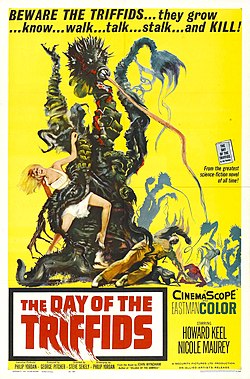
A meteor shower blinds most of the world's population and spreads spores that cause triffid plants to become animated. Bill Masen, a merchant navy officer, escapes the catastrophe after spending the night in a hospital with his eyes bandaged. At a railway station, he meets Susan, an orphaned schoolgirl who also avoided the blinding. They flee the chaotic streets and set off in an abandoned car to reach Masen's ship, but are attacked by a triffid along the way when the car becomes stuck and barely escape.
Elsewhere, scientist Tom Goodwin and his wife Karen, isolated in a lighthouse, learn of the global disaster via radio. After a triffid invades their lighthouse and is apparently killed, they discover the plants can regenerate themselves. They barricade themselves in and begin searching for a way to stop them.
Masen and Susan reach the docks and, after hearing troubling news over the radio, travel by boat to France. There they meet Christine Durant, who leads them to a château sheltering blind survivors. During a supply run with Mr Coker, a worker at the castle, they discover dozens of the plants and Coker is killed by one. Later, escaped convicts invade the château, allowing triffids to overrun it during the chaos. Only Bill, Susan, and Christine survive, fleeing in a prison bus.
As they head toward the American naval base in Cádiz, they encounter a blind couple, Luis and Teresa de la Vega, and help her deliver a baby boy. Luis tells Masen that the Cadiz base has been evacuated by submarine since those who were underwater didn't get blinded by the meteor shower. Masen gets de Vega's radio transmitter, which relays news of a final naval evacuation in Alicante. That night, after deciding to leave in the morning, he tries to electrify the villa's fence, but it fails due to weak electrical current. When triffids attack, Masen fends them off with a makeshift flamethrower and uses a noisy clown car to lure them away so the others can escape. He is then rescued by a naval dinghy.
Back at the lighthouse, triffids break in, forcing Tom and Karen to retreat upstairs. In a last-ditch effort, Tom turns a salt-water fire hose on the plants, causing them to dissolve in clouds of green smoke. He realizes that seawater is lethal to triffids and kills the rest of the plants in the lighthouse.
In the final scene, the narrator declares that humanity has triumphed over the triffids by turning to the very element that gave it life: the sea. Survivors from the submarine disembark and head to a church to give thanks for their survival.
The rights to a film of Wyndham's novel were sold to Sydney Box's production company, Orbital Films, in June 1959 with the intention that Box work with Philip Yordan's Security Pictures to make the film as a co-production. However, Box suffered a cerebral haemorrhage and withdrew from the project.[3].
In June 1960 it was announced that Frank and Maurice King of King Brothers Productions would make the film from a script by Phil Yordan once they had completed production of Gorgo.[4]. Their connection with the project was very short-lived as they followed Gorgo with a series of films for Metro-Goldwyn-Mayer[3].
Production began in September 1961, after Security Pictures struck a deal with Rank to produce the film at Shepperton Studios, having secured financing of $1,230,000 from Beverly Hills National Bank,[5][6], a Western Hemisphere distribution deal having been finalised with Allied Artists in August.[7]
It was the first British film for director Steve Sekely.[8] Howard Keel recalled Sekely as "a lovely man with a thick Hungarian accent and a habit of offering a direction and walking away from you, so you caught very little of what he said. But somehow you knew what he wanted. We all loved him and his humor."[9]
Keel said "The script was awful and was rewritten by the producer and his wife, which only made it worse."[9] Keel said filming was cut short as the producers ran out of money before they had the chance to film a lighthouse sequence where his character learns how to kill the Triffids.[10]
Reshoots
When the final film was assembled, and after a number of special-effects sequences were deleted, it ran for only about 60 minutes. One of Philip Yordan's regular writers, Bernard Gordon, who had written the production's screenplay anonymously due to his blacklist status, was asked to develop additional material. Gordon later recalled that Yordan blamed the producer and director for the film running short,[11] although uncredited producer Bernard Glasser stated that the primary cause was the removal of effects sequences that proved technically unsuccessful or too expensive to complete. Glasser explained that the mechanical limitations of the Triffid models meant that much of the action called for in the script could not be realised, forcing schedule changes and deletions. He also noted that Yordan was constrained by the need to spend most of the budget in the United Kingdom in order to qualify for a government subsidy under the Eady Plan.[12]
Glasser stated that the shortened cut was not the fault of director Steve Sekely. After Allied Artists head Steve Broidy viewed the abbreviated version and expressed dissatisfaction, Yordan travelled to London with Gordon to address the problem. Along with Glasser and editor and production troubleshooter Lester Sansom, they reviewed the existing footage and concluded that new material would be required to bring the film up to feature length.[12]
Gordon was therefore asked to devise a new storyline that would add approximately thirty minutes of running time without recalling the original cast, who were considered too expensive to bring back. The solution was a lighthouse-based subplot, involving only two characters, integrated with the existing footage. The screenplay for these sequences was written by Jon Manchip White, based on a treatment by Gordon, although Yordan had given Manchip White the impression that he had written it.[11] The scenes were directed by Freddie Francis and filmed over three weeks, from Monday 24 September to Wednesday 3 October 1962, on Stage 6, at MGM-British Studios[13]. Francis recalled, "We didn’t make it a good film, but at least we made it acceptable to the people who were going to put money in."[14]
In addition to the lighthouse material, some second-unit footage was shot in Spain after Sekely had left the production, including carnival scenes using doubles for the principal cast and an abandoned sequence in which the Triffids were intended to walk into the sea and be destroyed by saltwater. Many of these ideas were ultimately discarded due to technical and practical difficulties. Glasser later remarked that, despite the production problems, the film performed well commercially for Allied Artists.[12]
In August 1962 Glasser said "I am pleased with the film now. But it's an experience I'll be happy to forget."[15]
The movie was not released in cinemas until May 1963.
Although the film retained some basic plot elements from John Wyndham's novel The Day of the Triffids, it is not a particularly faithful adaptation: "It strays significantly and unnecessarily from the book and is less well regarded than the BBC's intelligent (if dated) 1981 TV serial".[16] Unlike in the novel, the triffids arrive from a meteor shower, some of the action is moved to France and Spain, and an important character, Josella Playton, is deleted.[17] Most seriously, the screenplay supplies a simplistic solution to the triffid problem: salt water dissolves them and "the world was saved".[18]
The film version is enjoyable, luring the effective-looking Triffids away with music from an ice-cream van and some other good action scenes. The Triffids' death-by-seawater climax is weak and contrived though. But it would still rank in my all-time top 100 films.[19]
Halliwell's Film Guide claimed the film was a "rough and ready adaptation of a famous sci-fi novel, sometimes blunderingly effective and with moments of good trick work".[20]
Filmink argued "It’s a shame that when Rank finally dipped its toe in sci-fi waters... the result was such a mess.... People love this movie, but we don’t think even its most rabid fans would call it well made."[21]
After the film's initial run, the rights to the picture reverted to producer Philip Yordan, who eventually transferred them to screenwriter Bernard Gordon and his business partner, Richard Rosenfeld. In an effort to generate quick income from the picture, they sold non-exclusive home video rights to a number of discount VHS labels.
This move incensed film restoration expert Mike Hyatt, who had been a fan of the picture since his youth. Hyatt was able to obtain the well-worn original negative from Gordon, while Rosenfeld, still short of money, sold Hyatt the North American theatrical and home video rights. Hyatt then began an arduous and decades-long effort to restore the film, resorting to manually using a jeweler's loupe and a needle to pick specks of dirt out of the emulsion side of the negative. Hyatt eventually had an interpositive struck from the restored negative which in 2010 was shown at the Museum of Modern Art in New York City. By the fall of 2014 Hyatt had obtained the majority of the worldwide rights to the film and had planned to arrange a 4K digital scan of the negative.[23] The status of the project was unclear when Hyatt died in February 2024.
↑See the description of the original artwork that was auctioned in 2012: "The Day of the Triffids (Allied Artists, 1962). Joseph Smith Original Movie Poster Art (22" X 27.25")". Dallas, Texas: Heritage Auctions. Retrieved 23 October 2017.. This artwork has also been attributed to Reynold Brown. Brown's own records indicate that he worked on the campaign for The Day of the Triffids: "Movie Campaigns, A Listing". Archived from the original on 23 April 2012. Retrieved 12 March 2013. The narrative accompanying the sale of the original artwork in 2012 by Heritage Auctions looks to be conclusive, and supports the attribution to Smith.
12McGilligan, Patrick (1997). Tender Comrades: A Backstory of the Hollywood Blacklist. New York: St. Martin’s Press. p. 265. ISBN 9780312152479.
123Weaver, Tom; Brunas, Michael; Brunas, John (2006). Science Fiction Stars and Horror Heroes: Interviews with Actors, Directors, Producers and Writers of the 1940s Through 1960s. Jefferson, North Carolina: McFarland & Company. pp. 117–122. ISBN 9780786428571.
↑"The Day of the Triffids – Schedules". Academy Collection. Academy of Motion Picture Arts and Sciences. Retrieved 27 January 2026. Metro-Goldwyn-Mayer British production records, Margaret Herrick Library. Manuscript file containing production schedules for The Day of the Triffids (1963).
↑Dixon, Wheeler W. (1991). The films of Freddie Francis. p.67.
↑"The triffids win through". Evening Standard. 19 October 1962. p.10.
↑"John Wyndham". The Guardian. London. 22 July 2008. Retrieved 25 May 2010.
↑Bartok, Dennis; Joseph, Jeff (2016). A thousand cuts: the bizarre underground world of collectors and dealers who saved the movies. Jackson: University Press of Mississippi. ISBN978-1-4968-0773-1.
Bibliography
Keel, Howard (2005). Only make believe. Barricade.
McGilligan, Patrick (1997). Tender comrades: a backstory of the Hollywood blacklist. St Martin's Press.
Warren, Bill. Keep Watching the Skies, American Science Fiction Movies of the Fifties, Vol. II: 1958–1962. Jefferson, North Carolina: McFarland & Company, 1986. ISBN0-89950-032-3.
This page is based on this Wikipedia article Text is available under the CC BY-SA 4.0 license; additional terms may apply. Images, videos and audio are available under their respective licenses.