Related Research Articles
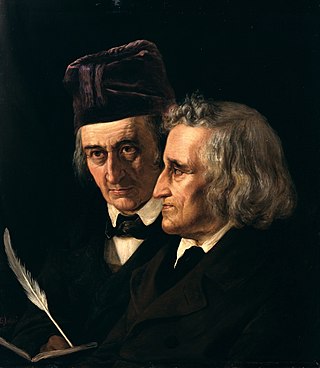
The Brothers Grimm, Jacob (1785–1863) and Wilhelm (1786–1859), were German academics who together collected and published folklore. The brothers are among the best-known storytellers of folktales, popularizing stories such as "Cinderella", "The Frog Prince", "Hansel and Gretel", "Town Musicians of Bremen", "Little Red Riding Hood", "Rapunzel", "Rumpelstiltskin", "Sleeping Beauty", and "Snow White". Their first collection of folktales, Children's and Household Tales, was first published in 1812.

"Rapunzel" is a German fairy tale most notably recorded by the Brothers Grimm and published in 1812 as part of Children's and Household Tales. The Brothers Grimm's story was developed from the French literary fairy tale of Persinette by Charlotte-Rose de Caumont de La Force (1698), which itself is an alternative version of the Italian fairy tale Petrosinella by Giambattista Basile (1634).

"The Golden Goose" is a fairy tale collected by the Brothers Grimm.

Dorothea Viehmann was a German storyteller. Her stories were an important source for the fairy tales collected by the Brothers Grimm. Most of Dorothea Viehmann's tales were published in the second volume of Grimms' Fairy Tales.
The Blue Light is a Brothers Grimm fairy tale about a soldier who finds a magical object that provides him a supernatural helper. Many of the features from Hans Christian Andersen's later work The Tinderbox and from the story of Aladdin and his magic lamp originate with this version. Other tales of this type include The Three Dogs and The Tinderbox.
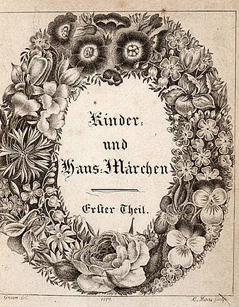
Grimms' Fairy Tales, originally known as the Children's and Household Tales, is a German collection of fairy tales by the Brothers Grimm, Jacob and Wilhelm, first published on 20 December 1812. Vol. 1 of the first edition contained 86 stories, which were followed by 70 more tales, numbered consecutively, in the 1st edition, Vol. 2, in 1815. By the seventh edition in 1857, the corpus of tales had expanded to 200 tales and 10 "Children's Legends". It is listed by UNESCO in its Memory of the World Registry.

"The Singing, Springing Lark", "The Singing, Soaring Lark", "The Lady and the Lion" or "Lily and the Lion" is a German fairy tale collected by the Brothers Grimm, appearing as tale no. 88.
"The Thief and His Master" is a German fairy tale collected by the Brothers Grimm in Grimm's Fairy Tales as tale number 68. In the first edition there was another fairy tale at place 68. The name of the fairy tale is "Von dem Sommer- und Wintergarten".
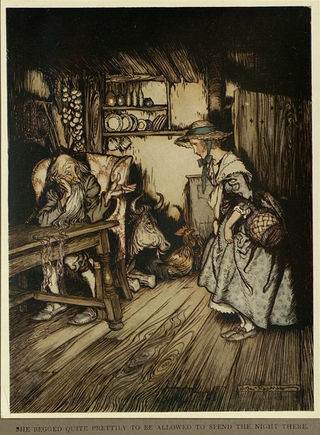
"The Hut in the Forest" is a German fairy tale collected by the Brothers Grimm. Andrew Lang included it in The Pink Fairy Book (1897). It is Aarne-Thompson type 431.
"The Glass Coffin" is a German fairy tale collected by the Brothers Grimm, tale number 163. Andrew Lang included it in The Green Fairy Book as The Crystal Coffin.
The Three Dogs is a German fairy tale. Andrew Lang included it in The Green Fairy Book, listing his source as the Brothers Grimm. A version of this tale appears in A Book of Dragons by Ruth Manning-Sanders.

"The King of the Golden Mountain" is a German fairy tale collected by the Brothers Grimm in Grimm's Fairy Tales.

"The Old Man and his Grandson" is a German fairy tale collected by the Brothers Grimm in Grimm's Fairy Tales as tale number 78.

"The Gnome" is a German fairy tale collected by the Brothers Grimm in Grimm's Fairy Tales, tale number 91.
"The Duration of Life" is a German fairy tale collected by the Brothers Grimm in Grimm's Fairy Tales, number 176. It was first included in their fourth edition.
"The Dog and the Sparrow" is a German fairy tale collected by the Brothers Grimm. It is a story of Aarne-Thompson type 248.

The Six Servants is a German fairy tale collected by the Brothers Grimm and published in Grimm's Fairy Tales. It is of Aarne-Thompson type 513A.

The Jew Among Thorns, also known as The Jew in the Brambles, is an antisemitic fairytale collected by the Brothers Grimm. It is a tale of Aarne–Thompson type 592. A similar antisemitic tale in the collection is The Good Bargain.

"The Grave Mound" is a German fairy tale collected by the Brothers Grimm, KHM 195. It is Aarne-Thompson type 779, Divine Rewards and Punishments.

"The Good Bargain" is a German fairy tale collected by the Brothers Grimm, KHM 7. This antisemitic fairytale was added to the Grimms' collection Kinder- und Hausmärchen with the second edition of 1819. It is a tale of Aarne–Thompson type 1642. A similar anti-Semitic tale collected by the Grimms' is The Jew Among Thorns.
References
- 1 2 Jacob and Wilheim Grimm, Household Tales, "The Bright Sun Brings it to Light"
- ↑ D. L. Ashliman, "The Grimm Brothers' Children's and Household Tales (Grimms' Fairy Tales)"


 | This folklore-related article is a stub. You can help Wikipedia by expanding it. |