Related Research Articles

The music of Colombia is an expression of Colombian culture, music genres, both traditional and modern, according with the features of each geographic region, although it is not uncommon to find different musical styles in the same region. The diversity in musical expressions found in Colombia can be seen as the result of a mixture of Amerindian, African, and European influences, as well as more modern American.

The United Self-Defenders of Colombia were a Colombian far-right paramilitary and drug trafficking group which was an active belligerent in the Colombian armed conflict during the period from 1997 to 2006. The AUC was responsible for retaliations against the FARC and ELN communist organization as well as numerous attacks against civilians beginning in 1997 with the Mapiripán massacre.

Costa Rican culture has been heavily influenced by Spanish culture ever since the Spanish colonization of the Americas including the territory which today forms Costa Rica. Parts of the country have other strong cultural influences, including the Caribbean province of Limón and the Cordillera de Talamanca which are influenced by Jamaican immigrants and indigenous native people, respectively.

The Bogside Artists are a trio of mural painters from Derry, Northern Ireland, consisting of brothers Tom and William Kelly, and Kevin Hasson. Their most famous work, a series of outdoor murals called the People's Gallery, is located in the Bogside neighbourhood of Derry and depicts the events surrounding sectarian violence and civil rights protests in Northern Ireland during the Troubles.

Afro-Ecuadorians, also known as Black Ecuadorians, are Ecuadorians of predominantly Sub-Saharan African descent.
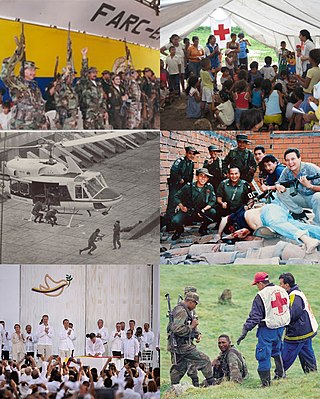
The Colombian conflict began on May 27, 1964, and is a low-intensity asymmetric war between the government of Colombia, far-left paramilitary groups and crime syndicates, and far-left guerrilla groups, fighting each other to increase their influence in Colombian territory. Some of the most important international contributors to the Colombian conflict include multinational corporations, the United States, Cuba, and the drug trafficking industry.
Right-wing paramilitary groups in Colombia are paramilitary groups acting in opposition to revolutionary Marxist–Leninist guerrilla forces and their allies among the civilian population. These right-wing paramilitary groups control a large majority of the illegal drug trade of cocaine and other substances. The Colombian National Centre for Historical Memory has estimated that between 1981 and 2012 paramilitary groups have caused 38.4% of the civilian deaths, while the Guerillas are responsible for 16.8%, 10.1% by the Colombian Security Forces and 27.7% by non-identified armed groups, although the chief prosecutor of the ICC would contradict these numbers.
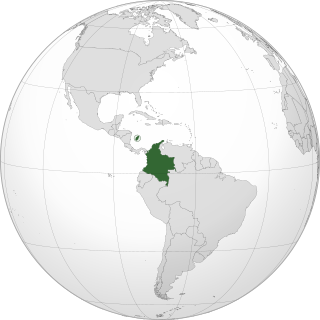
Lesbian, gay, bisexual, transgender, and queer (LGBTQ) rights in Colombia have advanced significantly in the 21st century, and are now quite progressive. Consensual same-sex sexual activity in Colombia was decriminalized in 1981. Between February 2007 and April 2008, three rulings of the Constitutional Court granted registered same-sex couples the same pension, social security and property rights as registered heterosexual couples.

Afro-Colombians, also known as Black Colombians, are Colombians who have predominantly or total Sub-Saharan African ancestry. They stand out for having dark skin. In the national censuses of Colombia, black people are recognized as 3 official groups: the Raizals, the Palenques and other Afro-Colombians.
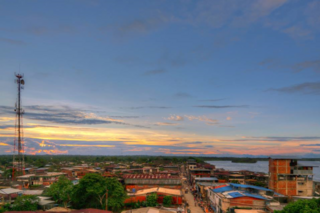
Guapi is a town and municipality in the Cauca Department, Colombia. The municipality of Guapi is located on the Guapi River, 4 miles (6.4 km) from the Pacific Ocean, and also covers the island of Gorgona.
Joseph A. Cari Jr. is an American merchant banker, public policy expert, and philanthropist currently residing in New York. Cari's professional career has spanned the worlds of merchant banking, media, public policy, politics, law and education.

Luis Gilberto Murillo Urrutia is a Colombian diplomat, mining engineer, and politician who was the Minister of Environment and Sustainable Development from 2016 to 2018. He has also served as Governor of the predominantly Afro-Colombian Department of Chocó in Colombia. Murillo was kidnapped in 2000 and after his release he went into and moved to the United States and only returned to Colombia in 2011. In July 2022, Murillo was nominated by president-elect Gustavo Petro to serve as ambassador to the United States.
Joel Bergner is an American muralist, street artist, and educator who creates large-scale works of art with the participation of young people and communities around the world. Bergner is the co-founder and co-director of the non-profit organization Artolution, which organizes community-based public art initiatives with those who have experienced armed conflict, trauma and social marginalization. He has led such projects with incarcerated teenagers, Syrian refugees, youth from slum areas, the mentally and physically disabled, young people with substance abuse issues, orphans and street children.
Colombia has been in the throes of civil unrest for over half a century. Between 1964 and now, 3 million persons have been displaced and about 220,000 have died, 4 out of 5 deaths were non-combatant civilians. Between left and right-winged armed forces, paramilitary and/or guerrilla, and an often corrupt government, it has been difficult for Colombia to set up any kind of truth or reconciliation commission. That is why the first on the scene, so to speak, were representatives of the UN. The Office of the United Nations High Commissioner for Human Rights has been present in Colombia since 1997. Since 2006 though, there has been another international movement turning its attention to Colombia; namely the International Center for Transitional Justice (ICTJ). The works of both of these institutions have led to a few semi-official national committees to oversee truth seeking missions in the hopes of eventually achieving reparation. In 2012, the Colombian government and the Revolutionary Armed Forces of Colombia (FARC) began their fourth attempt to negotiate an end to the fighting. Peace talks between the Colombian government of Juan Manuel Santos and the FARC, the main guerrilla force in the country, are currently underway in Havana, Cuba. The main issues are land redistribution, integration of the FARC into the political arena and an end to the powerful cocaine cartels. Though past attempts at peace talks have failed, negotiators in Havana, Cuba have gotten significantly further than ever before. Experts agree that it is not unreasonable to expect an accord by the end of 2014. In the words of President Santos: "Only in a Colombia without fear and with truth can we begin to turn the page."

Lisa Marie Thalhammer is an artist living in Washington D.C.
The United Nations General Assembly declared the year 2011 as International Year for People of African Descent. That year also marked the 10th anniversary of the World Conference Against Racism, which approved a resolution stating that slavery along with the colonization that sustained it were crimes against humanity.

The Robert W. Saunders Sr. Public Library is a member of the Tampa-Hillsborough County Public Library System (THPL) and the Hillsborough County Public Library Cooperative (HCPLC). Located on 1505 Nebraska Avenue in Tampa, Florida, the 26,244 square foot library is one of only two African-American research libraries in Florida. The library provides access to the full suite of Adobe Creative Cloud desktop apps by booking in advance or by a walk-in booking. The library features art and history displays about African Americans in Tampa.
The Colombian peace process is the peace process between the Colombian government of President Juan Manuel Santos and the Revolutionary Armed Forces of Colombia (FARC–EP) to bring an end to the Colombian conflict, which eventually led to the Peace Agreements between the Colombian Government of Juan Manuel Santos and FARC-EP. Negotiations began in September 2012, and mainly took place in Havana, Cuba. Negotiators announced a final agreement to end the conflict and build a lasting peace on August 24, 2016. However, a referendum to ratify the deal on October 2, 2016 was unsuccessful after 50.2% of voters voted against the agreement with 49.8% voting in favor. Afterward, the Colombian government and the FARC signed a revised peace deal on November 24 and sent it to Congress for ratification instead of conducting a second referendum. Both houses of Congress ratified the revised peace agreement on November 29–30, 2016, thus marking an end to the conflict.
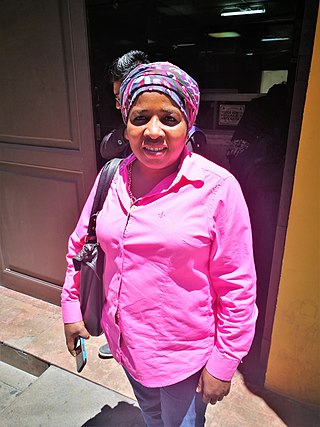
Adalberta Mónica Rey Gutiérrez is an Afro-Bolivian cultural leader and activist whose anthropological research helped pass legislation for formal recognition of Afro-Bolivians as an ethnic category in the census of the country. After serving as an educator and cultural activist for many years, she went to work in the government. She is currently a supranational delegate in the Plurinational Legislative Assembly of Bolivia.

Dejusticia is a non-profit legal organization established in 2005 that promotes human rights and the social rule of law in Colombia, Latin America and other regions of the Global South.
References
- 1 2 "Afro-Colombian Mural: Currulao y Desplazamiento". AfroColombia NY. Retrieved 5 May 2015.
- 1 2 "Artist Bio". Joel Artista. Retrieved 5 May 2015.
- 1 2 Bridges, Toure (March 6, 2010). "Afro-Colombian Mural: Currulao y Desplazamiento". The Different Things that Define Us. Retrieved May 5, 2015.
- ↑ "Danza en Red - Currulao - Grupo Tangaré". danzaenred.co.
- ↑ "The Afro-Colombian Mural Inauguration Event". WOLA: Washington Office of Latin America. Retrieved 5 May 2015.