Related Research Articles
Agrarianism is a social and political philosophy that advocates for rural development, a rural agricultural lifestyle, family farming, widespread property ownership, and political decentralization. Those who adhere to agrarianism tend to value traditional forms of local community over urban modernity. Agrarian political parties sometimes aim to support the rights and sustainability of small farmers and poor peasants against the wealthy, powerful and famous in society.

A peasant is a pre-industrial agricultural laborer or a farmer with limited land-ownership, especially one living in the Middle Ages under feudalism and paying rent, tax, fees, or services to a landlord. In Europe, three classes of peasants existed: non-free slaves, semi-free serfs, and free tenants. Peasants might hold title to land outright, or by any of several forms of land tenure, among them socage, quit-rent, leasehold, and copyhold.
Maurice Herbert Dobb was an English economist at Cambridge University and a Fellow of Trinity College, Cambridge. He is remembered as one of the pre-eminent Marxist economists of the 20th century. Dobb was highly influential outside of economics, having helped to establish the Communist Party Historians Group which developed social history and attracted future members of the Cambridge Five to Marxism in the 1930s.
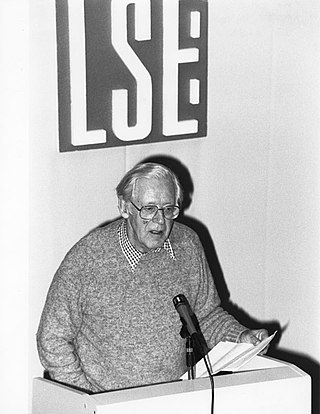
Rodney Howard Hilton was an English Marxist historian of the late medieval period and the transition from feudalism to capitalism.

Giovanni Arrighi was an Italian economist, sociologist and world-systems analyst, from 1998 a Professor of Sociology at Johns Hopkins University. His work has been translated into over fifteen languages.
Crawford Brough Macpherson was an influential Canadian political scientist who taught political theory at the University of Toronto.
Robert Paul Brenner is an American economic historian. He is a professor emeritus of history and director of the Center for Social Theory and Comparative History at UCLA, editor of the socialist journal Against the Current, and editorial committee member of New Left Review. His research interests are early modern European history, economic, social and religious history, agrarian history, social theory/Marxism, and Tudor–Stuart England.
Alfredo Saad-Filho is a Brazilian Marxian economist.
Political Marxism (PM) is a strand of Marxist theory that places history at the centre of its analysis. It is also referred to as a form of neo-Marxism or Western Marxism.

Teodor Shanin was a British sociologist who was for many years Professor of Sociology at the University of Manchester. He was credited with pioneering the study of Russian peasantry in the West, and is best known for his first book, The Awkward Class: Political Sociology of Peasantry in a Developing Society, Russia, 1910–25. After the collapse of the Soviet Union, Shanin moved to Russia where, with funding from The Open Society Institute, Ford Foundation and others, he founded the Moscow School for the Social and Economic Sciences in 1995. Shanin was President of the Moscow School, Professor Emeritus of the University of Manchester, and an Honorary Fellow of the Russian Academy of Agricultural Sciences.
The Journal of Peasant Studies, subtitled Critical Perspectives on Rural Politics and Development, is a bimonthly peer-reviewed academic journal covering research into the social structures, institutions, actors, and processes of change in the rural areas of the developing world. It is published by Routledge and the editor-in-chief is Saturnino "Jun" Borras Jr..
Henry Bernstein is a British sociologist and Emeritus Professor of Development Studies at the University of London's School of Oriental and African Studies.
The Journal of Agrarian Change is a peer-reviewed academic journal established in 2001 covering agrarian political economy. The journal publishes historical and contemporary studies of the social relations and dynamics of production, power relations in agrarian formations and ownership structures and their processes of change.
Tom Brass is an academic who has written widely on peasant studies. For many years he was at the University of Cambridge as an affiliated lecturer in their Faculty of Social and Political Sciences and at Queens' College, Cambridge as their Director of Studies of the Social and Political Sciences. For many years he was an, and then the, editor of the Journal of Peasant Studies. Murray reports Brass as being "dismissive of the cultural turn in peasant studies" and the rise of post-modern perspectives and his notion that this has been a conservative process and that it has lent support to neoliberalism.
The Brenner debate was a major debate amongst Marxist historians during the late 1970s and early 1980s, regarding the origins of capitalism. The debate began with Robert Brenner's 1976 journal article "Agrarian class structure and economic development in pre-industrial Europe", published in the influential historical journal Past & Present.
Political economy in anthropology is the application of the theories and methods of historical materialism to the traditional concerns of anthropology, including but not limited to non-capitalist societies. Political economy introduced questions of history and colonialism to ahistorical anthropological theories of social structure and culture. Most anthropologists moved away from modes of production analysis typical of structural Marxism, and focused instead on the complex historical relations of class, culture and hegemony in regions undergoing complex colonial and capitalist transitions in the emerging world system.
Agrarianism is social philosophy or political philosophy which values rural society as superior to urban society, the independent farmer as superior to the paid worker, and sees farming as a way of life that can shape the ideal social values. It stresses the superiority of a simpler rural life as opposed to the complexity of city life.
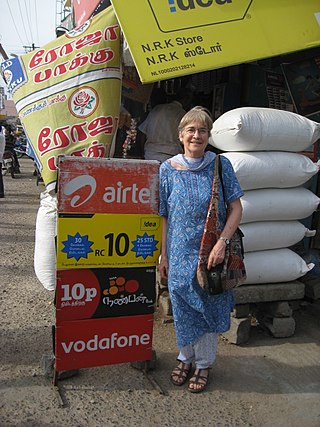
Barbara Harriss-White is an English economist and emeritus professor of development studies. She was trained in geography, agricultural science, agricultural economics and self-taught in development economics. In the 1990s, she helped to create the multi- and inter- disciplinary thematic discipline of development studies in Oxford Department of International Development; and in 2005-7 founded Oxford's Contemporary South Asia Programme. She has developed an approach to the understanding of Indian rural development and its informal economy, grounded in political economy and decades of what the economic anthropologist Polly Hill called ‘field economics’.

John Charles Harriss is an emeritus professor of international studies at Simon Fraser University, visiting faculty at the London School of Economics and Professorial Associate at SOAS. In 2017, Harris was elected a Fellow of the Royal Society of Canada.
Agrarian change is the process by which the political economy of the agrarian sector alters in some way. It involves changes in the social relations and dynamics of production, power relations in agrarian formations and ownership structures in the agricultural sector of an economy. The kind of dimensions covered in the study of this typically include not only technological and institutional forms such as agricultural productivity and farm-size and organisation; land reform; paths of capitalist transition; the politics of transnational agrarian social movements; the environmental contradictions of capitalist agriculture; global value chains and commodity certification schemes; the agrarian roots of violence and conflict; and migration and rural labour markets but also issues around gender, migration and rural labor markets, social differentiation and class formation.
References
- ↑ SOAS: Department of Economics: Professorial Research Associate Terry Byers
- ↑ http://www.blackwellpublishing.com/pdf/joac002.pdf Bernstein, H. and Byres, T. J. (2001), From Peasant Studies to Agrarian Change. Journal of Agrarian Change , 1: 1–56. (Accessed May 2011)
- ↑ Byres, Terence J., 1994. ‘The Journal of Peasant Studies: Its Origins and Some Reflections on the First Twenty Years’. In The Journal of Peasant Studies: A Twenty Volume Index 1973–1993, eds Henry Bernstein, Tom Brass and T.J. Byres, with Edward Lahiff and Gill Peace, 1–12. London: Frank Cass.
- ↑ Meliczek, Hans(1999), Book Reviews. Development and Change, 30: 381–406.
| International | |
|---|---|
| National | |
| Other | |
