
Fort Totten station is a Washington Metro station in northeastern Washington, D.C. It is one of the four major transfer points on the Metrorail system. It acts as a transfer point between the Green and Red Lines. It is the last station on the Green Line in the District of Columbia before heading into Maryland and the second to last for the Red Line. It is one of two stations with three levels, and is doubly unique in being the only multi-level transfer station built above ground and being the only such station to have island platforms on both levels, as opposed to just the lower level. The station's name comes from a Civil War-era fortification which itself was named after General Joseph Gilbert Totten, the Chief Engineer of the antebellum US Army.

Northeast is the northeastern quadrant of Washington, D.C., the capital of the United States. It encompasses the area located north of East Capitol Street and east of North Capitol Street.

Brookland, also known as Little Rome or Little Vatican, is a neighborhood located in the Northeast (NE) quadrant of Washington, D.C. Bounded by Fort Totten Metro Train tracks NE, and Brookland CUA Metro train tracks, Taylor Street NE, Rhode Island Avenue NE, South Dakota Avenue NE. It is best known for its numerous Catholic institutions, including schools, religious communities, shrines, institutes, and other organizations built and based around the Catholic University of America.
Trinidad is a neighborhood located in Ward 5, in the northeast quadrant of Washington, D.C., and is a largely residential area. Bounded by West Virginia Avenue NE, Florida Avenue NE, Mount Olivet Road NE, and Bladensburg Road NE

Neighborhoods in Washington, D.C., the capital of the United States, are distinguished by their history, culture, architecture, demographics, and geography. The names of 131 neighborhoods are unofficially defined by the D.C. Office of Planning. Neighborhoods can be defined by the boundaries of wards, historic districts, Advisory Neighborhood Commissions, civic associations, and business improvement districts (BIDs); these boundaries will overlap. The eight wards each elect a member to the Council of the District of Columbia and are redistricted every ten years.

Woodridge is a residential neighborhood located in Ward 5 of Northeast Washington, D.C. Woodridge is contained between Eastern Avenue N.E. to the east, Taylor Street N.E. to the north, South Dakota Avenue N.E. to the west, and Bladensburg Road N.E. to the south. Its central commercial strips are Rhode Island Avenue NE and Bladensburg Road N.E. Woodridge borders the adjacent neighborhoods of Brookland, Langdon, North Michigan Park, and Fort Lincoln in Northeast Washington D.C. In addition to these neighborhoods in the District of Columbia, Woodridge borders the city of Mount Rainier and town of Cottage City in Maryland. In terms of public transportation, residents of Woodridge have access to the Brookland-CUA and Rhode Island Avenue Metro stations.

Takoma, Washington, D.C., is a neighborhood in Washington, D.C. It is located in Advisory Neighborhood Commission 4B, in the District's Fourth Ward, within the northwest quadrant. It borders the city of Takoma Park, Maryland.

Massachusetts Avenue is a major diagonal transverse road in Washington, D.C., and the Massachusetts Avenue Historic District is a historic district that includes part of it.

Fort Totten is a neighborhood located in Ward 5 of Northeast Washington, D.C.

NoMa is a neighborhood of Washington, D.C., located in Ward 6 of the city. The neighborhood encompasses the region north of Massachusetts Avenue located north and east of Union Station. It includes the Sursum Corda, Eckington, and Near Northeast areas, as well as a section known as Swampoodle.

Queens Chapel is a mostly residential neighborhood with commercial elements located in Ward 5 of Northeast Washington, D.C.

Michigan Park is a neighborhood in Ward 5 of Northeast Washington, D.C. in the Upper Northeast area element. The boundaries of Michigan Park and North Michigan Park neighborhoods are contested due to the history of racial disparity between the two, but in general Michigan Park is considered to be contained between South Dakota Avenue to the west, Eastern Avenue to the east, Galloway Street NE to the north and Taylor Street NE to the South. Both neighborhoods are in DC Neighborhood Cluster 20 along with the University Heights neighborhood. Michigan Park is home to two established Civic Associations: the North Michigan Park Civic Association which has its established boundaries that include both Michigan Park which includes North Michigan Park are bounded by Taylor Street NE, Michigan Avenue NE, Fort Totten Metro Train Tracks, Gallatin Street NE, Eastern Avenue NE.

North Michigan Park is a neighborhood located in Ward 5 of Northeast Washington, D.C. North Michigan Park is contained between Eastern Avenue N.E. to the east, Gallatin Street N.E. to the north, Michigan Avenue N.E. to the south, and South Dakota Avenue N.E. to the west. North Michigan Park borders the neighborhoods of Michigan Park, Queens Chapel, and Woodridge, which also are located in Ward 5 of Northeast Washington D.C. In addition to these neighborhoods in Ward 5 of Northeast Washington D.C., North Michigan Park also borders the adjacent neighborhoods of Avondale and Chillum, which are both located in Prince George's County, Maryland. North Michigan Park neighborhood is often confused with the North Michigan Park Civic Association which has boundaries that include both North Michigan Park and Michigan Park. North Michigan Park and Michigan Park neighborhoods have been historically designated as separate neighborhoods because they were segregated by race. North Michigan Park was the less desirable neighborhood where African-Americans lived while Michigan Park was a much more desirable neighborhood where the neighborhood where their white counterparts lived. Both neighborhoods are separated from each other by South Dakota Avenue N.E. The Washington Metropolitan Area Green Line train tracks pass through the North Michigan Park neighborhood, notably, through a tunnel when traveling between the West Hyattsville and Fort Totten Metro Stations. The Washington Metropolitan Area Green Line train tracks initially are above ground when traveling between the West Hyattsville Metro Station and a certain portion of the neighborhood of Avondale. The Washington Metropolitan Area Green Line tracks then gradually enter a tunnel, which they use throughout the rest of the Avondale neighborhood, a small portion of the Chillum neighborhood, the North Michigan Park neighborhood, and Queens Chapel neighborhood before entering the lower level portion of the Fort Totten Metro Station, located below the Washington Metropolitan Area Red Line train tracks.
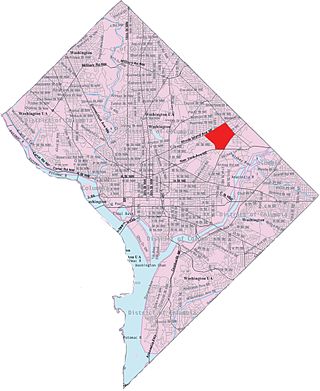
Langdon, is a neighborhood located in Ward 5 of Northeast Washington, D.C. Historical surveys of D.C. recognize Langdon as a neighborhood dating back to at least 1903. Langdon is bounded by Montana Ave. NE to the west/southwest, New York Ave. NE to the south, Bladensburg Rd. NE to the southeast, South Dakota Ave. NE to the northeast, and Rhode Island Ave. NE to the north/northwest. Langdon is adjacent to the Northeast D.C. neighborhoods of Brentwood (west), Woodridge (east), Fort Lincoln (southeast), Gateway (south), and Brookland (north).

Edgewood is a neighborhood located in Ward 5 of Northeast Washington, D.C. Edgewood is bounded by Michigan Avenue NE to the north, Rhode Island Avenue NE to the south, North Capitol Street to the west, and the Washington Metro's Red Line to the east. The eastern boundary originates with the establishment of the former Metropolitan Branch of the Baltimore and Ohio Railroad in 1873, creating the physical barrier which today separates Edgewood from Brookland to the east.
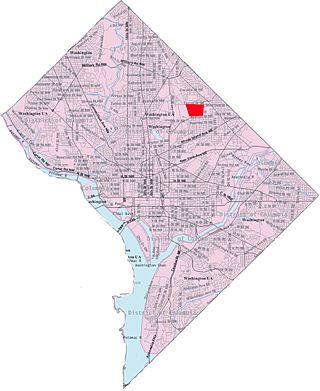
University Heights is a neighborhood adjacent to The Catholic University of America in Ward 5 of Northeast Washington, D.C. in the Upper Northeast area element. It is located east of the University and west of the Franciscan Monastery, bounded by the tracks for the Red Line of the Washington Metro to the west; 14th Street NE to the east; Taylor Street to the north; and Otis Street to the south. University Heights is in DC Neighborhood Cluster 20 along with the Michigan Park and North Michigan Park neighborhoods.

Pleasant Hill is a neighborhood located in Ward 5 of Northeast Washington, D.C. Pleasant Hill is contained between Allison Street NE and Bates Road NE to the north, Taylor Street NE to the south, the Washington Metropolitan Area Red Line tracks to the east, and North Capitol Street NW to the west. Pleasant Hill borders the adjacent neighborhoods of Fort Totten (north), North Michigan Park (northeast), Michigan Park (east), University Heights (south), Petworth (west), Brightwood Park (northwest), and Park View (southwest). It is adjacent to the Catholic University of America and even houses its athletic facilities. Pleasant Hill houses the Catholic University of America's soccer and football fields as well as its Raymond A. DuFour Athletic Center.
The North Central Freeway was a planned freeway in the District of Columbia that would have run from the Inner Loop in D.C. to the Capital Beltway (I-495) at Silver Spring.

The following outline is provided as an overview of and topical guide to the District of Columbia:


