英文互译镜像站

Sternula

Last updated

Sternula
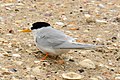
Sternula albifrons 2 - Little Swanport.jpg
Little tern
Scientific classification OOjs UI icon edit-ltr.svg
Kingdom: Animalia
Phylum: Chordata
Class: Aves
Order: Charadriiformes
Family: Laridae
Subfamily: Sterninae
Genus: Sternula
F. Boie, 1822
Type species
Sterna minuta Linnaeus, 1766= Sterna albifrons Pallas, 1764
Species

7, see text

Sternula is a genus of small white terns, with a global distribution along sheltered sandy coasts and large rivers.

Contents

Taxonomy

The genus Sternula was introduced in 1822 by the the German zoologist Friedrich Boie to accommodate a single species, Sterna minuta Linnaeus, 1766. [1] This scientific name is a junior synonym of Sterna albifrons Pallas, 1764, the little tern. [2] The genus name Sternula is a diminutive of Sterna that was introduced by Carl Linnaeus in 1758. [3]

The seven species are all closely related, with similar plumage and size, all are between 22–28 cm long and 39–63 g weight. All are pale grey above, and white or very pale grey below; in all the outer primaries are darker grey (to nearly blackish), but the number of primaries that are dark varies slightly between the species. Most have a distinctive head pattern in the breeding season, with a black crown and eyeline, and a white forehead; one (fairy tern) differs in lacking the black eye line, and one (Damara tern) has a fully black crown with no white forehead in the breeding season. The legs and bill are mostly yellow (with or without a black tip) in the breeding season, but black in Damara tern. In all species the winter plumage has a more extensive white forehead, the bill is black, and the legs darker red-brown to blackish. [4]

Although the genus was first described in 1822, the species in the genus were generally retained within the larger genus Sterna , the genus that holds most terns, until a study in 2005 showed that this treatment was paraphyletic, with these seven species less closely related to typical Sterna terns, than several other terns long treated in other genera like Chlidonias and Larosterna . [5]

Sternula diverged early from other terns about 16 million years ago, with only the very different noddies (Anous and Gygis), and the 'brown-backed' Onychoprion terns diverging earlier. [6] Despite the early origin of the genus, the current diversity within the genus is much more recent, with the species having a common ancestor around 4 million years ago. [6] Saunders's and least terns were both formerly considered to be subspecies of little tern. [4]

Species

The genus contains seven species: [7]

ImageCommon nameScientific nameDistribution
Damara Tern (8077271589) (cropped).jpg Damara tern Sternula balaenarumbreeds coastal Namibia to Cape Province; winters to northern Angola
New Zealand Fairy Tern on shell-beach (cropped).jpg Fairy tern Sternula nereisAustralia, New Caledonia, northern New Zealand
Charrancito Sternula albifrons 1.jpg Little tern Sternula albifrons SternulaAlbifronsIUCN.png
Yellow-billed tern Sternula superciliaris.jpg Yellow-billed tern Sternula superciliaris Sternula superciliaris map.svg
Peruvian Tern (cropped).JPG Peruvian tern Sternula lorata Sternula lorata map.svg
Saunders's Tern (Sternula saundersi) in flight, Jeddah, Saudi Arabia.jpg Saunders's tern Sternula saundersibreeds Red Sea and Persian Gulf to islands between India and Sri Lanka; winters mainly Seychelles to Maldives and Cocos Islands (Keeling) Islands
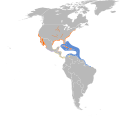
Least Tern RWD22.jpg Least tern Sternula antillarum Sternula antillarum map.svg

References

  1. Boie, Friedrich (1822). "Ueber Classification, insonderheit der europäischen Vogel". Isis von Oken (in German). Cols 545–564 [563].
  2. Dickinson, E.C.; Remsen, J.V. Jr., eds. (2013). The Howard & Moore Complete Checklist of the Birds of the World . Vol. 1: Non-passerines (4th ed.). Eastbourne, UK: Aves Press. p. 229. ISBN   978-0-9568611-0-8.
  3. Jobling, James A. "Sternula". The Key to Scientific Names. Cornell Lab of Ornithology. Retrieved 1 April 2026.
  4. 1 2 Burger, J.; Golchfeld, M. (1996). "Family Laridae (Gulls)" . In del Hoyo, J.; Elliott, A.; Sargatal, J. (eds.). Handbook of the Birds of the World. Vol. 3: Hoatzin to Auks. Barcelona, Spain: Lynx Edicions. pp. 572-623 [656-659]. ISBN   978-84-87334-20-7.
  5. Bridge, E.S.; Jones, A.W.; Baker, A.J. (2005). "A phylogenetic framework for the terns (Sternini) inferred from mtDNA sequences: implications for taxonomy and plumage evolution" (PDF). Molecular Phylogenetics and Evolution. 35 (2): 459–469. doi:10.1016/j.ympev.2004.12.010.
  6. 1 2 Černý, David; Natale, Rossy (2022). "Comprehensive taxon sampling and vetted fossils help clarify the time tree of shorebirds (Aves, Charadriiformes)". Molecular Phylogenetics and Evolution. 177 107620. doi: 10.1016/j.ympev.2022.107620 .
  7. AviList Core Team (2025). "AviList: The Global Avian Checklist, v2025". doi: 10.2173/avilist.v2025 . Retrieved 1 April 2026.
烟雨镜像程序 伪原创镜像站 递归网站下载 一键镜像站群 镜像软件