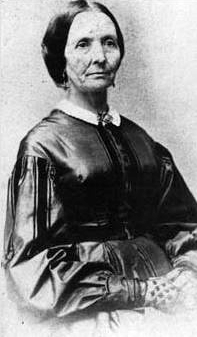
Eliza Roxey Snow was one of the most celebrated Latter-day Saint women of the nineteenth century. A renowned poet, she chronicled history, celebrated nature and relationships, and expounded scripture and doctrine. Snow was married to Joseph Smith as a plural wife, and was a plural wife to Brigham Young after Smith's death. Snow was the second general president of the Relief Society of the Church of Jesus Christ of Latter-day Saints, which she reestablished in the Utah Territory in 1866. She was also the older sister of Lorenzo Snow, the LDS Church's fifth president.

Pioneer Day is an official holiday celebrated on July 24 in the U.S. state of Utah, with some celebrations taking place in regions of surrounding states originally settled by Mormon pioneers. It commemorates the entry of Brigham Young and the first group of Mormon pioneers into the Salt Lake Valley on July 24, 1847, where the Latter-day Saints settled after being forced from Nauvoo, Illinois, and other locations in the eastern United States. Parades, fireworks, rodeos, and other festivities help commemorate the event. Similar to July 4, many local and all state-run government offices and many businesses are closed on Pioneer Day.

The Lion House is a large residence built in 1856 by Brigham Young, second president of the Church of Jesus Christ of Latter-day Saints, in Salt Lake City, Utah.
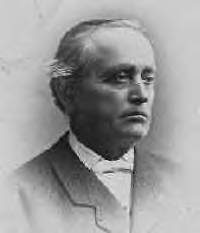
Erastus Snow was a member of the Quorum of the Twelve Apostles of the Church of Jesus Christ of Latter-day Saints from 1849 until his death. Snow was a leading figure in the Mormon colonization of Arizona, Colorado, and New Mexico.
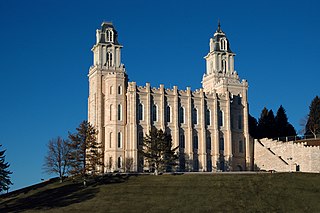
The Manti Utah Temple is the fifth constructed temple of the Church of Jesus Christ of Latter-day Saints. The temple construction was completed in 1888. Located in the city of Manti, Utah, it was the third Latter-day Saint temple built west of the Mississippi River, after the Mormon pioneers trekked west. The Manti Temple was designed by William Harrison Folsom, who moved to Manti while the temple was under construction. The temple dominates the Sanpete Valley and can be seen from many miles. Like all Latter-day Saint temples, only church members in good standing may enter. It was previously one of only two remaining Latter-day Saint temples in the world where live portrayal was used in the endowment ceremony. All other temples use a film in the presentation of the endowment, a practice that will also be used in Manti beginning in 2024 following renovation. It is an early pioneering example of four rooms representing the journey of life.

The Mormon Pioneer Cemetery is located at 3300 State Street in present-day Florence at the north end of Omaha, Nebraska. The Cemetery is the burial site of hundreds of Mormon pioneers who lived in Winter Quarters, a temporary settlement that lasted from 1846 to 1848 as the settlers moved to Salt Lake City, Utah. It was designated a landmark by the City of Omaha in 1990.

Avard Tennyson Fairbanks was a 20th-century American sculptor. Over his eighty-year career, he sculpted over 100 public monuments and hundreds of artworks. Fairbanks is known for his religious-themed commissions for the Church of Jesus Christ of Latter-day Saints including the Three Witnesses, Tragedy of Winter Quarters, and several Angel Moroni sculptures on spires of the church's temples. Additionally, Fairbanks sculpted over a dozen Abraham Lincoln-themed sculptures and busts among which the most well-known reside in the U.S. Supreme Court Building and Ford's Theatre Museum.
Ortho Rollin Fairbanks was one of many members of the Fairbanks family who have been prominent artists.

The Eagle Gate monument is a historical monument—more in the form of an arch than a gate—seventy-six feet across, situated at the intersection of State Street at South Temple, adjacent to Temple Square, in Salt Lake City, Utah.

The Mormon Pioneer Memorial Monument is a private cemetery and memorial. It is the burial site of Brigham Young and several of his wives and children. Part of the property was dedicated to the Mormon pioneers who died making the journey to Utah from Illinois and other parts of the world between 1847 and 1869.
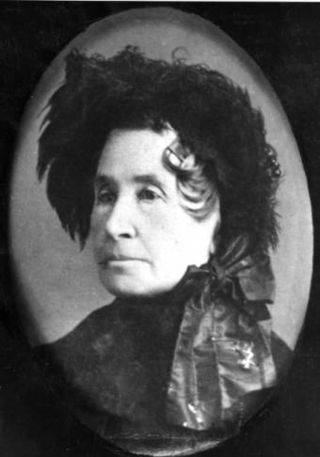
Hannah Dorcas Tapfield King was a 19th-century British-born American writer and pioneer. After converting to the Church of Jesus Christ of Latter-day Saints in England in 1850, her family emigrated to Utah in 1853 where she became endeared to the people of that state. She was the author of Songs of the Heart, several poems, and writings addressed to young readers. She was the last of 56 women sealed to Brigham Young. She died in 1886.
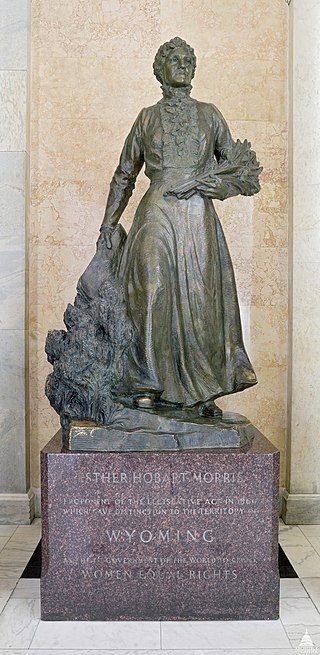
Esther Hobart Morris is a bronze sculpture depicting the first woman justice of the peace in the United States by Avard Fairbanks.

A statue of Thomas L. Kane by Ortho R. Fairbanks is installed outside the Utah State Capitol in Salt Lake City, in the U.S. state of Utah.
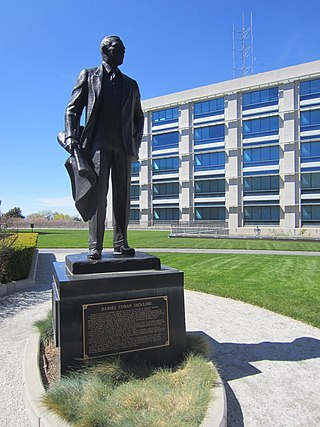
A bronze statue of Daniel C. Jackling by Avard Fairbanks is installed outside the Utah State Capitol in Salt Lake City, in the U.S. state of Utah.
Priesthood Restoration is a 1957 bronze sculpture by Avard Fairbanks, installed in Salt Lake City’s Temple Square, in the U.S. state of Utah.

The Nauvoo Bell, also known as the Relief Society Memorial Campanile, is a bell tower in Salt Lake City's Temple Square, in the U.S. state of Utah.

An eight ft (2.4 m) bronze sculpture of Vasilios Priskos by Daniel Fairbanks is installed in Salt Lake City, Utah, United States.

The Pioneer Memorial Museum is in Salt Lake City, Utah, United States and is operated by the Daughters of Utah Pioneers.

Ever Pressing Forward is a bronze sculpture installed on the exterior east side of the Pioneer Memorial Museum in Salt Lake City, Utah. It was sculpted by Karl Alfred Quilter (1929-2013) in 2001. Across the street is the associated Lest We Forget monument and plaque are on the southwest grounds of the Utah State Capitol Building.


