
Carl Lee Perkins was an American guitarist, singer and songwriter. A rockabilly great and pioneer of rock and roll, he began his recording career at the Sun Studio, in Memphis, beginning in 1954. Among his best-known songs are "Blue Suede Shoes", "Honey Don't", "Matchbox" and "Everybody's Trying to Be My Baby".
The story of Tennessee's contribution to American music is essentially the story of three cities: Nashville, Memphis, and Bristol. While Nashville is most famous for its status as the long-time capital of country music, Bristol is recognized as the "Birthplace of Country Music". Memphis musicians have had an enormous influence on blues, early rock and roll, R&B, and soul music, as well as an increasing presence in rap.

Yodeling is a form of singing which involves repeated and rapid changes of pitch between the low-pitch chest register and the high-pitch head register or falsetto. The English word yodel is derived from the German word jodeln, meaning "to utter the syllable jo". This vocal technique is used in many cultures worldwide. Recent scientific research concerning yodeling and non-Western cultures suggests that music and speech may have evolved from a common prosodic precursor.
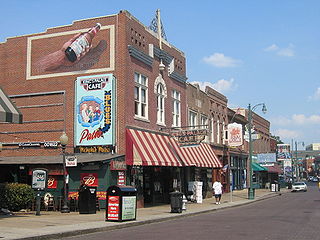
Beale Street is a street in Downtown Memphis, Tennessee, which runs from the Mississippi River to East Street, a distance of approximately 1.8 miles (2.9 km). It is a significant location in the city's history, as well as in the history of blues music. Today, the blues clubs and restaurants that line Beale Street are major tourist attractions in Memphis. Festivals and outdoor concerts frequently bring large crowds to the street and its surrounding areas.
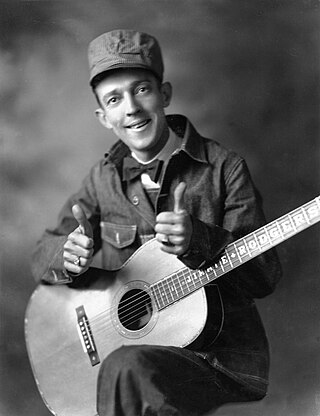
James Charles Rodgers was an American singer-songwriter and musician who rose to popularity in the late 1920s. Widely regarded as the "Father of Country Music", he is best known for his distinctive yodeling. Rodgers was known as "The Singing Brakeman" and "America's Blue Yodeler". He has been cited as an inspiration by many artists, and he has been inducted into multiple halls of fame.

Sun Studio is a recording studio opened by rock-and-roll pioneer Sam Phillips at 706 Union Avenue in Memphis, Tennessee, on January 3, 1950. It was originally called Memphis Recording Service, sharing the same building with the Sun Records label business. The Sun label that was housed within the studio played a large role in Elvis Presley's early career.

Same Train, A Different Time is the ninth studio album by American country music artist Merle Haggard backed by The Strangers, released in 1969, featuring covers of songs by legendary country music songwriter Jimmie Rodgers. It was originally released as a 2 LP set on Capitol (SWBB-223).
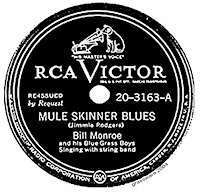
"Blue Yodel no. 8, Mule Skinner Blues" is a classic country song written by Jimmie Rodgers. The song was first recorded by Rodgers in 1930 and has been recorded by many artists since then, acquiring the de facto title "Mule Skinner Blues" after Rodgers named it "Blue Yodel #8".
"In the Jailhouse Now" is an American novelty blues song originally found in vaudeville performances from the early 20th century, The earliest known version was written in 1915 by Davis and Stafford. It later became associated with Jimmie Rodgers, by way of the yodeling country music versions he recorded in 1928 and 1930, and has been extensively covered in the subsequent years, often giving songwriting credit to Rodgers. The song's first two verses trace the exploits of Ramblin’ Bob, who cheats at cards and gets caught, while the final verse tells about taking a girl named Susie out on the town and winding up in jail together.
This is a list of notable events in country music that took place in the year 1933.
The blue yodel songs are a series of thirteen songs written and recorded by Jimmie Rodgers during the period from 1927 to his death in May 1933. The songs were based on the 12-bar blues format and featured Rodgers’ trademark yodel refrains. The lyrics often had a risqué quality with "a macho, slightly dangerous undertone." The original 78 issue of "Blue Yodel No. 1 " sold more than a half million copies, a phenomenal number at the time. The term "blue yodel" is also sometimes used to differentiate the earlier Austrian yodeling from the American form of yodeling introduced by Rodgers.
The first season of the Theme Time Radio Hour, hosted by Bob Dylan, ran from May 3, 2006, to April 18, 2007 on XM Satellite Radio for a total of 50 shows.
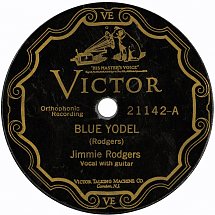
"Blue Yodel No. 1 " is a song by American singer-songwriter Jimmie Rodgers. The recording was produced by Ralph Peer, who had originally recorded with Rodgers during the Bristol Sessions. It was released by the Victor Talking Machine Company on February 3, 1928. Rodgers recorded it during his second session with Victor, on November 30, 1927.
The Mojo Triangle, a geographical and cultural area located within a triangular connection between New Orleans, Nashville and Memphis, is the birthplace of country, blues, jazz, and rock and roll. The Mojo Triangle has creative artists, not just in music, but also in literature and films.

"Waiting for a Train" is a song written and recorded by Jimmie Rodgers and released by the Victor Talking Machine Company as the flipside of "Blue Yodel No. 4" in February 1929. The song originated in the nineteenth century in England. It later appeared in several song books, with variations on the lyrics throughout the years.
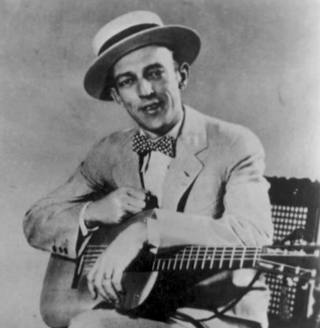
The discography of Jimmie Rodgers is composed of 111 songs that spanned the blues, jazz and country music genres. His first recording was made on August 4, 1927, during the Bristol sessions. The sessions were organized by Ralph Peer, who became Rodgers' main producer. Rodgers enjoyed success. At the height of his career, he made US $75,000 in royalties in 1929. After the Great Depression, his sales dropped to US$60,000. His last recording session took place in New York City on May 24, 1933. Rodgers died two nights later at the Taft Hotel after years of suffering from tuberculosis.

The Singing Brakeman is a 1929 short film, starring Jimmie Rodgers, and released by Columbia-Victor Gems. Rodgers sings three of his songs: "Waiting for a Train", "Daddy and Home" and "Blue Yodel".
Blue yodeling is a musical style that essentially consists of a combination of elements of blues and old-time music, enriched with characteristic yodelings. Initially sometimes referred to as yodeling blues, it reached its greatest popularity during the 1920s and 1930s in the United States, Canada and Australia.


