
Tata Institute of Fundamental Research (TIFR) is an Indian Research Institute under the Department of Atomic Energy of the Government of India. It is a public deemed university located at Navy Nagar, Colaba in Mumbai. It also has campus in Bangalore, International Centre for Theoretical Sciences (ICTS), and an affiliated campus in Serilingampally near Hyderabad. TIFR conducts research primarily in the natural sciences, the biological sciences and theoretical computer science.

Obaid Siddiqi FRS was an Indian National Research Professor and the Founder-Director of the Tata Institute of Fundamental Research (TIFR) National Center for Biological Sciences. He made seminal contributions to the field of behavioural neurogenetics using the genetics and neurobiology of Drosophila.
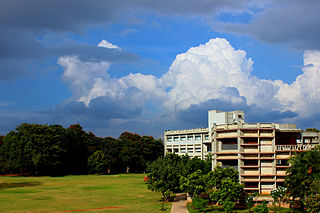
National Centre for Biological Sciences (NCBS) in Bangalore, Karnataka, is a research centre specialising in biological research. It is a part of the Tata Institute of Fundamental Research (TIFR) under the Department of Atomic Energy of the Government of India. The mandate of NCBS is basic and interdisciplinary research in the frontier areas of biology. The research interests of the faculty are in four broad areas ranging from the study of single molecules to systems biology. Obaid Siddiqi FRS was an Indian National Research Professor and the Founder-Director of NCBS. He made seminal contributions to the field of behavioural neurogenetics using the genetics and neurobiology of Drosophila.
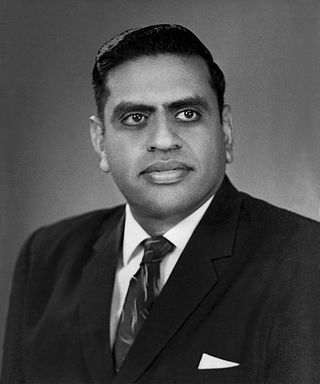
Alladi Ramakrishnan was an Indian physicist and the founder of the Institute of Mathematical Sciences (Matscience) in Chennai. He made contributions to stochastic process, particle physics, algebra of matrices, special theory of relativity and quantum mechanics.

Nagarjuna G. works in the Homi Bhabha Centre for Science Education, Tata Institute of Fundamental Research in Mumbai, India. His major research interests include Science Education, Cognitive Science, History and Philosophy of Science and Structure and Dynamics of Knowledge. As an activist he focuses on promoting free knowledge and free software and serves as the chairperson of Free Software Foundation of India.

Dr. Krishnaswamy VijayRaghavan is an emeritus professor and former director of the National Centre for Biological Sciences. On 26 March 2018, the Government of India appointed him as the principal scientific adviser to succeed Dr. R Chidamabaram. His term as Principal Scientific Adviser ended on April 2, 2022. In 2012, he was elected a fellow of The Royal Society and in April 2014 he was elected as a foreign associate of the US National Academy of Sciences. He was conferred the Padma Shri on 26 January 2013 and is also a recipient of the Infosys Prize in the life sciences category in 2009.
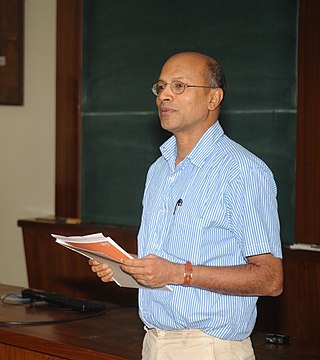
Dipendra Prasad is an Indian mathematician. He is a professor of mathematics at the Indian Institute of Technology Bombay. He is a number theorist known for his work in the areas of automorphic representations and the Gan–Gross–Prasad conjecture. He is currently the president of Commission for Developing Countries (CDC) of International Mathematics Union (2018–2022) and of Indian Math Society (2021–2022).

Vasudevan Srinivas is an Indian mathematician working in algebraic geometry. He is a Distinguished Professor in the School of Mathematics Tata Institute of Fundamental Research, Mumbai. Srinivas is an elected Fellow of the Third World Academy of Sciences, American Mathematical Society, Indian National Science Academy, and the Indian Academy of Sciences.
Yamuna Krishnan is a professor at the Department of Chemistry, University of Chicago, where she has worked since August 2014. She was born to P.T. Krishnan and Mini in Parappanangadi, in the Malappuram district of Kerala, India. She was earlier a Reader in National Centre for Biological Sciences, Tata Institute of Fundamental Research, Bangalore, India. Krishnan won the Shanti Swarup Bhatnagar Prize for science and technology, the highest science award in India in the year 2013 in the Chemical Science category.
Roop Mallik is an Indian biophysicist who works on nanoscale molecular motor proteins that transport material such as viruses, mitochondria, endosomes etc. inside living cells. The motors, such as kinesin and dynein generate forces of pico-newton order to carry our various cellular processes namely cell division, vesicular transport, endocytosis, molecular tethering etc. His lab is working to understand how motor proteins help in degradation and clearance of pathogens, and also how these motors work inside the liver to maintain systemic lipid homeostasis in the animal. Mallik is currently a professor at the Department of Biosciences and Bioengineering, Indian Institute of Technology Bombay.
Veronica Filomena Rodrigues (1953–2010) was a Kenyan born Indian biologist. Veronica completed a B.A with honors in microbiology from Trinity College Dublin. After being inspired by the work of Obaid Siddiqi and his co-workers, she moved to India to pursue her Ph.D. While doing her PhD, considering her exceptional work, she was offered a permanent faculty position at TIFR. She also served as a senior professor at the National Centre for Biological Sciences, Bangalore. In 2004 she received the Senior National Woman Bioscientist Award. She died in 2010 after suffering from breast cancer for five years.

Professor Ramakrishna Vijayacharya Hosur is an Indian biophysical scientist, known for his expertise in the areas of nuclear magnetic resonance and molecular biophysics. The Government of India honoured him, in 2014, by awarding him the Padma Shri, the fourth highest civilian award, for his contributions to the fields of science and technology.
Rangaswamy Narasimhan was an Indian computer and cognitive scientist, regarded by many as the father of computer science research in India. He led the team which developed the TIFRAC, the first Indian indigenous computer and was instrumental in the establishment of CMC Limited in 1975, a Government of India company, later bought by Tata Consultancy Services. He was a recipient of the fourth highest Indian civilian award of Padma Shri from the Government of India in 1977.
Vadapalli Chandrasekhar is an Indian inorganic and organometallic chemist and is currently a distinguished professor and the centre director of the Tata Institute of Fundamental Research Hyderabad. He is known for his studies on the chemistry of inorganic clusters and rings and is an elected fellow of the Indian National Science Academy National Academy of Sciences, India, The World Academy of Sciences and the Indian Academy of Sciences The Council of Scientific and Industrial Research, the apex agency of the Government of India for scientific research, awarded him the Shanti Swarup Bhatnagar Prize for Science and Technology, one of the highest Indian science awards, in 2003, for his contributions to chemical sciences.
Sudhanshu Shekhar Jha is an Indian condensed matter physicist and a former director of Tata Institute of Fundamental Research. Known for his research in optoelectronics, Jha is an elected fellow of all the three major Indian science academies – Indian National Science Academy, National Academy of Sciences, India and Indian Academy of Sciences – as well as of The World Academy of Sciences and American Physical Society. The Council of Scientific and Industrial Research, the apex agency of the Government of India for scientific research, awarded Jha the Shanti Swarup Bhatnagar Prize for Science and Technology, one of the highest Indian science awards, for his contributions to Physical Sciences in 1979.
Narendra Kumar was an Indian theoretical physicist and a Homi Bhaba Distinguished Professor of the Department of Atomic Energy at Raman Research Institute. He was also an honorary professor at Jawaharlal Nehru Centre for Advanced Scientific Research.
Echur Varadadesikan Sampathkumaran is an Indian condensed matter physicist and a Distinguished Professor at the Tata Institute of Fundamental Research. Known for his research on the thermal and transport behaviour of magnetic systems, Sampathkumaran is an elected fellow of all the three major Indian science academies viz. Indian Academy of Sciences, Indian National Science Academy and National Academy of Sciences, India as well as The World Academy of Sciences. The Council of Scientific and Industrial Research, the apex agency of the Government of India for scientific research, awarded him the Shanti Swarup Bhatnagar Prize for Science and Technology, one of the highest Indian science awards, for his contributions to physical sciences in 1999.
Gattamraju Ravindra Kumar is an Indian laser physicist and a senior professor of Nuclear and Atomic Physics at Tata Institute of Fundamental Research. Known for his research on Ultrashort pulse and Warm dense matter, Kumar is an elected fellow of the Indian Academy of Sciences and the Indian National Science Academy. The Council of Scientific and Industrial Research, the apex agency of the Government of India for scientific research, awarded him the Shanti Swarup Bhatnagar Prize for Science and Technology, one of the highest Indian science awards, for his contributions to physical sciences in 2003. He is also a recipient of the B. M. Birla Science Prize and Infosys Prize.
Balajapalli Sriram Shastry is an Indian-American condensed matter physicist, specializing in strongly-correlated Fermi systems, quantum integrable systems, and statistical mechanics.


