Achondroplasia is a genetic disorder with an autosomal dominant pattern of inheritance whose primary feature is dwarfism. It is the most common cause of dwarfism and affects about 1 in 27,500 people. In those with the condition, the arms and legs are short, while the torso is typically of normal length. Those affected have an average adult height of 131 centimetres for males and 123 centimetres (4 ft) for females. Other features can include an enlarged head with prominent forehead and underdevelopment of the midface. Complications can include sleep apnea or recurrent ear infections. Achondroplasia includes the extremely rare short-limb skeletal dysplasia with severe combined immunodeficiency.

Achondrogenesis, type 2 is an uncommon skeletal dysplasia that is autosomal dominant and occurs at a frequency of approximately 0.2 per 100,000 births. Also known by the name Langer-Saldino achondrogenesis, it is one of the fatal short-limbed dwarfisms linked to structural mutations in type II collagen.
Spondyloepimetaphyseal dysplasia, Strudwick type is an inherited disorder of bone growth that results in dwarfism, characteristic skeletal abnormalities, and problems with vision. The name of the condition indicates that it affects the bones of the spine (spondylo-) and two regions near the ends of bones. This type was named after the first reported patient with the disorder. Spondyloepimetaphyseal dysplasia, Strudwick type is a subtype of type II collagenopathies.

Collagen, type II, alpha 1 , also known as COL2A1, is a human gene that provides instructions for the production of the pro-alpha1(II) chain of type II collagen.

Autosomal recessive multiple epiphyseal dysplasia (ARMED), also called epiphyseal dysplasia, multiple, 4 (EDM4), multiple epiphyseal dysplasia with clubfoot or –with bilayered patellae, is an autosomal recessive congenital disorder affecting cartilage and bone development. The disorder has relatively mild signs and symptoms, including joint pain, scoliosis, and malformations of the hands, feet, and knees.
An osteochondrodysplasia, or skeletal dysplasia, is a disorder of the development of bone and cartilage. Osteochondrodysplasias are rare diseases. About 1 in 5,000 babies are born with some type of skeletal dysplasia. Nonetheless, if taken collectively, genetic skeletal dysplasias or osteochondrodysplasias comprise a recognizable group of genetically determined disorders with generalized skeletal affection. These disorders lead to disproportionate short stature and bone abnormalities, particularly in the arms, legs, and spine. Skeletal dysplasia can result in marked functional limitation and even mortality.

Multiple epiphyseal dysplasia (MED), also known as Fairbank's disease, is a rare genetic disorder that affects the growing ends of bones. Long bones normally elongate by expansion of cartilage in the growth plate near their ends. As it expands outward from the growth plate, the cartilage mineralizes and hardens to become bone (ossification). In MED, this process is defective.

Pseudoachondroplasia is an inherited disorder of bone growth. It is a genetic autosomal dominant disorder. It is generally not discovered until 2–3 years of age, since growth is normal at first. Pseudoachondroplasia is usually first detected by a drop of linear growth in contrast to peers, a waddling gait or arising lower limb deformities.

Cartilage oligomeric matrix protein (COMP), also known as thrombospondin-5, is an extracellular matrix (ECM) protein primarily present in cartilage. In humans it is encoded by the COMP gene.

Matrilin-3 is a protein that in humans is encoded by the MATN3 gene. It is linked to the development of many types of cartilage, and part of the Matrilin family, which includes Matrilin-1, Matrilin-2, Matrilin-3, and Matrilin-4, a family of filamentous-forming adapter oligomeric extracellular proteins that are linked to the formation of cartilage and bone, as well as maintaining homeostasis after development. It is considered an extracellular matrix protein that functions as an adapter protein where the Matrilin-3 subunit can form both homo-tetramers and hetero-oligomers with subunits from Matrilin-1 which is the cartilage matrix protein. This restricted tissue has been strongly expressed in growing skeletal tissue as well as cartilage and bone.
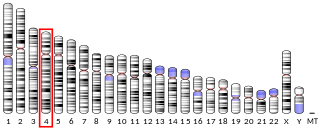
NK3 homeobox 2 also known as NKX3-2 is a human gene. It is a homolog of bagpipe (bap) in Drosophila and therefore also known as Bapx1. The protein encoded by this gene is a homeodomain containing transcription factor.
Parastremmatic dwarfism is a rare bone disease that features severe dwarfism, thoracic kyphosis, a distortion and twisting of the limbs, contractures of the large joints, malformations of the vertebrae and pelvis, and incontinence. The disease was first reported in 1970 by Leonard Langer and associates; they used the term parastremmatic from the Greek parastremma, or distorted limbs, to describe it. On X-rays, the disease is distinguished by a "flocky" or lace-like appearance to the bones. The disease is congenital, which means it is apparent at birth. It is caused by a mutation in the TRPV4 gene, located on chromosome 12 in humans. The disease is inherited in an autosomal dominant manner.
Liebenberg syndrome is a rare autosomal genetic disease that involves a deletion mutation upstream of the PITX1 gene, which is one that's responsible for the body's organization, specifically in forming lower limbs. In animal studies, when this deletion was introduced to developing birds, their wing buds were noted to take on limb-like structures.
Eiken syndrome, also known as "Eiken skeletal dysplasia", is a rare autosomal bone dysplasia with a skeletal phenotype which has been described in a unique consanguineous family, where it segregates as a recessive trait. First described in 1985, the syndrome primarily affects the development of bones, leading to short stature, long limbs, and joint dislocations. Eiken syndrome is caused by mutations in the PTH1R gene, located on chromosome 3, and is involved in skeletal development.
Acromesomelic dysplasia is a rare skeletal disorder that causes abnormal bone and cartilage development, leading to shortening of the forearms, lower legs, hands, feet, fingers, and toes. Five different genetic mutations have been implicated in the disorder. Treatment is individualized but is generally aimed at palliating symptoms, for example, treatment of kyphosis and lumbar hyperlordosis.
Dysosteosclerosis (DSS), also known as autosomal recessive dysosteosclerosis or X-linked recessive dysosteosclerosis, is a rare osteoclast-poor form of osteosclerosis that is presented during infancy and early childhood, characterized by progressive osteosclerosis and platyspondyly. Platyspondyly and other skeletal abnormalities are radiographic features of the disease which distinguish DSS from other osteosclerotic disorders. Patients usually experience neurological and psychological deterioration, therefore patients are commonly associated with delayed milestones.
Spondyloepimetaphyseal dysplasia-short limb-abnormal calcification syndrome is a rare genetic disorder which is characterized by osseous anomalies resulting in short stature and other afflictions.
Schneckenbecken dysplasia is a rare pre-natally fatal hereditary autosomal recessive condition which affects the bones and pre-natal growth.
SOFT syndrome, also known for the name its acronym originates from: Short stature-onychodysplasia-facial dysmorphism-hypotrichosis syndrome, is a rare genetic disorder characterized by the presence of short stature, underdeveloped nails, facial dysmorphisms, and hair sparcity across the body. It is caused by homozygous, autosomal recessive mutations in the POC1A gene, located in the short arm of chromosome 3. Fewer than 15 cases have been described in the medical literature.
Spondyloenchondrodysplasia is the medical term for a rare spectrum of symptoms that are inherited following an autosomal recessive inheritance pattern. Skeletal anomalies are the usual symptoms of the disorder, although its phenotypical nature is highly variable among patients with the condition, including symptoms such as muscle spasticity or thrombocytopenia purpura. It is a type of immunoosseous dysplasia.

