
Jakarta EE, formerly Java Platform, Enterprise Edition and Java 2 Platform, Enterprise Edition (J2EE), is a set of specifications, extending Java SE with specifications for enterprise features such as distributed computing and web services. Jakarta EE applications are run on reference runtimes, which can be microservices or application servers, which handle transactions, security, scalability, concurrency and management of the components they are deploying.
A web service (WS) is either:
Transport Layer Security (TLS) is a cryptographic protocol designed to provide communications security over a computer network, such as the Internet. The protocol is widely used in applications such as email, instant messaging, and voice over IP, but its use in securing HTTPS remains the most publicly visible.
Messaging Application Programming Interface (MAPI) is an API for Microsoft Windows which allows programs to become email-aware. While MAPI is designed to be independent of the protocol, it is usually used to communicate with Microsoft Exchange Server.
Web development is the work involved in developing a website for the Internet or an intranet. Web development can range from developing a simple single static page of plain text to complex web applications, electronic businesses, and social network services. A more comprehensive list of tasks to which Web development commonly refers, may include Web engineering, Web design, Web content development, client liaison, client-side/server-side scripting, Web server and network security configuration, and e-commerce development.
REST is a software architectural style that was created to guide the design and development of the architecture for the World Wide Web. REST defines a set of constraints for how the architecture of a distributed, Internet-scale hypermedia system, such as the Web, should behave. The REST architectural style emphasises uniform interfaces, independent deployment of components, the scalability of interactions between them, and creating a layered architecture to promote caching to reduce user-perceived latency, enforce security, and encapsulate legacy systems.

A web API is an application programming interface (API) for either a web server or a web browser. As a web development concept, it can be related to a web application's client side. A server-side web API consists of one or more publicly exposed endpoints to a defined request–response message system, typically expressed in JSON or XML by means of an HTTP-based web server. A server API (SAPI) is not considered a server-side web API, unless it is publicly accessible by a remote web application.

Network Security Services (NSS) is a collection of cryptographic computer libraries designed to support cross-platform development of security-enabled client and server applications with optional support for hardware TLS/SSL acceleration on the server side and hardware smart cards on the client side. NSS provides a complete open-source implementation of cryptographic libraries supporting Transport Layer Security (TLS) / Secure Sockets Layer (SSL) and S/MIME. NSS releases prior to version 3.14 are tri-licensed under the Mozilla Public License 1.1, the GNU General Public License, and the GNU Lesser General Public License. Since release 3.14, NSS releases are licensed under GPL-compatible Mozilla Public License 2.0.
An open API is a publicly available application programming interface that provides developers with programmatic access to a software application or web service. Open APIs are APIs that are published on the internet and are free to access by consumers.
Gears, formerly Google Gears, is a discontinued utility software offered by Google to create more powerful web apps by adding offline storage and other additional features to web browsers. Released under the BSD license, Gears is free and open-source. Gears was conceived at a time when a comparable alternative was not available. However, Gears was discontinued in favor of the standardized HTML5 methods that eventually became prevalent.
Web storage, sometimes known as DOM storage, is a standard JavaScript API provided by web browsers. It enables websites to store persistent data on users' devices similar to cookies, but with much larger capacity and no information sent in HTTP headers. There are two main web storage types: local storage and session storage, behaving similarly to persistent cookies and session cookies respectively. Web Storage is standardized by the World Wide Web Consortium (W3C) and WHATWG, and is supported by all major browsers.
The W3C Geolocation API is an effort by the World Wide Web Consortium (W3C) to standardize an interface to retrieve the geographical location information for a client-side device. It defines a set of objects, ECMAScript standard compliant, that executing in the client application give the client's device location through the consulting of Location Information Servers, which are transparent for the application programming interface (API). The most common sources of location information are IP address, Wi-Fi and Bluetooth MAC address, radio-frequency identification (RFID), Wi-Fi connection location, or device Global Positioning System (GPS) and GSM/CDMA cell IDs. The location is returned with a given accuracy depending on the best location information source available.

WebGL is a JavaScript API for rendering interactive 2D and 3D graphics within any compatible web browser without the use of plug-ins. WebGL is fully integrated with other web standards, allowing GPU-accelerated usage of physics, image processing, and effects in the HTML canvas. WebGL elements can be mixed with other HTML elements and composited with other parts of the page or page background.
SPDY is an obsolete open-specification communication protocol developed for transporting web content. SPDY became the basis for HTTP/2 specification. However, HTTP/2 diverged from SPDY and eventually HTTP/2 subsumed all usecases of SPDY. After HTTP/2 was ratified as a standard, major implementers, including Google, Mozilla, and Apple, deprecated SPDY in favor of HTTP/2. Since 2021, no modern browser supports SPDY.
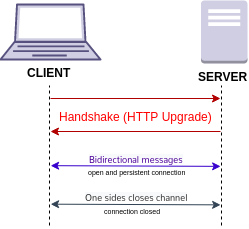
WebSocket is a computer communications protocol, providing a simultaneous two-way communication channel over a single Transmission Control Protocol (TCP) connection. The WebSocket protocol was standardized by the IETF as RFC 6455 in 2011. The current specification allowing web applications to use this protocol is known as WebSockets. It is a living standard maintained by the WHATWG and a successor to The WebSocket API from the W3C.
WebRTC is a free and open-source project providing web browsers and mobile applications with real-time communication (RTC) via application programming interfaces (APIs). It allows audio and video communication and streaming to work inside web pages by allowing direct peer-to-peer communication, eliminating the need to install plugins or download native apps.

Internet Explorer 11 (IE11) is the eleventh and final version of the Internet Explorer web browser. It was initially included in the release of Windows 8.1, Windows RT 8.1 and Windows Server 2012 R2 on October 17, 2013, and was later released for Windows 7 and Windows Server 2008 R2 on November 7, 2013. It is the successor to Internet Explorer 10, released the previous year, and was the original, default browser in Windows 8.1 and Windows Server 2012 R2. Internet Explorer 11 was also included in the release of Windows 10 on July 29, 2015, as well as in Windows Server 2016 and Windows Server 2019. On April 16, 2019, Internet Explorer 11 was made available to Windows Server 2012 and Windows Embedded 8 Standard, the only still supported edition of Windows 8 as the final expansion of Internet Explorer 11 availability. Internet Explorer 11, like its predecessor, is not available for Windows 8, Windows Vista, Windows Server 2008, and earlier versions of Windows and Windows Server.

Progress Telerik Test Studio is a Windows-based software test automation tool for web and desktop that supports functional testing, software performance testing, load testing and RESTful API testing developed by Telerik. The tool ships with a plugin for Visual Studio and a standalone app that use the same repositories and file formats. Test Studio supports HTML, AJAX, Silverlight, ASP.NET MVC, JavaScript, WPF, Angular, React, ASP.NET AJAX, ASP.NET Core, and Blazor. Any application that runs on .NET 5, .NET Core, .NET 6 or higher can be automated with Test Studio. Test Studio supports cross-browser testing for Internet Explorer, Firefox, Microsoft Edge, and Chrome.

