 |
Shadi A. Karam (born 1948) is a Lebanese businessperson and banker. He is a pioneer in microcredit lending.
|
Shadi A. Karam (born 1948) is a Lebanese businessperson and banker. He is a pioneer in microcredit lending.
Shadi A. Karam was born on September 16, 1948, in Lebanon.[ citation needed ] Karam received degrees from the American University of Beirut (AUB), Columbia University, and Harvard University.[ when? ][ citation needed ]
In his primary professional capacity, he is known as a specialist in the restructuring of organizations and distressed companies, [1] most notably occupying the post of Financial Adviser to the Director General of UNESCO and serving as a Chairman and CEO of several major companies in Europe and the Middle East in various sectors, ranging from industry to real estate development, hotels, trading and financial services. [2]
Karam was the lead principal in the restructuring and modernization of the Real Estate Bank of Syria, a State-owned bank, in 1996-1997 and the successful turn around of Lebanon's BLC Bank, [3] one of the major commercial banks of Lebanon which had to be taken over by the Central Bank of Lebanon in 2002. [4] He also played a key role in the modernization of the banking sector in Syria in general, [5] its liberalization and its opening to international financial markets - an effort he was able to press further as CEO [6] of Souria Holdings, [7] the second largest investment company in the country and the first in Syria to implement the Public Private Partnership model. [8] [9] He resigned from Souria Holding and left Syria in 2010 in the very early phases of the Syrian unrest which turned into the Syria's internal strife. Some critics have argued, however, that despite the multiple efforts of Syrian, Lebanese and foreign institutions like the EU, the economic reforms introduced by President Bashar Al-Assad in the early years of his ascension as head of state in 2000 have had a far more limited impact than promised and may have even precipitated the unrest and protests that began in the Spring of 2011 and later developed into the Syrian Civil War. [10]
Among other aspects of his career, he has taught Economics, Finance and Banking at several universities, such as Harvard University, The University of Southern Europe, and the Institut des Etudes Politiques – IEP. [11] He was the Chairman of ASTRO Bank, Cyprus, formerly known as Piraeus Bank, which he resigned from in December 2021 [12] He is also the Vice Chairman of the International Chamber of Commerce Lebanon national committee.
Prior to this role, [13] Karam served as the Special Adviser to the President of the Republic of Lebanon, Michel Suleiman for the duration of his six-year mandate and as Senior Adviser to Prime Minister Tammam Salam during the critical period of presidential vacancy in the country, 25 May 2014 to 31 October 2016. In this post, he launched a National Sustainable Development Strategy - acting as the national focal point for the Syrian refugee issue - and oversaw international relations for the Office of the Prime Minister. Karam also served as the Adviser to the Deputy Prime Minister in charge of Economic Affairs of the Arab Republic of Syria, Mr. Abdullah Dardari, entrusted with driving the Public Private Partnership initiative in the country. Dardari served thereafter as the Senior Advisor on Reconstruction for the Middle East and North Africa at the World Bank and is now a United Nations Development Program (UNDP) Representative.
A patron of the arts and of his alma mater AUB, [14] Karam is a member of the Board of Trustees of the Holy Spirit University Kaslik, the President of the Association Libanaise pour le Développement du Mécénat Culturel and holds several decorations, including the Grand Officer of the Spanish Order of Isabella the Catholic, a Commander of the Greek Order of the Phoenix and a Commander of the Lebanese Order of the Cedar. Karam is married with three children, one girl and two boys. [15]
In 2002, the Banque du Liban (BDL) took control of BLC after bad management pushed the BLC to the edge of bankruptcy. The prospects for a turnaround were widely thought to be grim, with the Central Bank expected to, at best, protect deposits. However, Riad Salameh, governor of the BDL, was determined to develop a plan to rebuild the bank and return it to profitability in Lebanon’s renowned and competitive banking sector. Accordingly, over the next three years he brought in a dynamic management team led by Karam, who already had a great deal of international experience having also worked for several years in the 1990s as a leading banker at Merrill Lynch. Karam was reportedly concerned about BLC’s fundamentals at first, telling the business magazine Executive: "The bank had a very high negative net worth. The level of accumulated net losses was historic plus... there were dramatic structural problems.” In late 2005, after successfully implementing a plan developed by Karam and approved by Salameh, the BDL decided to sell BLC. Initial reports said that Salemeh was hoping for a $150 million price tag, but bidding began at $165 million. The highest offer, however, came in at $236.37 million for a 96% stake from the High Supreme Council for Qatari Economic Affairs and Investment, which later became known as the Qatar Investment Authority. The BDL recovered all of the central bank’s investments and made a substantial profit of $90 million. [16]
Karam has been described as a leading, un-traditional Lebanese banker not only because he has international work experience in the field of finance, but also because he is politically and financially independent - something that Karam argues "protected [me] from being pressured or blackmailed by pressure groups and political parties, unlike other Lebanese bankers who are being criticized and attacked because of that fact." Although he was the subject of defamation campaigns, lawsuits and personal threats, he was able to avoid the pressure traditionally placed on business leaders in the country by politicians because he imposed on the Central Bank head Salameh to allow him complete autonomy in restructuring the troubled company. [17]
In 2004, Karam led BLC bank to become the first bank in the country to provide micro credit loans to small businesses. The Spanish microfinance cooperation program provided 4 million Euros for the effort initially, which directly injected much needed liquidity “directly into the veins of the economy,” as Karam put it at the time. “[Since] the success of this initiative depends on providing cheap financing to the micro-enterprises, it is imperative for the lending institution (BLC) to source out funds at low rates. For this reason, the management of BLC turned to outside funding agencies as costs of funds outside Lebanon are currently cheaper than the local market,” explained the bank’s press release. [18]
In 2008, Karam wrote a series of articles in the local and regional media laying out Lebanon's unsustainable debt situation (currently pegged at over 160% of debt to GDP) and recommending ways to deal with the looming crisis head on. "It is recognized that the public debt," he wrote, "is one of the most crucial problems that Lebanon faces today. More important than security considerations, it is susceptible, if mismanaged, to cause damage to the country's basic foundations far more lasting than burnt buildings and regrettable life loss. It is also likely to become itself a source of turbulence." Karam explained further that the country has been "on the brink of disaster for several years and were it not for the steps taken by the governor of the central bank, today and in past years, little would have been done to avoid the collapse." Such steps, he argued, "are cosmetic and their purpose is to avoid an immediate crisis and buy time for true reform and fundamental structural fiscal measures to be conceived and implemented. Financial engineering has never replaced sound policy."
Karam decried the lack of care or concern evinced by "political circles," asking, "What better illustration of the adage that if you owe a little sum you lose sleep over it but if you owe millions, it is your banker who loses sleep over it. [19] He also criticized his own industry, Lebanese banks, for being slow to reform themselves and to implement new Basel II regulations, a rare move by an insider for an insular sector. [20]
In several op-eds later in the year, he called for a series of controversial structural reforms, saying that as a first matter, Lebanon "needs to address the Treasury's financial priorities by starting to implement existing solutions to the problem of Electricite du Liban, thus tackling one of the main chunks of the budget deficit. Showing determination in this area will encourage the implementation of Paris III and maybe convince donors" not only to deflect assistance from specific projects to direct and indirect unconditional budget support, but also to "accelerate the pace of their payments." [21]
Noting that inter-Arab trade volumes are much more modest than they should be, Karam has argued that the reasons for this are "principally the lack of extensive distribution networks, the absence of comprehensive trade agreements that go beyond the existing accords and the fact that transactions have to go through the US dollar." As such, Karam has become one of the leading voices in the Arab Middle East calling for a common currency. "The pegging to the US dollar of most of the major currencies in the region will facilitate the technical engineering of the process," he says. "This currency could be named the Umma, with reference to the unattainable dream of a unified Arab nation."
Admitting that there are some potential pitfalls, Karam nevertheless has challenged policymakers and financial analysts alike to "imagine oil barrels partially priced in Umma. Imagine Arab and foreign tourists paying hotels and restaurant bills in one currency all over the Arab world... Imagine an Umma resting solidly on the foundation of a multi trillion economy fueled by three hundred million consumers. Finally, imagine the economic and political convergence this will inevitably generate. Imagine ... But, is it not the lack of imagination our worst endemic disease?" [22]
In 2007, Karam, urged the Syrian authorities to implement several measures to enhance the role of the central bank and improve the performance of commercial banks in the country, most notably via a lecture he delivered entitled “Issues and the Future of Syrian Banks” before an audience of prominent Syrian businessmen, bankers and politicians at the Four Seasons Hotel in Damascus. Karam stressed the need for the full independence of the central bank and its total control over exchange rate management, monetary policy and banking supervision to put a stop to the interference of the Ministry of Finance in the banking sector and the role of the Commercial Bank of Syria (CBOS) in exchange markets. Although most of these reforms were subsequently implemented, some critics argue that deeper reforms will be necessary if Syria is to emerge from the decades of state-owned, authoritarianism that has, in part, created long-term systemic risks for the country. [23]

The economy of Lebanon has been experiencing a large-scale multi-dimensional crisis since 2019, including a banking collapse, the Lebanese liquidity crisis and a sovereign default. It is classified as a developing, lower-middle-income economy. The nominal GDP was estimated at $19 billion in 2020, with a per capita GDP amounting to $2,500. In 2018 government spending amounted to $15.9 billion, or 83% of GDP.
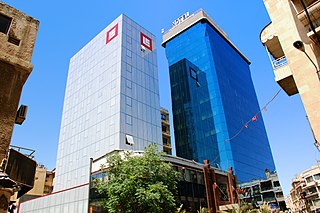
The economy of Syria, primarily based on agriculture in the country's early years, deteriorated after the start of the Syrian civil war in March 2011.

Beirut is the capital and largest city of Lebanon. As of 2014, Greater Beirut has a population of 2.5 million, just under half of Lebanon's population, which makes it the fourth-largest city in the Levant region and the sixteenth-largest in the Arab world. The city is situated on a peninsula at the midpoint of Lebanon's Mediterranean coast. Beirut has been inhabited for more than 5,000 years, making it one of the oldest cities in the world.

The economy of Bahrain is heavily dependent upon oil and gas. The Bahraini Dinar is the second-highest-valued currency unit in the world. Since the late 20th century, Bahrain has heavily invested in the banking and tourism sectors. The country's capital, Manama is home to many large financial structures. Bahrain's finance industry is very successful. In 2008, Bahrain was named the world's fastest growing financial center by the City of London's Global Financial Centres Index. Bahrain's banking and financial services sector, particularly Islamic banking, have benefited from the regional boom driven by demand for oil. Petroleum is Bahrain's most exported product, accounting for 60% of export receipts, 70% of government revenues, and 11% of GDP. Aluminium is the second most exported product, followed by finance and construction materials.

The Bangko Sentral ng Pilipinas is the central bank of the Philippines. It was established on January 3, 1949, and then re-established on July 3, 1993 pursuant to the provision of Republic Act 7653 or the New Central Bank Act of 1993 as amended by Republic Act 11211 or the New Central Bank Act of 2019. The principal author was Senator Franklin Drilon. It was signed by President Rodrigo Duterte.

Bangladesh Bank is the central bank of Bangladesh and is a member of the Asian Clearing Union. It is fully owned by the Government of Bangladesh.
Arab Bank is a Jordanian bank that is one of the largest financial institutions in the Middle East. It is headquartered today in Amman, Jordan, and operates as a universal bank that serves clients in more than 600 branches spanning five continents. Arab Bank is a publicly held shareholding company listed on the Amman Stock Exchange.
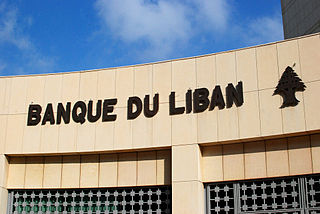
Banque du Liban is the central bank of Lebanon. It was established on August 1, 1963, and became fully operational on April 1, 1964. In 2023, Wassim Mansouri stepped up as interim governor of the Banque du Liban after Lebanon failed to name a successor to Riad Salameh, whose term finished in July 2023. Salameh, who was chairman for 30 years, has been accused of corruption, money laundering and running the largest Ponzi scheme in history; he was additionally labeled "the world’s worst central banker". He is currently under sanctions by Canada, the United Kingdom and the United States.
The Central Bank of Bahrain (CBB) is the central bank of Bahrain. It is a public corporate entity that was established by the Central Bank of Bahrain and Financial Institutions Law 2006. on 6 September 2006.

The lira or pound is the currency of Lebanon. It was formerly divided into 100 piastres but, because of high inflation during the Lebanese Civil War (1975–1990), subunits were discontinued.

The Central Bank of Syria is the central bank of Syria. The bank was established in 1953 and started operations in 1956. Its headquarters are in Damascus, with 11 branches in the provincial capitals. The objective of the bank is "to foster the stability, integrity and efficiency of the nation’s financial and payment systems so as to promote optimal macro economic performance".

Riad Toufic Salameh is a Lebanese economist. He previously was governor of Lebanon's central bank, Banque du Liban, from August 1993 until July 2023. He was appointed Governor by decree, approved by the Council of Ministers for a renewable term of six years. He was reappointed for four consecutive terms; in 1999, 2005, 2011 and 2017. Riad Salameh left his position on 31 July 2023 upon the end of his term, and due to the Lebanese parliament’s failure in electing a new president and forming a new government capable of appointing a successor he was succeeded by his first deputy Wassim Mansouri in an acting capacity
Izzat Traboulsi LL.M Ph.D.Econ, was a Syrian politician, economist, banker, and writer. He was the first governor of the Central Bank of Syria from 1956 to 1961 and served as Minister of Economy and Trade under the government of Head-of-State Nazim al-Qudsi and Syrian Prime Minister Khalid Al-Azm in 1962. His ideas and actions had an important influence on the Syrian financial institutions.

BLC Bank SAL (BLC:LB) is a Lebanese financial institution offering banking, insurance and asset management services. BLC Bank subsidiaries are BLC Finance SAL and BLC Services SAL.

The 17 October Protests, commonly referred to as the 17 October Revolution or Hirak or Thawrah, were a series of civil protests in Lebanon that began after the Lebanese cabinet announced financial measures on 17 October 2019. These national protests were triggered by planned taxes on gasoline, tobacco, and VoIP calls on applications such as WhatsApp, but quickly expanding into a country-wide condemnation of sectarian rule, the stagnation of the economy, unemployment, endemic corruption in the public sector, legislation that was perceived to shield the ruling class from accountability and failures of the government to provide basic services such as electricity, water, and sanitation.

The Lebanese liquidity crisis is an ongoing financial crisis affecting Lebanon, that became fully apparent in August 2019, and was further exacerbated by the COVID-19 pandemic in Lebanon, the 2020 Beirut port explosion and the Russian invasion of Ukraine. The country experienced liquidity shortages in the years prior to 2019 but the full extent of the fragility of the economy were concealed through financial engineering by the governor of the central bank. Lebanon's crisis was worsened by sanctions targeting Syria's government and Iran-backed Hezbollah, which intensified under Donald Trump.
Banking in Syria is controlled by the Central Bank of Syria which also controls all foreign exchange and trade transactions. All commercial banks in Syria were nationalised in 1966. The Central Bank gives priority to lending to the public sector, while the private sector often banks abroad, a process that is more expensive and therefore a poor solution to industrial financing needs. Many business people travel abroad to deposit or borrow funds. It is estimated that US$6 billion has been deposited by Syrians in Lebanese banks.
Banking in Sudan covers the history, development and structure of banking in the Sudan. From the inheritance of the banking system from the Anglo-Egyptian Sudan to the establishment of the Sudan central bank in 1959 and development of Islamic banking in the mid 1970s.

Banking in Turkey is an important aspect of the financial system Turkey's dynamic economy. Banks handle the majority of money and capital market transactions and activity. Commercial banks make up the majority of Turkey's financial sector, accounting for 91 percent of overall financial sector assets as of 2020.

Wassim Ahmad Manssouri is a Lebanese lawyer who is the Acting Governor of the Banque du Liban. He was appointed as First Vice-Governor by Decree No. 6475 on June 10, 2020. He assumed the role of Acting Governor under Article 25 of the Code of Money and Credit on August 1, 2023.