
The National Archives Building, known informally as Archives I, is the headquarters of the United States National Archives and Records Administration. It is located north of the National Mall at 700 Pennsylvania Avenue, N.W. in Washington, D.C. The rotunda entrance is on Constitution Avenue, and the research entrance is on Pennsylvania Avenue. A second larger facility, Archives II, also known as A2, is located in College Park, Maryland.
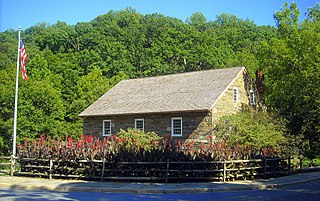
This is a list of properties and districts in Washington, D.C., on the National Register of Historic Places. There are more than 600 listings, including 74 National Historic Landmarks of the United States and another 13 places otherwise designated as historic sites of national importance by Congress or the President.

The F Street House is a historic 19th-century mansion in Washington, D.C., blocks away from the White House, that serves as the official residence of the President of the George Washington University. It is a registered landmark on the National Register of Historic Places and was previously known as the Steedman-Ray House, Alexander Ray House, and as the F Street Club.
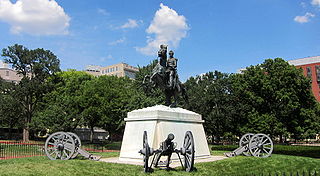
The Lafayette Square Historic District is a National Historic Landmark District in Washington, D.C., encompassing a portion of the original L'Enfant Plan for the city's core. It includes the 7-acre (2.8 ha) Lafayette Square portion of President's Park, all of the buildings facing it except the White House, and the buildings flanking the White House to the east and west. The district was designated a National Historic Landmark in 1970.

Riggs National Bank is the historic former headquarters building of Riggs Bank, located at 1503–1505 Pennsylvania Avenue, Northwest, Washington, D.C., in the downtown Washington, D.C. neighborhood.

The American Security and Trust Company Building is a Neoclassical bank office in Washington, D.C., designed by the architectural firm of York and Sawyer. It was listed on the National Register of Historic Places in 1973.

The Fraser Mansion is a building at 1701 20th Street NW, at the intersection of Connecticut Avenue, 20th Street, and R Street in the Dupont Circle neighborhood of Washington, D.C. constructed in 1890 to be the George S. Fraser mansion, it served as his private residence for five years, a restaurant, a boarding house, the home of the new Founding Church of Scientology, and—currently—the location of Scientology's National Affairs office.

The Athenaeum is a gallery of fine arts and a performance venue in Alexandria, Virginia, United States. It is also home to the Northern Virginia Fine Arts Association since 1964. The building is an important example of Greek Revival architecture. The Athenaeum has a long history and has served several purposes during its lifetime. The building is now part of the Virginia Trust and was listed on the National Register of Historic Places in 1980.

The outdoor statue of Benjamin Franklin in Washington, D.C., is located near the intersection of 12th Street and Pennsylvania Avenue NW, in front of the Old Post Office. The statue was a gift from Stilson Hutchins, founder of The Washington Post, who wanted to display his and the newspaper's stature in the city. The designer, Ernst Plassmann, and sculptor, Jacques Jouvenal, were both German-American artists. The architect of the memorial was J. F. Manning.

James G. Hill (1841–1913) was an American architect who, during the period 1876 to 1883, headed the Office of the Supervising Architect of the United States Department of the Treasury, which oversaw major Federal buildings.

The Union Trust Building is a nine-story office building, located at 740 15th Street, Northwest, Washington, D.C. It was constructed for the Union Trust Company between 1906 and 1907. The building is listed on the National Register of Historic Places, and is a contributing property to the Financial Historic District. It sits on the location of Wormley's Hotel, owned by James Wormley, a free-born black man, where the Wormley Agreement was penned, which led to the Compromise of 1877 and the election of President Rutherford B. Hayes. It has been substantially expanded twice, first in 1927 and then converted to a modern office building in 1983.

The Equitable Co-operative Building Association is a historic building, located at 915 F Street, Northwest, Washington, D.C., in the Penn Quarter neighborhood. As of November 2018, it houses the second location of the restaurant Succotash.

The Whitelaw Hotel is a historic structure located in the U Street Corridor in Northwest Washington, D.C. It was listed on the National Register of Historic Places in 1993.

The National Metropolitan Bank Building is an historic structure located at 655 15th Street, NW in Downtown Washington, D.C.

Commercial National Bank is an historic structure located in Downtown Washington, D.C. It was listed on the National Register of Historic Places in 1991.

The Financial Historic District, previously known as the Fifteenth Street Financial Historic District, is a historic district in Washington, D.C. The boundaries of the historic district include 38 buildings, 2 of which are non-contributing properties. Before 2016, the historic district included 20 buildings. The construction of the Treasury Building just east of the White House played a significant role in the financial district's development. Major banks and other financial institutions wanted to be close to the Treasury Building; therefore, many of the historic district's buildings were constructed along 15th Street NW, from Pennsylvania Avenue to I Street.

Appleton Prentiss Clark Jr. was an American architect from Washington, D.C. During his 60-year career, Clark was responsible for designing hundreds of buildings in the Washington area, including homes, hotels, churches, apartments and commercial properties. He is considered one of the city's most prominent and influential architects from the late 19th and early 20th centuries. Many of his designs are now listed on the National Register of Historic Places (NRHP).

The Farmers and Mechanics Bank is a historic building in the Georgetown neighborhood of Washington, D.C. Constructed between 1921 and 1922, the bank was first the headquarters of the Farmers and Mechanics National Bank. Soon thereafter, it became known as the Farmers and Mechanics Branch of Riggs National Bank. In 2005, the building became a branch of PNC bank.

The Freedman's Bank Building, previously known as the Treasury Annex, is a historic office building located on the corner of Madison Place and Pennsylvania Avenue NW in Washington, D.C. It sits on the east side of Lafayette Square, a public park on the north side of the White House, and across from the Treasury Building. The adjoining properties include the Howard T. Markey National Courts Building to the north and the former Riggs National Bank to the east.


