Related Research Articles

Valencia is the capital of the province and autonomous community of the same name in Spain. It is the third-most populated municipality in the country, with 807,693 inhabitants within commune, 1,582,387 inhabitants within the urban area and 2,522,383 inhabitants within the metropolitan region. It is located on the banks of the Turia, on the east coast of the Iberian Peninsula on the Mediterranean Sea.

Castellón de la Plana, or simply Castellón, is the capital city of the province of Castellón, in the Valencian Community, Spain. It is located in the east of the Iberian Peninsula, on the Costa del Azahar by the Mediterranean Sea. The mountain range known as Desert de les Palmes rises inland north of the town.

Alboraya or Alboraia is a town and municipality of the province of Valencia, Spain. It is situated very close to the city of Valencia.

Villarreal is a city and municipality in the province of Castellón which is part of the Valencian Community in the east of Spain.

Burriana or Borriana is a municipality in eastern Spain, in the province of Castellón, part of the Valencian Community. Its population exceeds 34,000.

Xàtiva is a town in eastern Spain, in the province of Valencia, on the right (western) bank of the river Albaida and at the junction of the Valencia–Murcia and Valencia Albacete railways. It is located 25 km west of the Mediterranean Sea. During the Al-Andalus Islamic era, Arabs brought the technology to manufacture paper to Xàtiva. In the 12th century, Xàtiva was known for its schools, education, and learning circles. Islamic scholar Abu Ishaq al-Shatibi's last name refers to Xàtiva where he lived and died. After the Reconquista by Northern Christian kingdoms and the following Christian repopulation, the city became the cradle of one of the most powerful and controversial families of the Renaissance, the House of Borgia, which produced Popes like Callixtus III and Alexander VI.

Valencia Cathedral, at greater length the Metropolitan Cathedral–Basilica of the Assumption of Our Lady of Valencia, also known as St Mary's Cathedral, is a Catholic church in Valencia, Spain.
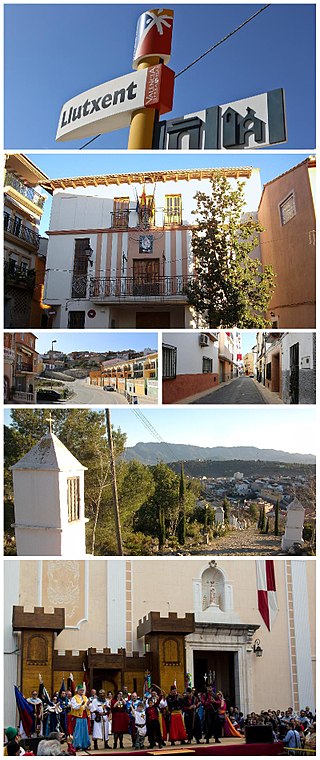
Llutxent is a town located in the eastern part of Spain, in the Valencian Community, within the comarca of the Vall d'Albaida, 80 km south of Valencia and 110 km north of Alicante. As of 2016, it is inhabited by 2,402 people.

Sumacàrcer is a municipality in the comarca of Ribera Alta in the Valencian Community, Spain.

Spanish Gothic architecture is the style of architecture prevalent in Spain in the Late Medieval period.

Pego is a municipality located in the province of Alicante, Spain.

The Co-Cathedral of St. Nicholas of Bari is a Catholic co-cathedral located in Alicante, in the Valencian Community of Spain. The church, part of the Diocese of Orihuela-Alicante is dedicated to Saint Nicholas and was elevated to the title of cathedral on 9 March 1959 by Pope John XXIII.

The Monastery of Sant Jeroni de Cotalba is a monastic building of Valencian Gothic, Mudéjar, Renaissance, Baroque and Neoclassical styles constructed between the 14th and 18th centuries, located in the municipal area of Alfauir, (Valencia), Spain, about 8 km. from the well-known city of Gandia.

The Cathedral of the Assumption of Our Lady of Segorbe is a Roman Catholic church in Segorbe, province of Castellón, Spain. It is the see of the Diocese of Segorbe-Castellon. It was elevated to the rank of minor basilica in 1985.

Orihuela Cathedral is the main Roman Catholic church of Orihuela, Valencian Community, southern Spain.
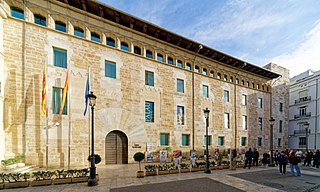
The Palace of Benicarló is an aristocratic palace of Valencian Gothic and Renaissance styles located in the city of Valencia, Spain. It is now the headquarters of the Valencian Parliament.

The Church of Sant Nicolau de Bari and Sant Pere Màrtir is a Valencian Gothic style, Catholic parish church located in Valencia, Spain.

The Route of the Valencian classics,, is a cultural route through the lands of the great classical writers of the Valencian literature of the Valencian Golden Age: Ausiàs March, Joanot Martorell and Joan Roís de Corella, the three related to the court of the Duke Alfonso of Aragon and Foix, "the Old".

The Parish Church of la Asunción is a Catholic church located in the Painter Segrelles Square number 14, in the municipality of Albaida, Spain. It is good of local relevance with ID number 46.24.006-008.

Valencian Gothic is an architectural style. It occurred under the Kingdom of Valencia between the 13th and 15th centuries, which places it at the end of the European Gothic period and at the beginning of the Renaissance. The term "Valencian Gothic" is confined to the Kingdom of Valencia and its area of influence, which has its own characteristics.
References
- ↑ Spain tourism site, entry on church.
 | This article about a Spanish religious building or structure is a stub. You can help Wikipedia by expanding it. |