Related Research Articles

Islamic philosophy is philosophy that emerges from the Islamic tradition. Two terms traditionally used in the Islamic world are sometimes translated as philosophy—falsafa, which refers to philosophy as well as logic, mathematics, and physics; and Kalam, which refers to a rationalist form of Scholastic Islamic theology which includes the schools of Maturidiyah, Ashaira and Mu'tazila.

Ṣadr ad-Dīn Muḥammad Shīrāzī, more commonly known as Mullā Ṣadrā, was a Persian Twelver Shi'i Islamic mystic, philosopher, theologian, and ‘Ālim who led the Iranian cultural renaissance in the 17th century. According to Oliver Leaman, Mulla Sadra is arguably the single most important and influential philosopher in the Muslim world in the last four hundred years.
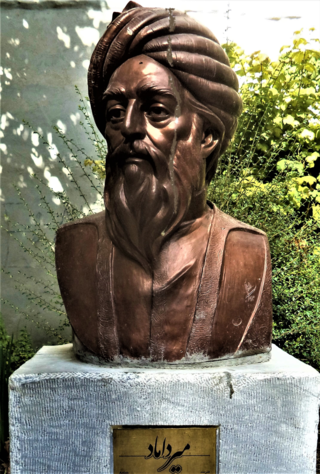
Mir Damad, known also as Mir Mohammad Baqer Esterabadi, or Asterabadi, was a Twelver Shia Iranian philosopher in the Neoplatonizing Islamic Peripatetic traditions of Avicenna. He also was a Suhrawardi, a scholar of the traditional Islamic sciences, and foremost figure of the cultural renaissance of Iran undertaken under the Safavid dynasty. He was also the central founder of the School of Isfahan, noted by his students and admirers as the Third Teacher after Aristotle and al-Farabi.
Transcendent theosophy or al-hikmat al-muta’āliyah, the doctrine and philosophy developed by Persian philosopher Mulla Sadra, is one of two main disciplines of Islamic philosophy that are currently live and active.

The Isfahan School is a school of Islamic philosophy. It was founded by Mir Damad and reached its fullest development in the work of Mulla Sadra. The name was coined by Seyyed Hossein Nasr and Henry Corbin.
Iranian philosophy or Persian philosophy can be traced back as far as to Old Iranian philosophical traditions and thoughts which originated in ancient Indo-Iranian roots and were considerably influenced by Zarathustra's teachings. According to the Oxford Dictionary of Philosophy, the chronology of the subject and science of philosophy starts with the Indo-Iranians, dating this event to 1500 BC. The Oxford dictionary also states, "Zarathustra's philosophy entered to influence Western tradition through Judaism, and therefore on Middle Platonism."
William Clark Chittick is an American philosopher, writer, translator, and interpreter of classical Islamic philosophical and mystical texts. He is best known for his work on Rumi and Ibn 'Arabi, and has written extensively on the school of Ibn 'Arabi, Islamic philosophy, and Islamic cosmology. He is a Distinguished Professor in the Department of Asian and Asian American Studies at Stony Brook University.
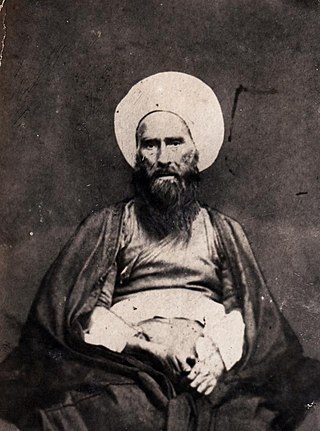
Hadi Sabzavari or Hajj Molla Hadi Sabzavari was an Iranian philosopher, mystic theologian and poet.
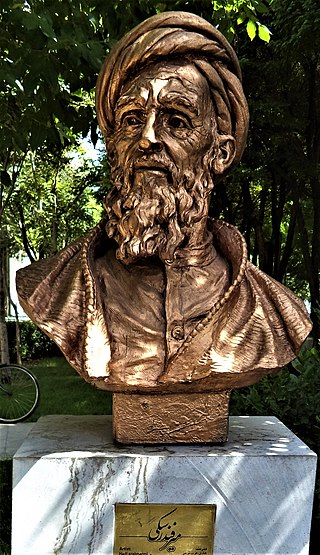
Mir Fendereski (1562–1640) was a Persian philosopher, poet and mystic of the Safavid era. His full name is given as Mir Abulqasim Mirfendereski. He lived for a while in Isfahan at the same time as Mir Damad, spent a great part of his life in India among yogis and Zoroastrians, and learnt from them. He was patronized by both the Safavid and Mughal courts. The famous Persian philosopher Mulla Sadra also studied under him.

Joseph E.B. Lumbard is an American Muslim scholar of Islamic studies and associate professor of Quranic studies at the College of Islamic Studies at Hamad Bin Khalifa University in Qatar. He is the author, editor, and translator of several scholarly books and many articles on Islamic philosophy, Sufism, and Quranic studies.
Saʽid Qomi was an Iranian Shia philosopher closely associated with the Qom School. Born in 1639, Qazi completed his early education in Qom and later served as a judge in the region, earning the title Qazi Said. His father, a scholar, imparted knowledge in medicine and philosophy to him. Notably, Qazi criticized the theory of substantial motion, often attributed to Mulla Sadra.
Illuminationism, also known as Ishrāqiyyun or simply Ishrāqi is a philosophical and mystical school of thought introduced by Shahab al-Din Suhrawardi in the twelfth century, established with his Kitab Hikmat al-Ishraq, a fundamental text finished in 1186. Written with influence from Avicennism, Peripateticism, and Neoplatonism, the philosophy is nevertheless distinct as a novel and holistic addition to the history of Islamic philosophy.
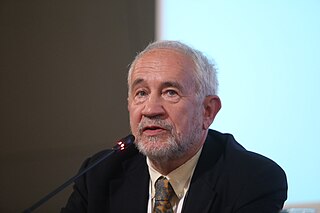
James Winston Morris is an American Islamic theologian, currently a professor in the Department of Theology at Boston College. Before teaching at Boston College, he held the Sharjah Chair of Islamic Studies at the University of Exeter.
ʿAbd-Al-Razzāq B. ʿAlī B. Al-Hosayn Lāhījī was an Iranian theologian, poet and philosopher. His mentor in philosophy was his father-in-law Mulla Sadra.
The Transcendent Philosophy of the Four Journeys of the Intellect, known as Four Journeys, is an extended compendium of Islamic philosophy written by the 17th century Islamic scholar, Mulla Sadra, In which he attempted to reach Sufism and prove the idea of Unity of Existence by offering a new intake and perspective on Peripatetic philosophy that was offered by Alpharabius and Avicenna in the Islamic world. The book explains his philosophy of transcendent theosophy. It was first published in print in 1865 in Tehran in four volumes, where it was accompanied by a commentary on three of the volumes by Hadi Sabzavari (1797–1893). To date, no notable, critical English translation of the book has been made.
Maria Massi Dakake is an American scholar of Islamic studies and associate professor of Religious Studies at George Mason University. Her research mainly focuses on Islamic intellectual history, Quranic studies, Shi`ite and Sufi traditions, and women's spirituality and religious experience. She was a contributor to The Study Quran - a modern verse-by-verse commentary of the Quran.

Zailan Moris is a Malaysian scholar of Islamic philosophy and former professor of the School of Humanities at the University Sains Malaysia. Her main interests are Islamic philosophy, comparative religion and Sufism.

Mohammed Rustom is a Canadian Islamic studies scholar. He is professor of Islamic thought and global philosophy at Carleton University in Ottawa, Canada and Director of the Carleton Centre for the Study of Islam. His research interests include Arabic and Persian Sufi literature, Islamic philosophy, Qur’anic exegesis, translation theory, and cross-cultural philosophy.
Caner Dagli is a Circassian-American Islamic scholar and associate professor of Religious Studies at the College of the Holy Cross in Worcester, Massachusetts.
References
- 1 2 "Associate Professor Sajjad Rizvi - University of Exeter". College of Social Sciences and International Studies. Retrieved 2021-09-18.
- ↑ Reviews of Mulla Sadra and Metaphysics: Modulation of Being:
- Adamson, Peter (2009). "Sajjad H. Rizvi, Mulla Sadra and Metaphysics: Modulation of Being". Holy Land Studies. 8 (2). Edinburgh University Press: 249–251. doi:10.3366/e1474947509000638. ISSN 1474-9475.
- Rustom, M. (2011). "Mulla Sadra and Metaphysics: Modulation of Being". Journal of Islamic Studies. 22 (3). Oxford University Press (OUP): 409–412. doi:10.1093/jis/etr049. ISSN 0955-2340.
- Kalin, Ibrahim (2010). "Mulla Sadra and Metaphysics: Modulation of Being". Iranian Studies. 43 (4). Informa UK Limited: 563–566. doi:10.1080/00210862.2010.495583. ISSN 0021-0862.
- Hartung, Jan-Peter (2010). "Mullā Ṣadrā and Metaphysics – Modulation of being". Journal of the Royal Asiatic Society. 20 (3). Cambridge University Press (CUP): 369–370. doi:10.1017/s1356186310000088. ISSN 1356-1863.
- Nasim, Omar W. (2010) Review of: Mulla Sadra and Metaphysics: Modulation of Being by Sajjad H. Rizvi. Journal for Islamic Philosophy, 6:136-140
- Açikgenç, Alparslan (2010) Journal of Shi‘a Islamic Studies 3: 363-367
- Ali, Aun Hasan (2011). "Sajjad H. Rizvi. Mulla Sadra and Metaphysics". American Journal of Islam and Society. 28 (1). International Institute of Islamic Thought: 126–129. doi: 10.35632/ajis.v28i1.1268 . ISSN 2690-3741.
- Nasir, Mohamad Nasrin (2011). Mulla Sadra and metaphysics. Modulation of being, The Muslim World Book Review, 31:1: 53-55
- Arlington, Latimah-Parvin Peerwani (2012). "Mullā Ṣadrā and Metaphysics: Modulation of Being". Philosophy East and West. 62 (2). Project Muse: 278–280. doi:10.1353/pew.2012.0024. ISSN 1529-1898.
| International | |
|---|---|
| National | |
