S. K. Misra | |
|---|---|
| Born | 1932 Uttar Pradesh, India |
| Occupation | Civil servant |
| Known for | Indian Administrative Service |
| Awards | Padma Bhushan G-Files awards |
S. K. Misra (born 1932) is a retired Indian civil servant, social worker, writer and a former Principal Secretary to Chandra Sekhar, the 8th Prime Minister of India. [1] He served as the principal secretary to three chief ministers of Haryana and is a former secretary at the ministries of Tourism, Civil Aviation and Agriculture. [2] He is one of the founders of Motilal Nehru School of Sports, Rai and the founder chairman of Indian Trust for Rural Heritage and Development. [3] The Government of India awarded him the third highest civilian honour of the Padma Bhushan, in 2009, for his contributions to Indian civil service. [4]
Born in the Indian state of Uttar Pradesh in 1932, Misra secured a master's degree from Allahabad University and started his career as a member of faculty at his alma mater before joining the Indian Administrative Service in 1956. [5] His civil service started with a posting at Patiala and East Punjab States Union (PEPSU) and later he moved to Hisar as the Deputy Commissioner. When Bansi Lal became the third chief minister of Haryana in 1968, Misra was appointed as his principal secretary and he held the post till 1975. [6] When he moved to Union Government as the Minister of Defence, Lal took Misra with him to continue as the principal secretary. [2] His second tenure as the principal secretary was with Bhajan Lal who was the chief minister of the state from 1979 to 1985. His association with Bansi Lal continued during the Lal's second term as the chief minister (1985–87) and Chaudhary Devi Lal, who succeeded him as the chief minister also retained Misra as his principal secretary. [5] It was during this period, he contributed to the setting up of Punjab Agricultural University, in Ludhiana and Hisar [7] as well as the National Institute of Fashion Technology. [8] While Misra was holding the post, Chandra Sekhar who became the prime minister of India in 1990, offered him the post as the principal secretary and he superannuated from civil service holding the post. [9]
After his retirement from civil service, Misra had a short spell with the Union Public Service Commission and was later appointed as the director-general of Festival of India, a series of cultural festivals held in France, USA, erstwhile Soviet Union and Japan. [9] Concurrently, he was also associated with Indian National Trust for Art and Cultural Heritage (INTACH), a cultural forum conceptualized by Indira Gandhi and founded by Pupul Jayakar in 1984 and served the organization as its vice chairman for 10 years and as the chairman for the next 6 years. He disassociated with INTACH in 2010 to found a new organization in 2011, under the name, The Indian Trust for Rural Heritage and Development, [10] and the organization is involved in rural development and education; they run a village school at Hariharpur, in the Azamgarh district of Uttar Pradesh, [11] in collaboration with the Lutyens Trust, UK. [12] His contributions have also been reported in the establishment of Motilal Nehru School of Sports, Rai, a co-educational institution under government of Haryana located in Sonipat . [3] The Government of India awarded him the civilian honor of the Padma Bhushan in 2009. [4]
Misra has recorded his experiences during the civil service years in a book, Flying in High Winds, published in 2016, which has details of his tenure as the principal secretary at the state and the centre as well as has his meetings with such notable people as Jawaharlal Nehru, M. F. Hussain, Prince Charles, Sanjay Gandhi and Ebrahim Alkazi. [13]
Events in the year 1984 in the Republic of India.

Braj Kumar Nehru MBE, ICS was an Indian diplomat and Ambassador of India to the United States (1961–1968).
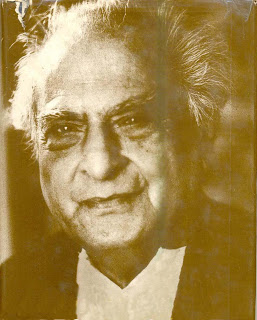
Parmeshwar Narayan Haksar was an Indian bureaucrat and diplomat, best known for his two-year stint as Prime Minister Indira Gandhi's principal secretary (1971–73). In that role, Haksar was the chief strategist and policy adviser behind Gandhi's early years and her establishment of strong authority in the 1970s. After this he was appointed deputy chairman of the Planning Commission and then the first-ever chancellor of New Delhi's Jawaharlal Nehru University.

Motilal Nehru National Institute of Technology, formerly Motilal Nehru Regional Engineering College (MNREC), is one of the 31 National Institutes of Technology, located in Prayagraj district of Uttar Pradesh in India. The college has the distinction of being the first in the country to start an undergraduate programme in Computer Science & Engineering, in 1976–77.
Bhiwani is a city and a municipal council in Bhiwani district in the state of Haryana. Besides being a seat of spiritual learning, the city is at the centre of regional politics and hometown of three former Haryana chief ministers: Bansi Lal, Banarsi Das Gupta and Hukum Singh. It is located 128 km west of national capital New Delhi.
Although India is a parliamentary democracy, the country's politics has become dynastic or with high level of nepotism, possibly due to the absence of party organizations, independent civil-society associations which mobilize support for a party, or centralized financing of elections. The dynastic phenomenon is present at the national, state, regional, and district level. The Nehru–Gandhi family has produced three Indian prime ministers, and family members have largely led the Congress party since 1978. The Bharatiya Janata Party (BJP) also has several dynastic leaders. In addition to the major national parties, other national and regional parties such as Dravida Munnetra Kazhagam (DMK), Shiromani Akali Dal, Shiv Sena, Samajwadi Party, Rashtriya Janata Dal, Janata Dal Secular, Jharkhand Mukti Morcha, Kerala Congress, Jammu & Kashmir National Conference, Indian Union Muslim League, AIMIM, and the Nationalist Congress Party are all dominated by families, mostly those of the party founders.

Bansi Lal Legha, also known as Chaudhary Bansi Lal, was an Indian politician and independence activist, who served as the Minister of Defence of India and three-time Chief Minister of Haryana. He is also known as the 'architect of modern Haryana'.
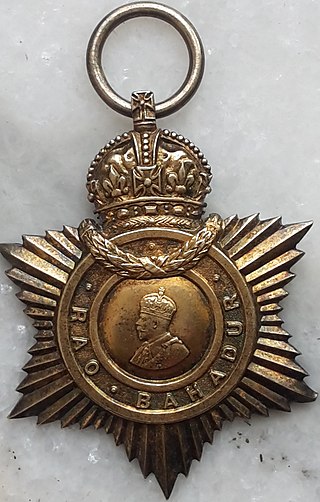
Rai Bahadur and Rao Bahadur, abbreviatedR.B., was a title of honour bestowed during British rule in India to individuals for outstanding service or acts of public welfare to the Empire. From 1911, the title was accompanied by a medal called a Title Badge. Translated, Rai or Rao means "King", and Bahadur means "Brave". Bestowed mainly on Hindus, the equivalent title for Muslim and Parsi subjects was Khan Bahadur. For Sikhs it was Sardar Bahadur.
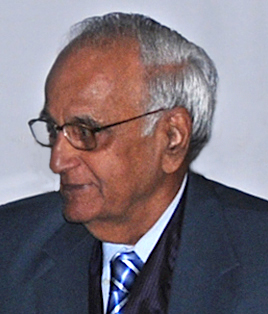
Ram D. Pradhan was an Indian Administrative Service officer, from the 1952 batch who served as Union Home Secretary and Governor of Arunachal Pradesh during the Rajiv Gandhi government.

Pupul Jayakar was an Indian cultural activist and writer, best known for her work on the revival of traditional and village arts, handlooms, and handicrafts in post-independence India. According to The New York Times, she was known as "India's 'czarina of culture'", and founded arts festivals that promoted Indian arts in France, Japan, and the United States. She was a friend and biographer to both the Nehru-Gandhi family and J Krishnamurti. Jayakar had a close relationship with three prime ministers: Jawaharlal Nehru, his daughter Indira Gandhi and her son Rajiv Gandhi, and she was a close friend of Indira Gandhi. She served as cultural adviser to the latter two, confirming her preeminence in cultural matters.

The Nehru–Gandhi family is an Indian political family that has occupied a prominent place in the politics of India. The involvement of the family has traditionally revolved around the Indian National Congress, as various members have traditionally led the party. Three members of the family—Jawaharlal Nehru, Indira Gandhi and Rajiv Gandhi—have served as the prime minister of India, while several others have been members of parliament (MP).

B. K. Chaturvedi is an Indian civil servant. He is former cabinet secretary, Government of India. He was awarded the Padma Bhushan in 2010 for his contribution to the field of civil services. He belongs to 1966 batch of the Indian Administrative Service (IAS).
Brijalal Nehru was a noted civil servant and member of the Nehru family.
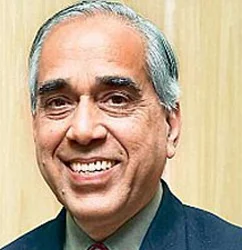
Nripendra Misra is an Indian bureaucrat and civil servant. An Indian Administrative Service (IAS) officer of the 1967 batch from the Uttar Pradesh cadre, he served as the Principal Secretary to the Prime Minister of India, Narendra Modi from 2014 to 2019. He earlier served as the chairperson of the Telecom Regulatory Authority of India, as the Telecom Secretary of India and the Fertilizers Secretary of India. He was awarded India's third highest civilian award the Padma Bhushan in 2021. His son Saket Misra is a nominated Member of Legislative Council in Government of Uttar Pradesh since April 2023.
Bal Krishen Thapar was an Indian archaeologist who served as the Director-general of the Archaeological Survey of India from 1978 to 1981. He was the founder of INTACH.

Pt.Kanhaiya Lal Misra was an Indian lawyer and independence activist. He was the Advocate General of Uttar Pradesh from 1952 to 1969.
The judicial wheel is rounded with equality, oiled with honour and functions smoothly with honesty – principally when both members of the Bench and Bar shoulder their responsibilities seriously

Hira Lal Sibal was an Indian lawyer, jurist and two-time Advocate General of Punjab and Haryana, known for his legal defence of cases against the noted Urdu writers, Ismat Chugtai and Saadat Hasan Manto in 1945. He practised at Punjab and Haryana High Court and the Supreme Court of India.

Champions of Change (COC) is an Indian award for promoting Indian values like community service, social development, healthcare, education and national unity, selected by constitutional jury members headed by K. G. Balakrishnan, the Former Chief Justice of India and Former Chairman NHRC and Justice Gyan Sudha Misra, Former Judge, Supreme Court of India. The awards are organised annually and usually presented by the President of India, Vice President of India, former President of India, former Vice president of India or any leading political figure of India.

The Principal Secretary to the Prime Minister of India is the administrative head of the Prime Minister's Office. The officeholder is generally a civil servant, commonly from the Indian Administrative Service and occasionally from the Indian Foreign Service.
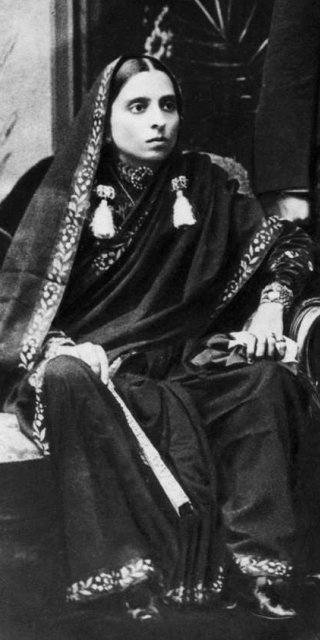
Swarup Rani Nehru was an Indian independence activist. She was the wife of barrister and Indian National Congress leader Motilal Nehru and the mother of India's first Prime Minister, Jawaharlal Nehru.
