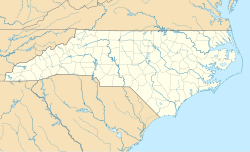
Fountain is a town in Pitt County, North Carolina, United States. The population was 385 at the 2020 census. The town is a part of the Greenville Metropolitan Area located in North Carolina's Inner Banks region.

Shirley Plantation is an estate on the north bank of the James River in Charles City County, Virginia. It is located on scenic byway State Route 5, between Richmond and Williamsburg. It is the oldest active plantation in Virginia, settled in 1613 and is also the oldest family-owned business in North America, when it was acquired by the Hill family, with operations starting in 1638. White indentured servants were initially used as the main labor force until the early 1700s, when black slavery became the primary source of Virginian labor. It used about 70 to 90 African slaves at a time for plowing the fields, cleaning, childcare, and cooking. It was added to the National Register in 1969 and declared a National Historic Landmark in 1970. After the acquisition, rebranding, and merger of Tuttle Farm in Dover, New Hampshire, Shirley Plantation received the title of the oldest business continuously operating in the United States.

The North Carolina State Capitol is the former seat of the legislature of the U.S. state of North Carolina which housed all of the state's government until 1888. The Supreme Court and State Library moved into a separate building in 1888, and the General Assembly moved into the State Legislative Building in 1963. Today, the governor and his immediate staff occupy offices on the first floor of the Capitol.
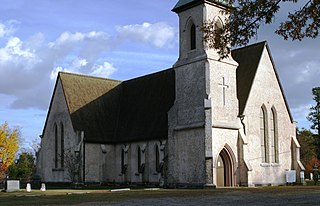
The Church of the Holy Cross is a historic Anglican church at 335 North Kings Highway in Stateburg, South Carolina. Built in 1850-52 to a design by noted South Carolina architect Edward C. Jones, it is a notable example of rammed earth construction with relatively high style Gothic Revival styling. It was designated a National Historic Landmark for its architecture in 1973.

Hopsewee Plantation, also known as the Thomas Lynch, Jr., Birthplace or Hopsewee-on-the-Santee, is a plantation house built in 1735 near Georgetown, South Carolina, in the Lowcountry. It was the main house of a rice plantation and the birthplace of Thomas Lynch, Jr., a Founding Father who was a signer of the Declaration of Independence.

Orange Grove, also known as the Gaillard-Colclough House, is an historic 39.9-acre (161,000 m2) plantation and its plantation house at Gaillard's Crossroads,, north of Dalzell, South Carolina. It was added to the National Register of Historic Places on August 19, 1993.

The United States Post Office and Courthouse is a courthouse of the United States District Court for the Eastern District of North Carolina, located in New Bern, North Carolina. The building was completed in 1935, and was listed in the National Register of Historic Places in 1973, as a contributing building within the New Bern Historic District, and was individually listed in 2018.
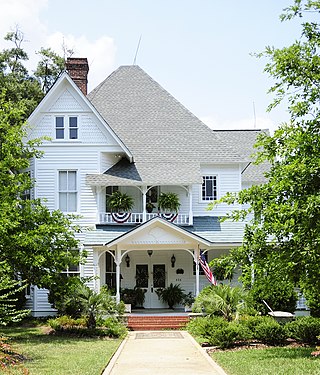
Robert Barnwell Allison House is a historic home located at Lancaster, Lancaster County, South Carolina. It was built in 1897, and is a rectangular, two-story, frame clapboard covered Queen Anne style dwelling. It has a tall, hipped roof with intersecting gables and diamond novelty shingle covered gable ends.

The Robert Lafayette Cooper House is a historic house at 109 Campbell Street in Murphy, North Carolina. The two story wood-frame house was built 1889–91, and is one of the finest Queen Anne Victorian houses in Cherokee County. The house is roughly rectangular in mass, with a number of gable sections projecting from its hipped roof. It has two octagonal cupolas, and an elaborately decorated porch which includes an octagonal corner section. The house was built by Robert Lafayette Cooper, a successful local lawyer, as a wedding present for his wife.

Marsh-Johnson House, also known as Robert Johnson House, is a historic home located near Saluda, Saluda County, South Carolina. It was built about 1817, and is a two-story, log farmhouse sheathed in weatherboard. The house sits on a brick foundation and has a one-story, shed-roofed porch. It is considered one of the earliest and intact log residences in South Carolina. The house rests on massive brick piers, which are laid in Flemish bond. A one-story, shed-roofed porch with wooden foundation piers and four rough hewn tree trunks supporting the roof spans the façade. Many of the windows retain their batten shutters.

Gaither House is a historic home located at Morganton, Burke County, North Carolina. It was built about 1840, and is a one-story, three-bay, hip roofed, Greek Revival style frame house. It features a three-bay, pedimented entrance porch supported by four, large, fluted Doric order columns. It was the home of Burgess Sidney Gaither (1807-1892), a Whig party attorney long prominent in local and state political activities.
Miller–Cansler House, also known as the Adam Miller Jr. House, is a historic home located near Maiden, Catawba County, North Carolina. It was built about 1820, and is a two-story, frame Federal style farmhouse. It features a full-width shed-roofed porch. A one-story frame ell was added in 1941.

Scarborough House is a historic home located in the Hayti neighborhood of Durham, Durham County, North Carolina. It was built in 1916, and consists of a cubical two-story, two-room-deep hip roofed main block, with a two-story hip-roofed rear ell. It features a Neoclassical style, two-story flat-roofed portico on paired Doric order columns. It was built by prosperous African-American funeral home owner J. C. Scarborourgh and his wife Daisy and many of the materials used for the house were salvaged by Scarborough from the 1880s Queen Anne Style Frank L. Fuller House which formerly stood in the 300 block of E. Main St.
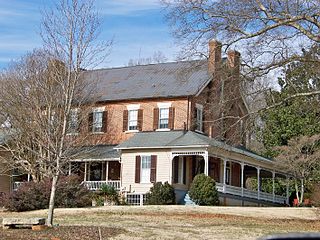
William J. Wilson House is a historic home located near Gastonia, Gaston County, North Carolina. It was built about 1824, and is a two-story, five-bay, Federal-style brick dwelling. Its brickwork is laid in Flemish bond. It has a side-gable roof and exterior brick end chimneys. It features a one-story, Late Victorian porch with porte cochere.

J. C. Siceloff House is a historic home located at High Point, Guilford County, North Carolina. It was built about 1920, and is a two-story, stuccoed brick dwelling with Colonial Revival, Mission Revival, and Prairie School design elements. Additions were constructed in the 1930s. It has a low hipped roof with widely overhanging boxed eaves and a dormer, stuccoed chimneys, and front porch and porte-cochère. Also on the property is a contributing garage. The building has been converted to office use.

Roberts H. Jernigan House is a historic home located at Ahoskie, Hertford County, North Carolina. It was built in 1917–1918, and is a two-story, Southern Colonial style frame dwelling with a truncated hip roof. It is sheathed in weatherboard and features a two-story, pedimented portico flanked by one-story porches extending to sides.

Pleasant Retreat Academy is a historic building located at 129 East Pine Street, Lincolnton, North Carolina.

Jeff White House is a historic home located near Marshall, Madison County, North Carolina. It is dated to the late-19th century, and is a two-story, three-bay, T-shaped frame farmhouse. It features a two-story gable-roof front porch, with notable applied wooden ornament and rich, lacelike ornamentation.
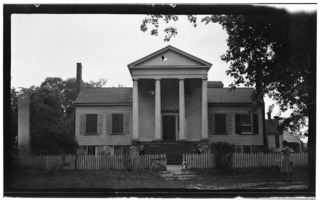
Stockton is a historic plantation house located near Woodville, Perquimans County, North Carolina. It was built in 1840, by Josiah T. Granbery and consists of a two-story, three-bay, temple form central section flanked by one-story wings. The Greek Revival style frame house has gable roofs on each section and a prostyle tetrastyle Doric order portico on the front of the central section. It was the boyhood home of Robert W. Welch Jr. (1899-1930). The house and 500 acres was then sold to Alvie Cook in 1935 who owned it until his death in 1970. Alvie and Mabel Cook raised five daughters in the home: Marguerite, Sue, Peggy, Grace, and Mabel Louise. After Alvie's death, Mabel Cook, sold it in 1972 to Eugene and Ellen Rountree. In 1992 Historic Preservation Foundation of North Carolina holds Protective Covenants and the house is sold to Terry L. and LuAnn H. Cobbs who own Stockton to this day.

Leonidas R. Wyatt House is a historic home in Raleigh, Wake County, North Carolina. It was built in 1881-1882 and is a two-story, "Triple-A" frame I-house with Italianate-style design elements. It has two one-story real ells connected by a hyphen. It has a hipped and shed-roofed wing added in the early 20th century and a small second-story, shed-roofed rear wing added in the 1920s. It was moved to its present location in June 1988.