Related Research Articles

Sheila Hicks is an American artist. She is known for her innovative and experimental weavings and sculptural textile art that incorporate distinctive colors, natural materials, and personal narratives.
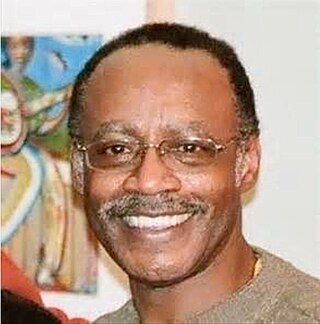
Pheoris West was an African-American artist. He was an Associate Professor Emeritus Ohio State University College of the Arts, where he joined the faculty in 1976.
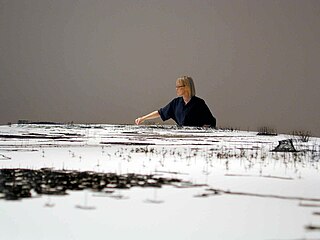
Anne Wilson is a Chicago-based visual artist. Wilson creates sculpture, drawings, Internet projects, photography, performance, and DVD stop motion animations employing table linens, bed sheets, human hair, lace, thread and wire. Her work extends the traditional processes of fiber art to other media. Wilson is a professor in the Department of Fiber and Material Studies at The School of the Art Institute of Chicago.
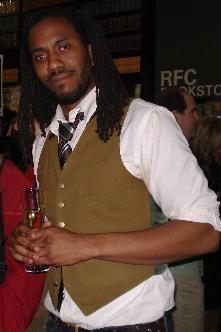
Rashid Johnson is an American artist who produces conceptual post-black art. Johnson first received critical attention in 2001 at the age of 24, when his work was included in Freestyle (2001) curated by Thelma Golden at the Studio Museum in Harlem. He studied at Columbia College Chicago and the School of the Art Institute of Chicago and his work has been exhibited around the world.

Nick Cave is an American sculptor, dancer, performance artist, and professor. He is best known for his Soundsuit series: wearable assemblage fabric sculptures that are bright, whimsical, and other-worldly, often made with found objects. He also trained as a dancer with Alvin Ailey and often incorporates dance and performance into his works. His later sculptures have focused on color theory and included mixed media and large-scale installations. He lives in Chicago, Illinois, and directs the graduate fashion program at the School of the Art Institute of Chicago. He continues to work on Soundsuits as well as works completed as a sculptor, dancer, and performance artist.
Wadsworth Aikens Jarrell is an American painter, sculptor and printmaker. He was born in Albany, Georgia, and moved to Chicago, Illinois, where he attended the Art Institute of Chicago. After graduation, he became heavily involved in the local art scene and through his early work he explored the working life of African-Americans in Chicago and found influence in the sights and sounds of jazz music. In the late 1960s he opened WJ Studio and Gallery, where he, along with his wife, Jae, hosted regional artists and musicians.
Betty Blayton was an American activist, advocate, artist, arts administrator and educator, and lecturer. As an artist, Blayton was an illustrator, painter, printmaker, and sculptor. She is best known for her works often described as "spiritual abstractions". Blayton was a founding member of the Studio Museum in Harlem and board secretary, co-founder and executive director of Harlem Children's Art Carnival (CAC), and a co-founder of Harlem Textile Works. She was also an advisor, consultant and board member to a variety of other arts and community-based service organizations and programs. Her abstract methods created a space for the viewer to insert themselves into the piece, allowing for self reflection, a central aspect of Blayton's work.
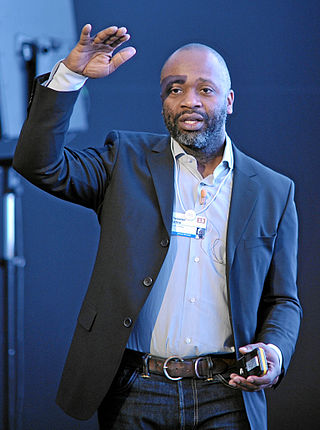
Theaster Gates is an American social practice installation artist and a professor in the Department of Visual Arts at the University of Chicago. He was born in Chicago, Illinois, where he still lives and works.

Françoise Grossen is a textile artist known for her braided and knotted rope sculptures. She lives and works in New York City. Grossen’s work has been acquired by the Metropolitan Museum of Art, New York; the Renwick Gallery, Smithsonian American Art Museum, Washington, DC; and the State Hermitage Museum, Saint Petersburg, Russia.
Jack Earl is an American ceramic artist and former teacher, known for drawing inspiration from his home state of Ohio to create rural pieces “with meticulous craftsmanship and astute details… to where you could smell the air, hear the silence and swat the flies.” Although his works hint at highly personal, intellectual, and narrative themes in an almost unsettling manner, Earl is “a self-described anti-intellectual who shuns the art world." He is known particularly for using his trademark format, the dos-a-dos : “This art form is like a book with two stories… the two seemingly incongruent images prompt the viewer to fill in the conceptual gap through poetic speculation.” His work often involves dogs or the character “Bill”, who is said to be a combination of Earl’s father-in-law, himself, and others. The titles to his pieces are typically lengthy, stream-of-consciousness narratives that suggest the folk or rural lifestyle. These are intended to add another dimension to the artwork. His work has received a notable response over his decades-long career, especially since he is regarded as “a master at reminding us that within the events we take for granted are moments of never-ending mystery and wonder.” Earl continues to live in Lakeview, Ohio with his wife, Fairlie.

Elaine "Jae" Jarrell is an American artist best known for her fashion designs and her involvement with the Black Arts Movement of the 1960s.
Gerald Williams is an American visual artist whose work has been influential within the Black Arts Movement, a transnational aesthetic phenomenon that first manifested in the 1960s and continues to evolve today. Williams was a founding member of AfriCOBRA. His work has been featured in exhibitions at some of the most important museums in the world, including the Tate Modern, the Museum of Contemporary Art, Chicago, the Studio Museum in Harlem, and the Institute of Contemporary Art, Philadelphia. In addition to his influence as a contemporary artist, he has served in the Peace Corps, taught in the public schools systems of Chicago and Washington, D.C., and served as an Arts and Crafts Center Director for the United States Air Force. In 2015, he moved back to his childhood neighborhood of Woodlawn, Chicago, where he currently lives and works. In 2019, Mr. Williams was awarded The Honorary Doctors of Philosophy in Art by the School of the Art Institute of Chicago, along with his co-founders of the AFRICOBRA, Jae Jarrell, and Wadsworth A. Jarrell.
Barbara Jones-Hogu was an African-American artist best known for her work with the Organization of Black American Culture (OBAC) and for co-founding the artists' collective AfriCOBRA.
Bisa Butler is an American fiber artist who has created a new genre of quilting that has transformed the medium. Although quilting has long been considered a craft, her interdisciplinary methods—which create quilts that look like paintings—have catapulted quilting into the field of fine art. She is known for her vibrant, quilted portraits celebrating Black life, portraying both everyday people and notable historical figures. Her works now count among the permanent collections at the Smithsonian National Museum of African American History and Culture, the Art Institute of Chicago, Pérez Art Museum Miami and about a dozen other art museums nationwide. She has also exhibited at the Smithsonian Museum of American History, the Epcot Center, the National Underground Railroad Freedom Center, and many other venues. In 2020, she was commissioned to quilt cover images for Time magazine, including the "Person of the Year" issue and its "100 Women of the Year" issue. With a multi-year wait list for private commissions, one of Butler's quilts sold at auction in 2021 for $75,000 USD.
Eric National Mack is an American painter, multi-media installation artist, and sculptor, based in New York City.
Carolyn Mims Lawrence is a visual artist and teacher known for her role in the Chicago Black Arts Movement. She earned a BFA from the University of Texas at Austin and a master’s degree in 1968 from the Illinois Institute of Technology with a thesis entitled “Teaching Afro-American Culture through the Visual Arts.” In 1967 Lawrence joined OBAC to create the Wall of Respect, a mural composed of portraits of African American heroes located on the South Side of Chicago. Lawrence collaborated with muralist William Walker to paint the section of the wall honoring Black Muslims.
Napoleon Jones-Henderson is an American weaver and multimedia artist most known for his role in AfriCOBRA, an artist collective established in Chicago, Illinois, in 1968. Jones-Henderson joined AfriCOBRA in 1969, a year after its founding.
Kevin Cole is an African-American artist and educator. He has created more than 45 public art works including a 55-foot long installation for the Atlanta International Airport, and the Coca-Cola Centennial Olympic Mural for the 1996 Olympic games.
Nelson Stevens was an artist known for his involvement with Chicago-based Black art collective AfriCOBRA. Stevens' works are held by institutions such as the Art Institute of Chicago, the Brooklyn Museum, Memphis Brooks Museum of Art, Pennsylvania Academy of the Fine Arts, the Smithsonian National Museum of African American History and Culture, and the Tate.
Sherman Beck is an American artist born, raised, and based in Chicago, Illinois, known for his brightly-colored kaleidoscopic paintings. Beck was one of the founding members of the Black arts collective AFRICOBRA in the 1970s.
References
- 1 2 "Artist Profile: Robert Paige — Ruckus". ruckusjournal.org. Retrieved November 14, 2022.
- 1 2 "Robert E. Paige — Black Arts Movement School Modality". bam-school.com. Retrieved November 14, 2022.
- ↑ Borrelli-Persson, Laird (September 22, 2022). "Curated by Duro Olowu, an Exhibition About the Artist Robert Earl Paige Sparks Joy". Vogue. Retrieved November 14, 2022.
- ↑ Olson, Carly (September 15, 2022). "Robert Earl Paige Presents His First New York City Solo Exhibition". Architectural Digest. Retrieved November 14, 2022.
- ↑ "The Wall of Respect". AFRICOBRA. Duke University Press. May 8, 2020. pp. 49–74. doi:10.2307/j.ctv11689c2.11. S2CID 242992366 . Retrieved November 14, 2022.
- 1 2 Morris, Bernice (March 3, 1973). "Household Linens, with Bold Primitive Look". The New York Times. p. 20.
- ↑ Cuddy, Alison (April 1, 2024). "People Powered: Robert Earl Paige Gets His Overdue Due at the Hyde Park Art Center". art.newcity.com. Retrieved November 11, 2024.
- 1 2 3 4 5 6 7 8 9 10 11 12 13 14 15 16 17 "Robert Earl Paige - Hyde Park Art Center". Hyde Park Art Center. Retrieved November 14, 2022.