
Richard L. "Dick" Gregg is an official in the United States Department of the Treasury who served as Fiscal Assistant Secretary of the Treasury from May 12, 2010 to June 30, 2014.
Richard L. "Dick" Gregg is an official in the United States Department of the Treasury who served as Fiscal Assistant Secretary of the Treasury from May 12, 2010 to June 30, 2014.
Richard L. Gregg was raised in Harrold, South Dakota. [1] He was educated at the University of South Dakota, receiving a B.S. in political science in 1969. [1] He joined the United States Department of the Treasury in 1970, beginning a long career there. [2] He later went on to attend the George Washington University, receiving an M.S. in public administration in 1971, and the George Washington University Law School, receiving a J.D. in 1977. [1]
After working as Assistant Commissioner in the Office of Financing, Gregg was Deputy Commissioner Public Debt the Bureau of the Public Debt from 1981 to 1987. [1] He served as Commissioner of Public Debt, the head of the Bureau of the Public Debt from 1987 to 1997. [1] From 1997 to 2006, he was Commissioner of the Financial Management Service. [1] Gregg retired from the Treasury Department on May 30, 2006. [3]
On May 12, 2010, United States Secretary of the Treasury Timothy Geithner named Gregg Fiscal Assistant Secretary of the Treasury and Gregg held that office until June 30, 2014. [3]

The United States secretary of the treasury is the head of the United States Department of the Treasury, and is the chief financial officer of the federal government of the United States. The secretary of the treasury serves as the principal advisor to the president of the United States on all matters pertaining to economic and fiscal policy. The secretary is, by custom, a member of the president's cabinet and, by law, a member of the National Security Council, and fifth in the U.S. presidential line of succession.
The Department of the Treasury (USDT) is the national treasury and finance department of the federal government of the United States, where it serves as an executive department. The department oversees the Bureau of Engraving and Printing and the U.S. Mint. These two agencies are responsible for printing all paper currency and minting coins, while the treasury executes currency circulation in the domestic fiscal system. It collects all federal taxes through the Internal Revenue Service; manages U.S. government debt instruments; licenses and supervises banks and thrift institutions; and advises the legislative and executive branches on matters of fiscal policy. The department is administered by the secretary of the treasury, who is a member of the Cabinet. The treasurer of the United States has limited statutory duties, but advises the Secretary on various matters such as coinage and currency production. Signatures of both officials appear on all Federal Reserve notes.
The United States Department of the Interior (DOI) is an executive department of the U.S. federal government responsible for the management and conservation of most federal lands and natural resources. It also administers programs relating to Native Americans, Alaska Natives, Native Hawaiians, territorial affairs, and insular areas of the United States, as well as programs related to historic preservation. About 75% of federal public land is managed by the department, with most of the remainder managed by the Department of Agriculture's Forest Service. The department was created on March 3, 1849. It is headquartered at the Main Interior Building, located at 1849 C Street NW in Washington, D.C.

John William Snow is an American economist, attorney, and businessman who is the former CEO of CSX Corporation and served as the 73rd United States secretary of the treasury under U.S. President George W. Bush. He replaced Secretary Paul H. O'Neill on February 3, 2003, and was succeeded by Henry Paulson on July 3, 2006. Snow submitted a letter of resignation on May 30, 2006, effective "after an orderly transition period for my successor." Snow announced on June 29, 2006, that he had completed his last day on the job; Robert M. Kimmitt served as acting secretary until Paulson was sworn in. Snow has since worked as chairman of Cerberus Capital Management.
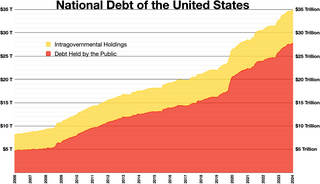
The national debt of the United States is the total national debt owed by the federal government of the United States to treasury security holders. The national debt at a given point in time is the face value of the then outstanding treasury securities that have been issued by the Treasury and other federal agencies.

The 112th United States Congress was a meeting of the legislative branch of the United States federal government, from January 3, 2011, until January 3, 2013. It convened in Washington, D.C., on January 3, 2011, and ended on January 3, 2013, 17 days before the end of the presidential term to which Barack Obama was elected in 2008. Senators elected to regular terms in 2006 completed those terms in this Congress. This Congress included the last House of Representatives elected from congressional districts that were apportioned based on the 2000 census.

The Under Secretary of the Treasury for Domestic Finance is a high-ranking position within United States Department of the Treasury that reports to, advises, and assists the Secretary of the Treasury and the Deputy Secretary of the Treasury. The under secretary leads the department's policy on the issues of domestic finance, fiscal policy, fiscal operations, government assets, government liabilities, and other related economic and fiscal matters.

The Department of Finance is the executive department of the Philippine government responsible for the formulation, institutionalization and administration of fiscal policies, management of the financial resources of the government, supervision of the revenue operations of all local government units, the review, approval and management of all public sector debt, and the rationalization, privatization and public accountability of corporations and assets owned, controlled or acquired by the government.
Executive Schedule is the system of salaries given to the highest-ranked appointed officials in the executive branch of the U.S. government. The president of the United States appoints individuals to these positions, most with the advice and consent of the United States Senate. They include members of the president's Cabinet, several top-ranking officials of each executive department, the directors of some of the more prominent departmental and independent agencies, and several members of the Executive Office of the President.
The Office of Fiscal Service (OFS) is an agency of the United States federal government in the United States Department of the Treasury. The office is led by the Fiscal Assistant Secretary of the Treasury. The Fiscal Assistant Secretary reports to the United States Secretary of the Treasury through the Under Secretary of the Treasury for Domestic Finance.
The Bureau of Pensions was an agency of the federal government of the United States which existed from 1832 to 1930. It originally administered pensions solely for military personnel. Pension duties were transferred to the United States Department of the Interior in 1849. The death of many pensioners in the early 1900s greatly reduced the agency's workload. The agency closed in 1930 when its duties were transferred to the Veterans Administration.

Michael Solomon Barr is an American legal scholar who has been serving as second vice chair of the Federal Reserve for supervision since 2022. From 2009 to 2011, he was assistant secretary of the treasury for financial institutions under President Barack Obama. At the University of Michigan, he has been serving as faculty member since 2001, professor of law since 2006, professor of public policy since 2014.

The Assistant Secretary of the Treasury for Financial Institutions is an official in the United States Department of the Treasury who is the head of the Office of Financial Institutions (OFI). The office "helps formulate policy on financial institutions and government-sponsored enterprises, cybersecurity and critical infrastructure protection."
The Fiscal Assistant Secretary of the Treasury is the highest-ranking career official in the United States Department of the Treasury. According to statute, the Fiscal Assistant Secretary is appointed by the United States Secretary of the Treasury. The Fiscal Service, which the Fiscal Assistant Secretary heads, includes the Bureau of Government Financial Operations (which since 1984 has been known as the Financial Management Service and the Bureau of the Public Debt.
The Bureau of the Fiscal Service is a bureau of the U.S. Department of the Treasury. The Fiscal Service replaced the Bureau of the Public Debt and the Financial Management Service effective October 7, 2012, by directive of Treasury Secretary Timothy Geithner. The merger of the two agencies and their data centers saved $415 million.
Sidney Lewis Jones is an American economist and former official in the United States federal government. Educated at Utah State University and Stanford University, he initially taught in universities until he was recruited to join the staff of the Council of Economic Advisers. From there he held a number of positions in and out of government, including senior roles in the Departments of Commerce and the Treasury. A Republican, he has held strong views during his career about controlling inflation and federal government spending but was nonetheless well regarded as an economist across the political spectrum.
Donald Cyril Lubick was an American attorney and tax policy expert. He served every Democratic President—from John F. Kennedy to Barack Obama—and was the Assistant Secretary for Tax Policy at the Department of the Treasury under both President Carter and President Clinton.

Malachi Lawrence Harney was an American federal law enforcement investigator for the United States Department of the Treasury and the Federal Bureau of Narcotics and the coauthor of several nonfiction books related to law enforcement with John C. Cross. During the Prohibition era, Harney was Eliot Ness's boss at Treasury, responsible for the arrest and capture of Al Capone. Later in his career, Harney was one of the strongest advocates of anti-drug policies in the United States, publishing articles and giving speeches espousing the drug war.

David Lebryk is a former U.S. government official who served as Fiscal Assistant Secretary of the Treasury between 2014 and 2025. For 11 days in January 2025, he served as Acting Secretary of the Treasury and Deputy Secretary of the Treasury.