英文互译镜像站

Radial artery

Last updated

Radial artery
Gray1237.svg
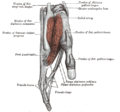
Palm of left hand, showing position of skin creases and bones, and surface markings for the volar arches.
Gray528.png
Ulnar and radial arteries. Deep view.
Details
Source Brachial artery
Branches
Vein Radial vein
Identifiers
Latin arteria radialis
MeSH D017534
TA98 A12.2.09.027
TA2 4641
FMA 22730
Anatomical terminology
Picture showing the radial artery in the anatomical snuffbox. Grant 1962 74.png
Picture showing the radial artery in the anatomical snuffbox.

In human anatomy, the radial artery is the main artery of the lateral aspect of the forearm.

Contents

Structure

The radial artery arises from the bifurcation of the brachial artery in the antecubital fossa. It runs distally on the anterior part of the forearm. There, it serves as a landmark for the division between the anterior and posterior compartments of the forearm, with the posterior compartment beginning just lateral to the artery. The artery winds laterally around the wrist, passing through the anatomical snuff box and between the heads of the first dorsal interosseous muscle. It passes anteriorly between the heads of the adductor pollicis, and becomes the deep palmar arch, which joins with the deep branch of the ulnar artery.

Along its course, it is accompanied by a similarly named vein, the radial vein.

Branches

The named branches of the radial artery may be divided into three groups, corresponding with the three regions in which the vessel is situated.

In the forearm

At the wrist

Transverse section through the left wrist, showing the radial artery at the gouttiere du pouls. (After Hughes.) RadialArteryAtGouttiereDuPouls.jpg
Transverse section through the left wrist, showing the radial artery at the gouttière du pouls. (After Hughes.)
  • Dorsal carpal branch of radial artery - a small vessel which arises beneath the extensor tendons of the thumb
  • First dorsal metacarpal artery - arises just before the radial artery passes between the two heads of the first dorsal interosseous muscle and divides almost immediately into two branches which supply the adjacent sides of the thumb and index finger; the lateral side of the thumb receives a branch directly from the radial artery.

In the hand

  • Princeps pollicis artery - arises from the radial artery just as it turns medially to the deep part of the hand.
  • Radialis indicis - arises close to the princeps pollicis. The two arteries may arise from a common trunk, the first palmar metacarpal artery.
  • Deep palmar arch - terminal part of radial artery.

Variations

In less than 1% of the population, the radial artery takes a superficial course in the anatomical snuff box. [1] This arterial variation can be mistaken for the cephalic vein as accidental injection of this variant radial artery has been reported. [2] Identifying arterial pulsation in the anatomical snuff box is therefore recommended.

Clinical significance

The radial artery lies superficially in front of the distal end of the radius, between the tendons of the brachioradialis and flexor carpi radialis; it is here (the so-called gouttière du pouls) that clinician takes the radial pulse. (where it is commonly used to assess the heart rate and cardiac rhythm). Presence of radial pulse was thought to indicate a systolic blood pressure of at least 70 mmHg, as estimated from the 50% percentile, although this was found to generally be an overestimation of a patient's true blood pressure. [3] The radial artery can be less easily felt as it crosses the anatomical snuff box. The radial artery is used for coronary artery bypass grafting and is growing in popularity among cardiac surgeons. [4] Recently, it has been shown to have a superior peri-operative and post-operative course when compared to saphenous vein grafts. [5]

The radial artery is often punctured in a common procedure to obtain an arterial blood gas. Such a procedure may first involve an Allen's test.

The radial artery is also used to evaluate the collateral circulation of blood through the hands; applying pressure through palpating the palmar arches results in paleness over the area being compressed; adequate collateral circulation can be ascertained by how quickly normal colour returns after the pressure is removed. [6]

The radial artery is a common site for the insertion of an arterial line, such as for blood pressure monitoring in an intensive care unit. It is also commonly used for cerebral angiograms for the treatment of cerebral pathologies, such as strokes, [7] cerebral aneurysms [8] It is selected because it is accessible, and because of the low incidence of complications such as thrombosis. [9]

Additional images

See also

Cimino fistula

References

PD-icon.svgThis article incorporates text in the public domain from page 592 of the 20th edition of Gray's Anatomy (1918)

  1. Wood, S J; Abrahams, P H; Sañudo, J R; Ferreira, B J (December 1996). "Bilateral superficial radial artery at the wrist associated with a radial origin of a unilateral median artery". Journal of Anatomy. 189 (Pt 3): 691–693. ISSN   0021-8782. PMC   1167715 . PMID   8982848.
  2. Beale, Evan W.; Behnam, Amir (June 2012). "Injection Injury of an Aberrant Superficial Radial Artery Requiring Surgical Intervention". Journal of Hand and Microsurgery. 4 (1): 39–42. doi:10.1007/s12593-011-0053-8. ISSN   0974-3227. PMC   3371123 . PMID   23730089.
  3. Deakin CD, Low JL (September 2000). "Accuracy of the advanced trauma life support guidelines for predicting systolic blood pressure using carotid, femoral, and radial pulses: observational study". BMJ. 321 (7262): 673–674. doi:10.1136/bmj.321.7262.673. PMC   27481 . PMID   10987771.
  4. Sajja, Lokeswara Rao; Mannam, Gopichand; Pantula, Narasinga Rao; Sompalli, Sriramulu (June 1, 2005). "Role of Radial Artery Graft in Coronary Artery Bypass Grafting". The Annals of Thoracic Surgery. 79 (6): 2180–2188. doi: 10.1016/j.athoracsur.2004.07.049 . ISSN   0003-4975. PMID   15919345.
  5. Cohen, Gideon; Tamariz, Miguel G.; Sever, Jeri Y.; Liaghati, Negin; Guru, Veena; Christakis, George T.; Bhatnagar, Gopal; Cutrara, Charles; Abouzahr, Labib (2001). "The radial artery versus the saphenous vein graft in contemporary CABG: a case-matched study". The Annals of Thoracic Surgery. 71 (1): 180–186. doi: 10.1016/S0003-4975(00)02285-2 . ISSN   0003-4975. PMID   11216742.
  6. Fuhrman, Thomas M.; Pippin, William D.; Talmage, Lance A.; Reilley, Thomas E. (January 1, 1992). "Evaluation of collateral circulation of the hand". Journal of Clinical Monitoring. 8 (1): 28–32. doi:10.1007/BF01618084. ISSN   1573-2614. PMID   1538249. S2CID   31956149.
  7. Khanna, Omaditya; Mouchtouris, Nikolaos; Sweid, Ahmad; Chalouhi, Nohra; Ghosh, Ritam; Al Saiegh, Fadi; Gooch, Michael R; Tjoumakaris, Stavropoula; Rosenwasser, Robert H; Romo, Victor; Jabbour, Pascal (March 2020). "Transradial approach for acute stroke intervention: technical procedure and clinical outcomes". Stroke and Vascular Neurology. 5 (1): 103–106. doi:10.1136/svn-2019-000263. PMC   7213497 .
  8. Mouchtouris, Nikolaos; Al Saiegh, Fadi; Sweid, Ahmad; Amllay, Abdelaziz; Tjoumakaris, Stavropoula; Gooch, Reid; Rosenwasser, Robert; Jabbour, Pascal M. (November 2019). "Transradial Access for Newly Food and Drug Administration–Approved Devices for Endovascular Treatment of Cerebral Aneurysms: A Technical Note". World Neurosurgery. 131: 6–9. doi:10.1016/j.wneu.2019.07.149.
  9. Bersten, Andrew D (2013). Oh's Intensive Care Manual. p. 123. ISBN   9780702047626.
网页镜像工具 干扰字符镜像 网站离线镜像 递归网站下载 自动镜像站群