Related Research Articles

Giovanni Pierluigi da Palestrina was an Italian composer of late Renaissance music. The central representative of the Roman School, with Orlande de Lassus and Tomás Luis de Victoria, Palestrina is considered the leading composer of late 16th-century Europe.

In Western classical music, a motet is mainly a vocal musical composition, of highly diverse form and style, from high medieval music to the present. The motet was one of the pre-eminent polyphonic forms of Renaissance music. According to the English musicologist Margaret Bent, "a piece of music in several parts with words" is as precise a definition of the motet as will serve from the 13th to the late 16th century and beyond. The late 13th-century theorist Johannes de Grocheo believed that the motet was "not to be celebrated in the presence of common people, because they do not notice its subtlety, nor are they delighted in hearing it, but in the presence of the educated and of those who are seeking out subtleties in the arts".

Charles-Marie-Jean-Albert Widor was a French organist, composer and teacher of the late Romantic era. As a composer he is known for his ten organ symphonies, especially the toccata of his fifth organ symphony, which is frequently played as recessional music at weddings and other celebrations.

Charles Arnould Tournemire was a French composer and organist, notable partly for his improvisations, which were often rooted in the music of Gregorian chant. His compositions include eight symphonies, four operas, twelve chamber works and eighteen piano solos. He is mainly remembered for his organ music, the best known being a set of pieces called L'Orgue mystique.

César Auguste Jean Guillaume Hubert Franck was a French Romantic composer, pianist, organist, and music teacher born in present-day Belgium.

Amédée-Ernest Chausson was a French Romantic composer.
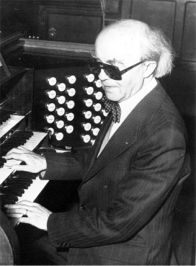
Jean François-Hyacinthe Langlais III was a French composer of modern classical music, organist, and improviser. He described himself as "Breton, de foi Catholique".

Quakers Hill is a suburb of Sydney, in the state of New South Wales, Australia. It is 40 kilometres (25 mi) westnorth-west (WNW) of the Sydney central business district, in the local government area of the City of Blacktown. Quakers Hill is part of the Greater Western Sydney region. Quakers Hill is colloquially known as 'Quakers'.
David Charles Stove was an Australian philosopher whose writings often challenged prevailing academic orthodoxy. He was known for his critiques of postmodernism, feminism, and multiculturalism.

The Société nationale de musique was an organisation in late 19th and early 20th century Paris, promoting French music and allowing rising composers to present their works in public. It was founded in the aftermath of France's defeat in the Franco-Prussian War of 1870–71 on a strong tide of nationalist feeling, and at first excluded all music by non-French composers. In its first 30 years it gave the premieres of works by composers including Saint-Saëns, Chabrier, Franck, Fauré, Dukas and Debussy.

The Symphony in D minor is the best-known orchestral work and the only mature symphony written by the 19th-century composer César Franck. It employs a cyclic form, with important themes recurring in all three movements.

Les XX was a group of twenty Belgian painters, designers and sculptors, formed in 1883 by the Brussels lawyer, publisher, and entrepreneur Octave Maus. For ten years, they held an annual exhibition of their art; each year 20 other international artists were also invited to participate in their exhibition. Painters invited include Camille Pissarro, Claude Monet, Georges Seurat, Paul Gauguin, Paul Cézanne (1890), and Vincent van Gogh.

William Peter Coleman was an Australian writer and politician. A widely published journalist for over 60 years, he was editor of The Bulletin (1964–1967) and of Quadrant for 20 years, and published 16 books on political, biographical and cultural subjects. While still working as an editor and journalist he had a short but distinguished political career as a Member of the New South Wales Legislative Assembly from 1968–1978 for the Liberal Party, serving both as a Minister in the State Cabinet and in the final year as Leader of the New South Wales Opposition. From 1981–1987 he was the member for Wentworth in the Australian House of Representatives.
Quakers Hill Press is a small press Australian publishing company. It was founded in 1990 by Peter Day, a former US correspondent for The Australian.

The Police Department of the MVD was the main police force of the Russian Empire and part of the Ministry of Police in the late 19th century, and was responsible for the management of all the police forces in the Russian Empire including Okhrana branches, and was aided by the Special Corps of Gendarmes.
This bibliography of James Madison is a list of published works about James Madison, the 4th president of the United States.
Les Éolides,, FWV 43, CFF 127, is a symphonic poem by French composer César Franck written in 1876 and premiered the next year. Its approximate duration is 11 minutes.
Joël-Marie Fauquet is a French musicologist.
Psalm 150 is a psalm setting by César Franck. He wrote the composition, setting Psalm 150 for four-part choir, orchestra and organ, in 1883. It was published in 1896 by Breitkopf & Härtel. Carus-Verlag published an arrangement for choir, strings and organ. The incipit in French is Halleluiah! Louez le Dieu, caché dans ses saints tabernacles.
Marinus Adrianus (Marius) Monnikendam was a Dutch composer, organist, and music critic. He studied at the Amsterdam Conservatory. In 1925 Monnikendam went to Paris and attended Vincent d’Indy's Schola Cantorum. During this time, he published his first works for piano and cello. He then became a lecturer at the Rotterdam Conservatory and the Amsterdam Music Lyceum. Monnikendam composed mostly religious and secular works. He also published books on César Franck and Igor Stravinsky. His Lamentations of Jeremiah for chorus and orchestra, written in 1956 was broadcast by Radio Holland during the funeral services for both former Queen Wilhelmine (1962) and President John F. Kennedy (1963). His most popular work is the Toccata for Organ (1936).
References
- ↑ "inauthor: "R. J. Stove"" . Retrieved 14 February 2010.
- ↑ Stove, David Charles (1995). Cricket versus Republicanism: and other essays By David Charles Stove. Quakers Hill Press. ISBN 9780646213286 . Retrieved 14 February 2010.
- ↑ "Triptych [music] : for organ / by R. J. Stove". catalogue. 2006. Retrieved 14 February 2010– via National Library of Australia.
- ↑ "Atheist Convert: R.J. Stove". Originally published in The Traditionalist, 2011. Retrieved 14 April 2012.
